


Sibiu and Brașov are the two classic bases for exploring Transylvania. Both offer handsome medieval streets, mountain backdrops and easy escapes to castles and ski resorts, yet they feel very different on the ground and work better for different kinds of trips. Understanding how they compare for transport, day trips, prices and atmosphere is essential before you commit to one as your base.
Get the latest updates straight to your inbox!
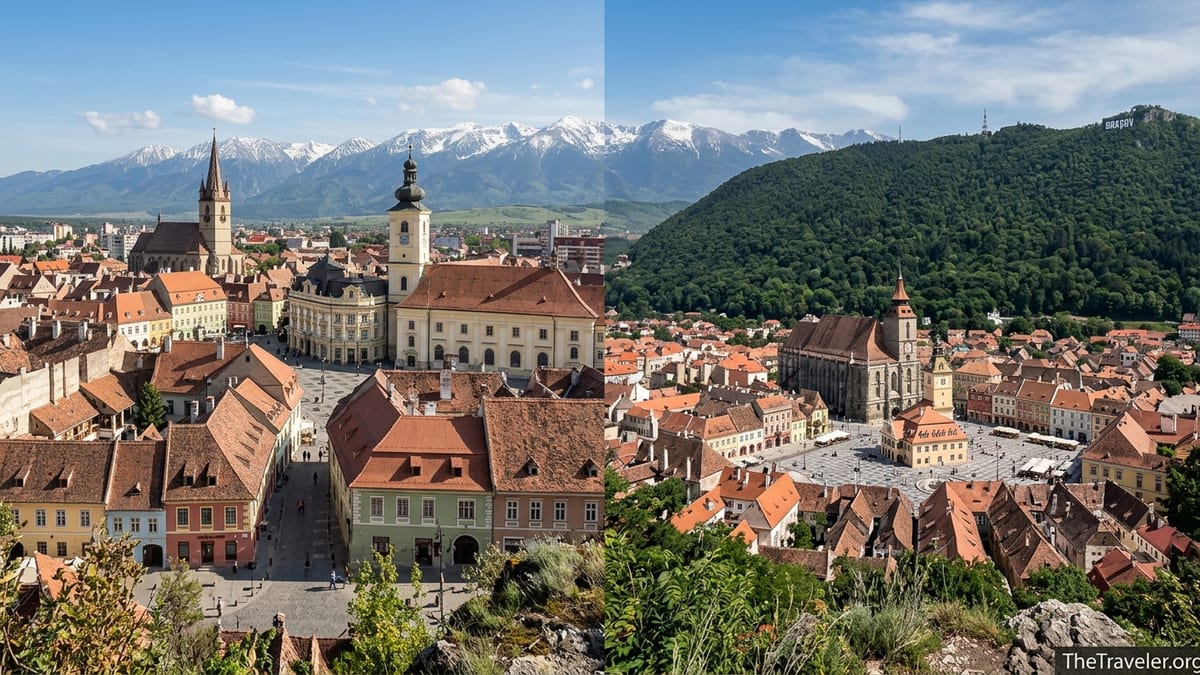
First impressions: compact Sibiu versus bigger Brașov
Sibiu’s historic core is a compact Saxon Old Town wrapped in partial walls and towers, with a tight cluster of squares like Piața Mare, Piața Mică and Piața Huet. You can cross the main historic area on foot in roughly 10 to 15 minutes, which makes sightseeing relaxed and orientation easy. The famous buildings with “eyelid” attic windows look down on cobbled streets, and most major sights – from the Brukenthal National Museum to the Bridge of Lies – sit within a few blocks of one another.
Just south of Sibiu, the huge ASTRA Museum of Traditional Folk Civilization unfolds in a forest and lakeside setting in the Dumbrava Sibiului park. It is an open-air museum of historic wooden churches, mills and farmsteads that can easily fill half a day. Beyond that, Sibiu gives relatively quick access by road to the Cindrel Mountains and the small resort of Păltiniș, which is the starting point for easy ridge walks and modest winter sports.
Brașov, in contrast, feels more like a small city than a large town. Its historic center spreads out around Council Square and the Black Church, then pushes up into the Schei district and beneath forested Tampa Mountain. The Old Town is still walkable, but distances between, for instance, the train station and the medieval core are greater than in Sibiu, and some streets climb quite steeply toward Tampa.
Under Tampa’s slopes, Brașov’s size brings more dining and nightlife, and its location in the Carpathians makes it a hub for excursions to Bran Castle, Râșnov Fortress, Sinaia and the Bucegi Mountains. This concentration of famous day-trip targets is the main reason many travelers choose Brașov as their first base in Transylvania.
Getting there and between: trains and buses
From Bucharest to Brașov, trains are frequent and relatively fast, because the route runs along one of Romania’s main lines. Recent summaries based on the 2025–2026 timetable show about 20 to 25 trains per day on a typical weekday from București Nord to Brașov, operated by CFR Călători, Softrans and Astra Trans Carpatic. Fast InterRegio and Intercity services usually take around 2 hours 30 minutes to 2 hours 45 minutes. Advance second-class fares on standard CFR trains are often around 70 to 80 lei one way, with private operators sometimes slightly higher but offering more modern rolling stock.
Direct buses and minibuses also connect Bucharest and Brașov. Schedules compiled from platforms like Autogari indicate dozens of departures per day, with journey times usually between 3 and 3.5 hours, depending on traffic through the Prahova Valley. Recent checks in late 2026 show one-way tickets commonly in the 60 to 80 lei range. Buses typically leave from Bucharest’s Militari bus terminal or other suburban stops and arrive at Brașov’s Bartolomeu or main bus stations, which then require a local bus or taxi ride to reach the Old Town.
Reaching Sibiu from Bucharest is slower and less frequent. CFR timetables for autumn 2026 list several daily direct trains between București Nord and Sibiu, with the quickest services taking about 6 hours and the slowest closer to 7 hours. One example from the current timetable is an evening InterRegio train covering the route in just over 6 hours. Recent fare compilations put second-class tickets on these direct trains generally just under or slightly over 100 lei, depending on the exact service and any advance discounts.
Direct long-distance buses between Bucharest and Sibiu exist but are fewer than those to Brașov, often run by regional operators and sometimes routed via Pitești and the Olt Valley. They usually take a similar 5.5 to 6.5 hours, and prices are broadly comparable to the train. For travelers considering both cities, it is entirely realistic to arrive in one and depart from the other using the Sibiu–Brașov train line.
Connecting Sibiu and Brașov without a car
Sibiu and Brașov are linked by a direct rail line through the Făgăraș area, so you do not need to backtrack via Bucharest. Current journey planners and ticket platforms show several direct CFR Călători services per day, with the fastest trains taking around 2 hours 55 minutes to 3 hours and slower regionals closer to 3.5 hours. This makes it straightforward to use Sibiu as a quieter first base, then continue to Brașov for castle excursions, or vice versa.
Recent Romanian-language schedules summarizing the 2025–2026 timetable mention roughly 6 to 8 direct trains daily on the Sibiu–Brașov route, starting in the early morning and running into the evening. Typical second-class tickets bought on Romanian planning sites are around 30 to 40 lei one way, with reservation usually included in the price on InterRegio trains. Journeys are scenic, with long sections running along river valleys and past views of the Făgăraș and Cindrel ranges.
Buses between Sibiu and Brașov are less prominent than trains, and many travelers now favor the rail connection because it avoids traffic through mountain passes. Rideshares via platforms like BlaBlaCar are commonly available, especially on Fridays and Sundays, but these are better treated as a back-up rather than a primary method for detailed itinerary planning.
For visitors combining multiple Transylvanian towns, Brașov is often the better onward hub. It has more frequent direct trains to destinations like Sighișoara and Cluj-Napoca, while Sibiu’s rail map leans more toward connections west to Alba Iulia and the Banat, usually with at least one change if you are heading toward Cluj.
Historic centers and museums: what you see on foot
In Sibiu, sightseeing begins in Piața Mare, the main square framed by pastel-colored merchant houses and the Council Tower. Walking through the arch to Piața Mică brings you to the cast-iron Bridge of Lies, which spans a small drop between upper and lower town. Just off Piața Mare stands the Brukenthal National Museum, one of Romania’s leading art collections, housed in an 18th-century palace. A standard combined ticket grants access to the main art galleries and several annex museums; prices have hovered in recent years in the dozens of lei rather than single digits, and are listed in detail at the entrance.
A few kilometers south, the ASTRA Museum covers hundreds of traditional buildings scattered around forest-fringed paths. Entry is not expensive by Western European standards and parking just outside the gates is straightforward if you are driving. Without a car, many visitors use Sibiu’s local buses, which run from the city to the Dumbrava Sibiului area in roughly 20 minutes. The combination of the compact Old Town and a half day at ASTRA makes Sibiu very strong for visitors who prioritise historic architecture and folk culture over famous fortresses.
Brașov’s Old Town centers on Council Square, dominated by the old town hall and ringed by cafes. One side of the square is anchored by the Black Church, a Gothic landmark whose darkened exterior reflects historic fire damage. Inside, there is a paid entry, with tickets again priced in the medium range for Romanian museums, and the church often hosts organ concerts on selected days. Brașov’s medieval streets run out from the square into narrow lanes like Strada Sforii and into the Schei district, once separated by a gate from the Saxon town.
Above the Old Town, Tampa Mountain offers a quick viewpoint. A cable car from the lower station near the city center usually operates much of the year, weather permitting, and climbs to the ridge in a few minutes. On clear days you see the red-tile roofs and city walls below and peaks of the Postăvaru and Bucegi ranges in the distance. When high winds or maintenance close the cable car, hikers can reach the top on steep forest paths in around one hour each way, though this is not suitable for all mobility levels.
Public transport to key excursions and mountain areas
From Sibiu, public transport is good enough for some, but not all, surrounding attractions. Local buses run from the city center or the main bus station toward the ASTRA Museum and the Dumbrava Sibiului park. For Păltiniș, a small resort in the Cindrel Mountains, published winter and summer timetables show several buses per day from Sibiu, taking roughly one hour. These are practical for day trips if you plan around the schedule, but departures tend to cluster in the morning and early afternoon, so late returns may require a taxi.
Brașov has stronger bus coverage for classic castle and ski excursions. Regular buses depart from Brașov’s bus stations toward Bran and Râșnov. Schedules compiled in Romanian transport guides in late 2026 indicate buses from Brașov to Bran, often via Râșnov, roughly hourly during the day, taking around 45 minutes to Râșnov and around one hour to Bran. Tickets are modestly priced, usually under the equivalent of 20 lei per person one way, making this a very practical car-free trip to Bran Castle and the hilltop citadel above Râșnov.
Poiana Brașov, the main local ski and hiking resort, is linked to Brașov by frequent city buses. The city transport operator runs routes that leave from near the Old Town and the train station, climbing to Poiana in about 25 to 30 minutes. In winter, these buses can be crowded with skiers, especially at weekends, but they remain one of the simplest ways in Romania to reach a ski area without a car. From Poiana, chairlifts and gondolas give access to ski runs and summer hiking routes around Postăvaru.
For Sinaia and the Bucegi Mountains, direct trains from Brașov follow the busy line down the Prahova Valley to Sinaia in around one hour. Dozens of services a day stop at Sinaia, with tickets usually priced at a few tens of lei depending on train category and booking method. From Sinaia station you can walk up to Peleș Castle in about 30 to 40 minutes, or take a local taxi. A cable car from the upper parts of town reaches high Bucegi plateaus, though it often closes in strong winds, for maintenance, or in shoulder seasons, so you should confirm operating status in town before committing to a day in the high mountains.
Hiking, cable cars, winter sports and seasonality
For beginner hikes and gentle mountain walks, Sibiu’s nearby Cindrel Mountains are lower and less dramatic than the Bucegi but also less crowded. Trails from Păltiniș lead through forests and meadows, and in summer and early autumn offer relaxed half-day options for reasonably fit walkers. Marked routes exist, yet waymarking and trail information are less developed than around Brașov, so casual visitors may want to ask at local tourist information offices for current recommendations and conditions. In winter, Păltiniș has several ski slopes suitable for beginners and families, usually served by chairlifts and drag lifts, but the ski area is comparatively small.
Brașov has a Denser infrastructure for outdoor activities. Poiana Brașov is one of Romania’s main ski resorts, with a network of slopes of varying difficulty, plus snowmaking and night-skiing on certain runs. Ski passes and rental prices change each season, but current winter brochures list several day-pass options priced significantly below Western European levels, which draws many domestic visitors at weekends and holidays. For absolute beginners, ski schools and rental shops at the base station are visible as soon as you step off the bus.
On Tampa Mountain, short marked hiking paths and the cable car give visitors an easy taste of the mountains without leaving the city. In winter, these trails can be icy and the cable car may shut in high winds or during heavy snow, so winter walkers should be prepared with proper footwear or choose the cable car only when clearly operating. On good days, however, Tampa is one of the most accessible viewpoints anywhere in the Carpathians.
Seasonality strongly affects both cities. In July and August, afternoon thunderstorms are frequent in the mountains, and trail closures can follow heavy rain or landslides. In December and around Orthodox and Western Christmas, ski resorts around Brașov fill quickly, and cable cars around Poiana and the Bucegi can run at or near capacity. Always check local notices or ask at tourist offices for the day’s operating status of specific lifts before planning a high-altitude excursion.
Accommodation, prices and Christmas markets
In Sibiu, many mid-range hotels and guesthouses cluster just outside or within a short walk of the Old Town. Typical three-star hotels and well-rated pensions a few minutes from Piața Mare often show summer weekend rates in the 350 to 500 lei per night range for a double room, when checked on major booking platforms for 2026 dates. Higher-end boutique hotels in renovated historic buildings can rise to 600 to 800 lei or more, especially during peak festivals.
Brașov’s Old Town has a broader spread of accommodation, from budget apartments and hostels near the walls to four-star hotels facing Council Square. Summer and early autumn weekends often see central three-star hotel prices between about 400 and 600 lei per night for two, with top properties overlooking the square or at the foot of Tampa priced significantly higher. Around December, especially for weekends that coincide with school holidays or strong snow forecasts, Poiana Brașov hotels can reach some of the highest nightly rates in the region, reflecting heavy demand from domestic skiers.
Christmas markets influence both cities. Sibiu’s Christmas Fair in Piața Mare, typically running from mid or late November through December, has built a national reputation for its lights and wooden stalls. Accommodation around the square often books out weeks or months in advance for key weekends, and prices in that period can be noticeably higher than in, say, early November. Brașov also hosts a central Christmas market in Council Square, and the combination of festive events plus easy access to Poiana Brașov drives up demand for both city and resort hotels from early December through New Year.
City tourism taxes also differ. Recent travel policy compilations indicate that Brașov has introduced a nightly visitor tax per person combined with a small mountain-rescue levy, while Sibiu applies a percentage tax on the accommodation cost instead of a fixed per-night sum. In practice, for a mid-range double room, the actual difference in nightly totals is modest, but it is one more factor that nudges Sibiu slightly ahead for budget-conscious couples staying several nights.
Sample three-day itineraries and budgets for couples
A three-day, two-night stay for a couple in Sibiu might start on Day 1 with a walk around the Upper and Lower Towns, exploring Piața Mare, the Council Tower, the Bridge of Lies and the Lutheran Cathedral. A visit to the Brukenthal Museum and a relaxed lunch or dinner in one of the square-side restaurants would round out the day. Day 2 could be devoted to ASTRA Museum, reached by city bus and explored at an unhurried pace, followed by an evening stroll along the remaining city walls. Day 3 might include a short trip out to Păltiniș for a gentle walk, weather permitting, before departure.
For budgeting, taking typical 2026 prices as a guide, a mid-range couple might spend around 800 to 1,000 lei per night in Sibiu including accommodation, meals and local transport. This figure assumes a comfortable central hotel at 400 to 500 lei per night, 250 to 350 lei per day for meals at mid-range restaurants and cafes, modest entry fees to museums and ASTRA, and a small allowance for buses and occasional taxis. Opting for apartment rentals, cooking some meals and choosing a simpler guesthouse can bring the daily total down considerably.
In Brașov, a three-day, two-night itinerary for a couple could begin on Day 1 with a deep dive into the Old Town: Council Square, the Black Church, the city walls and bastions, and the narrow side streets of the Schei district. Day 2 might be dedicated to castles, taking morning buses or a joined-up bus trip to Râșnov and Bran to visit the fortress and Bran Castle, returning in the late afternoon. Day 3 could focus on outdoor views, either with a morning ride up Tampa’s cable car or a full-day excursion to Poiana Brașov, reached by city bus, for a short hike or, in winter, skiing.
Given current accommodation and excursion patterns, a similar mid-range couple might plan on spending slightly more per day in Brașov than in Sibiu. A centrally located hotel could run 450 to 600 lei per night on summer or early autumn weekends, meals at restaurants around Council Square are often fractionally higher, and extra transport costs for castle and mountain buses add up. A realistic comfortable daily budget for two might fall between 900 and 1,200 lei, depending on restaurant choices, number of paid attractions and whether you visit Poiana or Sinaia, which introduces additional train and cable-car tickets.
Accessibility, parking, crowds and overall value
For drivers, Sibiu is noticeably easier. Street parking just outside the Old Town, combined with several paid lots, usually makes it possible to leave a car within walking distance of the center without excessive stress. Traffic flows are calmer than in Brașov, and leaving town for Păltiniș or for onward drives west along the Olt Valley is relatively straightforward. Within the Old Town, distances are short and gradients are gentle, although some streets are cobbled.
Brașov’s larger size and valley setting make parking and navigation more demanding, especially in high season. Evening congestion can build on the roads around the Old Town and on the route to Poiana Brașov. Central parking garages exist but can fill quickly on winter weekends when skiers arrive from Bucharest. Within the historic area, some streets climb quite steeply toward Tampa, and older pavements may be uneven in places, which travelers with mobility issues should bear in mind when choosing accommodation.
Crowds are another key difference. Sibiu feels busy during its main festivals and the Christmas market, but much of the year the Old Town has a calmer, more local rhythm, with a noticeable student presence from the city’s universities. Brașov, by contrast, experiences more pronounced peaks: sunny summer weekends, Christmas market weeks and good snow periods can all bring heavy foot traffic to Council Square and bottlenecks around Bran Castle and Poiana. Those who prefer quieter streets and shorter restaurant waits may appreciate Sibiu’s more measured visitor flow.
In pure value terms, Sibiu is often a little cheaper for accommodation and dining at comparable levels, especially outside the most sought-after December weekends. Brașov, however, can offer outstanding value if you factor in what you can do without needing a car: from one base you can reach castles, ski slopes and multiple mountain viewpoints on public transport, which reduces the need for car rental or private tours.
So, which city wins for which type of trip?
For castles and fortresses, Brașov is the clear winner. The combination of relatively short bus rides to Bran Castle and Râșnov Fortress, plus an easy train hop down the valley to Sinaia for Peleș and Pelișor castles, puts almost all the headline royal and medieval sites of southern Transylvania within a one-hour travel radius. Sibiu offers historic churches and towers, but no single fortress or royal residence with the fame of Bran or Peleș.
For hiking and mountain access, Brașov again edges ahead, thanks to Tampa, Poiana Brașov and the Prahova Valley toward the Bucegi. Beginners have straightforward options via cable cars and waymarked forest trails, and winter sports infrastructure is more extensive. Sibiu, however, rewards those seeking quieter, less commercialised walks in the Cindrel Mountains and a smaller ski area at Păltiniș, which can be ideal for families learning to ski away from big-resort crowds.
For museums and historic atmosphere, Sibiu competes strongly. The combination of the Brukenthal Museum, ASTRA open-air museum and the intimate Saxon Old Town makes it arguably the better city for travelers who care more about art, architecture and traditional culture than ticking off famous castles. Brașov has good local museums and powerful historic ambiance, but its wow factor often lies as much in its setting beneath Tampa and proximity to day trips as in the museums themselves.
For romance, many couples favor Sibiu’s compact squares, graceful houses and evening light over Piața Mare, which create a cinematic atmosphere with less bustle. Brașov is also romantic, especially at night under Tampa’s illuminated sign, but it feels busier and more urban. For families, Brașov often wins because of its easy access to varied attractions for different ages, from castles to ski slopes and mountain cable cars, all reachable without long drives.
For car-free travel, Brașov is the stronger base. High-frequency trains from Bucharest, regular buses to Bran and Râșnov, city buses to Poiana and frequent rail links to Sinaia and other Transylvanian towns give non-drivers a dense network of options. Sibiu is still workable without a car, particularly for its own sights and ASTRA, but excursions into the surrounding mountains require more careful planning and sometimes taxis.
For travelers combining multiple Transylvanian towns, a logical pattern is to start in Sibiu for two or three nights of museums and relaxed Old Town exploration, then take the direct train to Brașov for three or four nights of castles and mountain excursions. This approach lets you enjoy both moods: Sibiu’s cultured calm and Brașov’s energetic, outdoorsy feel. If time or budget forces a choice, pick Sibiu for historic ambiance and value, and choose Brașov if your priority is a convenient base for castles and mountains reached by public transport.