


Landing at the new Siem Reap Angkor International Airport, many travelers are surprised to discover that the city and Pub Street are nearly an hour away. With no metro and limited public transport, choosing the right transfer can make the difference between a smooth arrival and a stressful start. This guide compares the main options from Siem Reap Angkor Airport to the city center so you can match cost, comfort and convenience to your travel style.
Get the latest updates straight to your inbox!
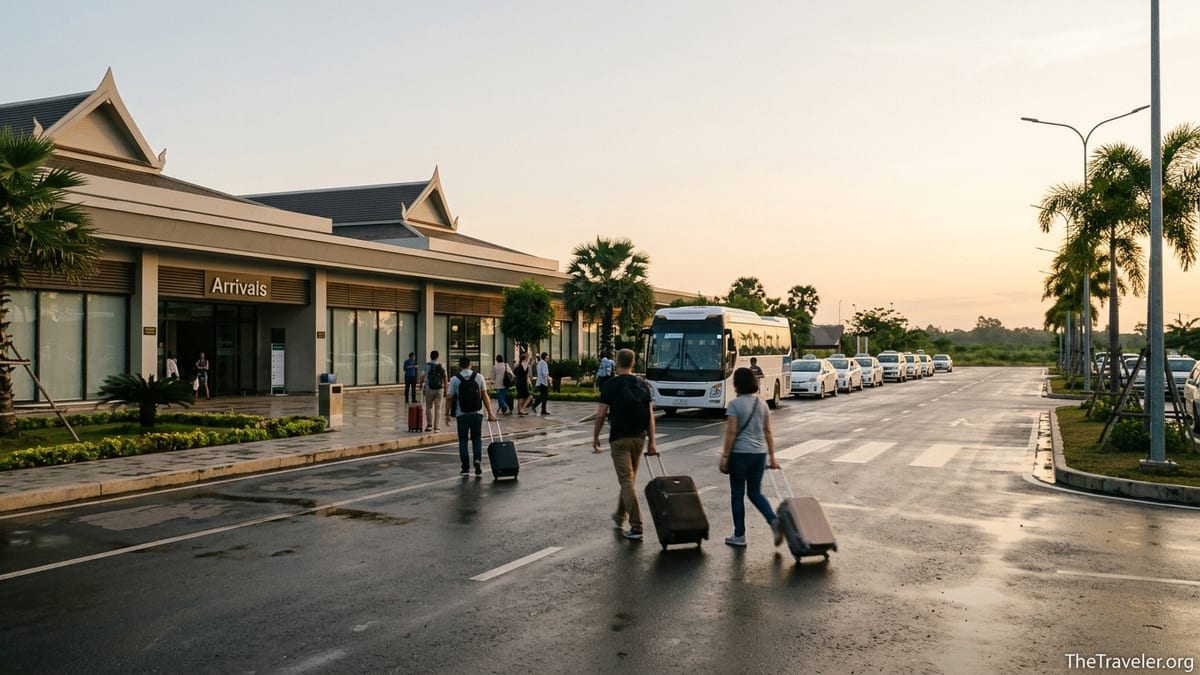
Key Facts About Siem Reap Angkor Airport Transfers
Siem Reap Angkor International Airport (often shown as SAI on tickets) replaced the old in-town airport in 2023. It sits roughly 45 to 50 kilometers east of central Siem Reap, and the drive to popular areas like Pub Street or the Old Market usually takes about 45 to 60 minutes depending on traffic and weather. There is no train or city bus link, so travelers rely on shuttle buses, taxis, private transfers and hotel-arranged pickups.
Most arriving passengers first encounter the official taxi counter immediately outside the arrivals exit. Staff quote fixed prices based on destination, so you do not need to negotiate. A little further along, representatives for the official airport shuttle bus and several private transfer companies sell tickets and confirm reservations. Because the airport is new and still developing, on-the-ground arrangements can change, so it is wise to reconfirm details like last shuttle departure times closer to your travel date.
For planning purposes, think of three broad price bands. The shuttle bus is usually the lowest-cost option per person at roughly 8 US dollars one way into town. A standard airport taxi booked at the counter typically runs in the range of 25 to 30 dollars per car to central Siem Reap, while pre-booked private transfers and hotel cars often sit between 25 and 40 dollars depending on vehicle size and service level. These figures can vary slightly with fuel prices and demand, but they give a realistic starting point.
Because of the distance, it is sensible to factor transfer time into your first and last day plans. If you land in the late afternoon and still hope to catch sunset drinks in town, expect to reach your hotel about 90 minutes after landing once you clear immigration, collect bags and transfer by road. Late-night or very early-morning flights also require more thought, since shuttle services run on limited schedules and pre-arranging a car can prevent a long wait in a nearly empty terminal.
Airport Shuttle Bus: Cheapest and Simple for Light Travelers
The official airport shuttle bus provides a straightforward, budget-friendly way to reach Siem Reap city. Operated with modern, air-conditioned minibuses or small coaches, the service generally charges about 8 US dollars per person for a one-way trip between the airport and a downtown stop located within walking distance or a short tuk-tuk ride of Pub Street and the Old Market. The journey normally takes around one hour, covering roughly 50 kilometers on the main highway into town.
Departures are scheduled several times a day in both directions. Recent timetables often show around eight daily trips, with the first bus in the morning and the last one in the late evening. However, departure times can be adjusted seasonally and may be reduced during quieter travel periods, so it is important to check current schedules and, if possible, reserve a seat online or through your accommodation before you fly. Some travelers report that the final bus from the airport can be around 22:00, while others note slight variations, which highlights the value of verifying specifics close to your travel date.
For solo travelers or couples with light luggage, the shuttle bus is usually the best-value choice. A backpack and one small suitcase per person is easy to manage, and the bus luggage storage can comfortably take standard checked bags. The main trade-offs are less privacy and an extra step at the Siem Reap end, as the bus does not drop you directly at your hotel. Many passengers simply hop off at the central stop, then take a short tuk-tuk ride for a few dollars to their guesthouse near Pub Street, Sok San Road or Wat Bo Road.
The shuttle is less ideal for those arriving after the last departure or carrying several large suitcases, sports equipment or film gear. Families with small children may find that waiting for the next scheduled departure after a long-haul flight feels tiring. In those cases, paying more for a taxi or private transfer often makes sense. Still, for backpackers, independent travelers and anyone keen to keep costs low while getting a feel for the area, the airport shuttle is a reliable, no-fuss option.
Official Airport Taxi: Door-to-Door Convenience at a Fixed Price
The official airport taxi service bridges the gap between budget and comfort. As you exit the arrivals hall at Siem Reap Angkor Airport, you will see a signed taxi counter run under airport supervision. Here, you tell staff your destination, pay a fixed fee at the desk and receive a ticket to present to your driver. Current prices to the central city, including the Pub Street and Old Market area, are commonly quoted in the 25 to 30 US dollar range per car, not per person, making taxis good value for couples or small groups of up to four passengers with standard luggage.
Unlike the shuttle bus, taxis provide door-to-door service. A typical ride to a midrange hotel near Sivatha Boulevard or the riverside takes about 50 minutes under normal conditions. Cars are usually modern sedans or small SUVs with air conditioning. Because fares are fixed at the counter, you avoid haggling after a long flight, and you also reduce the risk of being overcharged. Several travelers arriving on evening flights report that the taxi office is still operating for late arrivals, making this a dependable fallback if you miss the last shuttle bus.
The main advantages of the official taxi option are flexibility and comfort. You can leave as soon as you clear immigration and collect your bags, without waiting for a scheduled bus departure. The car will take you directly to your hotel entrance, which is especially welcome if you are staying in smaller streets behind Pub Street or in quieter neighborhoods like Wat Damnak or Taphul Village, where navigating with luggage in the heat or rain can quickly become tiring.
There are a few points to consider. Standard taxis are not usually configured for outsized sports equipment or very bulky luggage, so groups carrying large camera cases or multiple big suitcases should confirm vehicle size at the counter or consider requesting a larger car if available. Also, while ride-hailing brands operate in parts of Cambodia, they may not always have cars waiting directly at Siem Reap Angkor Airport, and the airport may prefer passengers to use the official taxi system. For simplicity and predictability, especially on your first visit, the airport taxi desk is often the most stress-free option.
Private Transfers and Pre-Booked Drivers: Best for Late Arrivals and Groups
Pre-booked private transfers offer the greatest level of control over your arrival. Many Siem Reap hotels, guesthouses and independent drivers now publish airport transfer prices on their booking pages or social channels. A typical quote for a private car from Siem Reap Angkor Airport to a hotel near Pub Street might be between 25 and 35 US dollars for two passengers, with larger vans for families or small tour groups running around 35 to 50 dollars depending on size and inclusions.
One common arrangement is booking through a tour platform or directly with a local driver who meets you at the arrivals exit holding a sign with your name. For example, a couple landing around midnight after a long connection from Europe might pay about 30 dollars for a pre-booked sedan transfer. They walk past the taxi counter to find their driver already waiting, then ride straight to their Riverside hotel without needing to queue or handle local currency. For travelers with tight schedules, late-night arrivals or mobility needs, this kind of arrangement significantly reduces stress.
Private transfers also suit passengers with extra luggage or special equipment. Photography groups visiting Angkor for sunrise shoots, for instance, often carry multiple tripods and heavy camera bags. In those cases, reserving a minivan rather than hoping an ordinary taxi has enough space is prudent. Many local operators advertise comfortable minivans that can take four to eight passengers plus large luggage, which can bring the per-person cost down for friends traveling together.
As with any pre-booked service, reliability varies, so checking recent reviews and confirming details the day before arrival is wise. It is helpful to provide your flight number and expected landing time so the driver can monitor delays. Most reputable providers include a reasonable waiting window, often around 60 to 90 minutes after scheduled arrival, before any extra fee is charged. For travelers who value a smooth, guaranteed pickup more than saving every dollar, private transfers are frequently the best fit.
Hotel Pickup Services: When It Makes Sense to Book Directly
Many midrange and upscale hotels in Siem Reap now offer direct airport pickup, either included in certain room packages or as an optional add-on. A boutique property in the Wat Bo area, for example, might charge 25 dollars for a one-way car transfer or offer complimentary pickup if you book a three-night stay. Larger resorts on the outskirts of town sometimes operate their own shuttles, bundling transfers with spa or dining credits to create attractive arrival packages.
The main advantage of reserving through your hotel is simplicity. You provide your flight number and arrival time when booking, then receive a confirmation email explaining exactly where your driver will meet you. The hotel’s staff typically track flight changes, and if your plane lands late they adjust the pickup time accordingly. For tired travelers stepping off a long-haul journey, seeing a familiar hotel logo and your name on a sign at the exit can be reassuring.
Hotel pickups are especially helpful if you are staying in less central areas where taxis and tuk-tuks may not be familiar with the exact location. Properties near the outer ring roads or along the road to Phnom Kulen, for instance, can be harder to explain to a driver on the spot. A hotel-arranged car avoids miscommunication and minimizes the chance of being dropped at the wrong place after dark. For families and older travelers who prize peace of mind, this kind of service is often worth the slightly higher cost.
The possible drawbacks are flexibility and price. Some hotels outsource transfers to third-party drivers, which can occasionally lead to confusion if communication is poor. Others may charge a premium compared with booking a taxi on arrival, especially if the transfer is bundled into a package without a clear breakdown of costs. Before confirming, it is worth asking the hotel for the exact one-way price and comparing it with a rough taxi estimate. If the difference is only a few dollars and the convenience is high, hotel pickup is usually a sensible choice.
Costs, Luggage, and Timing: How to Choose the Right Option
When deciding between shuttle bus, taxi, private transfer or hotel pickup, it helps to think in terms of three factors: budget, baggage and timing. Budget travelers and backpackers arriving during daytime will generally gravitate toward the shuttle bus. At around 8 dollars per person, even a solo traveler saves money compared with a 25 to 30 dollar taxi. Two backpackers staying near Pub Street might spend a combined 16 dollars on the shuttle plus 3 to 4 dollars on a short tuk-tuk ride from the downtown stop to their hostel, still well below the cost of a taxi.
Baggage is the next filter. A photographer arriving with two large checked bags, a carry-on and a tripod case may find the shuttle bus cumbersome, especially if the bus is reasonably full and space is limited. In this scenario, paying around 30 dollars for a private car or minivan that can take all the equipment safely in the trunk is a rational choice. Families with strollers, baby carriers and multiple suitcases usually reach the same conclusion, favoring a taxi or pre-booked van that delivers them directly to their hotel lobby without extra transfers.
Timing is often the decisive factor. If your flight lands at 17:00 and the next shuttle bus leaves at 18:00, waiting an hour in the terminal might not appeal after a long journey. In that case, pulling your itinerary up against the typical 45 to 60 minute drive, it may be worth walking over to the taxi counter and paying the fixed fare to be on your way within 10 or 15 minutes. By contrast, if your flight is scheduled to land at 13:00 and a shuttle bus is due at 13:30, you might easily clear immigration in time and enjoy a relaxed, low-cost ride into town.
Late-night arrivals demand the most caution. If a flight reaches Siem Reap Angkor Airport around 23:30, the official shuttle may have finished for the night. Some visitors in this situation choose to pre-book a transfer for peace of mind, while others rely on the airport taxi counter, which typically remains open while flights are operating. In either case, having some US dollars in small denominations ready and your hotel address written clearly can speed up the final stage of your journey.
Best Transfer Option by Traveler Type
Backpackers and budget travelers usually get the most value from the airport shuttle bus. A solo traveler staying in a budget guesthouse off Sok San Road, for example, might spend 8 dollars on the shuttle, then 2 to 3 dollars on a short tuk-tuk ride from the downtown stop to their accommodation. The total is still far below a private car, leaving more money for temple passes and street food. The bus ride also gives a first glimpse of the countryside outside Siem Reap as you travel along the main highway.
Couples and small groups who want an easy, door-to-door experience often find airport taxis or simple private transfers the best compromise. Two friends arriving from Bangkok in the early evening might split a 26 dollar taxi fare from the airport to a midrange hotel near the river, paying about 13 dollars each for a fast, direct ride. A family of four with two children and several bags could look at a pre-booked van for around 35 to 40 dollars, which gives them more space while still costing under 10 dollars per person.
For older travelers, those with mobility concerns or anyone arriving very late at night, a pre-arranged private transfer or hotel pickup usually offers the most peace of mind. Knowing that a driver will be waiting, with your exact destination already confirmed, removes several layers of uncertainty. Many returning visitors to Siem Reap form long-term relationships with local drivers, booking not only airport transfers but also temple day tours and countryside excursions with the same person, which can add a layer of familiarity and safety to the trip.
Finally, business visitors or travelers on tightly timed itineraries may prefer premium private transfers or hotel cars, even at a higher price. A conference delegate staying at a resort on the outskirts of town, for example, might accept a 40 dollar one-way hotel transfer as the cost of arriving on time for an early-morning meeting. In these cases, reliability and comfort outweigh savings, and arranging everything through the hotel or a reputable transfer company keeps logistics simple.
Practical Tips for a Smooth Arrival
A few small preparations can make your journey from Siem Reap Angkor Airport to the city center far smoother. First, keep your hotel name and full address handy in both English and Khmer if possible. Many properties display their Khmer name on booking confirmations; saving a screenshot on your phone makes it easier to show taxi drivers who may not speak much English. Mentioning landmarks like Pub Street, the Old Market or the riverside can also help orient your driver.
Second, carry some US dollars in small bills, such as 1, 5 and 10 dollar notes. While many transfers can be paid by card or in Cambodian riel, US dollars remain widely accepted and often preferred for airport journeys. Having the exact fare simplifies payment at the taxi counter or with a private driver. Some shuttle bus services also take cash on the day, so it is helpful to have a little ready even if you booked online.
Third, think about your onward plans after check-in. Because the airport is an hour away from town, an evening arrival may not leave much time for a full dinner and exploration. Many travelers choose to book a hotel within walking distance of Pub Street or the Old Market on their first night, so they can stretch their legs and get a simple meal without more transport. Others staying in quieter neighborhoods plan ahead by asking their hotel about nearby restaurants or ordering room service after arrival.
Finally, remember that Siem Reap’s climate can be hot and humid, especially between March and May, and heavy rains are common during the monsoon season. After a long flight, air conditioning and a guaranteed seat can significantly improve your mood. If you know you are sensitive to heat or travel fatigue, it may be worth paying a bit more for a taxi or private car rather than focusing solely on the cheapest available option.
The Takeaway
Reaching Siem Reap city center from the new Siem Reap Angkor International Airport is straightforward once you understand the trade-offs between the main transfer options. The airport shuttle bus is the clear winner for value, especially for solo travelers and backpackers arriving during daytime hours. Official airport taxis strike a comfortable balance between price and convenience, particularly for couples or small groups who want a fast, door-to-door ride without advance planning.
Pre-booked private transfers and hotel pickups come into their own for late arrivals, families, groups with extra luggage and anyone who prioritizes a seamless arrival. The drive itself, typically 45 to 60 minutes through the Cambodian countryside, can be a gentle introduction to the region before you dive into the energy of Pub Street and the serenity of Angkor’s temples. By matching your budget, baggage and arrival time to the right option, you can start your Siem Reap adventure relaxed, informed and ready to explore.
FAQ
Q1. How far is Siem Reap Angkor International Airport from the city center?
The new airport sits roughly 45 to 50 kilometers from central Siem Reap, and the drive to areas like Pub Street and the Old Market usually takes about 45 to 60 minutes.
Q2. What is the cheapest way to get from the airport to Siem Reap city?
The official airport shuttle bus is generally the cheapest option at around 8 US dollars per person one way, with several departures a day to a central stop near the main tourist area.
Q3. How much does a taxi from Siem Reap Angkor Airport to Pub Street cost?
Official airport taxis booked at the counter typically cost in the range of 25 to 30 US dollars per car to the Pub Street and Old Market area, regardless of whether there are one or several passengers.
Q4. Are private transfers worth it for late-night arrivals?
For flights landing late in the evening or near midnight, private transfers are often worth the extra cost because they guarantee a pickup, avoid shuttle schedules and take you directly to your hotel door.
Q5. Can I use ride-hailing apps like Grab from the airport?
Ride-hailing services operate in parts of Cambodia, including Siem Reap, but availability at the airport itself can vary, and the airport often encourages travelers to use the official taxi counter or pre-booked transfers.
Q6. Is it easy to take the shuttle bus with large luggage?
The shuttle bus can handle standard checked bags, but if you have several large suitcases or bulky items like tripods and sports gear, a taxi or private van is usually more comfortable and convenient.
Q7. Should I book my airport transfer in advance?
Advance booking is not essential for everyone, but it is recommended if you arrive very late, travel with children, carry a lot of luggage or simply prefer the certainty of a driver waiting with your name.
Q8. Do hotels in Siem Reap offer free airport pickup?
Some midrange and upscale hotels include airport pickup in special packages or for longer stays, while others charge a separate fee similar to or slightly higher than official taxi prices, so it is worth asking when you book.
Q9. Is it safe to take a taxi from Siem Reap Angkor Airport?
Using the official airport taxi counter is generally considered safe, with fixed prices and registered drivers; as always, keep valuables with you and confirm the fare before leaving.
Q10. What transfer option is best for families with young children?
Families usually prefer a private car or van, either booked through the airport taxi counter, a local driver or their hotel, as these options provide seatbelts, more space for strollers and direct hotel drop-off without extra transfers.