


Singapore Changi Airport is more than a place to catch a flight. Consistently ranked among the world’s best airports, it is a vast complex of four terminals, gardens, a full-scale mall and the now-iconic Jewel development with its indoor waterfall. For a first-time visitor, that can feel overwhelming. With a little planning, though, Changi becomes one of the easiest and most enjoyable airports to navigate. Here is what you need to know before you land.
Get the latest updates straight to your inbox!
Understand Changi’s Layout Before You Land
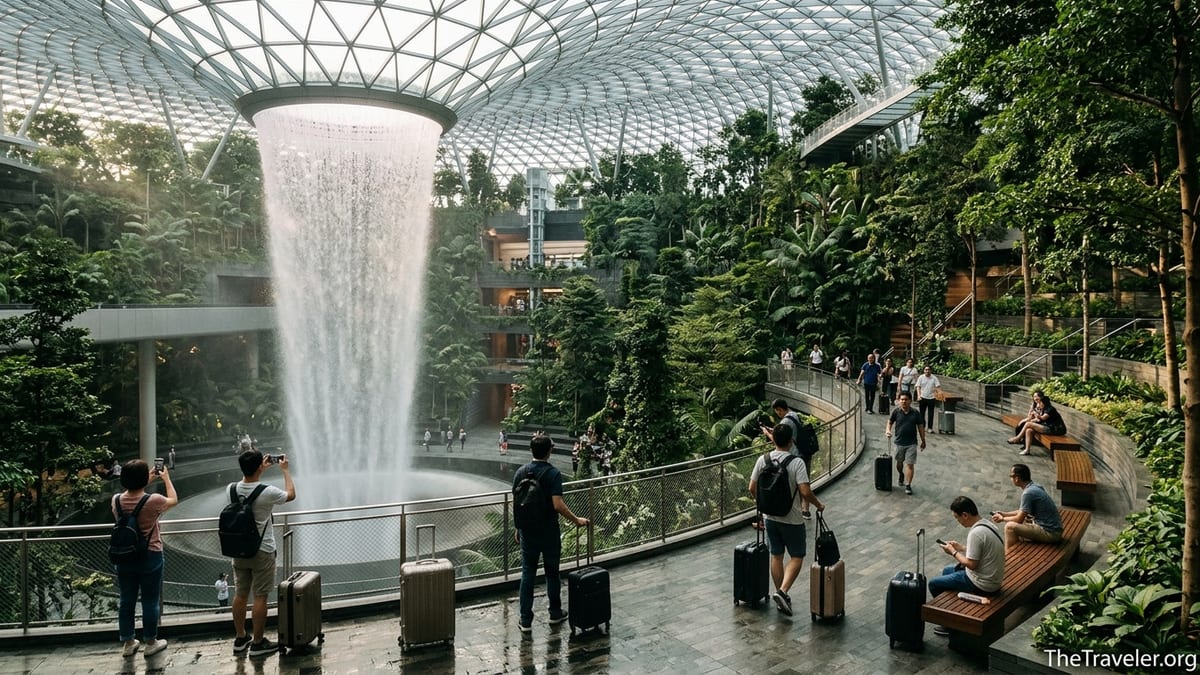
Changi has four terminals in full operation: T1, T2, T3 and T4. Terminals 1, 2 and 3 sit along the same spine and are linked airside by the Skytrain and landside by walkways. Jewel Changi Airport, the glass-and-steel dome with the Rain Vortex waterfall, is physically attached to Terminal 1 and connected to Terminals 2 and 3 by enclosed bridges. Terminal 4 is separate, linked by shuttle bus rather than Skytrain, so you should factor that into your timing if you are arriving or departing from T4.
Most long-haul carriers such as Singapore Airlines, Lufthansa and United typically use Terminals 1, 2 or 3, while many regional and low-cost airlines operate from Terminal 4. Always check your booking or airline app to confirm which terminal your flight uses. If you are connecting on separate tickets, try to keep flights in the same terminal group. For example, flying in on Singapore Airlines to T3 and out on Scoot from T1 is easier than transferring to an airline at T4, which would require a landside shuttle.
Skytrains between T1, T2 and T3 are frequent and free, and the ride between adjacent terminals is only a few minutes. The trains operate both in the public area and the transit area. If you are simply changing gates within the same airline alliance, look for signs marked “Transit” and “Skytrain to T…”. First-time visitors are often surprised by how short the walks are; a typical gate-to-gate transfer within T1–T3 can be done in under 15–20 minutes if you move promptly.
Terminal 4, on the other hand, is connected to the other terminals by shuttle buses that run from T2, usually from the coach bay level. Allow at least 30 minutes extra if your journey involves T4, especially during busy evening peaks, since you will need to go landside and clear security again on arrival at T4.
Arrivals, Immigration and Baggage: What to Expect
On arrival you will follow clearly marked signs for “Arrivals” and “Immigration”. Singapore uses automated immigration gates for many passport holders. If you are from the United States, most of Europe, Australia, New Zealand and many Asian countries, you are generally eligible to use the e-gates using your passport and fingerprints. First-time visitors must submit an electronic SG Arrival Card, which can be done online or through the official app in the three days before arrival; airline staff often remind you of this during the flight.
Lines at immigration are usually shorter than at major hubs in Europe or North America, but they can still build during late-evening arrival waves. Even then, it is common to be through in 20–40 minutes. Once you exit immigration, baggage carousels are immediately ahead. Changi’s baggage delivery is known for being quick; on many flights, priority and even standard bags begin arriving within around 15–20 minutes of landing, often beating passengers who walk slowly from the gate.
After collecting your bags, you will pass customs, which is usually a short walk with occasional random checks rather than a long queue process. Right after customs you will find arrival halls with money changers, telecom counters for local SIMs or eSIM help, and information desks. If you are planning to use public transport, look for the MRT signage and ticket machines near the exits in Terminals 2 and 3. If you prefer a taxi or ride-hailing service, taxi ranks are directly outside each arrival hall and are well marshalled, so you simply join the line and wait to be directed to a car.
If you have a long transit and bags checked through to your final destination, you can remain airside. Follow the “Transfer” signs, visit a transfer desk if you need a new boarding pass, and enjoy the transit-side attractions such as the Butterfly Garden in Terminal 3 or the Sunflower Garden in Terminal 2. These are true gardens, not just potted plants, and make a refreshing stop after a long-haul flight.
Getting Between the Airport and the City
First-time visitors are often surprised by how straightforward and good value the transport options are from Changi to central Singapore. The Mass Rapid Transit, or MRT, is the most economical and predictable choice for solo travelers. Changi Airport MRT Station is located between Terminals 2 and 3, accessible via underground passages from both. Trains connect to the East–West Line at Tanah Merah or Expo depending on the time and service pattern. A typical journey from the airport to central hubs like City Hall or Bugis is usually under an hour door to door, including the transfer.
Fares depend on distance, and in 2026 a single MRT ride from the airport to the city with an adult contactless card is typically in the range of just a few Singapore dollars. You can tap in with major credit cards like Visa or Mastercard, or use stored-value cards and tourist passes sold at MRT counters. As a real-world example, a ride from Changi to City Hall station usually costs around what you might pay for a cup of hawker-center coffee. Trains run roughly from early morning to around midnight, so late-night arrivals may need a taxi or ride-hailing service instead.
Metered taxis line up outside each terminal and provide a simple door-to-door option, particularly if you are carrying large luggage or traveling as a family. A typical fare from Changi to downtown hotels in areas like Marina Bay or Orchard Road can vary, but many travelers report paying the equivalent of a mid-range restaurant meal for the whole car, not per person. Keep in mind there are surcharges for airport pick-ups and late-night rides, and these are automatically added to the meter. If you prefer to book via app, local ride-hailing platforms and traditional taxis can both be summoned from the airport with designated pick-up zones.
Public buses operate to and from all terminals and are the cheapest option, with fares usually under a few dollars, paid with the same contactless cards used on the MRT. Buses are a good choice if your hotel lies along a direct route and you are not in a rush, but they are slower than the MRT due to traffic and frequent stops. For most first-time visitors, the practical hierarchy is simple: MRT if you want a balance of speed and cost, taxi or ride-hail if you want comfort and convenience, or bus if you are on a tight budget and comfortable reading local route maps.
Making the Most of Jewel Changi on Any Layover
Jewel Changi Airport is the centerpiece of many people’s first impression of Singapore. The toroidal glass dome with its 40-meter Rain Vortex waterfall sits outside the secure transit area, connected directly to Terminal 1 and via link bridges to Terminals 2 and 3. That means you must clear immigration to visit Jewel, even if you are in transit. For travelers with a single through-ticket and bags checked to their final destination, this is often still possible as long as your layover is long enough.
As a rule of thumb, if your layover is under three hours gate to gate, you are usually better off staying airside and enjoying the terminal gardens, lounges and dining. With four to six hours, you can realistically clear immigration, walk to Jewel, spend roughly 90 minutes exploring the Rain Vortex and Shiseido Forest Valley, grab a meal at one of the many restaurants, and return through departure immigration without rushing. Overnight or half-day layovers give you time for paid attractions in the Canopy Park, such as the glass-bottom Canopy Bridge or hedge mazes, along with shopping at international brands.
Early-bird travelers departing from Singapore sometimes check in as soon as their airline counter opens and then head to Jewel baggage-free. Many airlines operating from Terminals 1–3 allow early check-in several hours before departure and some have early check-in facilities in Jewel itself, which lets you drop your bags and print boarding passes before entering the mall. A common pattern is to arrive four hours before a late-evening departure, check in at Jewel, have dinner overlooking the Rain Vortex, take photos as the light show begins after dark, then stroll back to your departure terminal with plenty of time for security checks.
Do pay attention to landside versus airside boundaries. Once you exit to visit Jewel you will later need to clear departure immigration and security again. If your outbound flight departs from Terminal 4, allow extra transfer and security time, since you will have to catch the shuttle from T2 to T4 after your Jewel visit. Check the operating hours for specific attractions in Jewel too; while the mall and waterfall view are accessible into the late evening, some ticketed experiences may close earlier.
Free Attractions and Quiet Corners Inside the Terminals
One of Changi’s biggest perks for first-timers is how much you can do without spending money. Themed gardens are scattered through the terminals. Terminal 3 houses the Butterfly Garden in the transit area, with hundreds of butterflies, a small waterfall and viewing platforms. Terminal 2 features the Sunflower Garden on its rooftop level in the transit area, home to rows of bright-yellow blooms and open-air views of aircraft taxiing. These spaces give you a chance to stretch your legs in natural light instead of sitting at the gate.
There are also free viewing galleries, art installations and play areas. In some terminals, you can watch planes from large glass windows equipped with comfortable seating. Families with children can seek out indoor playgrounds and interactive sculptures that double as climbing structures. During many school holidays and year-end periods, the airport hosts seasonal events such as themed displays and character installations in the public halls, which can turn a routine layover into an unplanned outing.
Changi also offers free movie screenings in certain terminals, usually in small cinemas or entertainment decks within the transit area. These are genuine, darkened movie rooms with proper screens, not just TVs at the gate, and many travelers use them to pass a couple of hours during long layovers. Reclining in a cinema seat with air-conditioning and a full-length film is significantly more restful than sitting upright in a noisy concourse. When you step back out, you are still only a short walk from your departure gate.
If you need genuine quiet, look for designated snooze lounges or rest zones that offer padded recliners and lower lighting. These spaces are scattered around the terminals, often tucked near the ends of piers or mezzanine levels. For those who need to work, you will find clusters of free seating with charging points and sometimes communal desks with power outlets. Unlike many airports where you must hunt for sockets, Changi tends to have charging options near most seating areas.
Money, Connectivity and Practical Essentials
Right after you exit customs you will see money changers and ATMs in each arrival hall. Exchange rates at the airport are usually slightly less favorable than in downtown areas like The Arcade at Raffles Place, but not egregiously so. If you are only staying a few days and mostly paying by card, changing a small amount for hawker centers and taxis is usually enough. Many visitors rely almost entirely on credit and debit cards, plus mobile payments, since most larger merchants, hotels and attractions accept them.
Changi offers free airport Wi-Fi throughout all terminals. To log on, you can scan your passport at a Wi-Fi kiosk to receive a password, use your mobile number for an SMS login, or connect using certain roaming agreements. The connection is generally stable enough for video calls and streaming. If you want guaranteed data coverage beyond the airport, consider buying a prepaid SIM or setting up an eSIM. Major local telecom providers such as Singtel, StarHub and M1 operate booths in the arrival halls where staff can install and activate tourist SIMs that include local data and sometimes regional roaming.
Power sockets in Singapore are typically Type G, the same three-prong rectangular plug used in the United Kingdom. Voltage is 230V. Many airport seating areas include multi-standard sockets and USB ports, but it is still wise to pack a universal adapter. Drinking water is safe from the tap in Singapore, and you will find bottle-filling stations and water fountains throughout the terminals. Carrying a reusable bottle will save you from buying expensive bottled water at every gate.
For food, Changi’s offerings run from budget-friendly food courts with local dishes like chicken rice and laksa to international chains and premium restaurants, particularly in Jewel. A traveler on a modest budget can easily have a filling meal in a terminal food court for the price of a simple fast-food combo in many Western cities, while those wanting a splurge can find upscale dining with runway or waterfall views. Coffee chains, bakeries and 24-hour outlets are common, so you can usually get a snack even during late-night layovers.
Sleeping, Showers and Longer Layovers
If your layover stretches into many hours, or if you arrive late and fly onward the next morning, Changi makes overnight rest relatively comfortable. Within the transit area, several terminals offer pay-per-use lounges where you can purchase access for a set number of hours. These lounges typically provide showers, buffets, soft drinks, Wi-Fi and quiet seating, with optional nap rooms. For example, a traveler with a 10-hour overnight layover might pay for a six-hour lounge package to sleep, shower and eat before continuing.
There are also transit hotels located airside, offering rooms by the block of hours rather than by the night. This is especially useful if you do not want to clear immigration or if your visa situation makes entry complicated. Booking a six- or twelve-hour block allows you to sleep in a real bed and take a proper shower without leaving the secure area. Some first-time visitors mistakenly assume they must leave the airport to access hotels; at Changi, that is not the case, though landside hotels at Jewel and nearby business parks are also convenient for longer stays.
For travelers on a budget, many of the terminals’ rest zones are acceptable for short naps. Snooze lounges with reclined chairs and dimmed lighting are informal but widely used. It is normal to see travelers napping with small luggage under their feet and backpacks hugged to their chests. As in any major transport hub, keep valuables on your person and avoid deep sleep in very open public areas, but overall Changi has a reputation for being a safe place to rest between flights.
Showers are available in some pay-per-use lounges and at certain independent facilities that charge a small fee for access. Having a shower before a long overnight flight can make a significant difference in how you feel. Towels and basic toiletries are usually included in the price. If you are unsure, visit an information counter and ask for the nearest shower facility in your terminal; staff are used to helping transit passengers with this request.
The Takeaway
For first-time travelers, Singapore Changi Airport can look vast on the map, yet on the ground it is one of the easiest major hubs to navigate. Understanding the basic layout of the four terminals, knowing that Jewel sits outside immigration, and having a sense of realistic transfer times will relieve most of the stress before you even land. From speedy immigration and efficient Skytrains to clear signage and helpful information counters, the airport is designed so that international visitors with no local knowledge can find their way.
Beyond the purely practical, Changi rewards curiosity. A two-hour layover spent wandering the Butterfly or Sunflower Gardens, catching a free movie or simply people-watching in Jewel will feel far shorter than the same time spent at the gate. Smart choices about transport to the city, Wi-Fi and SIM cards, and where to nap or shower will help you arrive at your final destination feeling more like a traveler than a jet-lagged passenger. With these tips in mind, your first experience of Changi is likely to set a very high bar for every airport you pass through afterward.
FAQ
Q1. How much layover time do I need to visit Jewel Changi Airport?
For most first-time visitors, a layover of at least four to six hours between flights is recommended if you want to visit Jewel. This allows time to clear immigration, walk to Jewel, enjoy the Rain Vortex and a meal, then return through departure immigration and security without rushing. With less than three hours gate to gate, it is usually safer to stay airside and explore the terminal attractions instead.
Q2. Can I see the Rain Vortex if I am only in transit and do not clear immigration?
No, the Rain Vortex and the main Jewel mall are in the public, landside area attached to Terminal 1. To see them you must clear arrival immigration into Singapore, which requires eligibility to enter the country and enough layover time to exit and re-enter through departure immigration. If your time is tight or you are unsure about visa rules, enjoy the airside gardens and free attractions inside the terminals instead.
Q3. What is the cheapest way to get from Changi Airport to downtown Singapore?
The MRT is generally the cheapest and most straightforward option for most travelers. Changi Airport MRT Station connects to the East–West Line, and a ride to central areas like City Hall or Bugis costs only a few Singapore dollars when you tap in with a contactless bank card or stored-value transport card. Public buses are slightly cheaper still but slower and less intuitive for a first-time visitor.
Q4. Is it easy to find vegetarian or halal food in Changi Airport?
Yes. Changi’s food courts and many restaurants offer vegetarian, vegan and halal options, often clearly labeled on menus or signboards. You will find Indian vegetarian dishes, Chinese-style vegetable stir-fries, Western salads and fast-food outlets with meat-free options. Halal-certified stalls are common in major food courts and some international chains, so it is quite feasible to maintain dietary preferences or religious requirements during a long transit.
Q5. Do I need cash at Changi, or can I rely on cards and mobile payments?
Most shops, restaurants, and service counters at Changi accept major credit and debit cards as well as mobile wallets. Many visitors pass through the airport without ever using cash. That said, it is useful to have a small amount of Singapore dollars for certain hawker-style food stalls, smaller purchases in the city, or if card terminals are temporarily offline. Money changers and ATMs are readily available in each terminal’s arrival hall.
Q6. Is there free Wi-Fi at Singapore Changi Airport?
Yes, free Wi-Fi is available throughout all terminals and in most areas of Jewel. You can connect by selecting the airport network and logging in with your mobile number, or by using the kiosks that scan your passport and print a Wi-Fi access code. The connection is usually stable enough for email, messaging and even video calls, which helps when you need to update family or make last-minute hotel arrangements.
Q7. What should I do with my luggage if I want to explore the airport or Jewel?
If your bags are checked through to your final destination, you can simply keep your cabin bag with you in the transit area or use short-term storage lockers and baggage services located in several terminals. If you have collected your luggage and want to visit Jewel or head into the city, paid luggage storage counters in both the public and transit areas can hold suitcases for a few hours or a full day. This is especially helpful if you have a long layover and want to walk around unencumbered.
Q8. Are there showers and places to sleep inside Changi Airport?
Yes. Several pay-per-use lounges offer shower facilities and quiet seating, and some independent shower facilities are available for a small fee. Transit hotels located airside provide rooms by the hour for proper rest if you prefer a bed and private bathroom. For shorter naps, snooze lounges with reclining chairs and dim lighting are scattered around the terminals and are free to use, though they can fill up during late-night peaks.
Q9. How early should I arrive at Changi for my departing flight?
For most international flights, arriving at the airport about three hours before departure is a sensible guideline for first-time visitors. This gives you time to check in, clear departure immigration and security, and walk to your gate without pressure. If you plan to check in at Jewel, have a sit-down meal or visit airside attractions before boarding, consider arriving even earlier, especially during peak evening or holiday periods.
Q10. Is Changi Airport safe for solo travelers and families with children?
Changi is widely regarded as a safe and family-friendly airport. Terminals are well lit, monitored and staffed, with visible security and information counters. Families will find changing rooms, nursing rooms and play areas, while solo travelers can comfortably use rest zones and lounges. Usual travel common sense still applies: keep valuables with you, watch your belongings in busy areas, and make sure children stay within sight, but most travelers report feeling very secure throughout their time at the airport.