


More news on this day
A sinkhole discovered near one of LaGuardia Airport’s primary runways on Wednesday, May 20, 2026, has shut down part of the airfield and caused cascading delays for travelers across the New York region.
Get the latest news straight to your inbox!
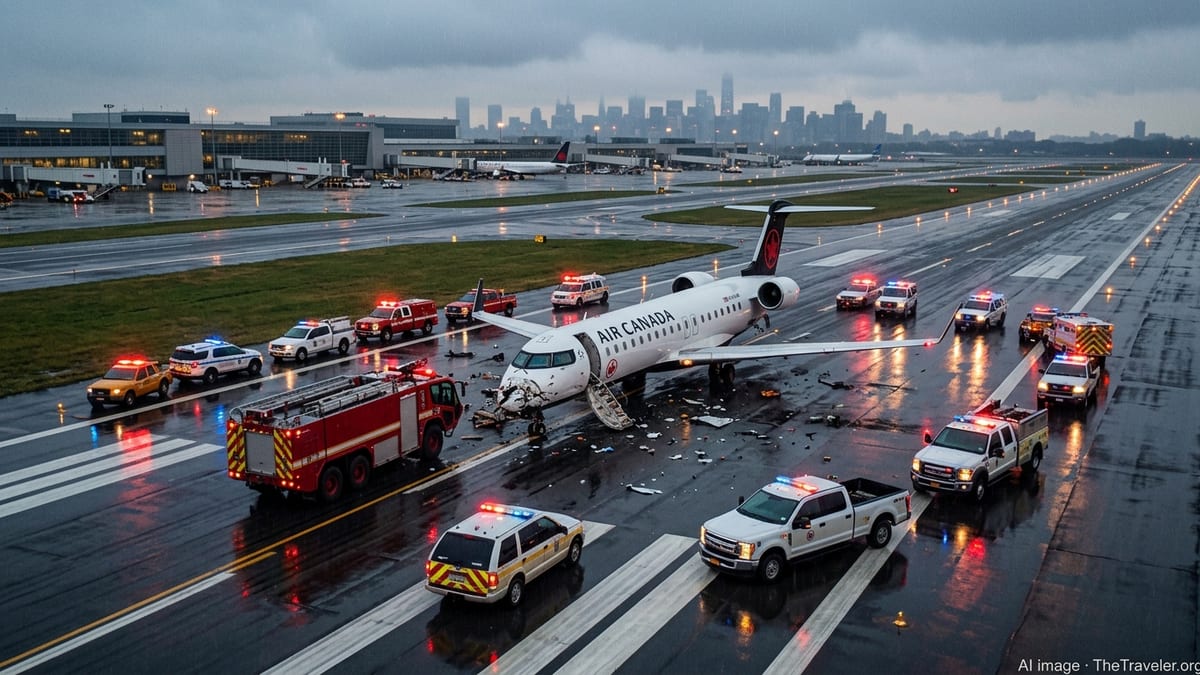
Runway Closure Follows Discovery Near Runway 4/22
Published coverage indicates the sinkhole opened near Runway 4/22, one of LaGuardia’s main airstrips used for both arrivals and departures. The affected section of pavement was identified during active operations, prompting an immediate stop to traffic on that runway and a rapid shift to alternate configurations.
Reports from multiple outlets describe the opening as a visible cavity in the pavement large enough to raise concerns about the structural integrity of the surrounding surface. Photographs circulating in news and social media coverage show maintenance crews and heavy equipment positioned around a cordoned-off section of the runway, with aircraft holding on taxiways while the situation was assessed.
According to publicly available information, the remaining runways at LaGuardia have remained open, but the loss of one of the airport’s key pieces of infrastructure sharply reduced capacity during the busy afternoon and evening periods. That reduction has had a swift impact on flight schedules, particularly for short-haul domestic services that rely heavily on LaGuardia’s tightly timed operations.
LaGuardia, located in Queens and serving primarily domestic routes, routinely operates near its maximum capacity. Any disruption to its runway system can quickly ripple through airline schedules, turning relatively minor infrastructure issues into regionwide operational challenges.
Flight Cancellations, Diversions and Long Ground Delays
Initial reports from airline trackers and airport status boards show dozens of delays and cancellations building through Wednesday afternoon and evening as carriers adjusted to the reduced runway availability. Some departures were held at gates for extended periods, while arriving aircraft were placed in holding patterns or diverted to nearby airports such as Newark Liberty International and John F. Kennedy International.
Travelers posting on social media and in local forums described aircraft stopping on taxiways as crews repositioned ground vehicles away from the compromised area. Others reported being advised of indefinite departure holds while air traffic controllers managed traffic into and out of the remaining runway.
Publicly available data from flight-tracking services indicates that the disruption has been most acute on high-frequency northeast corridor routes, including flights to Boston, Washington and other regional hubs. With one runway out of service, airlines have had to reduce the number of operations per hour, leading to a backlog that extended into the evening schedule.
Several carriers have begun waiving change fees for passengers scheduled to travel through LaGuardia on Wednesday and into Thursday, according to airline advisory pages. Travelers are being encouraged to rebook to later flights or alternate airports in the New York area when possible, in order to ease pressure on the constrained schedule at LaGuardia.
Ongoing Repairs and Safety Assessments on the Airfield
Images from the airfield show engineering and maintenance crews inspecting the damaged section of runway and using heavy machinery to excavate the area around the sinkhole. Publicly available information suggests that teams are working to determine the cause and full extent of the subsurface failure before proceeding with permanent repairs.
While specific technical details have not yet been released, aviation infrastructure specialists note in broader commentary that sinkholes or surface collapses near runways can be associated with aging pavement, drainage issues, or voids in underlying soil layers. LaGuardia’s location on previously developed and partly reclaimed land in Queens has long required extensive monitoring and maintenance of its paved surfaces.
Reports indicate that the compromised area remains isolated from active aircraft movements while the evaluation continues. Temporary fixes may allow limited reopening once the surface is stabilized, but more extensive reconstruction could be required if deeper structural problems are confirmed, potentially extending the operational impact.
Until a clearer picture emerges, the priority on the airfield remains ensuring that any runway brought back into service can safely handle the high volume of takeoffs and landings that LaGuardia manages each day. That emphasis on safety is expected to govern the pace at which the affected runway returns to normal use.
Broader Impact on New York’s Already Stressed Air Travel Network
The sinkhole comes at a time when New York’s airports are already under pressure from strong travel demand and recent operational disruptions, including earlier incidents at LaGuardia and nearby airports this year. With many flights scheduled in tight succession, the sudden loss of one runway has amplified existing strains on staffing, airspace management and ground operations.
According to published coverage, delays at LaGuardia quickly translated into missed connections across domestic networks, as aircraft and crew arriving late to New York were then unavailable for onward flights. Some travelers attempting to rebook reported limited same-day options, particularly on shuttle-style services that were already near capacity.
Transportation analysts note that LaGuardia has undergone extensive terminal reconstruction and infrastructure upgrades in recent years, winning industry recognition for improved passenger experience. The sinkhole incident serves as a reminder that airfield integrity, much of it out of public view, remains a critical factor in keeping schedules running smoothly even after terminal modernizations.
Regional rail and bus services also experienced an uptick in demand as some passengers opted to switch from short-haul flights to ground transportation between Northeast cities. Travel planners advise that anyone with flexibility consider alternative routes while airlines work through the immediate backlog created by the runway closure.
What Travelers Flying Through LaGuardia Should Expect Next
For passengers with upcoming flights to or from LaGuardia, publicly available advisories emphasize the likelihood of continued schedule adjustments until the sinkhole is fully repaired and the runway is cleared for use. Same-day travelers are being urged to monitor flight status closely and to arrive at the airport with extra time in case of reassignments or gate changes.
Airlines are updating customers through mobile apps, email alerts and airport information displays, but rapid shifts in runway availability can lead to last-minute changes. Industry observers suggest that travelers consider carry-on baggage when possible to maintain flexibility if an aircraft swap or rerouting is required.
Travel news outlets recommend that those with nonessential travel or tight onward connections review options for rebooking over the next several days, particularly if their itineraries rely on peak-time departures. Choosing early-morning or late-evening flights, when schedules can sometimes be more resilient, may help reduce the risk of extended delays.
As engineering assessments and repair work progress, further updates on the status of Runway 4/22 are expected from public airport and airline communications channels. Until then, the sinkhole at LaGuardia stands as the latest reminder of how quickly a localized infrastructure problem can ripple through one of the country’s busiest air travel corridors.