


More news on this day
New York travelers faced mounting disruptions on Wednesday after a sinkhole discovered near a primary runway at LaGuardia Airport forced an immediate closure, triggering hours of delays and hundreds of flight cancellations across the region.
Get the latest news straight to your inbox!
Runway 4/22 Taken Out of Service After Morning Inspection
Publicly available information indicates that the sinkhole was identified late Wednesday morning during a routine inspection of LaGuardia’s airfield. The affected area is near Runway 4/22, one of the airport’s two main runways and a critical piece of infrastructure for both arrivals and departures.
Reports from multiple outlets describe the depression as significant enough to require the immediate suspension of operations on the runway while engineers assessed the extent of the damage. Emergency construction teams moved in quickly with heavy equipment and materials to stabilize the ground and begin repairs.
According to published coverage, the closure was ordered shortly after the sinkhole was discovered, with air traffic controllers and airport operators shifting traffic to the remaining runway. That rapid response avoided a full airport shutdown but sharply reduced LaGuardia’s capacity at one of the busiest times of the day.
Initial assessments shared in news reports suggest that recent rainfall and ongoing subsurface work in and around the airfield may be examined as possible contributing factors, although no official cause has yet been confirmed in public documentation.
Ground Delays, Cancellations Mount as Thunderstorms Loom
With only one runway available, LaGuardia was placed under a formal ground delay program, significantly slowing the rate of flights allowed to depart for the airport. Aviation tracking services cited in media reports showed average departure delays approaching or exceeding an hour and a half for flights bound for the Queens hub.
Data from flight-tracking sites referenced in news coverage indicated that by late afternoon, nearly 200 flights into and out of LaGuardia had been canceled, with well over a hundred additional services delayed. Airlines began proactively trimming schedules, consolidating passengers onto fewer flights, and warning of rolling disruptions through the evening.
The timing of the incident further complicated operations, coming on a day when forecasters were already calling for thunderstorms in the New York metropolitan area. Aviation planners noted that the combination of convective weather and a single-runway operation at LaGuardia substantially reduced flexibility for arrivals and departures.
Public advisories urged travelers to monitor their airline apps and notifications closely, arrive early at the airport, and be prepared for gate changes, longer than normal taxi times, and potential diversions to other New York area airports such as John F. Kennedy International or Newark Liberty International.
Recent Safety Strains at a Congested Urban Airport
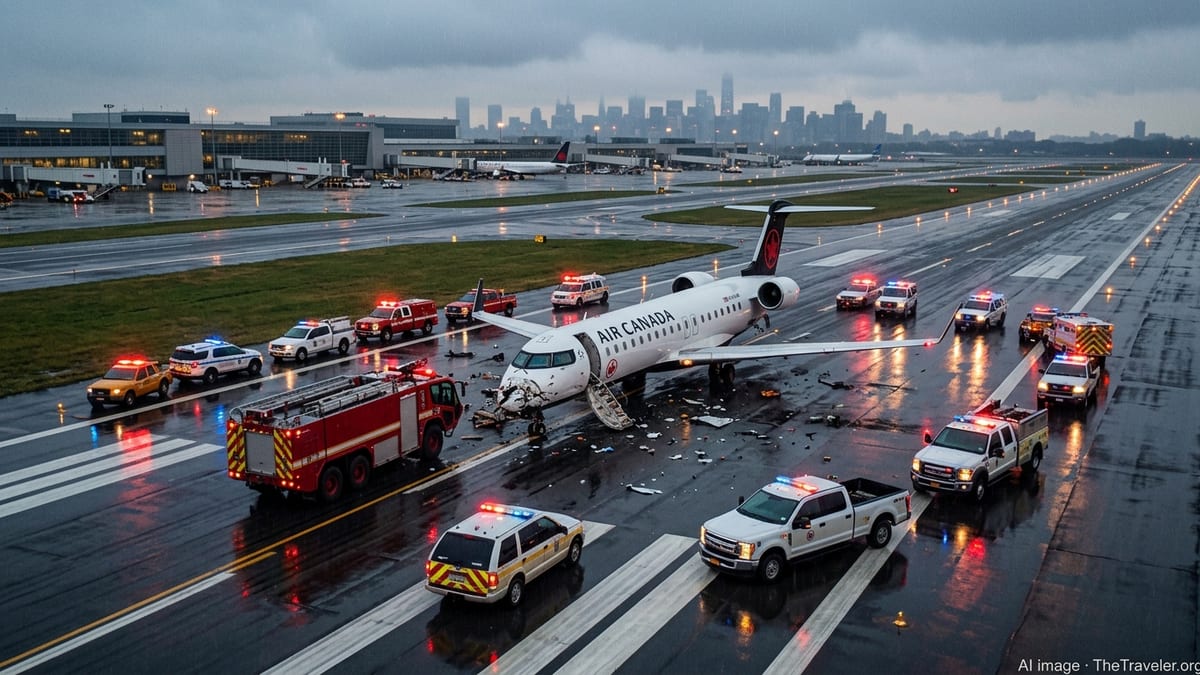
The sinkhole disruption comes less than two months after a fatal runway collision at LaGuardia involving an Air Canada regional jet and an airport firefighting vehicle, an incident that temporarily shut the airport and led to broader scrutiny of runway safety and airfield operations in New York.
In that earlier case, the airport experienced a full ground stop and closure while investigators documented the scene, underscoring how sensitive the New York air network is to any disruption at LaGuardia. The new sinkhole-related closure, although less catastrophic, adds to a growing list of recent operational challenges at the compact urban airport.
LaGuardia is among the most congested airports in the United States, handling tens of millions of passengers each year on relatively short runways hemmed in by water, highways, and dense neighborhoods. Infrastructure and safety experts frequently cite the airport as an example of how aging facilities and limited space can complicate both maintenance and emergency response.
Industry observers noted that Wednesday’s episode may further sharpen focus on long-planned airfield rehabilitation projects, drainage improvements, and monitoring of subsurface conditions beneath critical movement areas, particularly as climate patterns bring more intense rainfall events to coastal infrastructure.
What Travelers Need to Know Today
For passengers with flights scheduled into or out of LaGuardia, airlines and airport advisories emphasized several common steps. Same-day travelers were urged to check their flight status repeatedly, not just before leaving for the airport but also en route, as runway repair progress, weather changes, and air traffic control directives could all alter schedules with little notice.
Carriers serving LaGuardia began offering limited rebooking flexibility, with some allowing passengers to shift to later flights or alternate airports in the region without change fees, depending on fare class and availability. Travel experts pointed out that seats on remaining flights from nearby airports could fill quickly, raising the importance of acting early if a significant delay or cancellation appears likely.
Those already at LaGuardia reported longer lines at customer service counters and increased congestion in gate areas as passengers waited for updated departure times. Public information screens reflected the evolving situation, with clusters of flights grouped as delayed while air traffic managers sequenced arrivals into the reduced-capacity schedule.
Travelers facing lengthy waits were advised in public guidance to stay close to their gate, keep mobile devices charged, and consider the knock-on effects on ground transportation, including potential surges in demand for taxis and ride-hailing vehicles when large groups of delayed flights finally depart or arrive in quick succession.
Repairs Underway, But Full Timeline Still Unclear
Engineering teams spent the afternoon excavating and stabilizing the damaged section of pavement near Runway 4/22, with images published by local outlets showing crews and machinery working around a cordoned-off portion of the airfield. The visible activity suggested a priority effort to restore the runway to service, but by late day there was no firm public timeline for a full reopening.
Airport infrastructure specialists noted that even relatively small sinkholes near a runway require careful evaluation of the underlying soil, drainage systems, and adjacent pavement to ensure the problem is not more extensive than it appears from the surface. Depending on findings, repairs can range from rapid patching to more involved reconstruction of the affected section.
In the interim, airlines and air traffic controllers are expected to continue operating a constrained schedule using LaGuardia’s remaining runway. That configuration is likely to ripple through national flight networks, particularly for carriers that rely on the airport as a key node in their domestic operations.
For now, publicly available information points to a race against time for crews to complete repairs before the evening peak and before any additional weather-related slowdowns, with the prospect that delays and cancellations may continue into Thursday even after the immediate sinkhole hazard is addressed.