


More news on this day
New York air travelers faced fresh turmoil on May 20 after a sinkhole discovered on a runway at LaGuardia Airport forced closures, triggered waves of delays and cancellations, and added new strain to an already difficult spring for U.S. aviation.
Get the latest news straight to your inbox!
Runway shutdown compounds a volatile spring at LaGuardia
Reports indicate that a routine airfield inspection at LaGuardia on Wednesday uncovered a sinkhole on one of the airport’s runways, prompting an immediate shutdown of the affected strip and emergency repair work on the tarmac. Images shared by local broadcasters showed heavy equipment and work crews clustered around a gaping depression in the pavement as flights stacked up in departure boards across terminals.
According to publicly available flight-tracking data and local coverage, the closure quickly translated into a spike in delays and a growing list of cancellations affecting major domestic carriers operating at LaGuardia. Departures and arrivals were still moving on the remaining runway, but with reduced capacity and extended turnaround times, particularly during the busy afternoon peak.
The disruption arrived on top of an already unsettled period for LaGuardia operations, marked by rolling weather impacts, ongoing construction projects and lingering scrutiny after a deadly runway collision in March. For many passengers who had already endured a week of shifting departure times and missed connections, the sinkhole was the latest blow in what has become a season of uncertainty in New York skies.
Publicly available aviation data for May show LaGuardia running relatively high on-time averages by historical standards, but with sharp swings on stormy or constrained days. With one of its runways out of service on May 20 and thunderstorms in the regional forecast, the airport’s capacity was significantly tightened just as demand for late-spring travel continues to climb.
Flight chaos for New York travelers as delays ripple outward
As news of the sinkhole spread, travelers at LaGuardia reported long lines at rebooking counters, full customer-service phone queues and crowded gate areas as airlines attempted to consolidate flights and reroute aircraft. Publicly accessible flight-status boards for Wednesday afternoon showed dozens of delayed departures and a smaller but rising number of outright cancellations, affecting services to major hubs including Chicago, Atlanta, Dallas, Boston and Washington.
Some inbound flights were diverted to other New York area airports, including John F. Kennedy International and Newark Liberty, in a bid to ease pressure on LaGuardia’s constrained runway configuration. Social media posts and aviation forums referenced in-flight announcements about ground delays and diversions tied both to the runway issue and to air-traffic control programs managing storm cells moving along the East Coast.
The cascading nature of airline schedules meant that disruptions in New York quickly reverberated across the country. Aircraft that were scheduled to originate at LaGuardia later in the day were left out of position, leading to knock-on delays on routes with no direct connection to New York. In several cases, travelers connecting through LaGuardia reported missed onward segments and unexpected overnight stays far from their original plans.
For New Yorkers and visitors alike, the timing was particularly painful. The incident landed just as the region enters a period of heavier travel tied to graduations, early summer tourism and business events rescheduled from winter. With many flights operating near capacity, opportunities to be rebooked on the same day were limited, leaving some passengers facing lengthy waits for alternative options.
Safety inspections and infrastructure questions after the sinkhole
According to publicly available information, the sinkhole was detected during a standard inspection of the runway surface, a routine procedure at major airports designed to spot cracks, subsidence and other hazards before they pose a risk to aircraft. The immediate closure of the affected runway and the rapid mobilization of repair crews underscored the seriousness with which infrastructure anomalies are treated in the tightly regulated airfield environment.
Early images from the scene suggested that the depression was located near a portion of pavement that may be subject to heavy stress from repeated landings and takeoffs. Specialists typically assess whether such failures stem from underlying drainage issues, aging subgrade materials, or the impact of recent weather patterns that can saturate soil and weaken support layers beneath concrete and asphalt.
Federal Aviation Administration construction impact reports and long-term planning documents for LaGuardia have highlighted ongoing work on runway and taxiway systems in recent years, including overnight closures for maintenance and drainage improvements. While those reports do not single out the newly discovered defect, they provide context for the airport’s continued efforts to modernize infrastructure that often operates close to capacity and under demanding conditions.
In the short term, engineers will be focused on stabilizing the affected area, assessing whether surrounding pavement has been compromised, and determining when the runway can safely reopen. Even after visible repairs are completed, additional inspections and test operations are typically required before normal schedules resume on a repaired runway.
LaGuardia’s challenging year: from runway crash to construction pressures
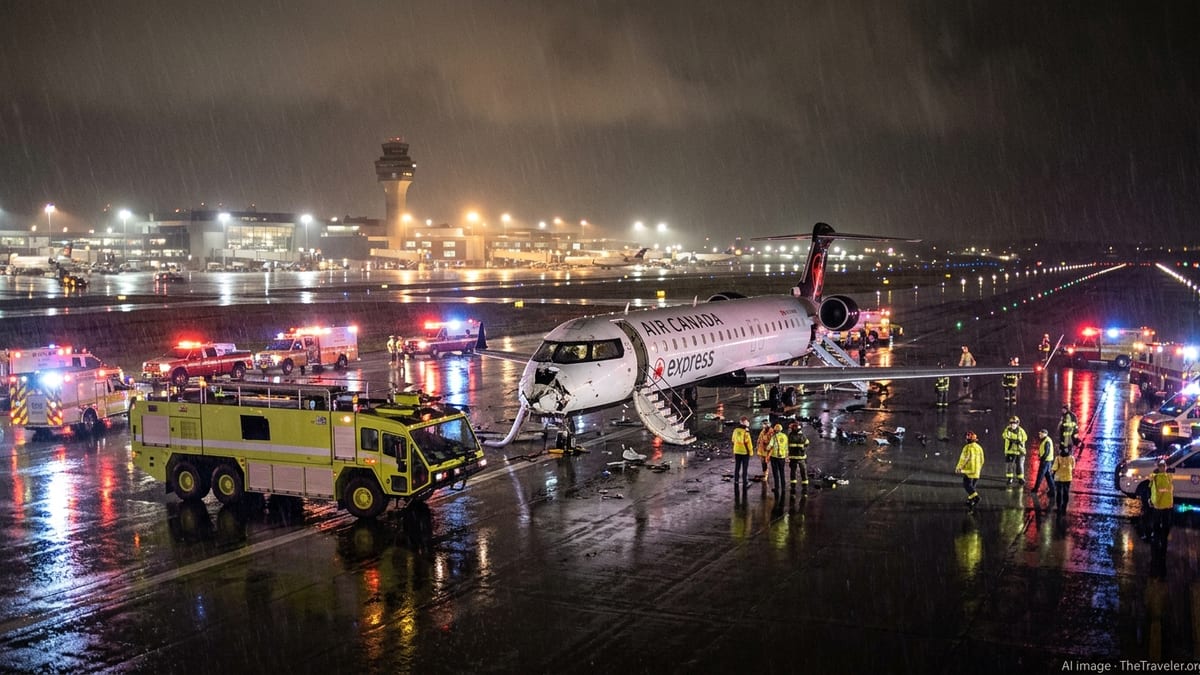
The sinkhole episode is the latest in a series of high-profile events at LaGuardia during 2026. In March, a regional jet operating as an Air Canada Express flight collided with an airport fire vehicle during landing, killing the two pilots and injuring dozens of passengers. The crash halted operations at the airport for hours and intensified nationwide debate over runway safety, ground-vehicle tracking and the complexity of operations at older, space-constrained airfields.
Publicly available summaries of that March incident indicate that investigators are examining communication protocols, ground radar coverage and vehicle-movement procedures, while federal regulators move to upgrade equipment such as transponders on airport vehicles. The crash refocused attention on how even relatively minor deviations on a crowded airfield can have outsized consequences when multiple systems falter simultaneously.
In parallel, LaGuardia continues to navigate a multi-year period of construction and infrastructure renewal following one of the most extensive terminal redevelopment projects in U.S. airport history. Federal planning documents show that runway and taxiway closures, along with power and drainage work, have been scheduled in phases to balance safety needs with the operational realities of serving tens of thousands of passengers each day.
Taken together, the March runway crash, this week’s sinkhole discovery and ongoing construction underscore the delicate balance between modernization and day-to-day reliability at one of the nation’s busiest urban airports. With limited space to expand and intense regional weather and traffic pressures, LaGuardia sits at the intersection of some of the toughest operational challenges in U.S. aviation.
What travelers can expect in the days ahead
For passengers looking ahead to flights in and out of LaGuardia over the coming days, publicly available forecasts and airline advisories suggest that conditions may remain fluid while repairs proceed and storms linger in the region. Carriers often respond to such events by issuing travel waivers that allow customers to change itineraries without standard fees, particularly when runway capacity is temporarily reduced and weather adds further uncertainty.
Travelers scheduled to depart from LaGuardia can expect that airlines will prioritize restoring core trunk routes and early-morning operations once the damaged runway returns to service, as these flights often set the tone for the rest of the day’s schedule. Less frequent routes and late-night departures may experience longer recovery times as aircraft and crews are repositioned.
Publicly accessible performance data show that New York area airports are particularly sensitive to small reductions in runway capacity, given the volume of traffic compressed into limited airspace. Even after immediate repairs are completed, residual disruptions can persist as carriers work through backlogs, reposition aircraft and accommodate stranded passengers.
For now, travel planners and passengers are watching closely for updates on when the affected runway will fully reopen and how quickly flight operations at LaGuardia can return to a more predictable rhythm. The sinkhole may ultimately prove to be a short-lived episode in operational terms, but for many travelers caught in Wednesday’s tangle of delays and diversions, it will stand as another reminder of how fragile the air travel system can feel when a single patch of ground gives way.