


Few travel hassles are as infuriating as watching your long-planned trip fall apart because of a delayed or cancelled flight. If you are flying to, from or within Europe, or on a UK carrier, EU and UK passenger rights rules may entitle you to cash compensation on top of refunds and rerouting. That is where services like Skycop come in, offering to handle the entire claim process for you in exchange for a cut of the payout. But is Skycop worth it, or are you better off claiming directly with the airline?
Get the latest updates straight to your inbox!
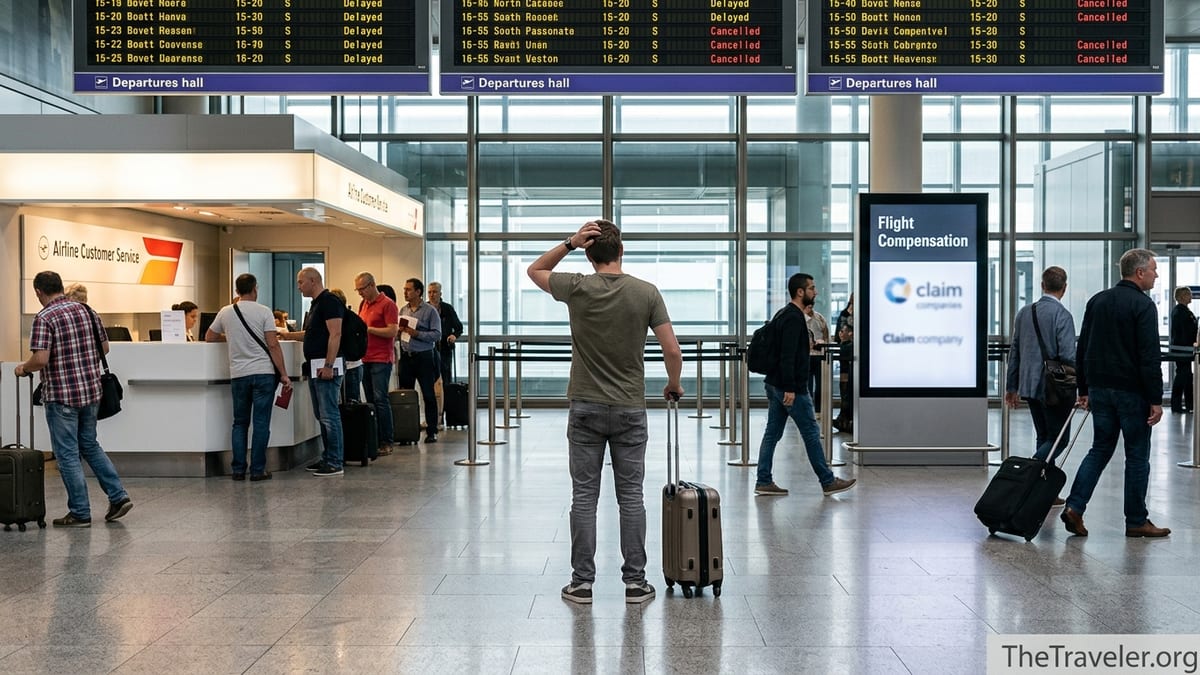
How Flight Compensation Works Under EU261 and Similar Rules
To decide whether you should use Skycop or claim directly with an airline, it helps to understand what you are actually entitled to. In the European Union, Regulation 261/2004 (often called EU261) sets common rules for compensation when flights are significantly delayed, cancelled, or you are denied boarding due to overbooking. Similar protections exist in the United Kingdom under UK261 and in countries such as Canada through its Air Passenger Protection Regulations.
Under EU261, compensation is based mainly on flight distance and delay at arrival. For example, for a long haul flight over 3,500 kilometers that arrives more than three hours late, compensation is typically about 600 euros per person if the disruption was within the airline’s control and not caused by extraordinary circumstances like severe weather or air traffic control strikes. Medium haul routes such as Paris to Athens often fall into a 400 euro band, while shorter hops such as Amsterdam to Berlin are usually 250 euros.
Crucially, this compensation is separate from your right to a refund or rerouting. If your London to Barcelona flight is cancelled, the airline must offer you a refund or an alternative routing, plus care such as meals and accommodation when needed. The fixed cash compensation is an additional payment that is often the focus of services like Skycop. These rules usually apply when you depart from an EU or UK airport on any airline, or when you arrive in the EU or UK on an EU or UK airline.
In practice, this means a family of four on a cancelled New York to Lisbon flight operated by a European carrier could be owed roughly 2,400 euros in compensation if conditions are met. That is a substantial amount, which explains both why airlines sometimes resist paying quickly, and why claim companies have emerged to take on the fight in exchange for a commission.
What Skycop Actually Does
Skycop is one of several European claim management companies that specialize in enforcing passenger rights. A traveler fills out an online form with flight details, uploads boarding passes and correspondence, and Skycop’s system checks whether a claim appears valid. If Skycop believes there is a good chance of success, the company offers to pursue the claim on behalf of the passenger.
From that point, Skycop handles most of the interaction with the airline. That can include sending formal demand letters, citing legal cases that interpret EU261, and, in some jurisdictions, working with partner law firms to take cases to court if the airline refuses. Travelers often see Skycop mentioned in situations where airlines argue that delays were caused by “extraordinary circumstances,” for instance by technical faults that the airline claims were sudden and unavoidable. Skycop’s team then decides whether it is worth challenging those arguments.
Skycop operates primarily on a success fee model. According to recent comparison articles by competitors and consumer review sites, Skycop’s standard commission on a successful EU261 or UK261 claim is often in the region of 25 percent of the compensation plus applicable taxes, though some sources and reviewers describe higher effective percentages once administration and legal costs are added. One independent cost-comparison site labels Skycop as charging up to around 50 percent in some scenarios, especially where court action is required, which illustrates how complicated fee structures can feel from a traveler’s perspective.
For frequent travelers, Skycop also markets a subscription product known as Skycop Care, sold for roughly the equivalent of around 27 pounds or 30 euros per year in some markets. Under that plan, Skycop advertises that it waives its success fee on covered flights and may include extras such as limited lounge access during disruptions. Travelers still have to meet normal eligibility criteria, and only flights during the membership period are generally protected, but it can be attractive for those who fly to and from Europe several times per year.
Claiming Directly With the Airline: The No Fee Option
Every airline that flies in or out of the EU or UK must provide a way for passengers to submit compensation claims. In practice, this usually means filling out an online form in the “customer relations” or “refunds and claims” section of the airline’s website. Major airlines such as Lufthansa, Air France, KLM, British Airways and Ryanair all provide specific EU261 or UK261 forms where you can enter your booking reference, describe the disruption and upload receipts.
For straightforward cases, claiming directly can be surprisingly quick. Take a common example: a Frankfurt to Madrid flight on a German airline arrives over three hours late due to a technical fault that was clearly under the airline’s control. Many travelers report receiving the standard 400 euro compensation per person within a few weeks of submitting a direct claim. In some cases, especially when airlines know they have a weak argument, the payment can arrive within days to the same card or bank account used to buy the ticket.
However, direct claims can also become frustrating. Airlines sometimes respond with generic denials citing “extraordinary circumstances” such as airport staffing shortages, air traffic control restrictions, or unspecified safety reasons. Travelers have described situations where carriers took months to reply, lost documentation, or attempted to settle with vouchers worth far less than the prescribed cash amount. For instance, a traveler on a Paris to Chisinau flight recently reported being offered a 50 euro voucher instead of the 400 euro cash compensation they believed was due. Others have shared examples where airlines treated reimbursement of hotel and meal expenses as if that satisfied their legal obligation, overlooking the fixed compensation entirely.
To push back, passengers may need to write multiple follow up emails, escalate complaints to national enforcement bodies, or even consider small claims court. That demands time, patience and comfort navigating legal language. For someone juggling work and family, investing several evenings into arguing with an airline over 250 euros might not feel worthwhile, which is exactly the gap claim companies seek to fill.
Skycop vs Direct Claim: Cost, Effort and Likely Payout
The central trade off between Skycop and a direct claim is straightforward: are you willing to invest time and effort to keep 100 percent of your compensation, or do you prefer to outsource the hassle in exchange for losing a significant percentage of the payout if successful?
Consider a long haul delay from Chicago to Rome on a European carrier where a solo traveler is clearly entitled to 600 euros under EU261. If the traveler claims directly and wins, they keep the full amount. If instead they work with Skycop under a typical success fee of about 25 percent including taxes, they might receive roughly 450 euros, with the remaining 150 euros going to the company. If court action or extra legal steps are needed and higher fees apply, the net amount could drop further, sometimes in the direction of half the compensation according to critical consumer sites.
Now scale that to a family of four on the same itinerary. The total compensation could be about 2,400 euros. Filing directly and winning would bring the whole sum back to the family. Working with Skycop on standard terms could reduce their net to somewhere around 1,800 euros, with several hundred euros in fees. For some families, that trade may be acceptable if they believe they would never have succeeded on their own, especially in complex multi leg journeys or when airlines are particularly resistant.
Effort and time are the other side of the equation. Direct claims typically involve filling out a form, monitoring email responses, and sometimes sending firm but polite follow ups citing EU261 or UK261 rules. Travelers who are comfortable writing concise complaint letters and who are not in a hurry can often resolve uncomplicated cases on their own. In contrast, Skycop compresses that work into a few minutes up front, then potentially months of waiting with occasional status updates. If the claim is borderline, the company may eventually decide not to pursue court action, in which case the passenger ends up with no compensation and no fee, but also possibly significant lost time.
When Using Skycop May Make Sense
There are scenarios where using a company like Skycop can be a rational choice despite the cost. One clear example is a complex itinerary involving several airlines and connections. Imagine a traveler flying from Toronto to Athens via London and Rome, booked under a single ticket with both a Canadian and a European carrier involved. A missed connection in London leads to an overnight delay, and blame is passed back and forth between airlines. Figuring out which segment and carrier falls under EU261 or UK261, and where to direct the claim, can be daunting for a casual traveler.
Another situation is a disputed cause of delay. Airlines often argue that things like unexpected technical defects, ground handling delays, or staff sickness are extraordinary circumstances that relieve them of compensation duties. European court rulings have narrowed this definition, but it remains a grey area and varies by case. Skycop and similar companies track case law and typical airline behavior and can judge whether it is worth challenging an airline’s explanation. For a passenger who does not want to research legal decisions, letting specialists make that call can be attractive.
There are also very practical considerations. Some airlines still require claims to be handled via postal mail or through customer service centers that are difficult to reach. Travelers who live abroad, who are not comfortable writing in the airline’s preferred language, or who simply do not have the bandwidth to follow up repeatedly may decide that a 25 to 40 percent fee is an acceptable price to avoid that administrative burden.
Finally, travelers who fly often may see value in Skycop Care as a sort of “insurance like” product. A consultant based in New York who makes monthly trips to Frankfurt, London and Dublin, for example, might decide that paying roughly 30 euros a year for Skycop Care is worth it if it means multiple potential compensation claims would be handled automatically without additional fees. In that case, the first successful payout of 400 or 600 euros would more than cover the annual membership cost.
When You Should Probably Claim Directly
On the other hand, many travelers can and probably should claim directly with the airline, especially in straightforward cases. If your flight departed late from an EU or UK airport on a clearly non extraordinary cause, arrived more than three hours late, and the airline already acknowledged a technical or operational problem within its control, you have a strong position under EU261 or UK261. Filing a direct claim through the airline’s online form and citing the regulation is often enough.
Take a simple scenario: a Copenhagen to Paris flight on an EU carrier is delayed by four hours due to a mechanical fault discovered during routine checks. Other flights are operating normally, the weather is fine, and no air traffic control strikes are mentioned. The distance fits squarely into the 400 euro bracket for each passenger. In that case, you might spend 20 minutes submitting a claim directly and receive the full amount in your bank account within a few weeks. Handing that over to Skycop might save you only a short form and one follow up email, at the cost of losing up to a quarter of the compensation.
Direct claims are especially worthwhile when the amount at stake is significant relative to your time. For example, a solo traveler on a short hop from Brussels to Amsterdam facing a 250 euro entitlement might be tempted to use a claim company because the payout is relatively small. From a purely financial perspective, though, this is precisely the scenario where losing 60 or 70 euros in fees has the biggest percentage impact. If you can manage a couple of emails yourself, the direct route will nearly always leave you better off.
Finally, claiming directly can give you more control over negotiation. Some airlines initially offer vouchers or lower cash amounts than the regulation specifies, especially if they sense that a passenger is unaware of their exact rights. Being informed and standing firm on the standard compensation bands often leads to the full payout. When you outsource to a company like Skycop, you may have less direct visibility into how aggressively they push in borderline cases.
Practical Tips Before You Decide
Before choosing between Skycop and a direct claim, there are several practical steps that can improve your odds either way. The most important is to keep documentation. Save boarding passes, booking confirmations, written notices of cancellation, and any messages from the airline explaining the reason for disruption. Take photos of airport departure boards that show delays, and keep receipts for meals, hotels and ground transport that you had to pay because of the disruption.
Next, do a quick eligibility check using a reputable calculator or by comparing your situation with well known EU261 band examples. If your flight from Lisbon to Berlin was delayed by two hours, you likely have no right to fixed compensation even though you might still claim expenses. If your London to New York flight on a UK carrier landed more than four hours late due to a maintenance problem, you are probably within the 600 euro band under UK261 rules.
Then, look at the airline’s track record. Online forums and consumer sites are full of recent experiences. Some airlines have a reputation for honoring clear cut EU261 cases promptly, while others are known for systematically refusing claims until passengers escalate. If you see that dozens of travelers recently succeeded with direct claims against your carrier, you may feel more confident going solo. If instead most stories describe lengthy battles that ended only after court filings or intervention by consumer agencies, using Skycop might feel more appealing.
Finally, read the fine print. Skycop’s own terms and independent review sites outline when success fees apply, how high they can go if court action is needed, and whether you are signing a power of attorney or exclusive mandate. Make sure you understand that once you assign a claim to Skycop, you generally cannot continue to pursue the same claim with the airline yourself in parallel.
The Takeaway
Whether you should use Skycop or claim directly with the airline depends mainly on the complexity of your case, the time and energy you are ready to invest, and how comfortable you are dealing with pushback. Skycop and similar claim companies exist because airlines often make compensation harder to obtain than the law intends, and for many travelers having an expert take over is worth the substantial fee.
For clear cut EU261 and UK261 cases, particularly when you are flying with major carriers that have reasonable compliance records, claiming directly will usually leave you with more money in your pocket. Spending an hour to secure the full 400 or 600 euros rather than three quarters of it is a sensible trade for most people. On the other hand, if your itinerary is complex, the airline is unresponsive, or you simply know you will never find time to chase the claim yourself, then Skycop can turn an otherwise lost opportunity into at least partial compensation.
In the end, there is no single right answer for every traveler. Treat Skycop as a backup plan rather than the default, start by understanding your rights and testing a direct claim, and only then decide if bringing in a specialist is worth their share of the payout.
FAQ
Q1. Does Skycop reduce my compensation amount?
Yes. If Skycop wins your case, it keeps a success fee that is typically around a quarter of your compensation including taxes, and can be higher when legal action is required, so you receive only the remaining share.
Q2. Is it free to submit a claim directly with the airline?
In most cases, yes. Airlines usually provide online claim forms at no charge, and if your EU261 or similar claim is approved, you receive the full compensation amount without paying any commission.
Q3. How long does a direct airline claim usually take?
Timelines vary, but for straightforward EU261 cases many airlines respond within a few weeks. Some travelers receive payment in under a month, while complex or disputed cases can take several months or longer.
Q4. What if the airline denies my direct claim?
If an airline rejects your claim and you still believe you are entitled to compensation, you can escalate to the relevant national enforcement body, consider small claims court, or then decide to work with a company like Skycop to pursue the matter.
Q5. Are all delays covered by EU261 or UK261?
No. These regulations usually cover flights that depart from EU or UK airports on any airline, and flights arriving in the EU or UK on EU or UK carriers, where the delay or cancellation is within the airline’s control and meets minimum delay thresholds.
Q6. Can I use Skycop if I already filed a claim with the airline?
You generally should not assign a case to Skycop if it is already being processed directly with the airline, because you may be granting Skycop exclusive rights to the claim. It is safer to wait for the airline’s final response before switching paths.
Q7. Is Skycop Care membership worth it?
Skycop Care can be worthwhile for frequent travelers who expect multiple eligible flights per year, since it can remove or reduce success fees on covered trips. For occasional travelers, the subscription cost may exceed the benefit.
Q8. Do I need a lawyer instead of Skycop?
Most travelers do not need a personal lawyer for typical EU261 claims. Skycop and similar firms collaborate with legal partners when necessary, while many direct claims are resolved without any legal representation at all.
Q9. Can I claim both expenses and compensation?
Often yes. You may be able to claim reimbursement for reasonable expenses like meals or hotels caused by the disruption, and still receive the fixed EU261 or UK261 compensation if all conditions are met.
Q10. What should I do right after a disruption to help my future claim?
Keep boarding passes and booking confirmations, ask airline staff to state the cause of disruption in writing if possible, photograph departure boards showing delays, and save all receipts for extra costs that the disruption creates.