


More news on this day
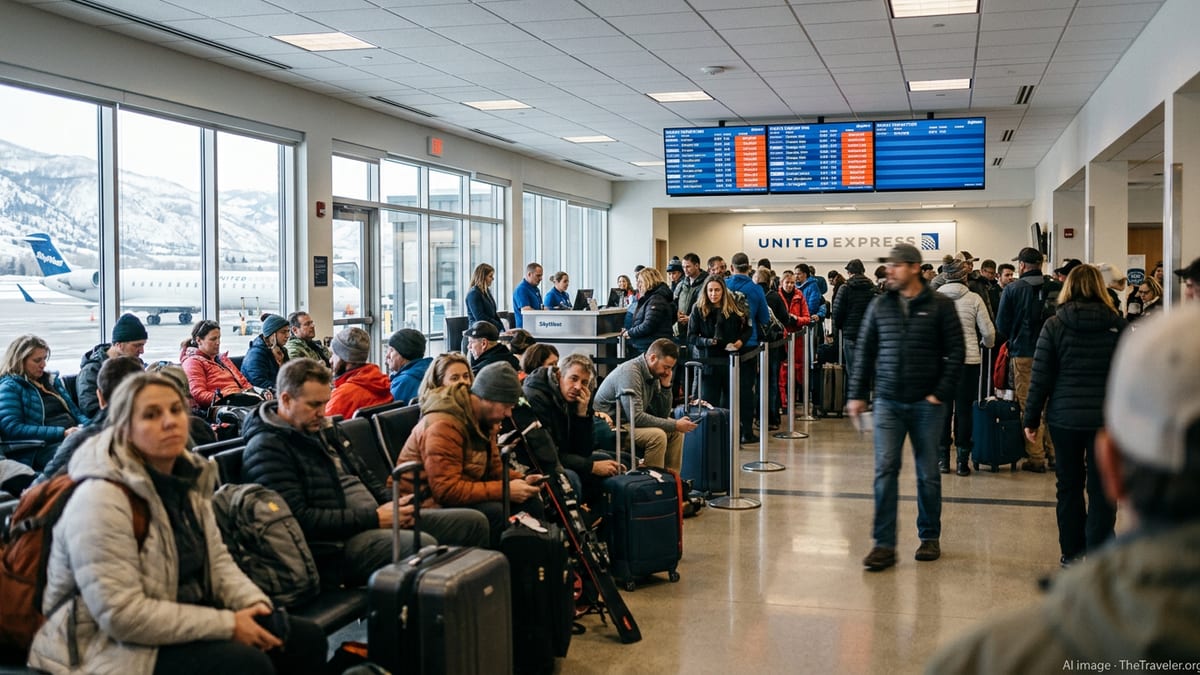
A SkyWest Airlines-operated flight from Austin to San Diego diverted to Palm Springs International Airport in mid-July 2026, temporarily stranding travelers in the California desert and drawing fresh attention to how regional carriers manage weather, air traffic and operational disruptions across their networks.
Get the latest news straight to your inbox!
Mid-July Diversion Alters Austin–San Diego Route
The SkyWest-operated service, flying under a major partner brand as Flight SKW3293 on the Austin to San Diego route, was scheduled as a routine domestic hop across the Southwest. Flight listings for this pairing show a regional jet pattern connecting Austin Bergstrom International Airport with San Diego International, typically using Embraer 175 aircraft configured for short to medium haul operations.
On this occasion in July 2026, the aircraft did not continue as planned to San Diego and instead diverted to Palm Springs International Airport, a comparatively small but busy desert gateway in California’s Coachella Valley. Publicly available flight-tracking information indicates that the diversion occurred late in the day, with the aircraft landing in Palm Springs before any onward segment to San Diego could be completed.
Reports from aviation data platforms suggest the diversion unfolded against a backdrop of summer operational challenges in the region, including high temperatures, thunderstorm activity common over the desert and mountain corridors, and congestion around major West Coast hubs. Those factors frequently contribute to reroutings, ground stops or fuel-related precautionary landings for regional flights.
While precise timing details vary between tracking services, the record is consistent on one point: passengers expecting a nonstop Austin to San Diego journey instead found themselves disembarking in Palm Springs, about 85 miles northeast of their intended coastal destination.
Palm Springs’ Growing Role in Regional Networks
The selection of Palm Springs as a diversion point reflects the city’s importance in SkyWest’s broader regional map. Company fact sheets list both Palm Springs and San Diego alongside Austin as part of the carrier’s network of cities served on behalf of its four mainline partners. The carrier has a long history in the Coachella Valley market and accounts for a significant share of scheduled seats at Palm Springs International.
Palm Springs International has steadily expanded its facilities and passenger traffic in recent years, with local airport reports showing millions of annual enplaned and deplaned travelers and a notable presence from SkyWest-operated services. The airport’s layout, available gates and ground-handling capacity make it a practical option for unplanned arrivals of regional jets that need parking, refueling and coordination with partner airlines.
For travelers on SKW3293, arriving in Palm Springs instead of San Diego likely meant an unfamiliar airport environment compared with the larger coastal hub. At the same time, the diversion location placed them within driving distance of San Diego, and within the web of short-haul regional flights that can be rebooked once operations stabilize.
The event also underscores the increasingly interconnected nature of secondary airports across the western United States. Facilities like Palm Springs function as more than just seasonal leisure gateways. They serve as flexible nodes for rerouting regional traffic when weather or congestion makes primary hubs more difficult to access on the day of travel.
Operational Pressures in Peak Summer Travel
The diversion came at the height of the July travel period, when domestic passenger volumes traditionally surge and weather patterns often complicate flight operations across the Sun Belt. Summer 2026 has seen robust demand in and out of Austin, Palm Springs and San Diego, with online fare and schedule data pointing to busy loads on routes that tie together Texas, Southern California and desert destinations.
Regional airlines such as SkyWest operate under capacity and scheduling agreements with major carriers, meaning they must balance tight turn times with the constraints of air traffic control, gate availability and crew duty limits. In this context, diversions can act as safety valves to avoid extended airborne holding, low fuel reserves or regulatory issues around crew working hours.
Industry observers note that Palm Springs’ desert climate adds additional complexity. High daytime temperatures in July can affect aircraft performance on takeoff and landing, while monsoonal thunderstorm systems occasionally bring sudden wind shifts, lightning and reduced visibility to desert and mountain airfields. When those conditions overlap with crowded airspace around Los Angeles and San Diego, dispatchers sometimes opt for alternative airports inland to reset flight plans.
Travelers on SKW3293 were therefore caught at the intersection of strong demand, regional weather and the fine margins that govern short-haul operations. While diversions of this kind remain relatively infrequent compared with the total number of flights, each incident serves as a reminder of how quickly a routine itinerary can change.
What the Diversion Means for Travelers
For passengers, the most immediate impact of a diversion is uncertainty. Instead of arriving in San Diego at the scheduled time, those on SKW3293 faced an unscheduled stop in Palm Springs with limited clarity, at least initially, about whether they would be reboarded to San Diego, rebooked on a later service or offered ground transportation alternatives.
Disruption management typically depends on the mainline partner whose flight number appears on the ticket, even when a regional operator performs the flying. Publicly available guidance from major U.S. airlines generally indicates that travelers affected by diversions may be rebooked without additional cost, with accommodation, meal vouchers or surface transport considered on a case by case basis depending on the length and cause of the delay.
In practical terms, some passengers from SKW3293 may have opted to continue by road, given that the drive from Palm Springs to San Diego, while crossing mountain terrain, can be completed in several hours. Others are likely to have chosen to wait for an onward flight once aircraft positioning, crew availability and air traffic conditions allowed a safe continuation of service.
For future travelers on the Austin to San Diego route, the incident serves as a reminder to build flexibility into itineraries, particularly during peak summer months. Travel planners often advise leaving more connection time, monitoring flight status tools closely on the day of departure and considering travel insurance or fare options that allow for same-day changes when irregular operations arise.
SkyWest’s Presence Across Austin, Palm Springs and San Diego
Beyond the disruption itself, the Flight SKW3293 diversion highlights how deeply SkyWest is embedded in the air travel links between Texas and Southern California. Corporate materials describe a network of more than 250 cities across North America served for partner airlines, with Austin, Palm Springs and San Diego all identified as core markets in the western and southwestern United States.
In Austin, SkyWest-supported services help connect the fast-growing Texas capital to major hubs across the country, feeding larger jets operated by partner brands. In San Diego, the carrier has become a familiar presence on regional routes that supplement mainline service along the West Coast and into the interior. Palm Springs, though smaller, appears in these documents as part of a cluster of desert and mountain markets where regional jets play an outsized role in sustaining year round connectivity.
The diversion therefore illustrates not only an isolated operational hiccup but also the broader web of relationships that underpins modern U.S. air travel. Routes that appear as simple nonstops on a booking confirmation can, in practice, rely on a network of secondary airports, shared crews and interchangeable aircraft that keep people and places linked when conditions are far from ideal.
As travel demand holds strong in the second half of 2026, travelers moving between Austin, San Diego and the broader Southwest are likely to continue flying on SkyWest-operated aircraft, even when their tickets display the names of the regional carrier’s larger partners. For most, the journey will remain uneventful. For a small number, as with those aboard Flight SKW3293, a diversion to a place like Palm Springs will become a memorable and unexpected chapter in the story of their trip.