


Planning your first big trip can feel exhilarating and intimidating at the same time. One of the biggest decisions is whether to travel completely on your own or to join an organized group tour. Both options can deliver an unforgettable first journey, but they offer very different experiences when it comes to cost, safety, independence, meeting people and how tightly your days are structured. This guide compares solo travel and group tours using real-world examples, to help you decide what fits you best right now, not in theory but in practice.
Get the latest updates straight to your inbox!
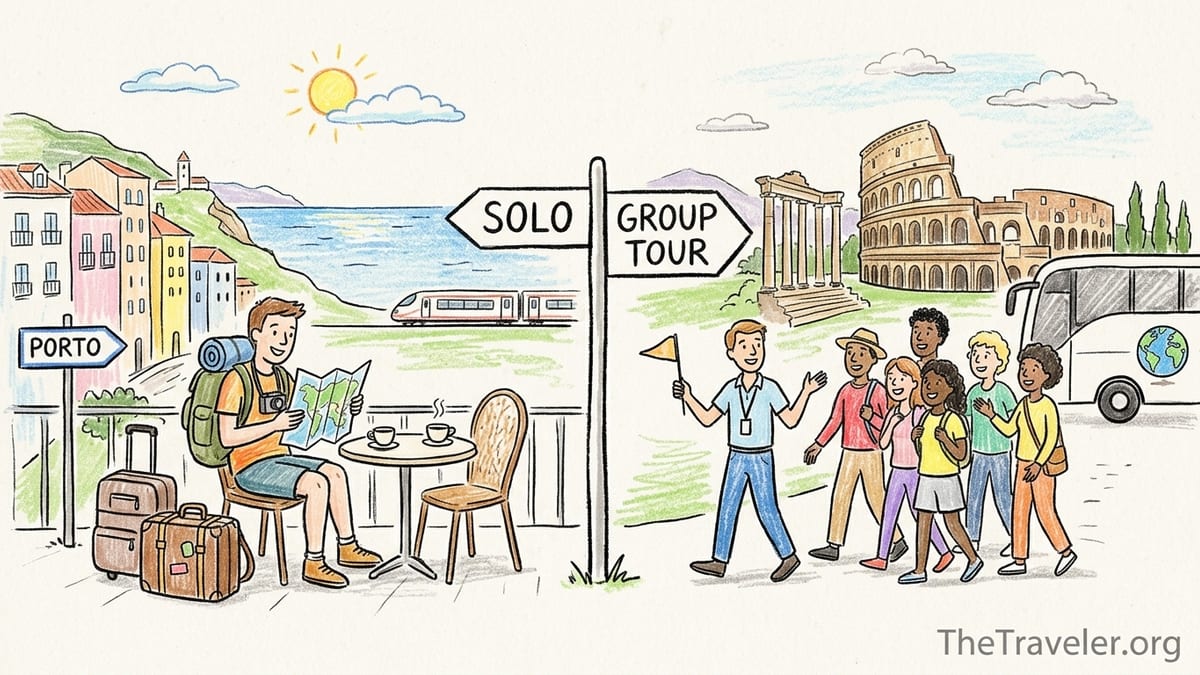
Understanding the Basics: What “Solo” and “Group Tour” Really Mean
Solo travel simply means you are not booking a trip with a fixed group or a professional tour leader. You might still join day tours along the way, stay in social hostels, or travel with people you meet, but you are the one choosing destinations, booking trains, picking hotels and handling problems as they come. For example, a first-timer might fly to Lisbon, spend three nights in a centrally located hostel for around 35 to 50 dollars per night in a shared dorm, book a Sintra day trip locally, then take the train to Porto on their own schedule.
Organized group tours, by contrast, package a route, accommodations, many activities and on-the-ground support into a single product. Companies like G Adventures, Intrepid Travel and Contiki run scheduled departures where 10 to 40 travelers follow a set itinerary with a dedicated trip leader. A typical 8 to 10 day Europe itinerary with these operators will include transport between cities, most accommodation, some guided sightseeing and a few group meals built into the headline price, while flights and many lunches and dinners remain extra.
There are shades between these extremes. Some travelers start with a structured one-week group tour, then continue alone. For instance, a traveler might book a 10 day Contiki European Horizon trip across several countries, then stay in Paris for four extra days on their own using the confidence and friends gained from the tour. Others begin solo but add short small-group adventures, such as an 8 day Camino de Santiago walk with a company like G Adventures, which handles lodging while they enjoy hiking independently during the day.
Understanding how much responsibility you want at this stage is key. Solo travel hands you nearly every decision, from which neighborhood to stay in to how to handle a canceled train in Italy. Group tours shift much of that burden to a company and tour leader. Neither is automatically better; the right choice depends on how comfortable you feel managing logistics and uncertainty on the road.
Costs in the Real World: Daily Budgets and Hidden Expenses
Price is one of the first questions beginners ask, and it is not as simple as saying solo travel is cheaper. In Western Europe, analysis of major tour operators shows that multi-day group tours often cluster around 180 to 250 US dollars per day for mid-range products when accommodation, transport between stops and some activities are included. Independent research into G Adventures’ Europe trips, for example, has found average daily prices around the low 200 dollar mark for standard itineraries, excluding flights and many meals.
On the other hand, a budget-minded solo traveler can often keep daily costs lower by choosing cheaper lodging and transport. Take a week in Italy. A solo traveler booking their own trip might pay about 45 dollars per night for shared hostel dorms in Rome and Florence, 10 to 15 dollars per intercity train if booked in advance, and 20 to 35 dollars per day for food by mixing supermarket lunches with simple restaurant dinners. That can bring the total daily spend to something like 90 to 130 dollars, plus attraction tickets such as the Colosseum or Uffizi Gallery. The trade-off is that this requires research, advance bookings and comfort comparing options in a foreign language.
Group tour pricing can also vary widely by destination and comfort level. In Southeast Asia, mainstream operators often advertise budget small-group tours with per-day rates nearer to 100 to 150 dollars because local accommodation and transport costs are lower. A one-week Thailand itinerary might include mid-range hotels, a sleeper train, some excursions and several meals. By contrast, in Western Europe, North America or New Zealand, the same style of tour can push well above 200 dollars per day once centrally located hotels and fuel costs are factored in.
Hidden or easily overlooked costs matter on both sides. Group tours often do not include optional excursions, some entrance fees and many lunches and dinners. A traveler on a Europe coach tour might pay extra for a Seine river cruise in Paris, a gondola ride in Venice or a cabaret night in Amsterdam, each adding 30 to 100 dollars to the overall spend. Solo travelers, meanwhile, can forget to budget for city tourism taxes on hotel bills, last-minute train surcharges when advance tickets sell out, or the cost of airport transfers if they arrive late at night and do not want to navigate public transport with luggage.
Safety and Support: How Much Backup Do You Want?
Safety is one of the main reasons beginners lean toward group tours, especially if they are worried about navigating unfamiliar cities, language barriers or after-dark logistics. Traveling in a group with a trained leader means someone else knows where you are supposed to be, which neighborhoods to avoid after dark, and how to respond if a member of the group loses their passport or becomes ill. On a guided trip through Morocco, for instance, the tour leader will usually coordinate safe taxis, know reliable local restaurants and have contacts in case of medical issues, which can be reassuring in a country where many first-time visitors are unsure about scams or food hygiene.
From a statistics perspective, reliable global data that cleanly compares solo versus group tour safety is limited, but large travel insurers and tourism boards consistently note that most incidents affecting visitors are petty theft and scams rather than violent crime. What changes between solo and group travel is not so much the baseline risk in a destination but how much help you have if something goes wrong. A solo traveler arriving at 11 p.m. into a large city like Bangkok or São Paulo must decide whether to use a meter taxi, app-based ride, airport bus or pre-booked transfer and handle any misunderstandings alone. On a group tour, an airport pickup or specified meeting point is usually arranged in advance.
That does not mean solo travel is inherently unsafe. Thousands of first-time travelers every year successfully plan their own trips to destinations like Japan, Portugal or Canada that have strong public transport and widely spoken English in tourist areas. Many solo travelers improve their safety by following simple habits such as arriving at new cities in daylight when possible, booking the first night’s accommodation in advance, keeping copies of key documents, and using money belts or cross-body bags to reduce the risk of pickpocketing on crowded metros.
Your personal risk tolerance should shape your decision. If you are anxious about reading train timetables, negotiating taxi prices or choosing safe neighborhoods in cities like Istanbul or Mexico City, starting with a small-group tour through a reputable operator can be a sensible step. You will still need travel insurance and basic precautions, but you gain a tour leader and fellow travelers who act as a first line of support. If, on the other hand, you already feel at ease using big-city public transport at home and are comfortable asking for help, you may find that solo travel gives enough security once you plan thoughtfully.
Independence and Itinerary Control: Freedom vs Structure
The biggest advantage of solo travel is control over your schedule. If you fall in love with a place, you can stay longer. If bad weather hits, you can swap a beach day for a museum without asking anyone’s permission. Picture a traveler in Croatia who planned three nights in Split but decides to extend to five after discovering the islands nearby. As a solo traveler, they can usually change hostel dates for a modest fee, whereas someone on a fixed 10 day group itinerary cannot simply skip scheduled stops and rejoin later.
Group tours trade that freedom for predictability. Coaches leave at set times, and you are expected to be on the bus at 8 a.m., luggage packed, whether you slept well or not. A traveler on a fast-paced coach tour of eight European cities in ten days might get only a few afternoon hours in each location before moving on. Reviews from past participants on long-established operators describe days that start early with long drives, followed by quick orientation walks and group dinners arranged at pre-selected restaurants. Some beginners enjoy the relief of not needing to think; others quickly feel rushed and wish for slower, more flexible days.
There is also a difference in how deeply you can explore a destination. A solo traveler spending a full week in Berlin can try different neighborhoods, attend a local language meetup, take a cycling tour one day and visit a smaller contemporary gallery the next. On a group tour that spends one night in Berlin, you might see key highlights like the Brandenburg Gate and Checkpoint Charlie on a brisk city tour, then move on the next morning. The group experience will give you a broad overview, but less time for personal discoveries.
For many beginners, a hybrid strategy works well. You might book a structured group tour for a complex region, such as a 10 day itinerary across Morocco, where a leader handles riad bookings and desert logistics, then travel independently in Spain afterward, where trains are easy to book online and English is widely spoken in tourist cities. That way, you get the comfort of structure first and a taste of independence later, with the option to decide which you preferred for your next trip.
Social Life and Community: How You Actually Meet People
One of the strongest selling points of organized tours is instant community. On a small-group trip with 12 to 16 people, you often meet fellow travelers from several countries, all starting on the same day, which can quickly feel like a temporary family. On youth-oriented brands like Contiki, which focuses on travelers roughly 18 to 35 years old, many itineraries are known for social evenings at bars, group nightlife outings and shared hostel-style hotels or cabins that encourage bonding. First-time travelers who worry about feeling lonely often find comfort in this built-in social circle.
Solo travel can also be very social, but you must lean into opportunities. Staying in hostels with common areas or booking social-style hotels in cities like Barcelona, Tokyo or Mexico City makes it easier to meet other travelers. Many solo travelers use apps and platforms to join walking tours, cooking classes, pub crawls or day trips. For example, in cities like Prague or Budapest, free or tip-based walking tours run almost daily from central squares, drawing dozens of independent travelers who often end up chatting over coffee afterward.
Where the experiences differ is in effort and compatibility. On a group tour, especially one that is fully booked, you do not choose your companions, and group dynamics can make or break the trip. If most of the group is a decade younger or older than you, or if the pace skews much more party-focused than you expected, you may feel out of place but still be committed to spending every day with them. On solo trips, if you find a group from a hostel pub crawl who wants to visit a museum you are not interested in, you can simply decline and do your own thing without any social obligation beyond that evening.
For shy or introverted first-timers, group tours can be a helpful bridge. The structure of shared buses, scheduled dinners and small daily decisions made as a group reduces the pressure to introduce yourself repeatedly. Some solo travelers purposely choose small-group tours with companies that limit group size to 12 to 18 and share demographic information, such as the average age of past groups, to increase the chance of finding like-minded people. Others prefer solo travel because they can choose when to be social and when to disappear into a quiet cafe with a book.
Rules, Restrictions and Cultural Immersion
Every organized group tour comes with rules, usually detailed in the pre-departure information. These include meeting times, dress codes for religious sites, luggage size limits and guidelines about punctuality. For example, a cultural tour in Jordan or Egypt might specify modest clothing and limit wheeled suitcases on certain days if accommodations are reached via narrow lanes or short hikes. Some tours strictly prohibit arriving late to buses or optional activities, with guides reminding the group that repeated lateness can result in leaving without the delayed person to keep the schedule on track.
These rules are not arbitrary. Tour leaders must balance the needs of the group, booked time slots at attractions and local regulations. However, they can feel restrictive to beginners who thought a vacation would mean waking up whenever they like. On high-intensity coach tours, it is common for participants to have breakfast at fixed hotel buffets around 7 a.m. most days, then follow a packed schedule until dinner, with limited opportunity to wander aimlessly or linger in a neighborhood that catches their interest.
Solo travelers face fewer formal rules but navigate informal norms. For instance, in Japan you are expected to speak quietly on trains and avoid eating on local subway lines, while in European cities you may encounter strict rules on where you can drink alcohol in public or how you buy tickets before boarding trams. Because no guide is reminding you, it becomes your responsibility to read local signage, research basic etiquette and observe what locals do.
Cultural immersion can work differently in each model. Some small-group tours deliberately build in homestays, market visits and meals with local families, which a nervous beginner might not seek out alone. In Peru, for example, certain Lake Titicaca tours include a night with a host family on one of the islands, offering insight into rural life in a way that would be challenging to arrange independently on a first trip. Conversely, a solo traveler renting an apartment in a residential district of Lisbon or Seoul and shopping at neighborhood markets could end up having more everyday contact with local life than someone sleeping in chain hotels on a whistle-stop coach tour.
Realistic Scenarios: When Each Option Works Best for Beginners
Consider a first-time traveler from the United States wanting to spend two weeks in Europe with a budget of around 3,500 dollars excluding flights. If they book a 10 day coach tour covering cities like Paris, Lucerne, Florence and Rome with a mainstream operator, the land price alone could reach 2,300 to 2,800 dollars depending on the season and room type. Adding optional excursions and most meals might bring the total to somewhere in the 3,200 to 3,800 dollar range for those ten days, leaving limited flexibility to extend the trip significantly.
The same traveler planning independently could design a slower route through three cities, such as Paris, Lyon and Barcelona. By mixing three or four nights in private hostel rooms at around 80 to 120 dollars per night with a few nights in cheaper shared dorms or guesthouses, choosing high-speed trains booked weeks in advance, and picking a handful of paid attractions like the Louvre or Sagrada Familia while enjoying many free sights, they might keep daily costs closer to 130 to 170 dollars. Over 14 days, that could roughly match or undercut the cost of a shorter, faster group tour, at the price of doing all the planning work themselves.
In another example, imagine a traveler curious about hiking in an unfamiliar environment such as Patagonia or the Nepalese Himalayas. For a beginner who has never trekked at altitude, joining a reputable small-group trek with local guides, porters and safety protocols is often far more practical and safer than trying to arrange guesthouses, permits and trail logistics solo. In these cases, paying for a guided itinerary, even if it feels expensive compared with everyday travel costs, can be worth it for peace of mind and reduced risk.
On the flip side, picture a digital nomad beginner planning three months in Southeast Asia with a flexible schedule and a laptop. In this scenario, solo travel makes far more sense than chaining together group tours. Monthly rentals in cities like Chiang Mai or Da Nang can cost less than a week in Western Europe, and slow solo travel allows them to find cafes, coworking spaces and social circles at their own pace. Joining occasional small-group day tours to places like Ha Long Bay or a Thai cooking school gives structure without locking them into a tight timetable for the entire stay.
These scenarios show that there is no universal winner. What matters is aligning the style of travel with the purpose and length of your trip, your appetite for planning and your comfort with uncertainty.
How to Decide: A Practical Framework for First-Timers
To choose between solo travel and an organized tour for your first big trip, begin by writing down your non-negotiables. If you know you will not enjoy early wake-ups and fixed schedules, heavy coach touring may disappoint you, no matter how many cities it promises. If, instead, the idea of navigating foreign train systems alone fills you with dread, the structure of a small group tour can transform a trip from stressful to manageable.
Next, consider your budget honestly, including flights, insurance, visas and spending money. If you can afford only one major international trip in the next few years, paying a bit more for a well-reviewed small-group tour in a destination that would be hard to manage solo, such as a multi-country West African itinerary, might be worthwhile. If you are more constrained, learning to piece together affordable independent trips to places with strong infrastructure, like much of Europe or parts of East Asia, can stretch your travel funds further.
A useful compromise for beginners is to blend approaches in a single journey. You might book a 7 to 10 day small-group tour in a region that feels daunting, then add five or six solo days in an easy, well-connected city. A traveler visiting South America for the first time could join a guided Peru highlights tour that includes Machu Picchu and the Sacred Valley, then spend extra time alone in Lima or Cusco afterward, booking their own food tours and museum visits. This strategy lets you test your comfort level with solo exploration while still enjoying the support of a group for the trickiest parts.
Finally, remember that your first choice does not define you as a traveler forever. Many experienced solo travelers started with group tours, learned the basics of packing, border crossings and managing jet lag, then gradually moved toward fully independent trips. Others discovered that they genuinely prefer the camaraderie and structure of group travel and now book one or two guided trips each year. The right answer for you as a beginner is the one that makes you feel excited rather than paralyzed when you imagine boarding the plane.
Conclusion: Start Where You Are, Not Where You Think You Should Be
Solo travel and organized group tours are not opposing camps as much as different tools for different stages and personalities. Group tours can be excellent for beginners who want extra safety, guaranteed company and minimal planning, even at a higher day-to-day cost and with less flexibility. Solo travel rewards those who are willing to trade some uncertainty and logistical work for the freedom to set their own pace, choose their own neighborhoods and stay longer wherever they feel at home.
When deciding how to take your first major trip, focus less on what others consider the “right” way to travel and more on what will actually get you out the door. If booking a reputable group tour is what makes you finally commit to seeing another continent, it is a good choice. If creating a simple three-city itinerary on your own feels achievable and exciting, you may be ready to start solo right away. In the long run, most travelers experiment with both and discover that the best adventures often happen not because of the format they chose, but because they found the courage to go.