


In Finland’s far northeast, close to the Arctic Circle, Ruka–Kuusamo has quietly become one of Europe’s most reliable outdoor playgrounds. With more than 160 kilometres of marked hiking paths, legendary long-distance routes like Karhunkierros, a modern ski resort that now runs almost year-round, and easy access to Oulanka National Park’s rapids and canyons, this compact region packs in a remarkable variety of trails and attractions in every season. This guide walks you through the key highlights, how to choose the right routes, and what first-time visitors need to know before lacing up boots or clipping into skis.
Get the latest updates straight to your inbox!
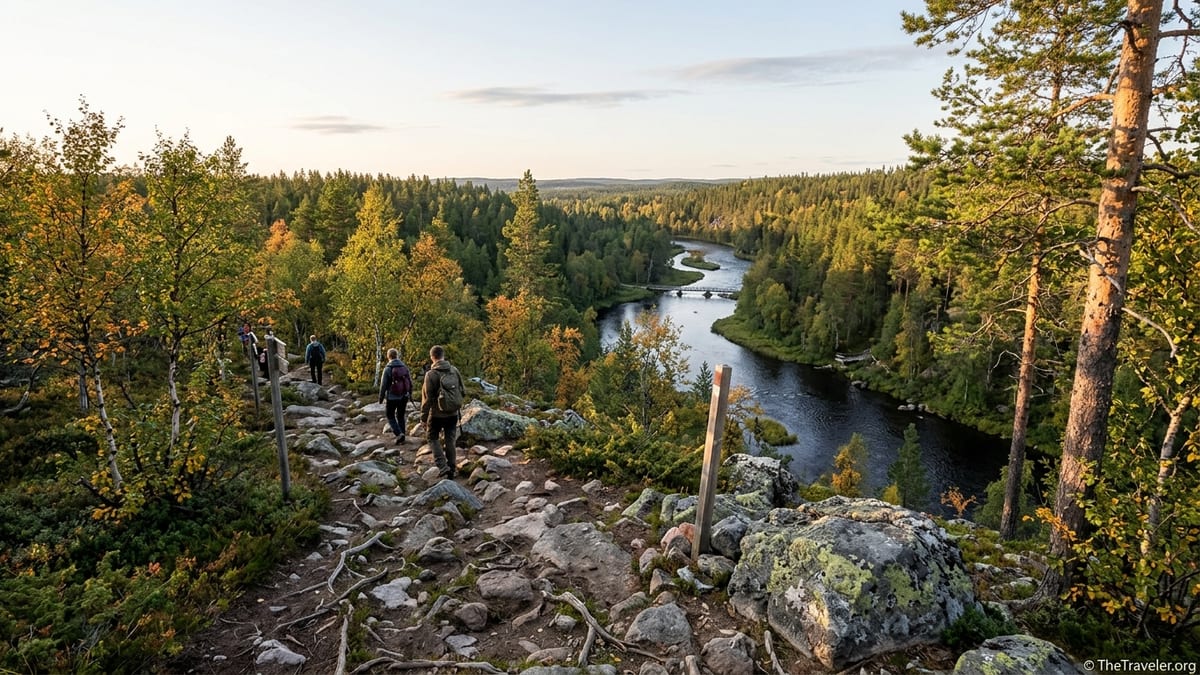
Getting Oriented in Ruka–Kuusamo
Ruka–Kuusamo sits in northeastern Finland, not far from the Russian border, in a landscape of low fells, dense boreal forest and clear, tannin-stained rivers. Kuusamo town is the administrative and service hub, while Ruka is the purpose-built resort village about 25 kilometres to the north. Most visitors fly directly into Kuusamo Airport from Helsinki and reach Ruka in about 25 to 30 minutes by shuttle or taxi, which makes it feasible to arrive on a morning flight and be on the trail or slopes before lunch.
The region brands itself as a land of national parks and that is not just marketing. Oulanka National Park lies practically on Ruka’s doorstep, with its famous canyons and the Karhunkierros trail system. To the east and south you have Russia’s border forests, while to the north the terrain gradually rises toward Lapland. In practical terms, you can stay in one accommodation base in Ruka or Kuusamo and still access long-distance hikes, gentle day trails, whitewater rafting sections and family-friendly ski runs without long transfers.
Orientation is straightforward. Ruka has a compact pedestrian village with hotels, self-catering apartments, supermarkets, gear rental shops and the main lifts. Kuusamo has larger supermarkets, a wider choice of budget accommodation and local services like outdoor outfitters, health care and banks. Visitors who plan to rely on buses and shuttles often prefer to base themselves right in Ruka village, while those with a rental car sometimes split their stay between Kuusamo town and a cabin near Oulanka or Lake Kitka.
English is widely spoken in accommodation, visitor centres and activity companies, and trail information is usually available in Finnish and English. Signage to major attractions like Oulanka National Park, the Pieni Karhunkierros loop and Ruka’s main chairlifts is generally clear, though it is worth downloading offline maps before you arrive because mobile coverage can be patchy on remoter sections of long-distance trails.
Signature Trails: Karhunkierros and Pieni Karhunkierros
The single most famous route in the area is Karhunkierros, often translated as the Bear’s Trail. This long-distance hike runs roughly 80 to 82 kilometres from Hautajärvi in the north to Ruka in the south, threading its way through Oulanka National Park’s river valleys, suspension bridges and forested ridges. It has been waymarked since the 1950s and today attracts around fifteen thousand hikers each year in the main season from mid-July to late September, when the ground is usually snow free and river levels are manageable.
For most visitors, the Bear’s Trail means a four to six day point to point trek, overnighting in a mix of simple wilderness huts, lean-to shelters and paid campsites. Distances between common stages vary from about 10 to 20 kilometres a day, and although the highest point is only around 470 metres above sea level, the constant small climbs and descents on roots and boardwalks can make it feel surprisingly physical. Wild camping is restricted inside Oulanka National Park, so careful stage planning and familiarity with hut etiquette are essential. Many hikers book a shuttle from Ruka to the northern trailhead in Hautajärvi and then walk back south to finish at the resort.
If you want a taste of Karhunkierros without committing to a full multi-day trek, Pieni Karhunkierros, or Little Bear’s Trail, is the classic day hike. This 12 kilometre loop begins at Juuma, about 50 kilometres from Ruka by road, and packs in many of Oulanka’s greatest hits in a single outing: multiple suspension bridges over churning rapids, steep wooden staircases, river bends framed by cliffs, and several well-maintained fire pits and rest spots. Fit hikers can complete the loop in four to five hours, but many visitors allow a full day to stop at scenic points such as the Myllykoski and Jyrävä rapids.
Other marked routes within Oulanka include shorter nature trails such as the Kiutaköngäs day trail near the Oulanka Visitor Centre and the Keroharju and Rytisuo paths across open mires and old-growth forest. These routes are well signposted and make good options when weather is unstable or you are travelling with less experienced walkers. Rental companies in Ruka and Kuusamo often include Oulanka transfers in guided day-hike packages, which can be useful if you prefer not to drive gravel roads or navigate local bus timetables.
Ruka as a Year-Round Outdoor Resort
Ruka is best known internationally as a ski resort, but it now operates very much as an all-season base. Modern snowmaking and snow farming techniques mean that at least some slopes usually open in October, with the main ski season stretching through April and often into early May, depending on temperatures. The resort typically offers more than 30 groomed slopes and has a reputation among snowboarders for dedicated terrain parks and well-shaped jumps during winter competitions and training camps.
Once the snow melts, Ruka transforms into a compact hiking and biking hub. The wider Ruka–Kuusamo area is promoted as having around 160 kilometres of hiking paths, over 600 kilometres of marked cycling routes, and roughly 350 kilometres of paddling routes on surrounding rivers and lakes. In practice, that means you can ride a lift up to the fell top in the morning, hike an easy signed route like the popular 6 kilometre Kanjonin Kurkkaus canyon loop after lunch, and finish the day with a sauna and dinner in the village without ever needing a car.
Summer 2026 programming in Ruka emphasises guided outdoor activities. The resort advertises a weekly activity schedule from early June through the end of September, with daily options that might include guided hikes on Pieni Karhunkierros, evening canoe trips on calm stretches of river, or family-focused mountain bike rides on flowy forest trails. These organised outings often include transport from the village, a local guide, and basic gear such as helmets, life vests or snowshoes in shoulder seasons, which can be good value if you are travelling light.
Accommodation at Ruka ranges from modern slopeside hotel rooms and full-service spa hotels to self-catering apartments and private log cabins with wood-fired saunas. In winter, many visitors choose ski-in ski-out apartments right by the main lifts, while summer guests sometimes prefer quieter cabins slightly outside the village, near lake shores or trailheads. Prices vary widely with season; midweek stays in May or early June can be significantly cheaper than peak February ski weeks or the autumn foliage period in late September.
Seasonal Highlights: When to Visit
Ruka–Kuusamo is genuinely multi-season, and the right time to visit depends heavily on what you want to do. For hikers, the main season for longer trails like Karhunkierros runs from roughly mid-June to late September. Early June can still see lingering snow patches, very wet sections and cold nights, while by mid-July most boardwalks and muddy spots have dried out and daylight hours are extremely long. August brings slightly cooler temperatures and a bit more chance of rain, while mid to late September is prized for autumn colours, with birch forests turning bright yellow and orange.
Winter typically starts in earnest around November, with reliable snow cover on cross-country and downhill ski trails from late November through March most years. December brings short days and the possibility of polar night gloom, but also a strong chance of seeing the northern lights on clear evenings. Many families aim for February sports holidays, when temperatures are cold but relatively stable and daylight has noticeably increased, though accommodation prices are correspondingly high. Late March and early April can be a sweet spot with softer temperatures, strong snow coverage and long sunny afternoons on the slopes.
Spring and late autumn are the true shoulder seasons. April and early May are still suitable for cross-country skiing at higher elevations, but many hiking trails remain partially snow covered or icy, especially in shaded valleys. In late October and early November, many lifts and services close temporarily for maintenance between summer and winter seasons. If you are planning a trip in these fringe periods, it is wise to check directly with accommodation providers and the Ruka tourist information office about which trails, lifts and activities are operating.
One seasonal factor worth planning around is insects. From late June into July, mosquitoes and blackflies can be abundant in forest and wetland areas, particularly in calm, warm weather. Local pharmacies and supermarkets sell effective repellents, and many hikers swear by lightweight head nets for evenings at camp. By late August, insect numbers usually drop sharply, making that month and September attractive for longer hikes if cooler temperatures are not a concern.
Practical Trail Information and Safety
Trails in the Ruka–Kuusamo area are generally well marked, but conditions can vary with weather and season. Long-distance routes like Karhunkierros use coloured paint blazes on trees and rocks, supplemented by signposts at junctions. On shorter nature trails and day loops you will often find duckboard sections across boggy ground and wooden staircases on steep slopes. In wet weather, these structures can become slippery, so footwear with good traction is essential even for short walks to popular viewpoints.
Many visitors underestimate the physical demand of Finnish trails because the absolute elevations seem modest. In reality, repeated small ascents and descents on uneven, rooty paths can be tiring, especially when carrying overnight gear. A typical day stage of 15 to 20 kilometres on Karhunkierros might take six to eight hours of steady hiking with breaks. Water is usually available from streams and rivers, but it is sensible to treat or filter it, particularly in areas close to huts and campgrounds.
Weather shifts quickly near the Arctic Circle, and you should be prepared for rapid changes even in midsummer. It is common to start a day of hiking in short sleeves and end it in a thermal layer and shell jacket due to sudden wind and rain. In June and July, temperatures can hit the low twenties Celsius in the afternoon but drop close to freezing at night in exposed valleys. In winter, cold snaps can take temperatures below minus 20 degrees Celsius, making appropriate layering, face protection and backup mittens critical.
Rescue and emergency services in Finland are well organised, but response times in remote forest can still be significant. Before setting out, leave your route plan with your accommodation or companions, carry a fully charged phone with a local SIM or roaming enabled, and consider a lightweight power bank for multi-day routes. In winter, stick to marked ski and snowshoe trails unless you have local avalanche and ice knowledge, and always check daily trail and weather updates from local visitor centres or the resort information office.
Beyond Hiking: Biking, Paddling and Wildlife Experiences
While hiking is the headline draw, Ruka–Kuusamo also offers extensive networks for cycling and paddling. Mountain bikers can explore several graded routes around Ruka, including purpose-signed trails that climb to the fell top and loop through surrounding forests. Recent local maps list more than 600 kilometres of cycling routes in the wider area, from family-friendly gravel paths near Kuusamo to more technical singletrack near the resort. In summer, lifts often carry bikes, making it possible to focus energy on descents rather than long uphill slogs.
Paddlers are drawn to the clear waters of Oulankajoki and Kitkajoki rivers and to Lake Kitka. Sections of these rivers are graded for whitewater boating, and commercial operators based in Ruka and Kuusamo run guided rafting trips from about late May to early October, depending on water levels. Typical half-day excursions tackle Class II and III rapids suitable for adventurous first-timers, while more demanding stretches are reserved for experienced paddlers. Many families opt for gentle scenic floats that combine wildlife watching with shore-side campfire coffee and grilled sausages.
Wildlife and nature experiences are another highlight. Oulanka’s mix of river canyons, mires and old-growth forest supports rare plants, numerous bird species and large mammals such as elk, bears, lynx and wolverine. Sightings of large predators are rare on busy trails, but patient visitors on quieter routes might see Siberian jays, capercaillie or fresh tracks in soft ground. In late summer and early autumn, berry picking is a popular pastime; under Finland’s everyman’s rights, visitors are typically allowed to collect berries and mushrooms for personal use outside strictly protected zones, though you should always confirm local rules inside national parks.
In winter, activity menus expand to include snowmobile safaris, reindeer farm visits, husky sledding and northern lights tours. Operators often bundle these into half-day or full-day packages with pick-up from hotels and apartments in Ruka or Kuusamo. Prices for such excursions can be significant by European standards, but many travellers find them a worthwhile splurge, especially for first-time Arctic visitors who want to experience more than just skiing or snowboarding.
Visitor Services, Costs and Logistics
Visitor infrastructure in Ruka–Kuusamo is well developed by Nordic standards. Oulanka National Park has at least one main visitor centre with exhibitions and updated information on trail conditions, recommended routes and seasonal safety advice. Staff can often suggest route variations based on your fitness and time window and clarify rules on camping, fires and dog access. In Ruka village, an information office and several activity companies provide printed summer and winter trail maps, which are worth picking up even if you are also using digital navigation.
Costs in northern Finland can feel high compared with southern Europe, but careful planning helps manage budgets. As a rough guide, a mid-range hotel room in Ruka in summer might cost somewhere in the low to mid hundreds of euros per night, while self-catering apartments can be more economical for small groups. Eating out in the resort usually ranges from casual pizza and burger places to bistro-style restaurants serving local fish and reindeer, with main courses often priced at levels similar to other Nordic ski destinations. Supermarkets in both Ruka and Kuusamo stock all the basics for self-catering hikers, including dehydrated meals, bread, cheese, snacks and gas canisters.
Public transport is more limited than in central Europe, but still workable. Seasonal ski buses and summer hiking shuttles connect key points like Ruka, Kuusamo, the airport and popular trailheads, especially during peak weeks in winter and high summer. Timetables change from season to season, so it is prudent to confirm departure times close to your travel dates. Renting a car at Kuusamo Airport gives the most flexibility, particularly if you plan to visit several national park trailheads or stay in remote cabins along gravel roads.
Gear rental options are extensive in Ruka, with shops offering downhill and cross-country skis, snowboards, snowshoes, fat bikes and sometimes camping equipment. Prices are generally in line with other European resorts. If you intend to hike Karhunkierros or other multi-day routes, bringing your own well-fitted backpack, boots and sleeping bag is wise, while renting supplementary items like trekking poles or camping stoves locally can reduce luggage weight.
The Takeaway
Ruka–Kuusamo brings together the best of Finnish outdoor culture in a compact, accessible package. It offers serious long-distance trails like Karhunkierros for committed trekkers, iconic day hikes such as Pieni Karhunkierros for casual walkers, and a modern resort base with reliable winter snow, developed bike routes and abundant guided activities. Oulanka National Park adds genuine wilderness feel without requiring expedition-level logistics, while Kuusamo town provides everyday services and easy air access.
Whether you come for a four-day hut-to-hut hike, a week of skiing and northern lights chasing, or a summer family holiday mixing rafting, canyon walks and lakeside sauna evenings, the region rewards slow exploration. With a little planning around seasons, trail conditions and transport, Ruka–Kuusamo can be both a first introduction to Nordic nature and a destination worth returning to as your skills and ambitions grow.
FAQ
Q1. How difficult is the Karhunkierros trail for first-time long-distance hikers?
The full Karhunkierros is physically demanding due to its length and uneven terrain, but not technically difficult. Fit beginners with good preparation, appropriate gear and a realistic daily distance plan can complete it. Many people start with shorter sections or Pieni Karhunkierros to test their comfort level.
Q2. Do I need to book huts in advance along Karhunkierros?
Simple open wilderness huts along the trail typically operate on a first-come, first-served basis, while some reservable cabins and commercial campgrounds may require advance booking. In peak season from mid-July to late August, starting your days early and having a backup tent or tarp increases flexibility if huts are busy.
Q3. When is the best time to hike Pieni Karhunkierros?
The Little Bear’s Trail is usually best from late June to late September, when most snow has melted and boardwalks have dried. Autumn foliage in September is particularly beautiful. Early season visitors should be prepared for wet sections and possibly high water near rapids.
Q4. Can I visit Ruka–Kuusamo without renting a car?
Yes, many visitors rely on airport shuttles, seasonal buses and guided tours. Staying in Ruka village places you within walking distance of lifts, shops and several trailheads, and organised tours often include transport to more remote starting points. A car, however, offers more freedom for exploring quieter trailheads and lakes.
Q5. Is Ruka suitable for beginners and families in winter?
Ruka has a good mix of gentle blue slopes, children’s areas and ski schools, making it suitable for first-timers and families. Short cross-country loops near the village and easy snowshoe trails provide alternatives for non-skiers. Many accommodations offer family rooms or apartments with kitchenettes and saunas.
Q6. How cold does it get in Ruka–Kuusamo in winter?
Winter temperatures typically range from a few degrees below freezing to well below minus ten degrees Celsius, with occasional colder snaps. Proper layered clothing, insulated boots, hats and mittens are essential, especially for young children or those joining slower-paced activities like northern lights watching.
Q7. Are there good options for vegetarian or special diets?
Most larger hotels and restaurants in Ruka and Kuusamo offer at least one vegetarian option, and some can cater to vegan or gluten-free diets if informed in advance. Supermarkets stock plant-based milks, basic meat substitutes and gluten-free products, making self-catering relatively straightforward.
Q8. Can I see the northern lights from Ruka?
Yes, the Ruka–Kuusamo area lies far enough north for regular aurora displays between roughly September and March, weather permitting. Clear, dark nights away from strong artificial lights give the best chances. Many visitors simply walk a short distance out of the village or join guided aurora tours for expert guidance.
Q9. Is it safe to encounter wildlife such as bears on the trails?
Large predators like bears and lynx are present in the wider region but are usually very shy and avoid people. Encounters on busy marked trails are rare. Basic precautions include storing food securely, keeping dogs on a leash where required and making normal hiking noise so animals are aware of your presence.
Q10. What should I budget for a week-long trip to Ruka–Kuusamo?
Budgets vary widely, but visitors often find that accommodation, meals out and guided activities are priced similarly to other Nordic destinations. A moderate plan might combine self-catered breakfasts and some dinners, mid-range lodging, a couple of guided excursions and several self-guided hikes using public trails to balance cost and experience.