


More news on this day
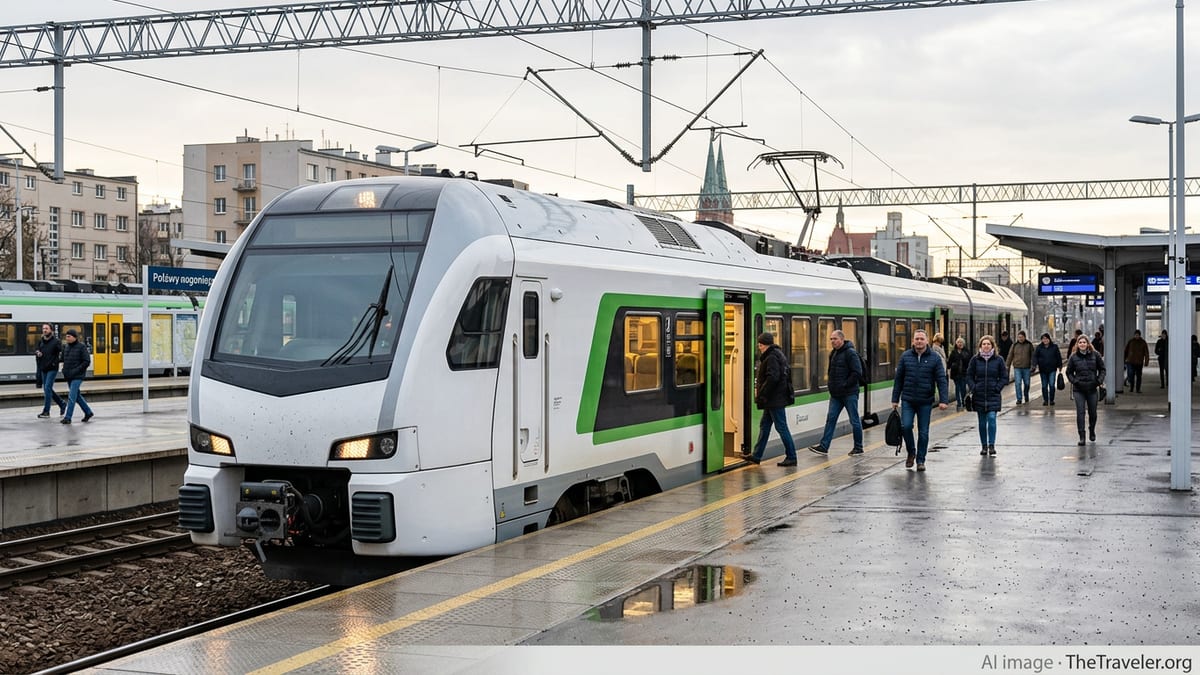
Regional rail services in Poland’s Mazovia region are being reshaped in 2026 as Stadler’s latest-generation FLIRT electric multiple units reach critical mass, with 35 trains now delivered to Koleje Mazowieckie under the operator’s ongoing fleet renewal programme.
Get the latest news straight to your inbox!
Rapid rollout within a major fleet renewal programme
Publicly available information shows that Stadler’s deliveries to Koleje Mazowieckie are part of a multi-year investment that has made Mazovia one of the most modern regional rail markets in Central Europe. Earlier contracts between 2020 and 2023 brought 61 FLIRT units into service, and framework agreements signed in 2024 and 2025 added 75 more trains to be produced at Stadler’s Polish plant in Siedlce. The current milestone of 35 units delivered marks a rapid ramp-up of the latest batch.
Reports indicate that the newest trains belong to the ER160 series, a five-car configuration tailored for regional and suburban services around Warsaw and across the wider Mazovia voivodeship. They are being introduced gradually as they complete mandatory approvals and supervised test operations, then transition into full commercial service on key commuter and interregional routes.
The pace of delivery in 2026 is notable. Railway industry coverage points out that more than 50 of the 75 new trains are scheduled to arrive within this calendar year alone. With 35 already handed over, over half of the order for this phase is either operating with passengers or preparing to enter service, reinforcing the scale and urgency of Mazovia’s rail modernisation push.
According to published coverage, the latest roll-in of trains follows initial handovers in early May, when the first group of units completed monitored passenger test runs. Since then, successive delivery batches have quickly increased the available fleet, allowing the operator to retire older rolling stock and strengthen high-demand services.
What the new FLIRT trains bring to Mazovia’s passengers
The new FLIRT units are designed to deliver a visibly higher standard of comfort and accessibility for daily commuters and leisure travellers in Mazovia. Passenger-focused features typically include low-floor entrance areas, wide doors to accelerate boarding and alighting, step-free access between coaches, and multi-purpose spaces for wheelchairs, bicycles, and prams, helping the trains better serve diverse user needs.
Interior layouts emphasise bright, open saloons, air conditioning, and modern passenger information systems. On-board displays, audio announcements, and clear signage are intended to improve wayfinding across a network that serves both dense suburban corridors around Warsaw and longer regional routes that reach smaller towns. Such improvements can be particularly significant for occasional travellers and visitors who rely on visual guidance.
Reports from recent launches in Mazovia point to a focus on safety and security, with surveillance systems, wide inter-car gangways, and improved lighting. The low-noise, smooth-acceleration characteristics of modern EMUs such as the FLIRT platform also contribute to a more pleasant travel experience compared with older locomotive-hauled or legacy electric stock.
For daily commuters, the combination of higher capacity, faster boarding, and improved reliability can translate into shorter journey times and less crowding at peak hours. The arrival of 35 units already allows Koleje Mazowieckie to strengthen its most heavily used corridors and to operate longer or more frequent trains where demand is strongest.
Production in Siedlce and the regional industrial footprint
The 75 trains now in the pipeline for Koleje Mazowieckie are being built at Stadler’s facility in Siedlce, in eastern Poland. This plant has become a central hub for the production of FLIRT units for the Polish market and for export, reflecting a broader trend in which international rolling stock manufacturers base significant manufacturing capacity in Central Europe.
Public statements from the manufacturer highlight the importance of close cooperation with the operator to maintain a high production and delivery tempo. The current milestone, with 35 trains already handed over, demonstrates that the Siedlce site is capable of sustaining a demanding schedule while completing extensive testing and certification processes required for each unit.
The industrial impact extends beyond the factory itself. Local supply chains, specialist maintenance providers, and training centres all benefit from a large and standardised regional fleet. The long-term partnership between Stadler and Koleje Mazowieckie, which now spans more than a decade, has helped build technical expertise around the FLIRT platform within Poland’s rail sector.
As more of the 75-train order enters service, Siedlce’s role is expected to remain central to after-sales support. The contracts linked to the new fleet include maintenance and repair packages, as well as staff training, which tie the manufacturing phase directly to long-term operation and service quality on Mazovian rails.
Environmental and operational implications for regional rail
The expansion of the FLIRT fleet in Mazovia is also framed as an environmental and operational upgrade for the region’s transport system. The new EMUs are designed for efficient acceleration and braking, regenerative energy use, and compatibility with modern signalling and traction systems, factors that collectively reduce energy consumption per passenger-kilometre compared with the older vehicles they replace.
For an area dominated by commuting flows into and around Warsaw, higher-performing electric multiple units can support timetable improvements and more reliable operations. Faster acceleration allows for tighter schedules with more stops, making it easier to offer both frequent suburban services and competitive journey times on longer regional routes that connect secondary cities and towns.
Published analyses of rail modernisation in Central Europe often highlight the role of high-quality regional trains in shifting passengers from cars to public transport. In Mazovia, the deployment of 35 newly delivered FLIRT units, with more to follow, contributes directly to this shift by increasing capacity, improving comfort, and raising the perceived quality of rail as a daily mobility option.
The programme also supports broader goals around reducing congestion and emissions in and around Warsaw. As the new EMUs take over more diagrams from older stock, the combination of better performance and lower life-cycle operating costs can help sustain an expanded timetable without proportionally higher operating budgets, strengthening the overall attractiveness of rail travel in the region.
What comes next as deliveries continue
With 35 of the 75 new FLIRT trains already delivered, the focus now turns to how quickly they can be integrated into regular service patterns and how subsequent units will be deployed. Industry reports on the delivery schedule suggest that the remaining trains are expected to arrive in several batches through the rest of 2026, bringing the latest order close to completion within a relatively short timeframe.
Each new batch creates opportunities for Koleje Mazowieckie to expand modern rolling stock onto additional lines, potentially replacing some of the oldest units still in service and reinforcing routes beyond the busiest radial corridors. As the share of FLIRT units in the fleet grows, the operator gains more flexibility to standardise maintenance, training, and operations around a single platform.
For passengers, the most visible changes will remain practical ones: more consistent interiors regardless of route, improved accessibility, reliable air conditioning during summer peaks, and clearer information systems. As the modern fleet becomes the norm rather than the exception, expectations for regional rail in Mazovia are likely to rise accordingly.
Looking ahead, the completion of the 75-unit delivery cycle and the absorption of 35 already supplied FLIRT EMUs into daily service will stand as a benchmark for similar regional rail modernisation efforts elsewhere in Poland and across Europe. The Mazovian experience illustrates how concentrated investment in a single, modern train family can quickly transform the quality and capacity of a regional network.