


For years, Stockholm Arlanda had a reputation as the underperformer of the Nordic hubs, trailing Copenhagen, Oslo and Helsinki in both passenger numbers and passenger satisfaction. Yet many travelers passing through in 2024 and 2025 report a different story: once you are actually using the airport, Arlanda often feels leaner, quicker and more intuitive than its regional rivals. From a radically reworked Terminal 5 to fast rail links and smarter security, the Swedish capital’s main airport has quietly turned itself into one of the more efficient ways to enter or leave Scandinavia.
Get the latest updates straight to your inbox!
A Compact Hub That Now Works Like One Airport
One of Arlanda’s biggest historical weaknesses was its fragmented terminal system. Domestic flights were mainly in Terminal 4, international in Terminal 5, and smaller carriers in Terminals 2 and 3. That meant awkward terminal changes and duplicated facilities. Over the last few years, Swedavia, the airport operator, has steadily rebuilt this into something closer to a single, integrated hub focused around Terminal 5. Since 2020, Terminal 5 has handled both domestic and international traffic, and in late 2025 all check in, baggage handling and security for Terminal 4 were finally moved into Terminal 5 as well. This consolidation means that a large proportion of passengers now experience Arlanda as one main building rather than a scattered campus.
In practice, this makes connections at Arlanda feel faster than at some other Nordic airports of similar size. Instead of exiting one terminal and reentering another, domestic to international transfers often happen entirely airside within Terminal 5. If you arrive from Gothenburg on SAS and continue to London or Berlin, you are usually just following the same concourse, perhaps up or down one level, rather than riding a shuttle train or walking through an outdoor corridor in winter. Compared with Helsinki Vantaa, where some long-haul and Schengen gates are still quite far apart, or Oslo Gardermoen, where domestic and international piers branch in different directions, Arlanda’s current layout can feel surprisingly compact for a capital-city airport.
That compactness also helps on arrival. Many passengers now disembark, walk through a short corridor to passport control or the baggage hall in Terminal 5, and find themselves just a few minutes from rail platforms and buses. The old experience of arriving in Terminal 4, then having to hunt for exits and long outdoor walks to the right bus stop, is being phased out. A more concentrated footprint means less wayfinding confusion, particularly for first time visitors connecting between domestic Sweden and Europe or for families juggling kids and carry ons during tight layovers.
Arlanda is still smaller than Copenhagen in absolute passenger numbers, and it lacks the vast pier systems of the Danish hub. Yet for many travelers that is precisely why it can feel efficient. There are fewer ultra long corridors, and walking distances inside Terminal 5 are generally manageable even for 45 to 60 minute connections when flights are on time.
Next-Generation Security That Fixes Old Pain Points
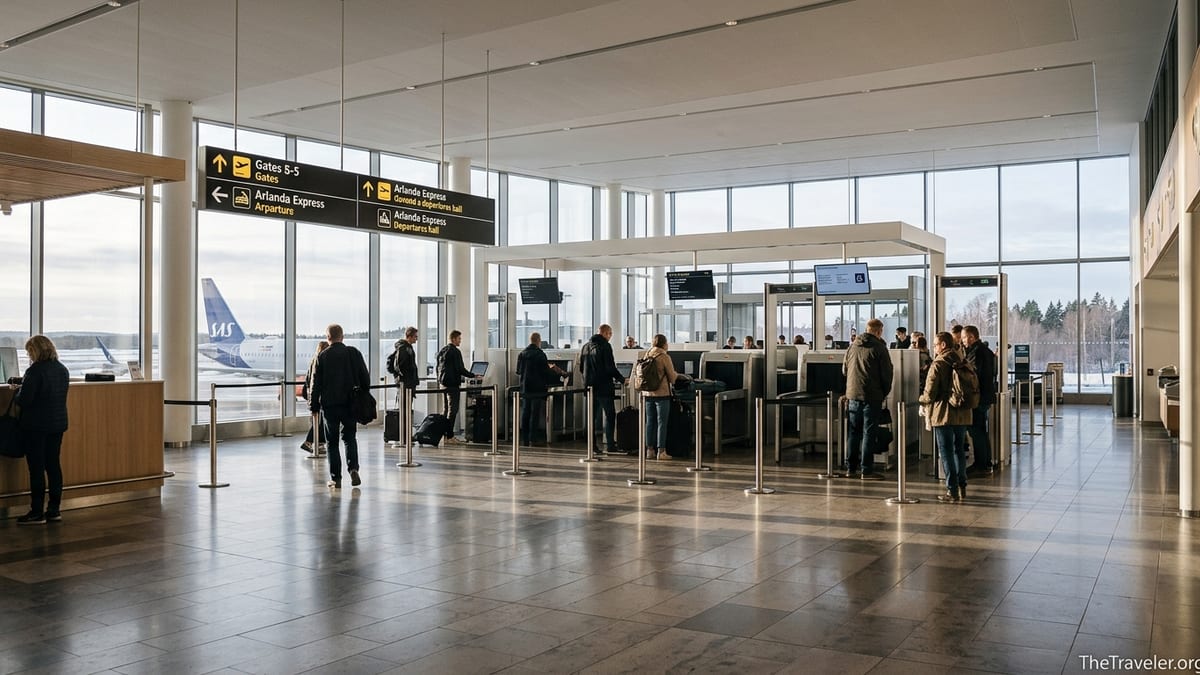
Perhaps the single most visible upgrade at Stockholm Arlanda is the new security hall in Terminal 5, opened in the summer of 2023 as part of the long running Project Porten redevelopment. This is not just a cosmetic refresh. The hall uses larger, more advanced security scanners and reconfigured lanes that allow trays and passengers to move at their own pace instead of being locked into a single linear belt. The result is an experience that, on a normal day, feels more like an orderly self-service process than an anxious bottleneck.
A key practical difference is liquid and electronics handling. At the new Terminal 5 security, many passengers can now keep laptops, tablets and 100 millilitre liquid bags in their hand luggage thanks to new scanner technology, instead of unpacking half their belongings into separate trays. For a business traveler carrying two laptops, a tablet and a phone, this can save several minutes and reduce the chance of leaving something behind at the belt. This contrasts with parts of Copenhagen and Oslo, where traditional tray procedures still dominate in some lanes, and where liquids and electronics still need to come out for inspection more often.
Space also matters. The new security hall is housed in a 330 metre long enclosed volume built in front of the existing terminal, with high ceilings and wide queuing areas. In older photos of Arlanda from 2022, lines used to snake through low-ceilinged corridors, leading to headlines about long waits and staffing problems. Today, most passengers entering Terminal 5 walk directly into a bright central check in and security area where queues are more clearly organised, with room to reroute passengers during peaks. On a typical weekday morning, waits at the main security checkpoint can be under 15 minutes even during the main rush, according to both the official airport app and recent traveler reports.
The airport also continues to operate Fast Track security lanes for premium airlines and some cardholders, which can be a lifesaver on school holiday days when Scandinavian airports traditionally see spikes in outbound traffic. While similar priority lanes exist at Copenhagen, Oslo and Helsinki, the combination of newer technology, smarter queuing and better real time information at Arlanda has significantly closed the gap with its neighbours and in many cases made the Stockholm experience feel smoother.
Smarter Passenger Flows and the “Marketplace” Concept
Beyond security, Project Porten has reimagined how passengers move through Terminal 5. After you clear security, you now emerge into an expanded marketplace area filled with shops, cafes and seating zones. The design is intentionally open and linear, allowing passengers to see a long way down the concourse and orient themselves quickly. Gate clusters branch off from this spine, meaning that you can usually spot the direction of your gate early, even if boarding is still an hour away.
Some travellers have been critical of having to pass retail on the way to the gates, a design feature shared with many modern airports. Yet Arlanda’s version of this does address several practical issues that plagued the older layout. For one thing, there are more seats and clearer sightlines. If you are travelling with children, it is easier to let them explore a nearby play area while keeping visual contact. Power outlets are more frequent, so business travellers or digital nomads are no longer forced to camp in one or two crowded corners near outdated sockets.
Importantly, the new marketplace design has also freed up space landside for check in and bag drop. Moving some commercial functions airside allowed Swedavia to expand lobby areas in front of security, which helps prevent the kind of chaotic crush once seen at peak times. When you arrive at Terminal 5 now, you are more likely to find a straightforward sequence: entrance, self service check in or staffed counter, bag drop, then directly into the security hall. The psychological effect is significant: with fewer tight chokepoints and clear lines of sight, Arlanda feels less stressful than some of its Nordic peers, where older terminal designs still force people through narrower corridors or unexpected level changes.
There is also a subtle operational benefit. Because domestic and international passengers share much of the same marketplace and concourse, airlines and airport managers can flexibly adjust staffing and queue layouts depending on where the peaks are. On a Monday morning with heavy business traffic to Gothenburg and Malmö, domestic gates can be prioritised. On Friday afternoons when leisure travellers are heading to southern Europe, the same central infrastructure can redirect capacity toward those flows without reopening or closing entire halls.
Ground Transport That Reduces Total Journey Time
Efficiency is not only about what happens from check in to boarding. For most travellers, the airport experience begins the moment they leave the city. Here, Arlanda’s rail and bus connections play a major role in why the overall journey can feel smoother than at several other Nordic airports, even if those airports are technically closer to their city centres.
The flagship link is the Arlanda Express, a dedicated high speed train that runs directly from Stockholm Central Station to the airport in about 18 minutes. Trains typically depart every 15 minutes during the day. The onboard experience is simple: step free boarding, wide luggage racks and free Wi Fi. For a solo business traveller heading to a 07:00 flight, this can be a near frictionless commute. You roll your suitcase from a downtown hotel to Stockholm Central, board the train with no ticket barriers on the platform, and step off underneath the airport at Arlanda North or Arlanda South with a short escalator ride up into the terminal.
Other options fill in the gaps. Regional and commuter trains link Arlanda with Uppsala and the wider Stockholm region, while dedicated airport buses connect major city districts and nearby towns. Within the airport perimeter, passengers can travel free of charge on certain buses and the Arlanda Express between terminal areas, which simplifies transfers between Terminals 2, 3 and 5. By connecting directly into Sweden’s main rail network, Arlanda allows travellers from cities such as Uppsala, Västerås or even Sundsvall to reach their departing flight without navigating a separate metro system or long highway transfers.
Compared with Oslo Gardermoen or Copenhagen Kastrup, which also benefit from strong rail links, Arlanda’s advantage lies partly in its simplicity. There is essentially one dominant fast train option to Stockholm Central, and it is clearly branded and signposted. At Copenhagen, travellers face a split between regional trains and the city metro underneath the terminal, which can be confusing at rush hour if you do not know which line serves your hotel or meeting. At Helsinki Vantaa, the circular rail line is efficient but takes closer to 30 minutes into the centre and requires attention to make sure you are on the correct branch.
Arlanda is not the cheapest airport to reach. A one way adult ticket on the Arlanda Express is a premium-priced purchase by European standards, though frequent promotions and advance booking discounts can soften the blow. However, when you factor in time saved and the reduced variability of rail travel in winter weather, many travellers find that the overall door to gate experience at Arlanda feels more efficient than a comparable taxi or bus based transfer at other Nordic airports.
Digital Tools and Real-Time Information
Another reason Stockholm Arlanda can feel efficient is the way it communicates with passengers. Swedavia’s official app and airport information screens now provide real time indicators of security wait times by checkpoint, updated throughout the day. This allows travellers to adjust their plans in a way that was simply not possible a few years ago during the well publicised queue crises of 2022.
If the app shows a 5 to 10 minute wait at Terminal 5 security, a frequent flyer may choose to arrive 90 minutes before departure instead of the two and a half hours they would budget at a less predictable airport. Conversely, when the app flags longer waits during school holidays or major events, passengers can see that in advance and adjust accordingly. This transparency reduces stress and makes the airport feel more trustworthy, even when things are busy.
Digitalisation also extends to check in and boarding. Most airlines at Arlanda now support full online check in and mobile boarding passes, with extensive self service kiosk and bag drop facilities in Terminal 5. For example, a SAS passenger on a morning Copenhagen flight can often check a bag at a self service counter within minutes, avoiding a staffed queue entirely. Low-cost carriers operating out of Terminals 2 and 3 are increasingly using automated bag drops as well. While self service is common across Nordic airports, Arlanda’s recent investments have created a mostly consistent, airport-wide experience where the technology and signage feel current rather than patched together.
At the gate, clear digital displays and audible announcements are backed up by a straightforward zone-based boarding process on many carriers. Combined with the relatively compact gate areas in Terminal 5, this can make actual boarding feel less chaotic than at some piers in Copenhagen or Oslo where long corridors, multiple doorways and mixed queues can confuse infrequent travellers.
Comparing Arlanda With Its Nordic Neighbours
No airport is perfect, and it is important to remember that perceptions of efficiency are shaped by personal itineraries and timing. Copenhagen Kastrup remains the largest and most globally connected Nordic hub, with a wide choice of long haul destinations and a generally well regarded transfer experience. Oslo Gardermoen is praised for its light filled architecture and coherent terminal design, and Helsinki Vantaa is repeatedly recognised for its smooth connections between Europe and Asia.
Yet when you look at specific, real world experiences, it is easy to see why many travellers now describe Arlanda as feeling more streamlined than they expected. A domestic to European connection that once required a terminal change and fresh security screening can now happen entirely within Terminal 5. The new security hall’s ability to keep liquids and electronics in bags for many passengers cuts down on the fumbling and delays that still slow lines in parts of its Nordic peers. The Arlanda Express delivers a reliable sub 20 minute link into the city centre, avoiding the maze of options sometimes faced under other airports.
There are, of course, trade offs. Copenhagen has more lounges and a broader range of food and retail, and its long haul network is currently stronger. Oslo and Helsinki both have reputations for calm, airy architecture that some travellers prefer to Arlanda’s quirkier mix of older structures and new glass fronted volumes. But if your main metric is “How likely am I to make my connection and get through the airport without unpleasant surprises?”, Stockholm Arlanda now compares very favourably.
Travelers who used Arlanda before and after the 2023 to 2025 upgrades often note the difference most sharply. The airport that once struggled with fragmented terminals and under-dimensioned security has turned those exact pain points into some of its strengths. In a region where winter storms, early morning business peaks and busy holiday exoduses can quickly expose weak spots, Arlanda’s mix of consolidation, modern technology and strong rail connections now gives it a genuine claim to being one of the more efficient Nordic gateways.
The Takeaway
Stockholm Arlanda’s journey from laggard to quietly efficient performer is still a work in progress, and it continues to trail Copenhagen in overall traffic and long haul connectivity. But in the areas that matter most to everyday travellers check in, security, wayfinding, transfers and the trip to and from the city the Swedish capital’s main airport has made tangible, real world improvements.
The consolidation of domestic and international flights around Terminal 5, the introduction of a spacious high tech security hall, and the continued reliability of the Arlanda Express together create an experience that can feel leaner and more predictable than at several of its Nordic peers. For passengers connecting within Europe or starting and ending their journey in Stockholm, the airport now offers a coherent, relatively low friction path from city to gate.
There will always be days when staffing shortages, weather disruption or simple bad luck create queues and delays. No amount of smart design can eliminate that entirely. But for travellers planning their next trip through Scandinavia, it is worth revisiting assumptions. The airport that once symbolised Sweden’s struggles to keep up has, quietly and pragmatically, become one of the region’s more efficient choices.
FAQ
Q1. Is Stockholm Arlanda really more efficient than Copenhagen Airport?
It depends on what you value. Copenhagen still wins on route network and lounge choice, but Arlanda’s compact Terminal 5, upgraded security and straightforward rail link often make the door to gate experience feel faster and more predictable, especially for point to point and simple connections.
Q2. How early should I arrive at Arlanda before an international flight?
In normal conditions, arriving around two hours before a European departure is usually sufficient if you are checked in online and travelling hand luggage only. During school holidays or busy winter sports weekends, give yourself closer to two and a half to three hours, especially if you need to check a bag.
Q3. Are security lines at Arlanda still as bad as in 2022?
No, most travellers now report significantly improved wait times, particularly at the new Terminal 5 security hall. Short peaks still occur during morning and evening rushes, but with more lanes, better staffing and real time updates in the Swedavia app, the situation is far more controlled than during the well publicised disruption a few years ago.
Q4. Does Arlanda have the new scanners that allow liquids to stay in your bag?
Yes, many lanes in the Terminal 5 security hall use newer scanner technology that allows most passengers to keep liquids and electronics in their hand luggage. However, procedures can vary by lane and day, so you should still be prepared to remove items if instructed by staff.
Q5. How does the Arlanda Express compare to airport trains in other Nordic capitals?
The Arlanda Express is one of the fastest dedicated airport rail links in the region, taking around 18 minutes between Stockholm Central and the airport. It is generally faster but more expensive than the trains serving Oslo Gardermoen, Copenhagen Kastrup or Helsinki Vantaa, where journey times into the city are typically closer to 20 to 30 minutes.
Q6. Is it easy to connect from domestic to international flights at Arlanda?
Yes, especially now that most domestic and international services are concentrated around Terminal 5. Many connections happen entirely airside, with clear signage and reasonable walking distances. For tight layovers, this can feel simpler than at airports where domestic and international operations are separated into different buildings or distant piers.
Q7. What tools can I use to check queues and gate information at Arlanda?
You can use the official Swedavia app or the airport’s departure boards to see real time security waiting times, gate assignments and any last minute changes. The app is particularly useful on busy days, as it allows you to adjust your arrival time or choose the best route through the terminal.
Q8. Are there good options for early morning departures from the city to the airport?
Yes. The Arlanda Express starts running early enough to cover most morning flights, and there are also night and early morning buses from various parts of Stockholm. Taxis and ride hailing services are widely available, and pre booking can help keep costs predictable during peak travel periods.
Q9. Is Arlanda a good choice for tight layovers within Europe?
For many itineraries, yes. If both of your flights use Terminal 5 and you have at least 50 to 60 minutes between scheduled arrival and departure, connections are usually workable when flights are on time. However, if you are changing terminals or switching between separate tickets, you should leave more margin.
Q10. Does Arlanda offer the same level of amenities as other Nordic hubs?
Arlanda’s range of shops, cafes and lounges has improved markedly with the new marketplace in Terminal 5, though Copenhagen still has the broadest selection overall. For most travellers, Arlanda now offers more than enough choice for a meal, a coffee or a last minute purchase without feeling overwhelming or hard to navigate.