


More news on this day
Severe convective storms combined with tightened airspace controls have triggered 106 flight cancellations and 4,116 delays across major airport hubs in Beijing, Shanghai and Shenzhen, causing widespread disruption for domestic and international travelers across China’s busiest aviation corridors.
Get the latest news straight to your inbox!
Weather Systems Collide With Congested Airspace
Publicly available operational data and aviation tracking platforms indicate that an early-summer pattern of intense thunderstorms, heavy rainfall and low cloud ceilings has repeatedly swept across eastern and southern China, affecting the dense flight corridors linking Beijing, Shanghai and the Pearl River Delta. These conditions have significantly reduced runway acceptance rates at key airports and forced longer separation between aircraft, sharply cutting hourly capacity.
Reports from Chinese-language regional outlets describe strong convective cells and so-called Jianghuai cyclones affecting the Yangtze River Delta in late May and into June, bringing rapid-onset downpours and lightning near Shanghai’s dual airports. Similar storm lines have pushed north toward Beijing’s Capital and Daxing airports and south toward Shenzhen, creating a moving band of turbulence and low visibility that has challenged airline schedulers and air traffic managers.
In parallel with the adverse weather, publicly posted notices and industry analyses point to continuing constraints in heavily used sections of Chinese airspace, particularly along coastal routes and near military training zones. When thunderstorms and airspace bottlenecks occur at the same time, airlines are often forced to stack holding patterns, reroute through longer tracks or ground aircraft entirely, amplifying the overall impact on punctuality.
Analysts note that these intertwined factors have manifested acutely in the current disruption episode, with the combined effect of 106 cancellations and 4,116 delays reflecting hours of lost capacity across multiple hubs rather than a localized outage at a single airport.
Beijing, Shanghai and Shenzhen Hubs Absorb the Shock
According to aggregated flight-status snapshots, the brunt of the latest disruption has been concentrated at Beijing’s twin hubs, Shanghai’s Pudong and Hongqiao airports, and Shenzhen Bao’an International Airport. These facilities form the backbone of China’s domestic trunk network and handle some of the country’s highest-density international routes, meaning even modest interruptions can ripple quickly through the system.
Recent coverage from Chinese media highlights how Beijing Capital and Daxing airports have fluctuated between normal operations and high alert in July, with passenger throughput remaining high while storm cells forced periodic reductions in takeoff and landing rates. On peak days, Beijing’s two airports together schedule more than 2,000 movements, leaving limited slack when arrival or departure streams must be slowed for safety reasons.
In the Yangtze River Delta, Shanghai’s role as both an international gateway and a domestic transfer node has left its airports particularly vulnerable to cascading delays. When strong thunderstorms roll through the region, aircraft inbound from northern and southern cities are often held en route, then arrive in compressed waves once conditions improve. This bunching effect can overwhelm terminal gates and apron space, stretching ground resources and pushing knock-on delays late into the evening wave.
Shenzhen, a critical hub for southern China and a bridge to Hong Kong and Southeast Asia, has also reported surges in late arrivals and departure queues as traffic flows are adjusted to accommodate weather deviations and traffic management initiatives further north. The combined disruptions across the three metropolitan areas help explain the unusually high number of delayed flights recorded in a relatively short window.
Air Traffic Management Measures Amplify Delays
Aviation specialists point out that, beyond the weather itself, formal air traffic management programs have played a central role in shaping the current wave of delays and cancellations. When thunderstorm forecasts intersect with peak travel periods, air navigation authorities typically introduce tools such as ground delay programs, flow control restrictions and temporary rerouting in order to maintain safety margins and prevent gridlock in the sky.
Publicly available descriptions of these mechanisms show that a ground delay program limits the rate at which flights can depart for a constrained airport, assigning controlled departure times that may be hours later than originally scheduled. While this approach reduces airborne holding and improves predictability, it effectively spreads the impact of a local storm across dozens of departure cities, increasing the total number of delayed flights recorded systemwide.
In more severe cases, short-term ground stops may be issued, prohibiting departures altogether for specific destinations until the worst of the convective activity subsides. Under such restrictions, airlines often preemptively cancel some services rather than operate them with extremely long delays. The 106 cancellations associated with the latest weather episode appear consistent with this pattern, with carriers selectively trimming frequencies on overlapping routes while attempting to preserve core trunk services.
Capacity constraints in shared airspace segments can further compound these measures. When narrow corridors must handle rerouted traffic away from storm cells or restricted zones, flight plan approval times lengthen and en route spacing increases, contributing to the 4,116 delayed movements attributed to the combination of severe weather and air traffic controls.
Passengers Face Missed Connections and Overnight Disruptions
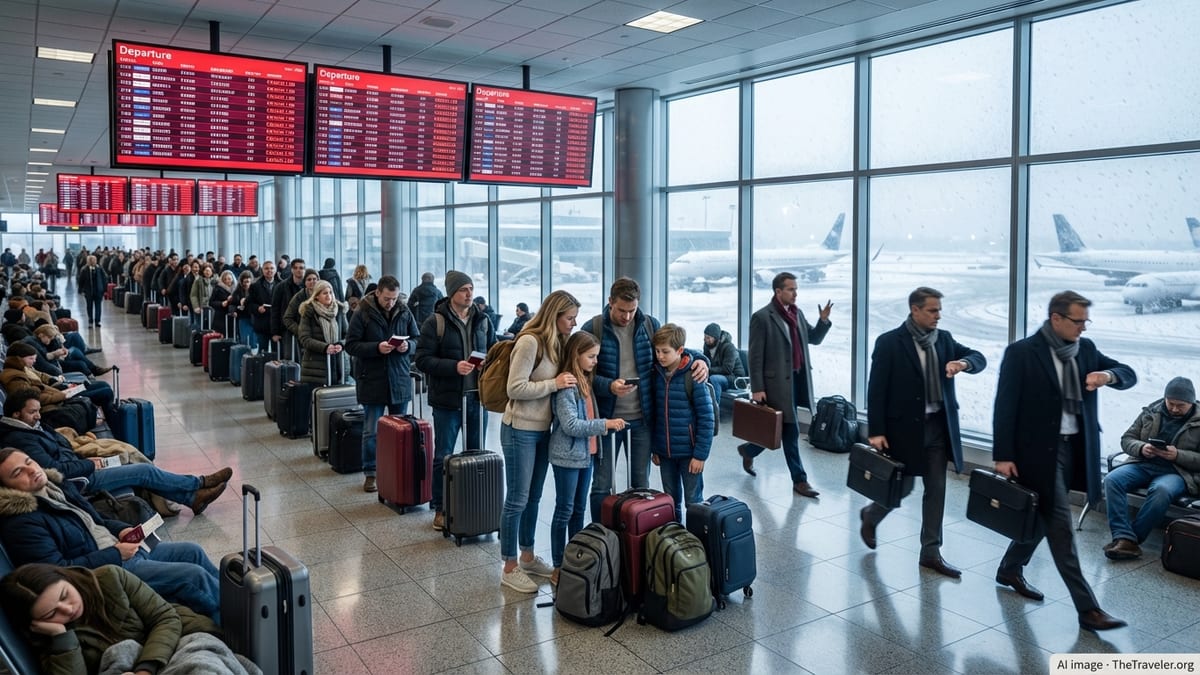
For travelers moving through Beijing, Shanghai and Shenzhen during the disruption period, the operational statistics translate into missed connections, rebooked itineraries and, in some cases, unexpected overnight stays. Social media posts and traveler forums over recent weeks have described abrupt cancellations on both domestic and international routes, with some passengers receiving rebooking offers only after queuing at airport counters or using airline apps late into the night.
Given the high share of connecting traffic at the three hubs, a single delayed inbound flight can cause multiple onward misconnects, particularly for travelers bound for smaller interior cities with limited daily frequencies. When the same weather system affects multiple hubs along a passenger’s route, options to reroute via alternate gateways can be limited, further lengthening total travel times.
Consumer advocates point to long-running complexities around passenger protections in such events. Publicly available guidance from regulators and airlines generally classifies extreme weather and airspace restrictions as conditions beyond a carrier’s control, which can limit obligations around compensation even when travelers experience lengthy delays. At the same time, most airlines operating in China state that they will provide basic care such as hotel accommodation or meal vouchers when disruptions become extensive, though delivery can vary depending on local capacity.
Travel industry observers recommend that passengers transiting Chinese hubs during the summer storm season build longer connection buffers, monitor flight-status tools closely, and be prepared for same-day itinerary changes, particularly when routing through Beijing, Shanghai and Shenzhen on the same trip.
Operational Resilience Under Scrutiny as Summer Peak Builds
The scale of the current disruption has renewed discussion about how well Chinese hubs can absorb compounding shocks as passenger volumes continue to recover. Official statistics released earlier in the year highlighted strong growth at Beijing’s airports and robust throughput at Shanghai and Shenzhen, suggesting that traffic is nearing or surpassing pre-pandemic baselines on some corridors.
Aviation analysts note that this rebound is occurring alongside increasingly volatile summer weather patterns and sustained airspace complexity, leaving airlines and airports with less margin to recover from short, sharp storms. When a thunderstorm cell parks over a key waypoint or an approach path for even an hour, tightly scheduled aircraft rotations can unravel, especially for carriers operating dense wave banks of departures and arrivals.
To counter these risks, industry commentary points to gradual investments in improved forecasting, enhanced air-ground coordination and more flexible scheduling strategies that spread demand more evenly across the day. However, implementing such measures at scale across multiple mega-hubs is a long-term undertaking, and near-term travel seasons are likely to see further episodes where severe weather and traffic management constraints intersect.
For now, the tally of 106 cancellations and 4,116 delays stands as a snapshot of how quickly conditions can deteriorate when storms and constrained airspace converge over some of the world’s busiest domestic aviation markets, and how dependent travelers remain on a tightly choreographed system that can be thrown off balance in a matter of hours.