


More news on this day
Thunderstorms sweeping across major U.S. hubs, combined with already stretched airline operations, have disrupted thousands of flights in recent days, underscoring how fragile the summer air travel system remains under intense demand.
Get the latest news straight to your inbox!
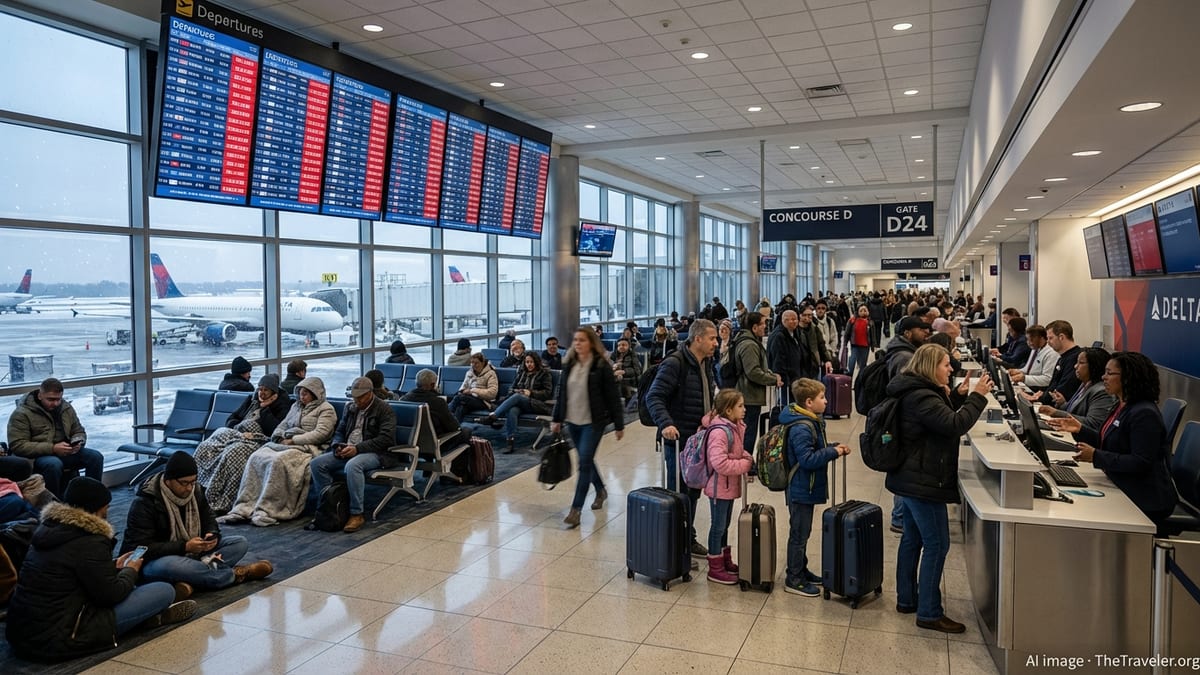
Severe Weather Pounds Key Hubs
A series of storm systems tracking across the South and Midwest into the East Coast has repeatedly forced ground stops, diversions and extended delays at some of the country’s busiest airports. Thunderstorms over the Dallas–Fort Worth region on July 13 and again on July 15 triggered rolling ground holds and congestion that cascaded through airline networks.
Publicly available flight tracking data shows that on July 15 alone, more than 900 flights were delayed across Dallas Fort Worth International Airport and Dallas Love Field as storms stalled departures and slowed arrivals. Earlier in the week, hundreds of additional flights at Dallas Fort Worth were either canceled outright or rescheduled as airlines attempted to work around lightning, low visibility and saturated runways.
Similar conditions around Atlanta at the start of July led to a ground stop at Hartsfield Jackson Atlanta International Airport, the world’s busiest hub by passenger volume. Coverage from local and national outlets indicates that more than 600 flights in and out of Atlanta were delayed within a 24 hour window as intense cells passed over the metropolitan area and arrival rates were sharply reduced.
Weather maps and National Weather Service outlooks suggest that this pattern of slow moving, moisture rich storms has been particularly disruptive to late afternoon and evening departures, when thunderstorm activity typically peaks. Those conditions have placed additional pressure on already full schedules during one of the busiest travel months of the year.
Network Strain Meets Record Passenger Volumes
The timing of these storms has collided with near record passenger volumes. Updated figures from the U.S. Bureau of Transportation Statistics show that U.S. airlines carried roughly 70 million domestic passengers in April 2026, with total traffic, including international and unscheduled operations, estimated at more than 90 million travelers.
Industry and government data point to a system running close to its limits on many peak days. Federal aviation planners have reported that summer traffic has at times approached or exceeded levels seen before the pandemic, with busy Fridays and holiday periods setting multi year highs for total flights handled in U.S. airspace.
When convective weather forces arrival and departure rates to be cut, that traffic density quickly translates into mounting delays. Airlines then face a complex juggling act as they attempt to rotate aircraft and crews through hubs that are operating at significantly reduced capacity, even for a few hours.
Passengers, in turn, experience the ripple effects in the form of missed connections, rolling gate changes and extended time on tarmacs. Social media posts, aviation forums and local news coverage from recent days describe travelers sleeping in terminals, rebooking through alternate hubs and, in some cases, abandoning trips after multiple cancellations.
Operational Pressures Amplify Weather Impacts
While thunderstorms are the immediate trigger for many of the latest disruptions, analysts and regulators have repeatedly highlighted underlying operational pressures that make the system more vulnerable. Testimony and reports released over the past year describe continuing shortages of air traffic controllers in some facilities and tight staffing at several large carriers.
Congestion and staffing constraints limit how much flexibility airlines and the Federal Aviation Administration have when storms appear on radar. When traffic is already high and schedules are dense, there is less spare capacity to reroute aircraft, build buffers into turn times or absorb extended ground holds without creating long chains of subsequent delays.
Recent history shows how non weather events can expose the same structural weaknesses. In July 2024, an outage related to a software update triggered a broad operational disruption at one major U.S. airline, which ultimately canceled more than a thousand flights and took days to normalize its schedule even after the initial technical problem was contained.
Aviation experts note that the combination of lean staffing, tightly optimized schedules and high passenger demand means that any disturbance, whether a line of thunderstorms or a system outage, can lead to large scale knock on effects. The current spate of summer storms is once again testing how quickly carriers can recover once the immediate weather threat passes.
Regional Hotspots and Systemwide Ripple Effects
In recent days, the most acute disruptions have clustered around weather sensitive hubs such as Dallas Fort Worth, Atlanta and airports along the Eastern Seaboard. Radar imagery and airport status dashboards indicate repeated periods when arrival rates into these hubs have been reduced, forcing airlines to hold flights at origin airports or cancel segments altogether.
When a large hub slows down, the impact quickly spreads beyond the immediate region. Aircraft and crews scheduled to operate onward flights from a delayed airport often arrive late or time out under federal duty rules, affecting routes that may be far from the original storm zone. A delay at a major connecting point can therefore cause disruptions for travelers on transcontinental and even international itineraries.
Travel forums and passenger reports from the past week highlight this network effect. Travelers departing from smaller cities on clear days have encountered significant delays because their inbound aircraft were trapped behind weather constraints at one of the major hubs. In some cases, those knock on delays have extended into the next day as airlines work through backlogs.
Operational planners refer to this phenomenon as schedule propagation: once a large enough portion of the daily timetable is pushed off track, it can take multiple rotations and flight cycles to restore normal flow. With load factors high and spare aircraft limited, opportunities to reset the schedule quickly are constrained.
Travelers Adjust as Disruptions Persist
With storms continuing to form over key corridors and forecasts pointing to more unsettled conditions, travelers are increasingly adjusting their plans in anticipation of potential disruptions. Online discussions and consumer travel advice columns in recent days have urged passengers to favor morning departures, build longer connection windows and remain flexible about routings when booking during peak summer weeks.
Some airlines have issued short term weather waivers for specific regions, allowing customers to rebook without change fees ahead of forecast storms. Public advisories emphasize the importance of monitoring flight status frequently, arriving early at airports to account for possible security bottlenecks and preparing for extended waits if schedules unravel.
Industry observers suggest that the current episode is likely to be repeated in various forms throughout the season, given the overlap of convective weather patterns and sustained high demand. For now, the combination of storms and operational strain is serving as a reminder that even routine summer thunderstorms can trigger widespread disruption when the aviation system is operating with little room to spare.