


More news on this day
Air travel across the United States faced another challenging day as 2,615 flights were delayed and 75 cancelled, with disruptions concentrated at major hubs including Chicago, Atlanta, San Francisco, Las Vegas, Boston, and Miami, affecting operations for American and regional partners such as SkyWest, Republic, Endeavor, and Envoy.
Get the latest news straight to your inbox!
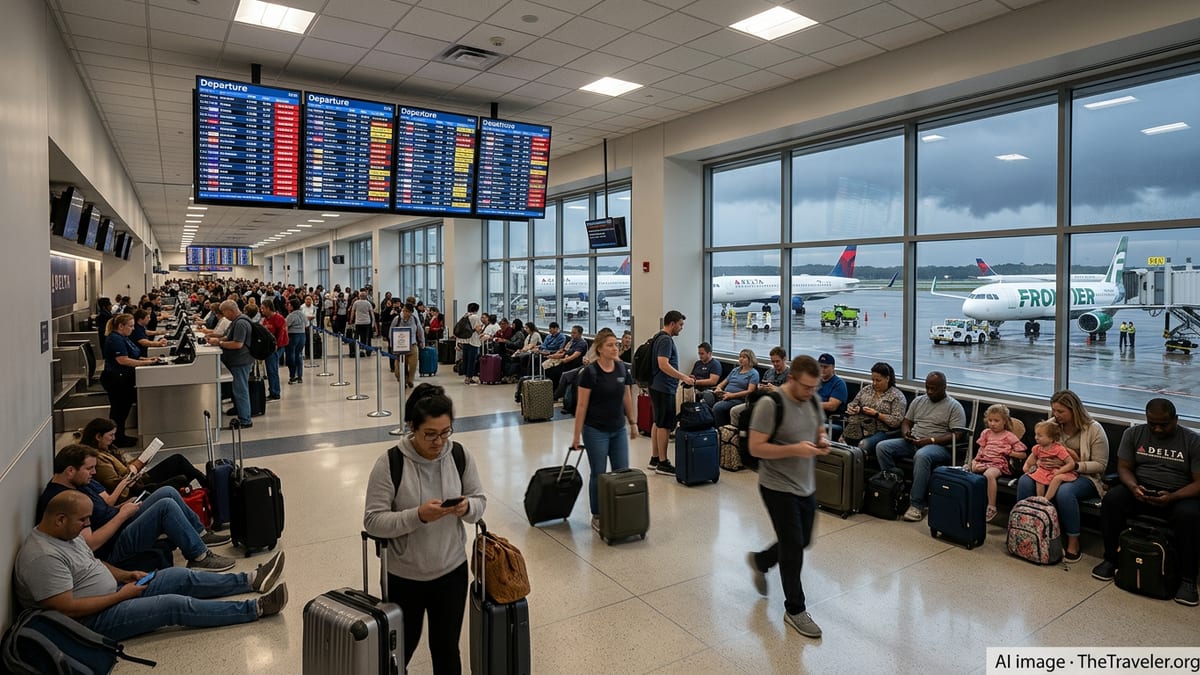
Major Hubs Struggle With Weather and Congestion
Publicly available tracking data for June 25 shows a broad pattern of delays across the national airspace system, with large hub airports again carrying the brunt of operational strain. Chicago, Atlanta, San Francisco, Las Vegas, Boston, and Miami all reported elevated disruption levels as thunderstorms, congested airspace, and traffic management programs combined to slow departures and arrivals.
Federal aviation data and national delay maps indicate that traffic headed into key hubs such as Chicago O’Hare, Atlanta Hartsfield Jackson, San Francisco International, and Las Vegas Harry Reid was subject to departure holds and flow restrictions, contributing to the 2,615 delayed flights logged across the country. While only 75 flights were fully cancelled, the imbalance between delays and cancellations created extended knock-on effects for connection-heavy itineraries.
Airport-level dashboards for Boston, Washington Dulles, Chicago, and other large facilities show hundreds of scheduled departures and arrivals moving through each hub on June 25, leaving tight margins when severe weather or congestion emerges. Even modest slowdowns at one or two major nodes can quickly ripple through the broader network, particularly during peak morning and evening banks.
Data from airport information portals also underscores how interlinked these hubs are. Routes between Boston, Chicago, Atlanta, San Francisco, Las Vegas, and Miami feature prominently across daily departure boards, so delays at one end of the route frequently trigger late turns for aircraft and crews at the other end, extending disruptions over several hours.
Regional Carriers Bear the Brunt for Major Airlines
The disruption has been especially visible among regional carriers that operate flights on behalf of the largest U.S. airlines. SkyWest, Republic, Endeavor, and Envoy run extensive networks of feeder services into and out of the country’s biggest hubs, connecting smaller cities with mainline operations for American, Delta, United, and others.
Recent coverage of similar disruption days in May 2026 highlighted how SkyWest, American, Envoy, and other operators accumulated some of the highest delay and cancellation counts at Chicago O’Hare and other hubs as weather and congestion worsened. Those patterns appear to be repeating as regional fleets again face tight schedules, short turnaround times, and heavy dependence on slot availability at constrained airports.
Historical on-time performance reports from the U.S. Department of Transportation show that regional affiliates such as Endeavor, Envoy, Republic, and SkyWest tend to experience higher cancellation and delay rates than some mainline carriers, largely because they feed the very hubs most vulnerable to bottlenecks. When hubs slow, regional flying is often among the first to be curtailed to preserve long-haul and high-capacity operations.
Industry data also indicates that these regional airlines frequently operate large numbers of short, high-frequency routes that amplify the impact of any disruption. A single ground stop or line of storms can force widespread schedule changes across dozens of smaller markets, even if total cancellations remain relatively limited in absolute terms.
Passengers Confront Missed Connections and Rebooking Challenges
Although the raw number of cancellations, at 75, is low compared to some of the severe disruption days seen earlier in the summer, the imbalance between thousands of delays and a much smaller pool of outright cancellations has created a different kind of challenge for travelers. Many passengers are not stranded overnight but face rolling delays, missed connections, and last-minute gate changes as airlines attempt to keep as many flights operating as possible.
Consumer-focused flight information sites show that major hubs such as Boston Logan, Washington Dulles, Chicago O’Hare, and Miami International all had dense departure schedules on June 25, increasing the complexity of rebooking options when connections are missed. With most seats already allocated, especially on peak business and leisure routes, same-day reaccommodation can be difficult, and travelers are often pushed to later departures or alternate routings.
Travel guidance published after previous disruption events in May and earlier in June recommends that passengers affected by widespread delays document their flight status, monitor updates through airline apps and departure boards, and be prepared for re-routes through secondary hubs. Those recommendations remain relevant as U.S. carriers again juggle rolling knock-on effects from weather and system constraints.
Experts who track air travel performance point out that operational recovery from a day of heavy delays can take 24 hours or more. Aircraft and crew rotations affected on June 25 may lead to early-morning delays on June 26, even if weather improves, as airlines work to reposition jets and realign schedules.
Underlying Vulnerabilities at America’s Busiest Airports
Broader disruption reports published this year highlight structural vulnerabilities at the busiest U.S. airports. Data compiled for 2025 shows that major hubs such as Chicago O’Hare, Atlanta, Miami, Las Vegas, San Francisco, and Boston all have relatively high shares of delayed flights, even in typical operating conditions, due to dense schedules, complex runway configurations, and exposure to volatile weather.
In that analysis, Chicago O’Hare recorded nearly 28 percent of flights delayed and more than 1 percent cancelled, while Atlanta approached a quarter of flights delayed over the year. Miami, Las Vegas, San Francisco, and Boston showed similar patterns, with roughly one out of every four flights arriving or departing behind schedule in 2025, illustrating how little spare capacity exists when storms or technical constraints intervene.
These structural factors help explain why even a few hours of adverse weather or airspace restrictions can generate large single-day disruption numbers such as the 2,615 delays reported nationwide. Once ground operations slow, aircraft queues lengthen, taxi times rise, and air traffic managers must meter departures into already saturated routes, especially on the East Coast and in busy transcontinental corridors.
Analysts also note that as airlines optimize their networks for high aircraft utilization and tight connection windows, they reduce built-in buffers that once helped absorb irregular operations. That efficiency improves profitability on ordinary days but leaves carriers more vulnerable when conditions deteriorate, as seen again during the latest wave of delays.
What Travelers Can Expect in the Coming Days
Looking ahead, aviation agencies and airport status dashboards suggest that continued summer thunderstorms and periodic airspace constraints are likely to generate further pockets of disruption, particularly around the same high-volume hubs now experiencing delays. Forecasts for the coming days point to unsettled weather in parts of the Midwest and Southeast, with potential impacts on Chicago, Atlanta, and surrounding airports.
Travel data providers advise that the combination of heavy seasonal traffic, weather risks, and tight schedules means travelers should expect occasional flare-ups of delays similar to those recorded on June 25, even if nationwide cancellation counts remain comparatively low. Peak travel periods around weekends and holidays are expected to be especially sensitive to any operational hiccups.
Passengers planning trips through the affected hubs are encouraged by published guidance to allow longer connection times, take earlier departures where possible, and monitor flight status closely from the day before travel. While airlines have improved tools for notifying customers and offering self-service rebooking options, network congestion can still limit the availability of alternate flights when many services are running behind schedule at the same time.
Industry observers emphasize that, for now, the June 25 disruption appears to be part of an ongoing pattern of weather-driven and capacity-related challenges rather than a single, isolated incident. With busy summer schedules in full swing, the balance between efficiency and resilience remains a central issue for American, its regional partners such as SkyWest, Republic, Endeavor, and Envoy, and the broader U.S. airline industry.