


More news on this day
A bout of severe summer weather is being linked to a June 24 freight train derailment, with preliminary information pointing to powerful straight-line winds as a key factor in toppling railcars and disrupting service along a busy Midwest corridor.
Get the latest news straight to your inbox!
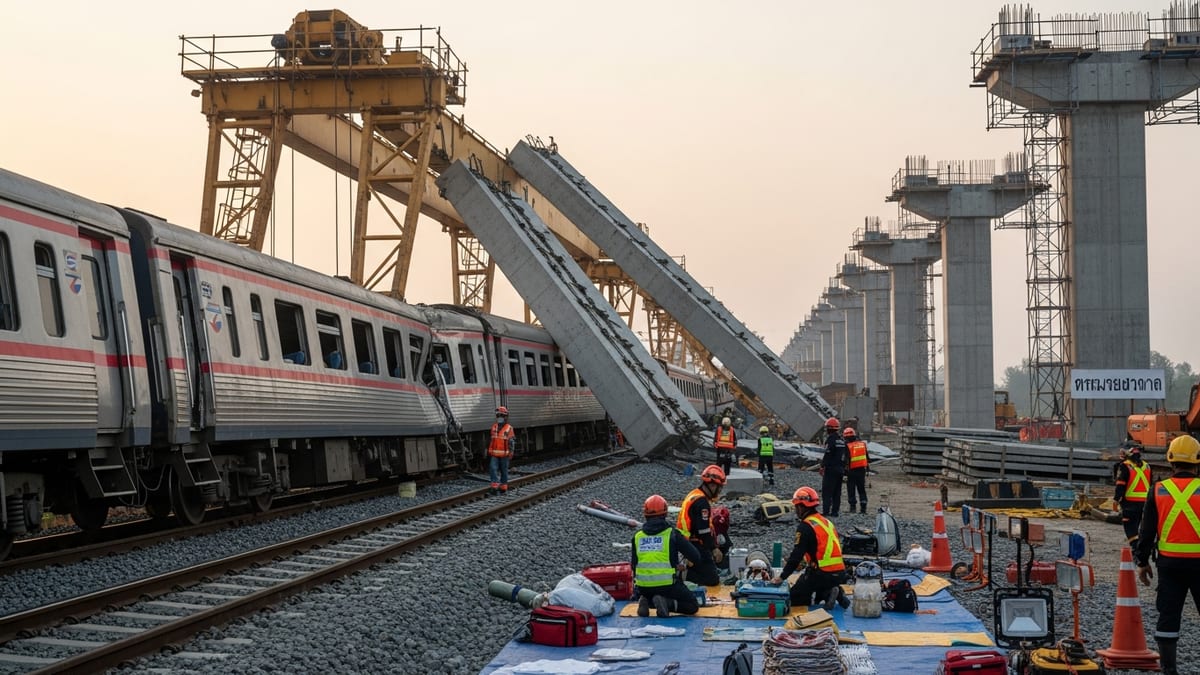
June 24 derailment tied to intense wind event
Publicly available weather data and regional media coverage indicate that a fast-moving storm system swept across portions of the central United States on June 24, bringing damaging gusts and pockets of severe thunderstorms along major rail corridors. Within that broader outbreak, one freight train derailed after multiple cars were blown off the tracks, interrupting rail traffic and drawing attention to the vulnerability of high-profile trains in extreme wind.
Initial reports describe the affected train as a mixed-freight consist that included tall, relatively light intermodal equipment. These types of cars, with their large side surface area, can act like sails when hit broadside by very strong straight-line winds, especially when containers are empty or only partially loaded. In this case, several cars tipped over in sequence, creating a chain reaction that left a portion of the train on its side along the right of way.
Railroad representatives have not publicly released a detailed technical narrative, but incident summaries and local coverage suggest that the track itself remained largely intact and that the primary force involved was the wind rather than a structural failure of rail or equipment. That early assessment aligns with broader rail safety data showing that severe weather, while less common than mechanical or track-related defects, can still trigger dramatic derailments under the right conditions.
Emergency response in the immediate aftermath focused on securing the area, assessing potential leaks, and verifying that no hazardous materials were released. Published accounts indicate there were no serious injuries associated with the June 24 event, and the incident was contained to the rail corridor, with nearby road traffic and communities experiencing mainly delays and detours rather than direct physical damage.
Straight-line winds and how they can overturn trains
Straight-line winds are powerful, non-rotating gusts that can rival tornadoes in intensity, often emerging from downbursts within severe thunderstorms. Unlike tornadoes, which are characterized by rotation, straight-line winds push in a single dominant direction. When these gusts exceed roughly 60 to 70 miles per hour, they can damage buildings, uproot trees, and in exposed areas, topple vehicles and railcars.
Rail safety specialists note that freight trains are typically very stable because of their weight and low center of gravity. However, aerodynamics can work against that stability when wind loads build against tall, flat-sided cars. Intermodal containers stacked on flatcars and high-cube boxcars are especially susceptible, particularly if they are empty, lightly loaded, or arranged on elevated and exposed stretches of track such as embankments, open farmland, or river crossings.
Federal accident records document several recent derailments in which high winds were cited as a primary factor. In one widely noted case earlier this year, a freight train operating on tangent, or straight, track experienced a sudden derailment when a storm system produced gusts above 70 miles per hour and a cluster of cars was blown over, triggering a 28-car pileup. That pattern, in which a handful of cars near the middle or rear of a train abruptly tip onto their sides, matches early descriptions from the June 24 incident.
Engineering analyses of past weather-related derailments point to a combination of train speed, wind angle, and car loading as critical elements. A moving train increases the effective side force of crosswinds, and if the gusts strike near perpendicular to the train, the sideways pressure on the car body can exceed the weight-based restoring force at the wheels. When that threshold is crossed, the car begins to roll, and once a few cars have left the rails, their momentum can pull neighboring equipment off the track as well.
Service disruptions ripple across passenger and freight networks
The June 24 derailment occurred along a corridor that hosts both freight and passenger operations, according to regional transport advisories. When the freight train went off the rails, it blocked one of the primary mainlines, forcing dispatchers to suspend or reroute a series of scheduled passenger services and other freight movements while crews evaluated the damage.
Public alerts from rail operators and local transit agencies described partial shutdowns, replacement bus services, and delays of several hours as trains were held at upstream stations or diverted onto secondary routes. In some cases, passenger rail operators opted to detour long-distance services along alternate lines, adding mileage and extending journey times but allowing travelers to complete their trips without cancellation.
Freight customers in the region faced their own ripple effects, with intermodal, agricultural, and manufactured goods shipments delayed while the line was cleared and inspected. For time-sensitive cargo, including automotive parts and consumer merchandise, logistics providers turned to trucking or alternate rail routings to maintain delivery schedules. According to industry bulletins, the rail line was reopened to limited traffic after debris was removed and temporary repairs were made, with full normal operations restored after additional inspections confirmed track integrity.
Transportation analysts note that even derailments without injuries or hazardous material releases can exert outsized impacts on regional mobility, especially where a single main line carries a mix of freight and passenger traffic. The June 24 incident joined a series of recent disruptions that have prompted renewed discussions about corridor redundancy, dispatching flexibility, and the resilience of passenger services that depend on freight-owned infrastructure.
Renewed focus on weather monitoring and rail resilience
The June 24 derailment adds to a growing body of evidence that extreme weather is an increasingly important factor in rail operations. As research highlights trends toward more frequent severe thunderstorm outbreaks in parts of North America, railroads are investing in enhanced real-time weather monitoring and decision-support systems aimed at identifying when and where to reduce speeds, stage trains, or temporarily halt movements.
Public filings show that some major freight carriers have begun integrating specialized meteorological services with dispatch centers, allowing controllers to view storm tracks, wind gust projections, and lightning activity overlaid on live train-position maps. When forecast gusts exceed predetermined thresholds, dispatchers can instruct crews to slow or hold trains in more sheltered locations, minimizing the risk of exposure on open, elevated, or otherwise vulnerable segments of track.
Industry groups and safety advocates are also examining whether current operational guidelines adequately reflect the risks of straight-line winds to modern freight trains that are longer, taller, and heavier than in past decades. Discussions include potential adjustments to maximum train length in exposed territories, revised loading practices for double-stack intermodal trains, and new standards for placing empty or lightly loaded cars within a consist to improve overall stability during storms.
For communities along busy rail corridors, the June 24 incident underscores both the robustness and the limits of current safety systems. While the derailment produced notable disruption, available information suggests that containment measures, emergency coordination, and infrastructure repair proceeded relatively quickly. At the same time, the event highlights how rapidly changing weather can outpace operational safeguards, prompting continued calls for more sophisticated forecasting tools, clearer wind-related operating rules, and sustained investment in rail resilience as severe weather becomes a more prominent planning concern.