


More news on this day
Work on the core Bulgaria–Turkey rail corridor has entered a decisive phase, as construction on Türkiye’s Halkali–Kapikule line advances alongside major EU-backed upgrades on the Bulgarian network, tightening one of Europe’s most important passenger and freight links.
Get the latest news straight to your inbox!
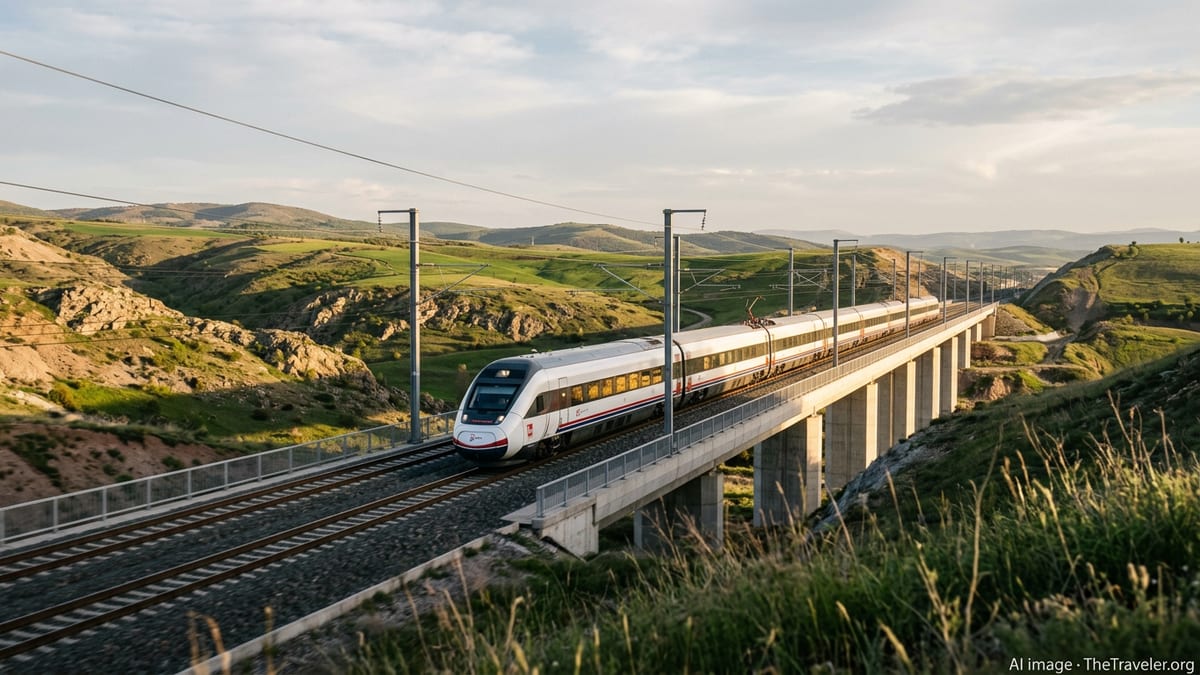
A pivotal stretch on the Istanbul–Kapikule route nears completion
Recent project updates from Türkiye indicate that the high-speed, double-track Halkali–Kapikule railway, which runs from Istanbul’s western suburbs to the Bulgarian border, has reached an advanced construction stage, with test runs already underway on parts of the route. The 229-kilometre line is being built for 200 km/h operation, electrified and fully signalled, and designed for both heavy freight and fast passenger services.
The corridor is divided into three main sections between Halkali and Kapikule, with contractors reporting substantial progress on civil works, tracklaying and systems installation. Local coverage in late April and early June 2026 points to the project moving into its final testing and commissioning phase on at least one long segment, an indication that a staged opening is drawing closer.
Once the new line is fully in service, journey times between Istanbul and the border near Edirne are expected to fall sharply. Current reports describe a reduction of the passenger travel time from around four hours to about one and a half hours between Halkali and Kapikule, dramatically improving the competitiveness of rail against road on this busy corridor.
The line is being developed in cooperation with European partners and is set to form Türkiye’s main physical connection to the EU’s Trans-European Transport Network. The cross-border section at Kapikule, directly facing the Bulgarian town of Svilengrad, is considered a strategic hinge between Türkiye and the wider European rail system.
Bulgarian upgrades align with EU core network standards
On the Bulgarian side, a series of modernization projects is under way to bring key east–west and north–south routes up to EU core network standards. Publicly available project summaries and government information refer to work on sections such as Sofia–Elin Pelin and Voluyak–Dragoman, both integral to international traffic moving toward Serbia and Türkiye.
These schemes typically involve full track renewal, new or upgraded electrification and signalling, longer passing loops and higher axle-load capacity. Technical documentation for several sections describes a design objective of accommodating 740-metre freight trains, 22.5-tonne axle loads and speeds of at least 100 km/h, placing the Bulgarian infrastructure in line with current EU freight corridor requirements.
In parallel, national planning documents highlight the role of the Vidin–Sofia axis and the broader Orient/East-Med and Baltic–Black Sea–Aegean corridors, with rail upgrades around Sofia acting as a hub for flows heading south to Thessaloniki and Istanbul or west to Belgrade. The cumulative effect is to increase line capacity and reliability on routes feeding into the newly built Turkish line at Kapikule.
Although works on some Bulgarian sections have been delayed in recent years, the overall strategy remains focused on closing bottlenecks and matching timetable potential across borders. The progress of the Halkali–Kapikule project is adding pressure and momentum to complete remaining Bulgarian upgrades so that trains can take full advantage of the new infrastructure on both sides of the frontier.
New travel dynamics for passengers and freight
The emerging Bulgaria–Turkey rail link is expected to reshape travel options between Istanbul, Sofia and further into Central and Eastern Europe. For passengers, the headline change will be substantially shorter and more reliable journeys, especially once border formalities are streamlined to match the improved rail infrastructure.
Current overnight services between Sofia and Istanbul make use of legacy lines with modest speeds and limited capacity, which constrain timetable planning and can lead to long, unpredictable travel times. With the high-speed, double-track section to Kapikule nearing completion and Bulgarian routes progressively upgraded, rail operators will gain more flexibility to introduce faster daytime trains, adjust frequencies seasonally and better integrate international services with domestic networks.
For freight, the impact may be even more significant. The Halkali–Kapikule line and its Bulgarian counterparts are being engineered to handle longer, heavier trains and higher line speeds, creating a competitive land bridge between European markets, the Middle East and, via other corridors, Central Asia. This should benefit container flows from Istanbul’s ports and logistics zones, as well as traditional bulk and automotive traffic crossing the Balkan peninsula.
Logistics analysts note that improved punctuality and journey time reductions on core rail freight corridors can encourage shippers to shift cargo from road to rail, particularly for medium and long-distance flows. As the Bulgaria–Turkey rail spine becomes more reliable, it is expected to attract a greater share of trade that currently moves by truck along congested highways.
EU-backed funding underpins cross-border ambitions
The strategic Bulgaria–Turkey rail connection is rooted in long-term European transport policy. Publicly accessible EU and international financial institution documents classify both the Halkali–Kapikule project and Bulgarian modernization schemes as key components of the Orient/East-Med and related core network corridors, making them eligible for co-financing through instruments such as the Connecting Europe Facility and loans from development banks.
In Türkiye, official project descriptions and international lender reports stress the importance of integrating the country with the EU’s Single European Transport Area and ensuring interoperability with European signalling and safety systems. The Halkali–Kapikule line is repeatedly cited as a flagship cross-border investment that supports these aims and strengthens resilience along the so-called Iron Silk Road between Europe and Asia.
In Bulgaria, recent public announcements about framework financing agreements with the European Investment Bank and other partners refer to large-scale support for rail infrastructure, including nodes and mainline corridors that will connect directly or indirectly to the Turkish border. This financing framework is intended to accelerate delayed works, address capacity constraints and align national infrastructure with forthcoming revisions to EU transport regulations.
The cross-border nature of the link, connecting a non-EU country to the EU’s core railway grid, has made it a priority in discussions on trade facilitation, energy-efficient transport and regional economic development. Analysts point out that the corridor also plays a geopolitical role by offering a stable, high-capacity route through a region where alternative land connections are limited or under strain.
What travelers and the industry should watch next
With construction milestones now being reported on the Turkish side and steady, if uneven, progress in Bulgaria, attention is turning to how and when the new infrastructure will translate into concrete timetable changes. Industry observers expect a staged rollout, beginning with partial use of completed segments for freight and selected passenger services, followed by full integration into international timetables once signalling and border arrangements are fully aligned.
Travelers planning overland trips between Istanbul and European cities such as Sofia, Bucharest or Belgrade are being advised by rail commentators to watch for updated schedules over the next couple of years. Early adopters may be able to experience shorter journey times on mixed old and new alignments before fully high-speed services become routine.
Rail freight operators meanwhile are monitoring capacity declarations and access conditions published by national infrastructure managers in both countries. Increased axle-load limits, longer train paths and higher permissible speeds will play a crucial role in determining the commercial attractiveness of routing cargo via the Kapikule–Svilengrad gateway compared with alternative maritime or land routes.
As testing progresses and more sections of the Halkali–Kapikule line move toward commissioning, the Bulgaria–Turkey rail corridor is approaching a pivotal moment. The coming phase, when infrastructure milestones meet operational decisions, will show how far this long-planned strategic link can reshape mobility and trade across the southeastern edge of Europe.