


More news on this day
Flight disruptions at Sydney Airport in mid-April have triggered a fresh wave of cancellations and delays, delivering a sharp stress test to Australia’s tourism recovery just as international demand accelerates.
Get the latest news straight to your inbox!
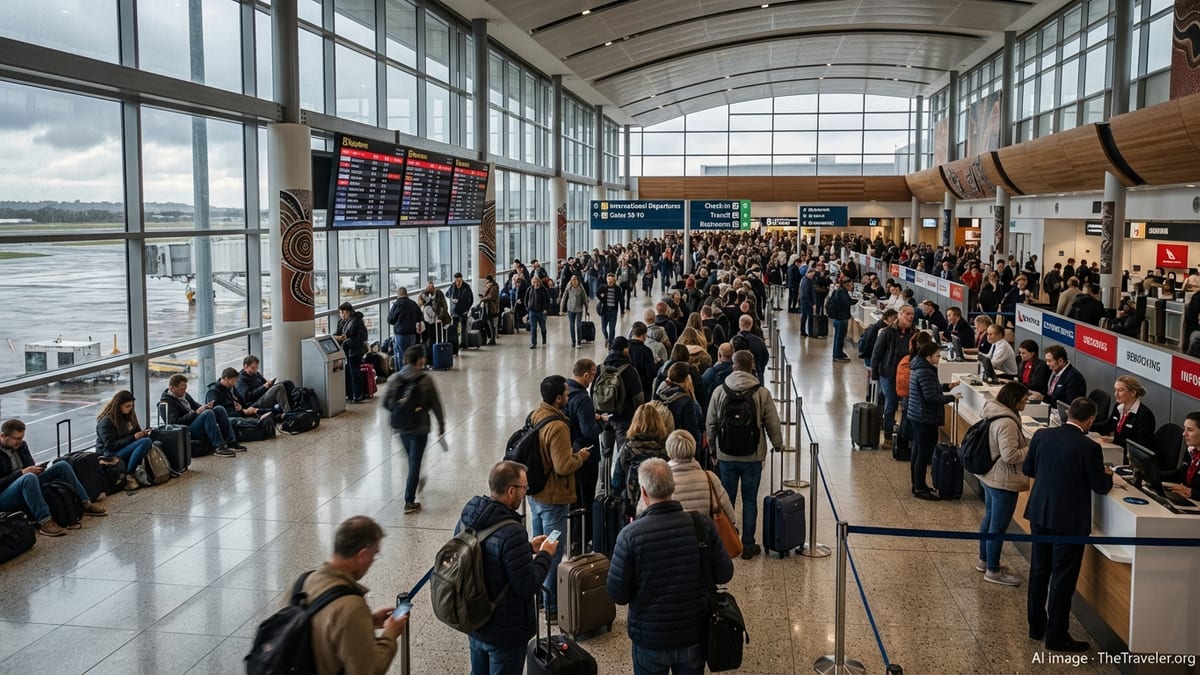
Ground Operations Strain Under Cancellations and Delays
Published reports for April 14 indicate hundreds of flights across Australia have been cancelled or delayed, with Sydney Airport emerging as the most heavily affected hub. Travel industry coverage points to a mix of fuel supply constraints, weather-related challenges and pre-existing operational fragilities that have converged to disrupt schedules at short notice.
Figures compiled by aviation and travel outlets suggest Sydney alone has logged well over 200 delayed services and more than a dozen cancellations in a single trading day, with knock-on effects for Melbourne, Brisbane, Perth and Canberra. Airlines including Qantas, Jetstar, Virgin Australia and several international carriers have been forced to reshuffle rosters, consolidate services and rebook passengers.
The cancellations follow a pattern of recent pressure on Sydney’s airside operations. In the past week, data cited by financial and market commentary has highlighted a spike in weather-driven delays at the airport, with rolling interruptions contributing to heightened volatility in airline and travel-related stocks on the Australian Securities Exchange.
Compounding matters, aviation forums and local reports have pointed to staffing gaps and tighter regulatory caps on hourly aircraft movements, which make it harder for Sydney to clear backlogs quickly once a disruption takes hold. Even short-lived ground holds can cascade across the national network, effectively bringing Australia’s primary gateway close to a standstill during peak periods.
Tourism Economy Faces Fresh Uncertainty
The timing of Sydney’s latest disruption is particularly sensitive for Australia’s visitor economy. Tourism businesses have been banking on 2026 as a consolidation year, with long-haul capacity returning on routes to Europe, North America and Asia and inbound spending edging closer to pre-pandemic levels.
Market analysts note that Sydney’s role as the country’s main international gateway magnifies the impact of any operational shock. When flights are halted or heavily delayed at Kingsford Smith Airport, it can interrupt travel itineraries that connect domestic leisure hotspots such as the Gold Coast, Cairns and Tasmania with high-value origin markets in Europe and North America.
Forward-booking data cited by corporate travel agencies shows strong demand for Europe-bound itineraries routed through Sydney and onward hubs like Singapore and Dubai. However, recurring disruption raises the risk that both business and leisure travelers may opt for alternative routings via Melbourne, Brisbane or even non-Australian gateways if they perceive Sydney as increasingly unreliable.
Tourism operators say, through public-facing statements and industry briefings, that they are monitoring the situation closely as the peak northern summer booking window approaches. While a single day of severe disruption is unlikely to derail the broader recovery, repeated episodes of gridlock at Sydney could dampen confidence, push up insurance and contingency costs, and erode the appeal of complex multi-leg Australian itineraries.
Airlines Juggle Fuel Costs, Network Cuts and Capacity Shifts
The latest gridlock at Sydney Airport is unfolding against a backdrop of significant airline restructuring across Australia. Coverage from travel trade media shows that Qantas Group is cutting a portion of its domestic flying program in response to higher jet fuel prices, while reorienting capacity toward more lucrative long-haul routes to destinations such as Paris and Rome.
These cuts, while commercially rational for carriers, reduce the slack in the domestic system that is often used to absorb disruption. With fewer spare aircraft and tighter crew scheduling, irregular operations triggered by weather, fuel issues or congestion at Sydney quickly translate into cancellations instead of short delays. Passengers are left with limited rebooking options, particularly on thinner regional routes.
Industry commentary also notes that low-cost carriers are facing similar pressure. Jetstar, for example, has been contending with a higher-than-normal volume of delayed services across major Australian airports in recent weeks, with Sydney often the focal point. In some cases, aircraft that might usually be redeployed to clear a backlog are instead locked into tightly timed international rotations.
Meanwhile, international airlines are gradually restoring or adjusting services through Sydney as global travel demand rebounds. This growth adds complexity to air traffic management, ramp services and security processing at the airport, raising the stakes when unforeseen events trigger a halt or sharp slowdown in movements.
Infrastructure Limits and Regulatory Caps Under Scrutiny
The latest disruption is once again drawing attention to the structural limits of Sydney’s existing airport configuration. Publicly available government and airport submissions have long highlighted the constraints imposed by the combination of a curfew, a legislated hourly movement cap and parallel runway operations that can be heavily affected by crosswinds or storms.
Recent policy documents on Sydney’s demand management regime underline how quickly those caps can become binding when a weather event, technical issue or safety incident forces aircraft to divert or hold. When off-schedule movements accumulate, the airport’s ability to recover during the following hours is constrained by regulation rather than just operational capacity, resulting in extended delays for thousands of passengers.
These factors are shaping the debate around Western Sydney International Airport, due to open in late 2026 with no curfew and more flexible operating parameters. Aviation analysts argue that the new airport may provide much-needed relief, but note that, in the short term, Sydney’s existing terminals and runways remain Australia’s critical chokepoint for international tourism.
Transport planners and local community groups are also closely watching how rail and road links evolve between the two airports. Without efficient surface connectivity, the benefit of diverting some traffic to Western Sydney could be blunted, leaving the current hub vulnerable to repeated bouts of congestion and ground stops that reverberate nationwide.
What Travelers Need To Know Right Now
For passengers scheduled to transit Sydney in the coming days, aviation experts and consumer advocates are emphasizing preparation and flexibility. Travelers are being encouraged, through widely shared guidance, to monitor airline notifications closely, allow additional buffer time for connections and consider travel insurance products that explicitly cover missed onward flights caused by congestion or ground halts.
Airlines have been advising customers through public channels to avoid heading to the airport without confirmed flight information. Many carriers are offering fee waivers or flexible change policies on affected routes, but availability is tightening as disrupted passengers compete for limited seats on later services.
For inbound visitors, particularly those with complex itineraries across multiple Australian states and territories, travel consultants are recommending a renewed focus on minimum connection times and, where possible, overnight stops in Sydney before key long-haul departures. This approach may reduce the risk that a single delay cascades into multiple missed segments.
Despite the current turmoil, tourism observers note that demand for Australia remains robust and that airlines, airports and regulators have strong incentives to keep international visitors moving. How effectively Sydney Airport navigates this latest test may help determine whether the country’s aviation network can sustain its recovery momentum through the rest of 2026.