


More news on this day
Sydney Airport’s latest traffic results show international travel surging past last year’s levels while domestic volumes remain broadly flat, creating a mixed picture for Australian flyers depending on whether they are heading overseas or staying within the country.
Get the latest news straight to your inbox!
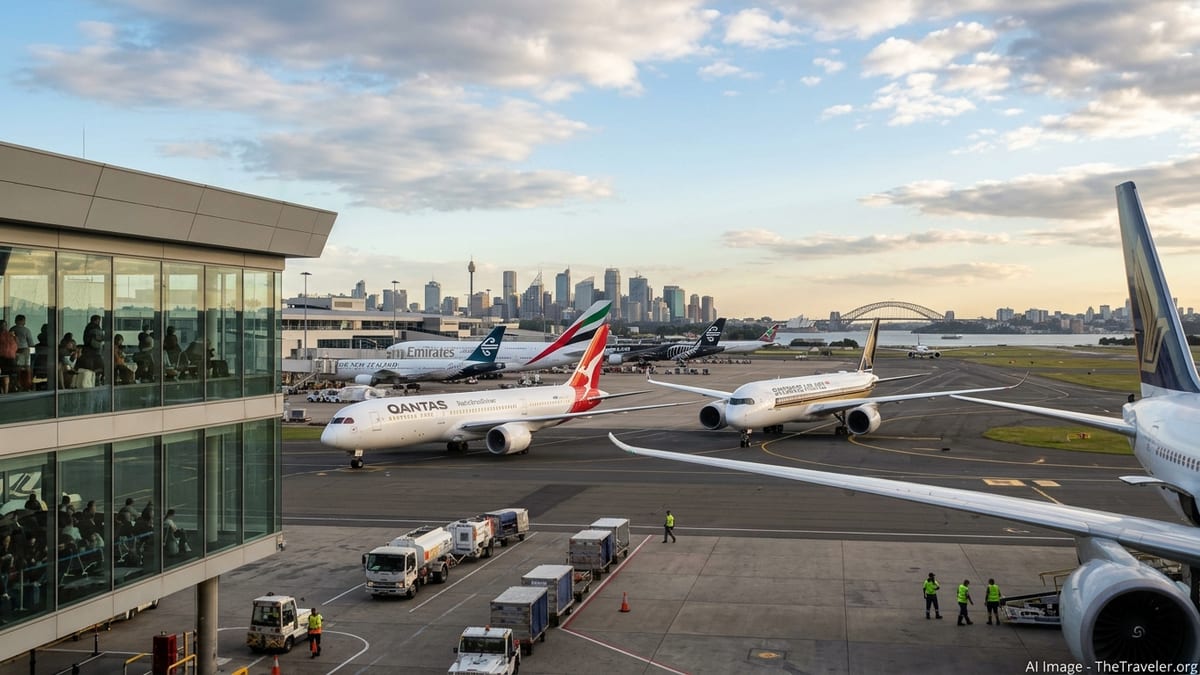
International passengers push Sydney ahead of 2025
In its traffic and operational performance update for the second quarter of 2026, published on 27 July, Sydney Airport reported that 20.7 million passengers used the airport in the first half of 2026, 1.5 percent more than in the same period of 2025. The operator attributed the increase primarily to continued strength in international demand rather than a broad domestic rebound.
The airport highlighted that the first quarter of 2026 was its strongest first quarter on record for international travel, with 4.57 million international passengers. Minutes from the Sydney Airport Community Forum meeting on 16 June confirm that total Q1 2026 throughput reached 10.78 million passengers, 3.6 percent higher than a year earlier, again driven by long haul and regional overseas markets rather than additional domestic flying.
Despite this international momentum, Sydney stated that domestic passenger traffic remained “in line with last year,” with 6.09 million passengers passing through its T2 and T3 domestic terminals over the first half. That leaves total volumes ahead of 2025 but still uneven by segment, with more capacity and demand concentrated on routes to and from overseas hubs.
National data shows modest domestic growth and stronger international flows
National figures from the Bureau of Infrastructure and Transport Research Economics indicate that Australian domestic traffic is only modestly above last year. BITRE’s Domestic aviation activity 2025–26 report shows domestic revenue passenger kilometres increasing 2.3 percent year on year to June 2026, with total domestic passenger movements at major airports such as Sydney and Melbourne up in the low single digits compared with the year to June 2025 and still hovering around, or just below, 2019 levels on many routes.
By contrast, BITRE’s international airline activity series for mid 2026 records faster growth in passenger traffic to and from Australia, particularly on Asia Pacific routes. Low cost and full service carriers from markets such as Singapore, New Zealand and Southeast Asia collectively carried a growing share of international passengers to and from Australian airports in July 2026, pointing to more seats and often more competitive pricing on regional overseas links than on some domestic sectors.
Globally, IATA’s September 2026 Air Passenger Market Analysis reports that industry wide passenger demand, measured in revenue passenger kilometres, fell 0.5 percent year on year, with domestic traffic down 2.2 percent. That backdrop underlines how Australia’s strong inbound and outbound flows through hubs like Sydney stand out against softer conditions in some other domestic and long haul markets.
How Sydney compares with Melbourne
The national averages also conceal differences between Australia’s largest airports. According to BITRE’s Domestic aviation activity 2025–26 data, Sydney was the country’s busiest domestic airport in the year ending June 2026 with 25.50 million domestic passenger movements, up 1.2 percent on the previous year. Melbourne followed closely with 24.61 million domestic passenger movements, growing 2.1 percent over the same period.
On the international side, BITRE’s airport traffic and international airline activity tables for the first half of 2026 show Sydney handling the largest number of international passengers in Australia and Melbourne recording solid growth from 2025, but still with patterns that differ by hub. Melbourne’s international recovery is supported by a concentration of services to Southeast Asia, the Middle East and New Zealand, while Sydney retains the widest spread of long haul and regional overseas routes and therefore benefits most directly from the current strength in Asia Pacific flows.
For travelers, that means Sydney generally offers the broadest range of international options, particularly to Asia and the Pacific, while Melbourne’s network is also expanding but from a slightly smaller base. On domestic routes between the two cities and to other capitals, capacity growth has been far more measured, contributing to tighter availability on some peak services compared with the more robust seat growth seen on certain international sectors.
What travelers are seeing on the ground
For passengers using Sydney, the current traffic mix translates into extensive international choice but less dramatic change domestically. Many pre pandemic international routes in the Asia Pacific region are now operating at or close to previous frequencies, with additional services from low cost and full service carriers helping to absorb strong demand and in some cases add new timing options.
Within Australia, BITRE data and recent airline schedules point to more capacity discipline. The main trunk routes, including Sydney to Melbourne and Sydney to Brisbane, are broadly back to near pre pandemic frequencies, but growth beyond that has been incremental. On thinner and regional routes from Sydney, some travelers may still encounter fewer daily flights than in 2019, which can contribute to yield driven fares and higher prices on popular departure times.
Operationally, delays at Sydney in recent months have often been linked by local reports and forum discussions to air traffic control staffing levels and to slot and runway management practices, rather than to passenger demand alone. The airport continues to operate under a night curfew, which concentrates arrivals and departures into peak daytime periods and can amplify the impact of any disruption on connection times and missed onward services.
Checking the latest numbers before you book
Travelers planning trips through Sydney in late 2026 and into 2027 should be aware that the figures cited here cover traffic up to July and the first half of the year. Individual airports, including Sydney and Melbourne, typically release traffic updates each quarter, while BITRE’s airport traffic and domestic aviation activity tables are updated monthly.
Before locking in complex itineraries, it is worth checking the most recent airport and government statistics, along with airline schedules, for specific routes. These will show whether additional international services have been loaded for upcoming seasons or if domestic capacity on your preferred city pair remains constrained, which can affect both fares and the range of departure times available.
Given the global backdrop of slightly weaker overall passenger demand reported by IATA and continued cost pressure from high jet fuel prices, travelers should expect airlines serving Australia to keep a close eye on capacity and yields. That is likely to preserve the current pattern in which Sydney and other major gateways are buoyed by strong overseas travel while domestic growth edges ahead more cautiously.