


More news on this day
Lufthansa Group has cut its 2026 profit outlook after lifting its expected jet fuel bill to €9.3 billion, about €600 million higher than forecast just three months ago, crystallizing how Europe’s jet fuel squeeze is directly feeding into airline finances, fares and capacity plans.
Get the latest news straight to your inbox!
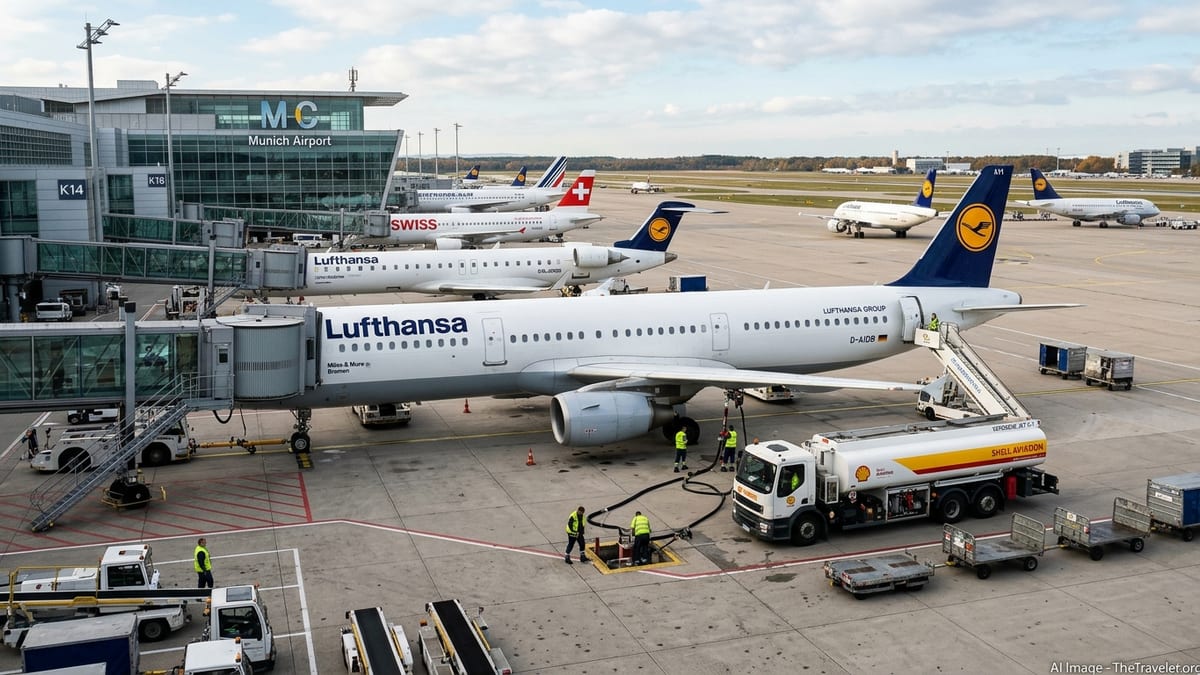
Lufthansa’s revised guidance puts fuel costs in the spotlight
In a quarterly update published on 3 November 2026, Lufthansa Group said it now expects a full-year 2026 fuel bill of €9.3 billion, compared with previous guidance of roughly €8.7 billion given at its mid-year results. The group simultaneously narrowed its 2026 adjusted EBIT guidance to a range of €1.7 billion to €2.0 billion, citing what it described as record-high oil prices and even higher kerosene prices alongside the impact of the Middle East crisis on its network.
The company’s Q3 2026 report shows operating expenses rising 8% year-on-year to a little over €33 billion, driven “above all” by higher fuel costs. Lufthansa indicated that fuel now accounts for roughly one third of its operating cost base, broadly in line with industry estimates, and acknowledged that this is putting “considerable pressure” on margins in its passenger airlines even as travel demand remains resilient.
According to the group’s investor presentation, Lufthansa remains substantially hedged for 2026, but its protection tapers in subsequent years. Management signaled that while this cushions the immediate impact of high jet fuel prices, the group faces greater exposure from 2027 onward, which is one reason it is pairing capacity growth more cautiously with cost-saving measures rather than pursuing more aggressive expansion.
Global fuel shock: IATA data shows costs surging faster than crude
Lufthansa’s move comes against the backdrop of a global fuel shock that industry body IATA says has halved expected airline profitability for 2026 compared with 2025. In its June 2026 financial outlook, IATA forecast that jet fuel would account for about 31.4% of airline operating expenses in 2026, up from 25.4% in 2025, primarily because jet prices have risen much faster than crude oil benchmarks.
IATA’s accompanying data shows average global jet fuel prices in 2026 far outpacing the increase in Brent crude, with the jet fuel crack spread projected to remain at historically high levels. The association pointed to the war-related disruption in the Middle East, including the closure of the Strait of Hormuz in late February, and stressed refinery constraints as key drivers pushing jet fuel prices well above earlier assumptions for the year.
While IATA’s figures are global rather than Europe-specific, its assessment highlights that regions heavily dependent on imported refined products are especially exposed. Europe sits in that category, with a significant share of its jet fuel supplies normally sourced from Gulf producers that have been directly affected by the conflict. For European carriers, that means higher input costs and a stronger incentive to adjust capacity and pricing.
Eurocontrol and OPIS: volatile prices and cautious winter capacity
Eurocontrol’s latest European Aviation Overview for week 45 of 2026 reports that average jet fuel prices in Europe fell sharply in early November, to about 4.42 US dollars per gallon, after a period of pronounced volatility. Even at that level, however, prices remain well above pre-crisis norms, and Eurocontrol notes that fuel remains a key headwind for airlines alongside softening seasonal demand.
The same Eurocontrol update confirms that several European carriers have implemented previously announced capacity reductions for the winter 2026/27 season. These cuts, which follow strong summer schedules, are focused on lower-yield routes and off-peak frequencies rather than wholesale route withdrawals, and are contributing to traffic slipping below 2025 levels at major hubs since the start of November.
Separate reporting from OPIS, a Dow Jones company, indicates that European airlines are also changing how they hedge fuel. A mid-November 2026 analysis found that carriers including Ryanair have reduced their hedge cover for 2027, preferring to keep more exposure to spot prices rather than lock in today’s very high forward levels. Ryanair’s CEO Michael O’Leary was quoted as saying that almost every other airline in Europe is “taking out capacity,” arguing that higher prices for unhedged oil are prompting competitors to trim schedules rather than risk flying marginal routes at a loss.
What travelers will notice: fares first, selective cuts second
For travelers planning trips in Europe, the most immediate effect of the jet fuel squeeze is appearing in fares rather than in large-scale route cancellations. Airlines such as Lufthansa and Ryanair have signaled that higher fuel costs are feeding through to ticket prices, particularly for short-haul leisure routes where fuel is a sizable share of total operating cost and where margins are thinner.
Capacity reductions for winter 2026/27 are, at this stage, selective. Schedules published for major European hubs still show a wide range of destinations, but with reduced frequencies on some off-peak days and fewer marginal seasonal routes than in winter 2025/26. Travelers may find slightly fewer departure time options on certain intra-European routes, especially midweek and late in the evening, but are unlikely to see a Europe-wide collapse in connectivity.
The more structural changes are occurring behind the scenes in airline planning. By cutting 2027 hedges and leaving a larger share of their future fuel needs unhedged, some carriers are effectively betting that today’s extreme prices will ease. If that proves correct, they could benefit from lower costs in future seasons. If it does not, they may need to rely more heavily on higher fares, ancillary revenues, or further capacity adjustments, which could filter through to travelers as pricier tickets or leaner schedules in specific markets.
What to watch into 2027
Travelers looking ahead to summer 2027 should keep an eye on several milestones. First will be any further guidance updates from major European groups such as Lufthansa, IAG and Air France-KLM in early 2027, which will show whether today’s fuel assumptions still hold and whether capacity plans for the peak season are being adjusted.
Another key variable is how jet fuel and crude prices evolve as the Middle East conflict and refinery supply conditions develop. A sustained easing in the jet fuel crack spread would reduce pressure on airline cost bases and could take some heat out of fares over time. Conversely, if prices remain elevated through 2027, travelers should be prepared for fares that stay higher than in pre-crisis years, particularly on routes where competition is limited and aircraft are already full.
Passengers booking European trips over the next year may want to secure summer flights earlier than usual on routes where they have limited flexibility, and periodically recheck schedules for winter 2026/27 and beyond in case of further timetable refinements. While the current squeeze is not grounding fleets, it is clearly influencing how airlines like Lufthansa shape their networks, price tickets and manage risk, and those decisions will increasingly be felt in travelers’ wallets and on departure boards.