


More news on this day
Victoria and Tasmania have recorded some of Australia’s fastest cruise‑tourism growth on the back of expanding coastal itineraries, even as national ship calls come under pressure, according to a new 2023–24 economic impact assessment released by Cruise Lines International Association (CLIA) Australasia and the Australian Cruise Association (ACA).
Get the latest news straight to your inbox!
Record national cruise spend, but mixed picture on ship calls
The CLIA and ACA Economic Impact Assessment for 2023–24 calculates that cruise tourism generated A$8.43 billion in total economic output across Australia, a 49.7% increase on 2022–23, supporting 26,369 full‑time‑equivalent jobs. The report attributes the national growth to higher passenger and crew spending and greater cruise‑line outlays, rather than a simple rise in ship numbers.
Industry commentary around the release notes that the value of cruise tourism has reached a record level even as the count of ship calls has come under pressure in some ports, reflecting deployment choices and operational constraints rather than a uniform expansion in vessel numbers. For travelers, this means more spending and activity per ship visit, but not necessarily more ships in every harbor.
Victoria’s cruise economy grows on new operators and wider coverage
Victoria’s cruise‑tourism impact reached A$636.9 million in 2023–24, up 67.8% on the previous financial year, according to the CLIA/ACA study. The report links this jump to an increase in ship visits across the state and the arrival of new operators in the Australian market, with cruise activity supporting an estimated 1,893 full‑time‑equivalent jobs.
State‑level figures from the accompanying AEC infographic show 88 ship visit days and 160,232 passenger visit days in Victoria in 2023–24, both higher than in 2022–23. While New South Wales and Queensland still account for the majority of national cruise output and employment, Victoria’s share of national cruise economic activity rose to 7.6 percent as lines added Melbourne and nearby ports to more itineraries.
Ports Victoria’s reporting for the 2024–25 cruise season underlines how this growth is spreading beyond central Melbourne. By the end of the season there had been 118 cruise visits to Victorian waters, including 101 berths at Station Pier in Port Melbourne, one call at Webb Dock for the Melbourne Cup period and 16 regional port calls split between Phillip Island, Geelong and Portland. Most of these regional stops are port‑of‑call visits rather than home‑port operations, giving passengers extra shore‑excursion options without shifting the main embarkation points away from larger cities.
Tasmania’s rising numbers and better tracking of cruise visits
Tasmania also posted strong growth in the latest CLIA/ACA assessment. Cruise tourism generated A$176.0 million in economic output in 2023–24, up 22.1% on 2022–23, and supported 542 full‑time‑equivalent jobs. The report notes that improved data collection in Tasmanian ports, particularly new passenger and crew expenditure surveys, has helped refine these figures.
The AEC infographic for 2023–24 records 151 ship visit days and 394,645 passenger visit days across Tasmania, again an increase on the previous year. Although Tasmania remains a smaller cruise market than the mainland east‑coast states in absolute terms, the rise in visit days and spending confirms that cruise itineraries are reaching more Tasmanian communities.
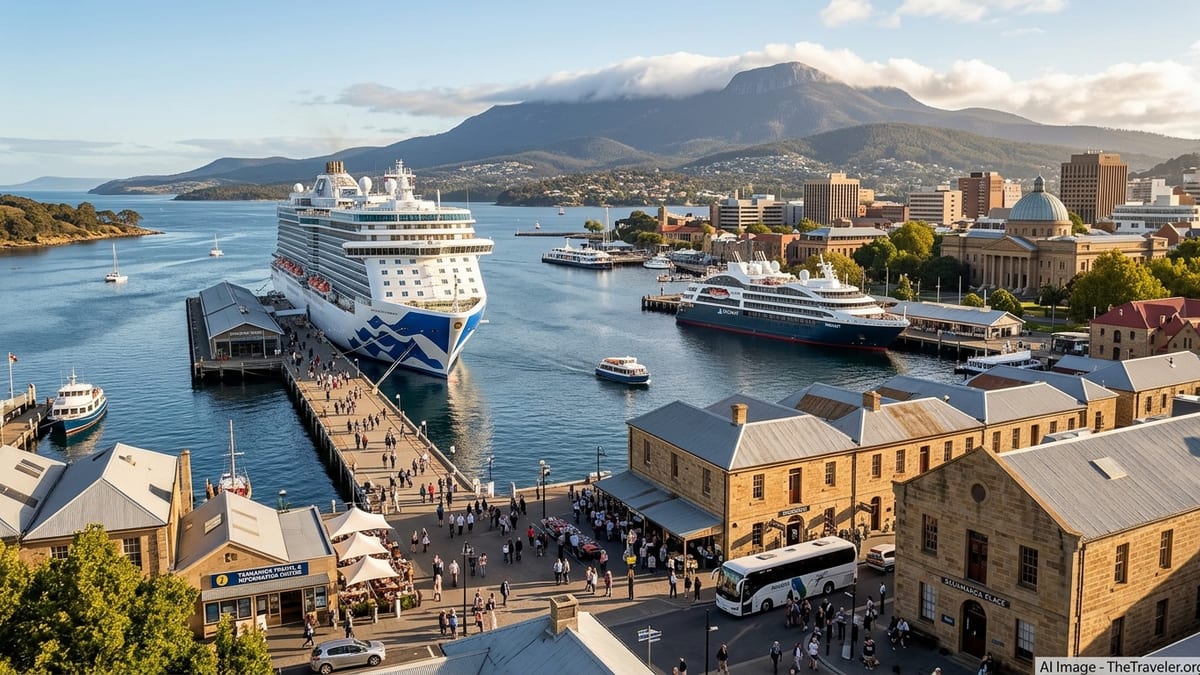
TasPorts’ current materials for the 2024–25 season show scheduled cruise calls spread across Hobart, Burnie, Port Arthur, Coles Bay and Bell Bay. On cruise days in Hobart, road closures around Franklin Wharf are reinstated, which is a practical consideration for visitors planning movements between the pier, Salamanca waterfront and the city centre.
What travelers can expect from more coastal calls
For cruise passengers, the shift is most visible in itineraries that now add secondary and regional Victorian and Tasmanian ports alongside traditional gateways such as Sydney and Brisbane. In Victoria, calls at Phillip Island bring easy access to surf beaches and the island’s well‑known wildlife experiences, while Geelong and Portland give travelers a path into the Bellarine Peninsula, Great Ocean Road and southwest coast without a long overland transfer from Melbourne.
In Tasmania, scheduled calls at Port Arthur, Coles Bay and Bell Bay open up shore‑excursion options to the Port Arthur Historic Site, Freycinet Peninsula and parts of the state’s north that are harder to reach on a short mainland visit. Hobart and Burnie remain the primary Tasmanian ports by traffic, but the growing number of port‑of‑call visits elsewhere means more itineraries now sample multiple Tasmanian regions within a single voyage.
These expanded coastal calls are generally transit stops rather than turnaround ports, so passengers should expect to embark and disembark their voyages primarily in larger cities such as Melbourne, Sydney or Brisbane. However, the added regional calls can change the feel of a voyage, with more time in smaller harbors and a wider variety of shore tours.
Planning ahead as cruise programs evolve
The CLIA/ACA economic assessment covers the financial year to 30 June 2024, and the Victorian and Tasmanian cruise schedules now running into 2024–25 and 2025–26 remain subject to change. Ports Victoria and TasPorts highlight that individual ship calls can be altered or cancelled at relatively short notice because of weather, operational needs or deployment decisions.
Travelers considering itineraries featuring regional Victorian ports such as Phillip Island, Geelong or Portland, or Tasmanian calls at Port Arthur, Coles Bay or Bell Bay, should therefore confirm the latest cruise line schedules and port advisories close to departure. The economic data confirms that more ships are reaching these coastal destinations than in 2022–23, but specific call dates, arrival times and shore‑excursion offerings are still managed sailing by sailing.
As cruise lines continue to refine their Australian deployment, the current data shows Victoria and Tasmania benefiting from a broader spread of cruise tourism rather than sheer growth in headline ship numbers. For passengers, the most tangible impact is a wider map of ports to choose from when comparing itineraries along Australia’s southern and eastern coasts.