


More news on this day
Heightened airspace and security controls around this week’s APEC leaders’ summit in Shenzhen are causing significant but localized flight disruption at Shenzhen Bao’an International Airport, with delays spilling into nearby Chinese hubs as airlines navigate temporary restrictions and crowded skies.
Get the latest news straight to your inbox!
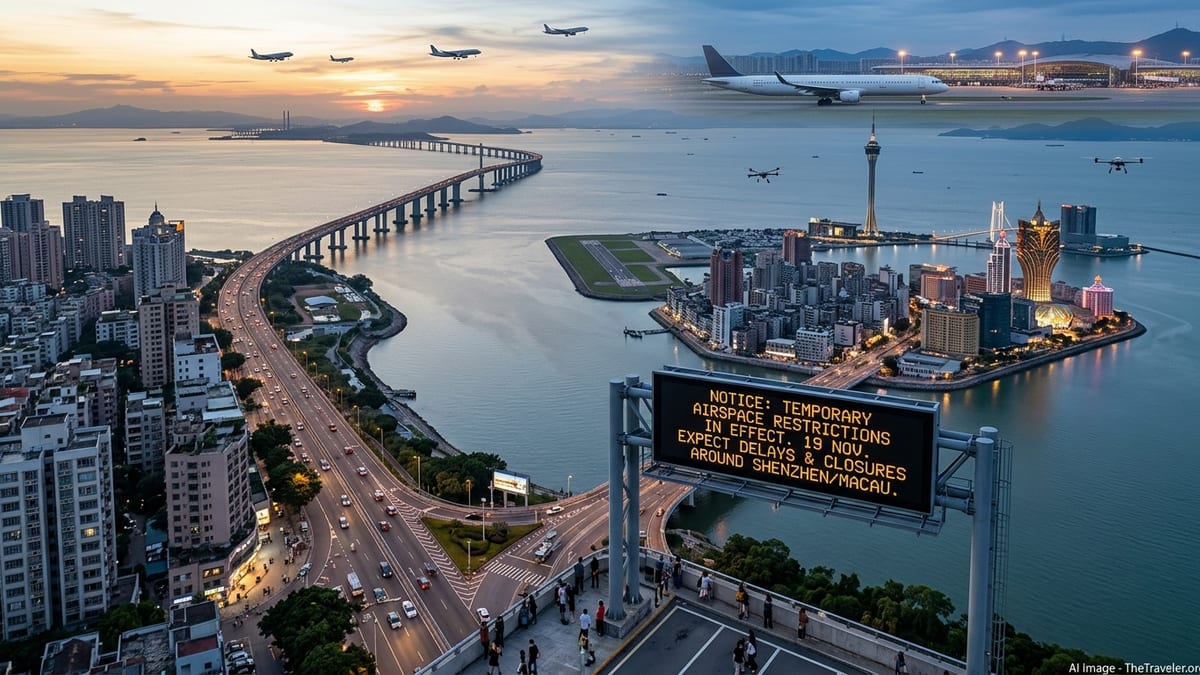
Targeted airspace restrictions around Shenzhen and Macau
Chinese and local authorities have imposed a dense web of temporary airspace controls around Shenzhen to support the APEC leaders’ meetings on 18–19 November 2026, including measures that affect both commercial and general aviation movements in the wider Pearl River Delta region.
Operational notices summarized by specialist aviation briefings describe a 200‑kilometre restricted zone around Shenzhen in Guangzhou-area airspace, where most non-scheduled and general aviation flights are prohibited unless specifically approved for APEC-related operations. Airlines need to follow tighter routing and altitude instructions, which limits flexibility and can slow traffic flows during busy periods.
In neighbouring Macau, the Civil Aviation Authority has gone further by temporarily banning all flight activities, including unmanned aircraft, across the entire Macau SAR airspace from 11 to 22 November 2026 under its air navigation rules. Separate government statements and Macau International Airport advisories urge passengers traveling during this window to monitor flight status closely and to arrive early because of security operations linked to APEC.
Delays surge at Shenzhen Bao’an after leaders depart
Local and regional media report that Shenzhen Bao’an began experiencing a wave of delays from the afternoon of 19 November, just as leaders’ aircraft and support flights were departing at the close of the APEC meetings. Coverage from Chinese-language outlets on 20 November shows crowded terminals and extended queues as passengers waited for aircraft held in increasingly busy surrounding airspace.
One Taiwanese report cited a Shenzhen–Taipei service on 19 November that was scheduled to depart mid-afternoon but did not take off until almost seven hours later, illustrating the scale of knock-on disruption on some cross-Strait routes. Screens at Shenzhen reportedly listed causes such as “other airspace user activity” and “traffic delay,” pointing to congestion and priority handling for summit-related movements rather than local weather or technical issues.
Airport-level performance data and live tracking sites confirm that Shenzhen is among the more affected Asian airports on 19–20 November, with an elevated proportion of flights departing significantly late and a smaller share cancelled or rerouted. However, the detailed statistics for delays and cancellations remain fluid, and at least one airport source notes that internal system maintenance is still limiting the publication of complete day-of delay tallies for 19–20 November.
Headline figures and data anomalies require caution
Large numbers circulating on some social platforms, such as claims that hundreds of flights have been cancelled and thousands delayed across Asia because of APEC, are not currently backed by named, reputable data providers using clearly defined geographic or time windows. Available analytics for Shenzhen Bao’an in the 10 days to 17 November show modest disruption before the main summit period, with low single-digit cancellation rates and average departure delays in the tens of minutes, indicating that the sharpest problems emerged only as leaders arrived and departed.
Analysts reviewing one major tracking dataset also highlight a roughly 70 percent drop in observed flight movements at Shenzhen on 16 November compared with surrounding days. The provider itself flags possible receiver or coverage issues for that date, meaning it remains unclear how much of the apparent reduction reflects real operational cuts and how much is a data artifact. Treating that single-day plunge as proof of mass cancellations would therefore be premature.
Across the broader region, live flight boards and analytics show that disruption is concentrated in the Pearl River Delta and a handful of large Chinese hubs such as Guangzhou and Shanghai that handle traffic to and from Shenzhen. Many other Asian airports are operating close to normal. Travelers should be wary of narratives suggesting an “Asia-wide meltdown” and instead focus on conditions at the specific airports they are using.
What travelers flying via Shenzhen and nearby hubs should expect
Passengers traveling to, from or via Shenzhen, Macau, Guangzhou, Hong Kong and other nearby airports between 11 and 22 November face a heightened risk of extended delays, last-minute schedule changes and selective cancellations as air traffic control manages restricted corridors and summit-related movements. Short-notice rerouting and holding patterns are possible even for flights that ultimately operate close to schedule on paper.
Authorities and airports in the region are urging travelers to monitor flight status through airline apps, official airport channels and booking platforms rather than relying solely on third-party trackers, which may show inconsistent data during periods of system maintenance or coverage gaps. Given tightened security, passengers should allow extra time at check-in and security, especially on departures from Shenzhen and Macau.
China’s existing rules on passenger notifications and basic care in the event of long delays or cancellations continue to apply, including provisions for information, rebooking and limited assistance. However, there is no equivalent to the statutory compensation regimes found in some Western jurisdictions, and payouts for disruption linked to airspace restrictions or security operations are unlikely. Travelers concerned about knock-on costs such as missed connections or hotel nights should review their travel insurance coverage and consider building longer buffers into itineraries involving Shenzhen during the APEC control period.
Outlook after the APEC control window
Most currently published security and airspace measures tied directly to APEC are scheduled to end on 22 November 2026, including Macau’s full airspace flight ban and the most stringent temporary controls around Shenzhen. Any extension or narrowing of these restrictions would need to be communicated via updated notices from civil aviation authorities and airport operators in the coming days.
For now, airlines are expected to gradually normalize schedules once leaders’ aircraft and related charters have departed and temporary restricted zones are lifted or scaled back. Travelers booked into the region after 22 November should still check for schedule changes, as carriers may adjust timings or aircraft rotations in the short term to reposition fleets and crews.
Anyone flying into or out of Shenzhen and neighbouring airports in the next few days should keep checking official channels up to departure, confirm minimum connection times and have contingency plans in case of rolling delays. As the APEC-related controls wind down, live data should provide a clearer picture of whether any residual disruptions reflect ongoing congestion or a return to more typical Pearl River Delta traffic patterns.