


More news on this day
Travellers flying through Sydney Airport in the coming days are being urged to prepare for the worst disruption in six months, as peak winter traffic, tight air traffic control staffing and long-standing slot constraints combine to strain the country’s busiest aviation hub.
Get the latest news straight to your inbox!
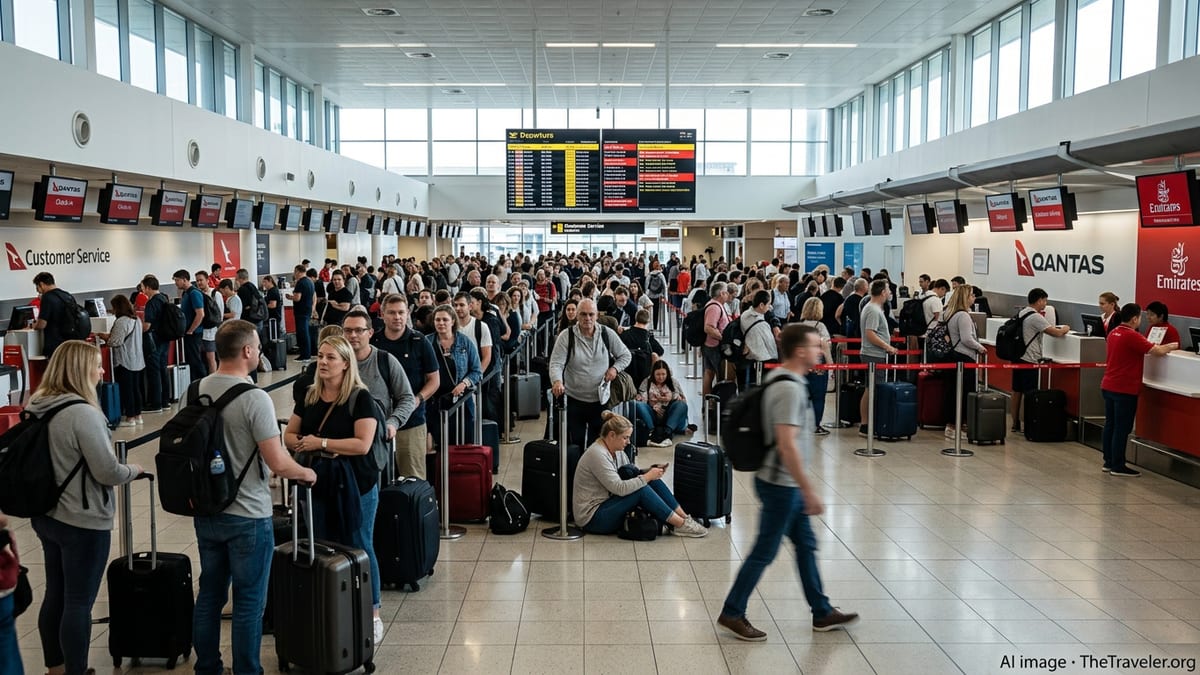
Peak winter rush collides with stretched air traffic control
Recent coverage of operations at Sydney Airport indicates that a sharp uptick in domestic and international traffic is colliding with ongoing workforce pressures in Australia’s air traffic control system, leading to widespread knock-on delays across the network. A series of air traffic control staffing gaps in early August has already triggered ground delay programs, forcing aircraft to depart later than scheduled and creating queues both in the air and on the tarmac.
Publicly available government submissions and performance data show that Sydney’s role as Australia’s primary international gateway magnifies the impact of any operational constraint. When traffic management programs are put in place, flights are often pushed back into already busy banks of departures and arrivals, leading to missed connections and congested terminals. Industry reporting suggests that this pattern has intensified in recent weeks as airlines operate near full capacity during the southern hemisphere winter school holidays.
Analysis prepared for regulatory reviews has repeatedly highlighted that the combination of high demand and limited spare staffing in key control towers leaves little buffer when unexpected absences or weather disruptions occur. When that happens at Sydney, delays propagate quickly throughout the national network, affecting regional links as well as trunk routes between major capitals.
Slot limits and curfew leave little room to recover
In addition to staffing pressures, Sydney Airport is working within a tightly regulated operating framework that includes slot controls on daytime movements and a strict overnight curfew between 23:00 and 06:00. Public submissions to federal inquiries describe how these rules, originally designed to manage noise and congestion, now limit the ability of airlines and the airport to “catch up” once schedules begin to slip.
Morning arrivals have become a particular pinch point. Airlines typically schedule a dense wave of long haul flights to touch down just after the curfew lifts, funnelling thousands of passengers into immigration, baggage and biosecurity within a narrow window. Travellers posting recent accounts of their journeys describe heavy congestion in these early hours, with long queues forming quickly if even a small number of flights are delayed or if technology or staffing issues occur at the border.
When daytime delays mount, the curfew can prevent late-running evening services from operating at all, resulting in cancellations rather than simple schedule slippage. Industry groups argue in published material that this dynamic increases the risk that Sydney experiences periods of severe disruption compared with airports that have more flexible operating hours and runway access.
Terminal queues set to lengthen as passenger volumes surge
While the most recent quarterly performance figures from Sydney Airport show generally strong on-time performance and very high proportions of passengers clearing security within 10 minutes during off-peak periods, there are signs that the next several days will test that resilience. Reports from passengers in recent months describe security and immigration queues that can at times snake through food courts and public areas, particularly during holiday peaks and early morning arrival banks.
Operational research focused on airport passenger flows indicates that even small mismatches between scheduled arrivals and available processing capacity can lead to rapidly growing queues when terminals are already busy. At Sydney, where international and domestic terminals both handle concentrated waves of flights, any disruption to one part of the system can quickly manifest as visible congestion at security, check in, immigration or baggage reclaim.
Travellers flying in the current peak are therefore being advised by airlines and travel agents, based on recent disruption patterns, to allow more time than usual before departure and to prepare for possible extended waits after landing. For many, the experience will still be relatively smooth, but the probability of encountering unusually long lines is higher than at any time since late summer.
New premium lanes and upcoming Western Sydney Airport offer partial relief
In anticipation of sustained pressure on its terminals, Sydney Airport has introduced new paid priority products that allow departing passengers to access dedicated lanes at security screening and outbound border controls. According to business media reports, the move positions Sydney as one of the first major Australian gateways to sell queue-jump options directly to travellers, mirroring practices long established in parts of Europe and North America.
The initiative has attracted mixed reactions, with some frequent flyers welcoming the chance to reduce uncertainty in peak periods and others expressing concern that standard queues could worsen if capacity is diverted to premium lines. Airport performance documents emphasise, however, that the vast majority of passengers are still expected to clear security within industry benchmarks, and that priority access is intended as an optional extra rather than a replacement for existing lanes.
Looking further ahead, the planned opening of Western Sydney International Airport in late 2026 is expected to gradually ease some of the pressure on the existing Sydney Kingsford Smith site by adding new capacity for both domestic and international services. Public commentary suggests that the impact will be gradual rather than immediate, as airlines and ground transport connections ramp up. For now, Kingsford Smith remains the dominant gateway and will continue to bear the brunt of peak-season demand and any associated delays.
What travellers can do to navigate the disruption
Travel experts and consumer advocates are pointing passengers to a few practical steps as Sydney braces for its worst delays in half a year. The most common recommendation is to build in substantial buffer time, both when departing and when connecting through Sydney from regional or international flights. For morning arrivals, particularly those landing soon after the 06:00 curfew lift, travellers should be prepared for potentially slow progress through arrivals halls.
Passengers are also being encouraged to monitor their airline’s app or website closely on the day of travel, as same-day schedule adjustments are now common when air traffic control restrictions or weather events emerge. Many carriers allow free same-day changes in the event of significant disruption, and rebooking early can reduce the likelihood of lengthy airport waits if a flight is delayed by several hours.
For those departing Sydney, packing light, checking in online and arriving earlier than the minimum recommended time can help mitigate some of the stress associated with unpredictable queues. While these steps cannot remove the risk of disruption entirely, they can make it easier for travellers to absorb the impact of what is shaping up to be Sydney Airport’s most challenging period of delays in six months.