


More news on this day
Taiwan’s tourism strategy is placing fresh emphasis on the outlying Penghu archipelago, as Magong’s harbor gains prominence in new “blue highway” ferry itineraries that increasingly begin or end in Kaohsiung and other western ports.
Get the latest news straight to your inbox!
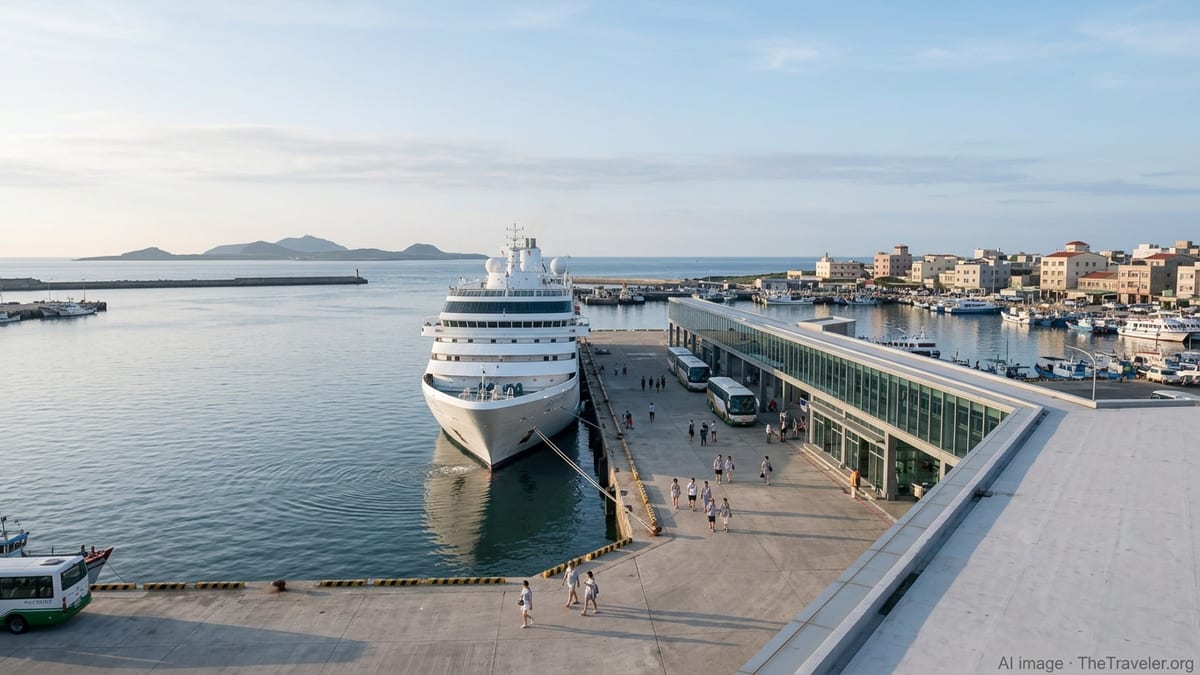
Blue Highway Policy Turns Toward Penghu
Publicly available information from Taiwan’s Maritime and Port Bureau shows that Penghu sits at the heart of a wider “blue highway” drive to expand sea-based tourism around the main island. The 2025 Blue Highway Maritime Tourism Carnival introduced several new and trial routes, with Penghu positioned as a showcase destination for marine sightseeing and island-hopping experiences.
Among these initiatives, Magong, Penghu’s main city, is being marketed as a natural hub for multi‑stop journeys that can be combined with domestic flights, cruise-style services and conventional ferries. The approach reflects a broader policy shift in which marine transport is framed not only as a means of access, but as a tourism product in its own right.
Penghu’s appeal, built on coral-fringed coasts, basalt formations and historic streets, aligns closely with Taiwan’s push to diversify beyond well-known urban stops such as Taipei and Kaohsiung. Tourism planners are increasingly treating the archipelago as a highlight of west coast itineraries rather than an optional side trip.
Magong Finale Routes Meet Kaohsiung Links
Penghu’s main harbor in Magong is emerging as a symbolic “finale” port on several tourism routes that either start or converge on Taiwan’s larger cities. Government tourism material and transport guides describe Magong as an endpoint for services connecting Kaohsiung, Tainan, Chiayi and Kinmen, creating loop-style journeys that combine the main island with offshore highlights.
The Kaohsiung–Magong route remains a backbone of this network, served by the Penghu Ferry and other operators on schedules that typically take around four to four and a half hours each way. The vessel’s design and onboard facilities have been promoted in local tourism publications as part of a premium sea-travel experience that frames the approach to Magong as part of the trip’s appeal.
In planning terms, this Kaohsiung link functions as both a feeder and a finale. Travelers can board in the southern port city after touring urban attractions, then sail onward to Magong, where many itineraries conclude with stays focused on beaches, water sports and island culture before visitors fly or sail back to the main island.
Transport information from Penghu county offices further indicates that Magong’s harbor infrastructure handles not only tourism vessels but also public ferries that knit the outlying islands to Kaohsiung. This dual function enlarges Magong’s role from a simple gateway to a consolidation point where local, regional and national routes intersect.
New Anping–Magong Tourism Ferry Adds Summer Capacity
The debut of a dedicated tourism ferry between Tainan’s Anping district and Magong is adding a fresh dimension to Penghu planning. Reports from Taiwan’s immigrant-focused news outlets note that the seasonal Anping–Magong service launched on June 30, 2026, with round-trip sailings every Tuesday and Friday during the main summer vacation period.
The new route shortens the sea journey to roughly two and a half hours and directly links historic Anping, itself a popular heritage and food destination, with the Penghu islands. This pairing allows domestic and international visitors to design itineraries that move seamlessly from Tainan’s fortresses and canals to Magong’s harborside promenades and offshore islets.
From a tourism-development standpoint, the Anping–Magong service complements, rather than replaces, the longer Kaohsiung–Magong connection. Together they create overlapping corridors that distribute visitor flows across multiple west coast cities, while still converging on Penghu as the central island-hopping platform.
Travel planners are already highlighting the potential for multi-port combinations in which visitors arrive in one city, sail to Magong, and then continue by air or sea to other parts of Taiwan, turning Penghu into a flexible pivot rather than a cul‑de‑sac.
Island-Hopping From Magong Reshapes Visitor Flows
Once in Magong, visitors have growing options for onward sea travel deeper into the archipelago. The Penghu National Scenic Area administration and county-level ferry schedules outline services from Magong’s Third Fishing Port to islands such as Wangan, Qimei, Tongpan and Hujing, as well as tourist-focused circuits branded as South Sea routes.
South Sea itineraries typically combine fixed public ferries with chartered or package boats, allowing travelers to stitch together day trips and overnight stays tailored to diving, turtle-watching or lighthouse visits. Updated fare tables show a range of point-to-point tickets from Magong to the southern islands, underlining efforts to keep island-hopping affordable while promoting local economies.
Tourist-facing materials emphasize Magong’s role as the operational base for these excursions. Visitor centers at the harbor act as starting points where passengers can purchase tickets, obtain schedule information and align their trips with bus services under the “Penghu Fun Easy” and Taiwan Tourist Shuttle programs, which sometimes bundle ferry access with local ground transport.
This layering of ferry and bus networks effectively turns each island-hop into a modular component of a wider holiday, encouraging travelers to stay longer and explore more than one cluster of Penghu’s islands.
Seasonal Planning and Capacity Challenges
Despite the expansion of routes, Penghu’s marine tourism remains highly seasonal. County and national tourism notices repeatedly caution that ferry timetables are subject to change due to weather, especially during the strong northeast monsoon months when winter winds disrupt crossings and reduce services.
Planning documents and publicly posted advisories point out that in some winter periods, only a limited number of vessels, such as the Penghu Boat on the Kaohsiung–Magong run, continue operating. This constraint requires careful itinerary design for off-peak visitors, who may need to rely more heavily on flights to and from Penghu Airport.
As Taiwan seeks to grow visitor numbers, the concentration of demand in summer and on weekends raises capacity questions for both ports and local communities. Popular dates around festivals and school holidays can produce bottlenecks on key routes into Magong and onward to smaller islands, prompting tourism managers to introduce advanced booking systems and combined tickets that smooth demand.
At the same time, the rise of new links such as the Anping–Magong tourism ferry, alongside well-established Kaohsiung services, illustrates how Taiwan is using marine transport to recalibrate visitor flows across its western seaboard. For Penghu, the result is a higher profile in national tourism planning, with Magong cast as both the finale to coastal journeys and the launchpad for exploring one of the country’s most distinctive island chains.