


More news on this day
A teenager has died after being struck by a Metro-North Railroad train near a Norwalk station, according to published coverage, disrupting regional rail travel and drawing fresh attention to safety along one of the Northeast’s busiest commuter corridors.
Get the latest news straight to your inbox!
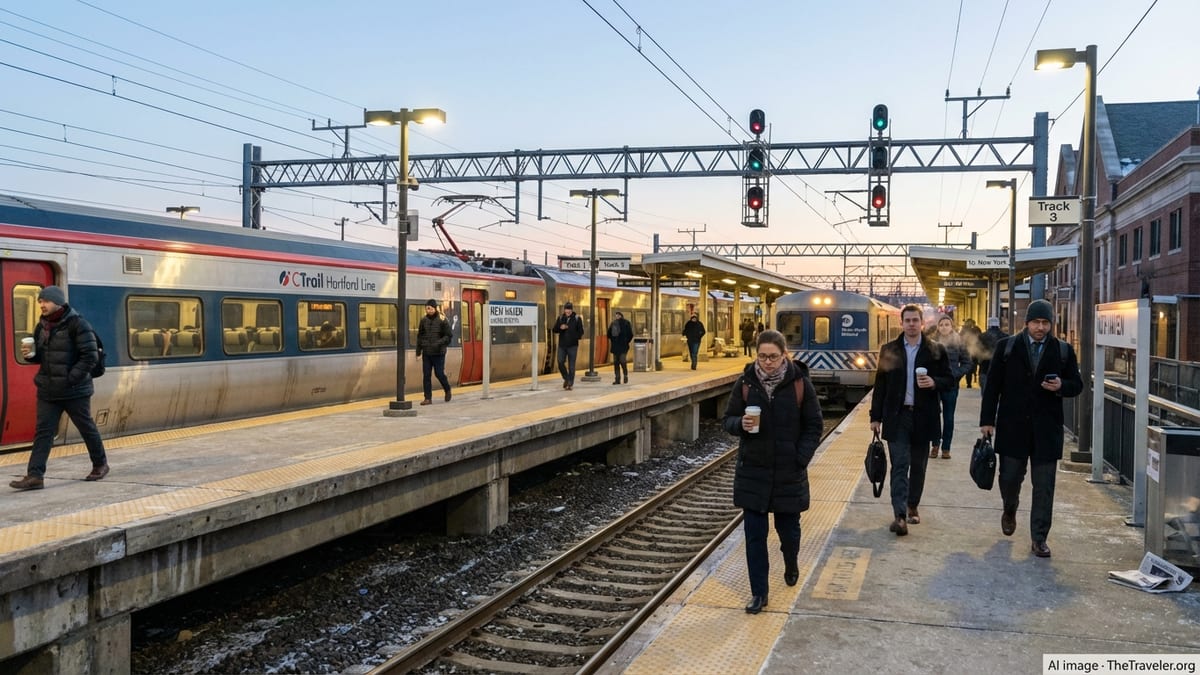
Collision near busy New Haven Line corridor
Reports indicate the incident occurred on the Metro-North New Haven Line in Norwalk, a stretch of track that carries thousands of passengers each weekday between New York City and communities across lower Fairfield County. Early accounts from local and regional news outlets describe a train traveling through the Norwalk area when it struck a teenager who was on or near the right-of-way.
Initial information made public so far has not detailed why the young person was on the tracks, nor whether the collision took place at a designated crossing, a station area or an open section of railroad. Published coverage notes that the teen was pronounced dead after the impact, with the location quickly secured while emergency responders and railroad personnel arrived on scene.
The Norwalk area has a long history as a rail junction connecting coastal Connecticut to New York, and the New Haven Line is a critical link for both daily commuters and regional travelers. Any serious incident on this corridor tends to have immediate ripple effects on train movements and highway traffic as riders seek alternate routes.
Service disruptions and delays for evening travelers
Following the collision, Metro-North service through Norwalk experienced significant disruption as trains were halted or slowed while responders worked in the area. According to publicly available timetable and alert summaries, some trains were held outside stations, while others were rerouted to different tracks, causing cascading delays along the New Haven Line.
Passengers posting on social media and local forums described trains standing for extended periods between stations and crowded platforms as people tried to rebook or wait out the disruption. In some cases, riders reported announcements referencing a “person struck by a train,” a phrase that has become unfortunately familiar to many frequent Northeast rail passengers when serious incidents occur on the right-of-way.
While normal operations gradually resumed after investigators cleared the scene, residual delays continued for some time, affecting both peak-period commuters returning to Norwalk and those traveling farther east toward Bridgeport and New Haven. For many riders, the inconvenience was secondary to the shock of learning that the disruption was tied to the death of a teenager in their community.
Investigation focuses on circumstances leading to impact
Publicly available information shows that standard post-incident procedures were initiated to examine the circumstances of the fatal collision. That process typically involves gathering data from the train’s onboard systems, reviewing available video from cab or station cameras, and documenting conditions along the track where the impact occurred.
At this stage, published coverage has not reported any official determination regarding how or why the teen came to be in the path of the train. Factors commonly examined in comparable incidents include the placement and condition of fencing, signage and pedestrian access points, recent reports of trespassing in the area, and the train’s speed and horn use prior to the collision.
Rail safety specialists often note that modern commuter trains require significant distance to stop, even in emergency braking. On busy main lines such as Metro-North’s New Haven corridor, trains can be operating at substantial speeds through Norwalk, leaving very little margin to avoid a collision once someone is on the tracks.
Community shock and renewed attention to rail safety
News of the teenager’s death has resonated in Norwalk and throughout southwest Connecticut, where many residents rely on Metro-North for daily commuting and school-related travel. Local discussions on community forums and social media reflect a mix of grief, concern for the teen’s family and friends, and questions about how such tragedies might be prevented in the future.
Recent years have seen ongoing conversations in Connecticut and neighboring states about safety along busy rail corridors, including calls for improved fencing near residential neighborhoods, clearer warning signs around informal crossings and more public education about the dangers of walking along active tracks. The Norwalk incident is likely to add urgency to those debates, particularly because it involves someone so young.
Rail safety campaigns commonly stress that railroad rights-of-way are restricted areas, even where tracks seem familiar or close to homes, schools or shopping districts. Advocates emphasize that trains can be far quieter and faster than many people expect, and that curves, bridges and station approaches can sharply limit a train operator’s ability to see a person in time to stop.
Travel considerations for visitors and commuters
For travelers planning trips through coastal Connecticut, the incident in Norwalk is a reminder that unexpected disruptions can affect even well-established rail routes. Trip-planning resources and rail service advisories suggest checking the latest train status information before heading to stations, especially in the hours after a serious incident, when schedules may still be recovering.
Visitors using Norwalk as a base to explore the region often rely on the New Haven Line to reach New York City, New Haven, Stamford and other destinations along Long Island Sound. When service is interrupted, local buses, rideshare options and interstate highways such as Interstate 95 and the Merritt Parkway can become crowded as passengers shift modes, lengthening travel times in and around the city.
While rail remains one of the safest modes of transportation overall, the teenager’s death near the Norwalk tracks underscores the importance of staying behind platform edge markings, using designated crossings and avoiding shortcuts that involve walking near or across active lines. For residents and visitors alike, heightened awareness around railway environments can help reduce the risk of future tragedies along this heavily used corridor.