


Landing at Tel Aviv Ben Gurion Airport can feel intense after a long flight, but the arrivals process is usually efficient if you know what to expect. From the moment your plane’s doors open to the moment you step into a taxi, train, or rideshare, each stage follows a clear pattern. This guide walks you, step by step, through immigration, baggage claim, customs, money, SIM cards and transport, with practical examples based on how Ben Gurion actually works in 2026.
Get the latest updates straight to your inbox!
First Steps Off the Plane and Finding Immigration
Most international flights arrive at Terminal 3, the main hub for Ben Gurion Airport. When you step off the aircraft, you will first pass through a corridor and follow yellow and black signs marked "Arrivals" and "Baggage Claim." These signs are bilingual in Hebrew and English, and in some areas also in Arabic and Russian. You do not need to make any choices yet: all arriving passengers are funneled toward passport control on the same level.
As you walk, you will pass information screens showing arriving flights and carousel numbers, but you do not need to worry about your bags until after immigration. There are also restrooms and drinking fountains along the way. If you require special assistance, such as wheelchair support, airline staff or an assistance provider should already be waiting at the aircraft door, and they will escort you down to passport control and beyond.
Before you reach the immigration hall itself, you may see signs reminding you about visa requirements and passport validity. Israel typically requires your passport to be valid for at least six months beyond your date of entry, and some nationalities need a pre-arranged visa, while many can enter visa free for short stays. If you are unsure, it is better to check with an Israeli consulate or airline before traveling rather than at the border itself.
Keep your passport and any supporting documents in hand from this point. Printed confirmations of your first hotel in Tel Aviv or Jerusalem, a return ticket, and basic travel insurance details can occasionally be requested, especially if you are visiting as a tourist without a pre-arranged visa.
Passport Control: E‑Gates, Interviews and Entry Slips
Ben Gurion’s passport control hall is broad, bright, and usually busy at the peaks of the day and night. Depending on your nationality and status, you will have two main options: automated border control e-gates or staffed immigration counters. Israeli citizens and many frequent travelers with biometric passports and pre-registration can use the e-gates, which often cut waiting time significantly, especially during the morning rush of European flights.
Most tourists and first-time visitors will proceed to the regular queues for foreign passports. Queues move in waves depending on how many flights arrive at once. At quiet times, such as midday on weekdays, you might clear immigration in 10–15 minutes. At busy times, like early Friday morning or after a cluster of North American flights in the evening, it can stretch closer to 45 minutes. Overhead screens and queue marshals will direct you to the next available booth.
At the counter, the immigration officer will scan your passport and usually ask a few short questions. Common topics include the purpose of your visit (tourism, business, visiting family), where you will stay (for example, a hotel near Tel Aviv's Rothschild Boulevard or a rented apartment in Florentin), how long you intend to stay, and whether you have a return ticket. Security and immigration questioning in Israel can be more detailed than in some other destinations, so it helps to stay calm, answer clearly and politely, and avoid jokes about security or politics.
Instead of stamping your passport, Israel issues a small printed entry slip that includes your personal details, the date of entry and the allowed duration of stay. This slip is printed at the booth or e-gate and handed to you. Guard it carefully and keep it with your passport, as hotels and car rental agencies may ask to see it, and you will need it if any questions arise when you leave the country. Once you have the slip in hand, you follow the signs toward baggage claim and customs.
Baggage Claim, Lost Luggage and Customs
After passport control, an escalator or ramp brings you down one level into the baggage claim hall. Large overhead displays list arriving flights with corresponding carousel numbers, so you simply match your flight number and walk to that belt. The area is modern and well lit, with restrooms, trolleys, information counters and a few vending machines around the perimeter.
Bags typically begin to appear about 15–30 minutes after landing, although this can vary by airline and time of day. Ben Gurion is not immune to delays, especially during traffic peaks or stormy winter weather, but handling is generally efficient. While waiting, it is a good moment to turn on your phone in airplane mode, connect briefly to the free airport Wi‑Fi, and check messages. The official Wi‑Fi network in the arrivals area covers most of the baggage hall and operates without a time limit, which is helpful if you need to coordinate a pickup or confirm an address.
If your luggage does not arrive, look for your airline’s baggage services desk near the carousels. For example, El Al, Turkish Airlines and other major carriers maintain their own or shared lost luggage offices within this zone. You will be asked to provide your baggage tag, boarding pass and a description of your suitcase. In most cases, delayed bags arriving on later flights are couriered to your Tel Aviv hotel or apartment at no extra charge, though this depends on the airline’s policy and the nature of the delay.
Once you have your bags, you proceed through customs. Israel uses a green lane and red lane system. If you have nothing to declare and are within personal import allowances, you simply follow the green "Nothing to Declare" exit. If you are carrying large amounts of electronics, high-value items, or more cash than the permitted threshold, you should choose the red lane for declaration. Most arriving tourists pass through customs in under a minute, with occasional random inspections.
Money, ATMs and SIM Cards in the Arrivals Hall
As you exit customs into the public arrivals hall of Terminal 3, you enter a broad concourse where friends and family wait behind barriers. Here you will find a selection of bank ATMs, currency exchange counters and mobile phone shops. The ATMs inside the terminal are usually operated by major Israeli banks and tend to offer more transparent conversion rates than dedicated currency exchange booths, which often advertise zero commission but use less favorable exchange rates.
Withdrawing a moderate amount of Israeli new shekels directly from an ATM is a practical choice for most travelers, especially for paying initial taxi fares or small purchases. Restaurants, hotels and many taxis in Tel Aviv and Jerusalem accept widely used credit and debit cards, but having at least a small amount of cash is useful for tipping or for smaller towns beyond the central region.
Several local operators sell prepaid SIM cards or plans from counters and small shops in the arrivals hall. In 2026, you can commonly find services associated with Partner, Cellcom, Pelephone and 019 Mobile, with counters usually clustered along the length of the public arrivals area. Packages change frequently, but typical tourist offers include a local Israeli number, unlimited or high-volume data and a validity period such as 7, 14 or 30 days. Prices are generally higher at the airport than in city branches, yet many travelers consider the convenience worth the premium after an overnight flight.
If you arrive late at night, some counters may be closed, although at least one major provider usually keeps extended hours to serve middle-of-the-night arrivals from Europe. If you do not strictly need an Israeli number, an international eSIM arranged before departure can be a good alternative, allowing you to connect instantly on landing and use airport Wi‑Fi to manage ride-hailing apps without hunting for a kiosk.
Exiting the Terminal: Taxis, Trains, Buses and Rideshares
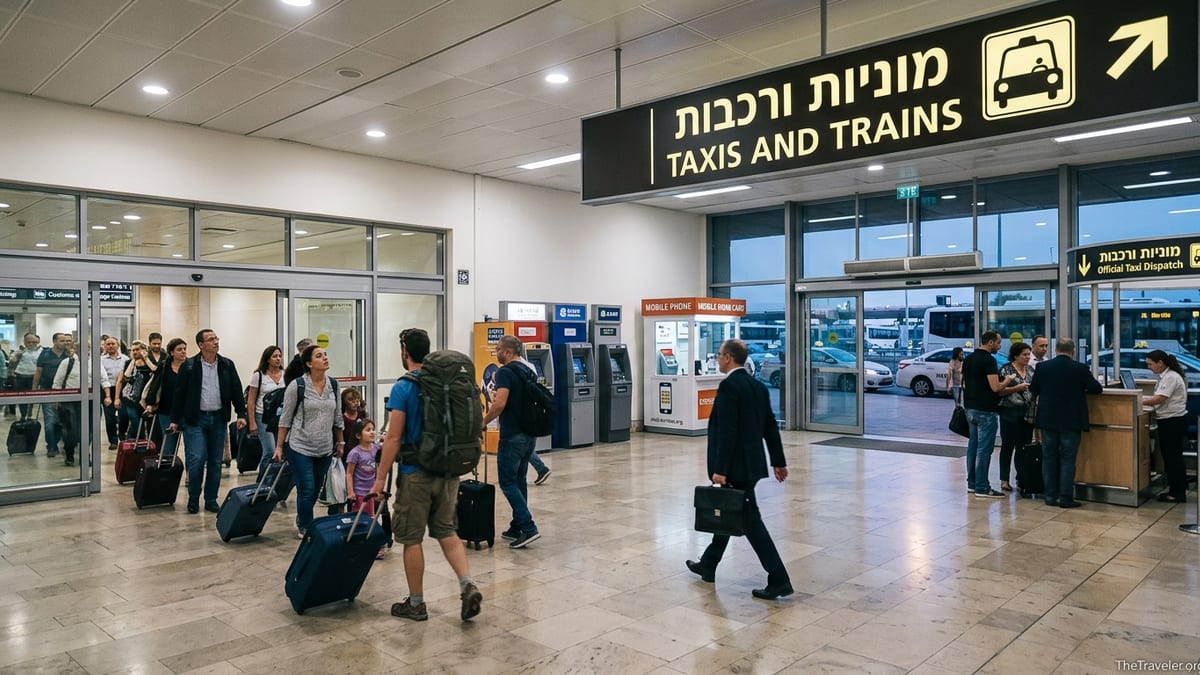
The main decision point before you physically leave Terminal 3 is how to get from the airport to your final destination. Signage throughout the arrivals hall directs you to three primary exit options: taxis, trains and buses. The exits are adjacent but on different levels, so checking signs carefully will save you time and backtracking with luggage.
Official taxis line up outside the arrivals hall on the ground level. Ben Gurion uses licensed taxi operators with regulated fares and a dispatcher system. You will usually see a central taxi desk near the exit where a dispatcher assigns vehicles and can provide an approximate fare based on your hotel’s address. Fares to central Tel Aviv can vary with traffic and time of day, but many visitors report a meter-based ride into the city center costing somewhere in the equivalent of a moderate restaurant meal for two. Night and weekend supplements apply, especially from Friday evening to Saturday evening during Shabbat. Drivers are accustomed to tourists, and credit cards are widely accepted, though it is still wise to ask before you get in.
The train is one of the fastest and most economical ways into Tel Aviv and other cities. Ben Gurion Airport’s train station sits directly beneath Terminal 3 on the lower level. From the arrivals hall, you take escalators or elevators down following the "Trains" signs. Trains run along the main coastal line, stopping at stations such as Tel Aviv HaHagana, HaShalom and Savidor Center, as well as continuing north or south at different times of day. Services are frequent during the week, often every 20–30 minutes, with reduced or suspended service on Friday evenings and Saturdays due to the national railway schedule.
If you arrive when trains are not running, intercity and regional buses are the main public transport alternative. Several companies operate lines that serve the airport, with bus stops typically located on the upper roadway outside Terminal 3. For instance, there are routes linking the airport to central Tel Aviv and to cities such as Jerusalem and Beersheba. In practice, many visitors still prefer the train for convenience when it is running, or a taxi or pre-booked shuttle if arriving during Shabbat or late at night.
Transport Apps, Car Rentals and Late-Night Arrivals
Most international ride-hailing platforms have limited or changing operations in Israel due to local regulations, so visitors generally rely on licensed taxis and local apps. One common approach is to take an official airport taxi to your accommodation, then use urban transport apps once you are settled. In Tel Aviv, popular local services and taxi dispatch apps provide app-based bookings and estimate fares in advance, similar to ride-hailing in other countries, but you usually only access these easily once you have a local SIM or a stable data connection.
Car rental desks for major companies, including both international brands and local firms, are concentrated in the arrivals level or one level above, depending on the company. Many operate 24 hours or with on-call staff for flights that arrive very late. If you have prebooked a rental car, you typically complete paperwork at the counter inside the terminal, then take a short shuttle or walk to the parking area where the vehicles are stored. For a first-time visitor planning to stay mostly in Tel Aviv or Jerusalem, public transport and taxis are usually easier than driving immediately after landing.
Late-night arrivals deserve special planning. If you land after midnight on a weeknight, the train service may still be limited, and some bus routes run less frequently. During Shabbat, from Friday evening until Saturday evening, public trains do not usually operate and many bus lines are paused or on reduced schedules. In this case, arranging a taxi or private transfer in advance, or budgeting for a metered ride into the city, helps avoid stress. Hotel reception teams in Tel Aviv are used to these patterns and can often book a reliable transfer for you.
Parents traveling with children should know that Israeli law requires appropriate child seats in private vehicles. Taxi companies sometimes provide them if requested in advance, but it is not guaranteed. Some families choose to bring their own lightweight travel booster or car seat and either book a private transfer that confirms appropriate equipment or rely more on the train into Tel Aviv before switching to smaller taxis within the city, where rides are short and easier to coordinate.
What to Do Before Leaving the Terminal
Once you have passed customs and entered the public hall, it can be tempting to rush straight for the door, especially after an overnight flight. A few minutes of organization inside the terminal, however, can make your first day in Israel smoother. This is the best time to confirm your phone connectivity, withdraw local currency, hydrate and double-check your onward transport plan while you are still in a controlled, well-signed environment.
Start by confirming that your phone and data are working, either through airport Wi‑Fi, a newly installed local SIM or a prearranged eSIM. Open your accommodation booking and note the exact address and neighborhood. Many Tel Aviv streets have similar names, and telling a driver only that you are going to "near the beach" or "near Rothschild" can lead to confusion. Having the name, street and nearby landmark, such as "next to Dizengoff Center" or "close to the Carmel Market," makes directions much easier.
Next, take a moment to check transport options in real time. Look at the current train schedule from the airport station to Tel Aviv or Jerusalem, and compare it with taxi availability outside. If there is a train leaving in ten minutes, it may be worth heading straight down to the platform. If the next service is much later, you might choose a taxi instead, especially if you have several suitcases or small children in tow.
Finally, confirm that you have your passport, entry slip, boarding passes, baggage tags and any medication or valuables securely packed before you exit into the open air. Ben Gurion is considered relatively safe and well monitored, but the arrivals area can still be crowded, and it is easier to fix problems such as a lost phone or missing bag tag while you are still near airline counters and airport information desks.
The Takeaway
Arriving at Tel Aviv Ben Gurion Airport in 2026 is a structured process that feels far less chaotic when you know the sequence: follow the signs to immigration, answer straightforward questions, collect your printed entry slip and proceed to baggage claim, customs and the arrivals hall. Each stage is designed to be intuitive, and English is widely used in signage and staff communication.
With a little preparation, you can also keep costs and stress under control. Having a rough idea of taxi prices, knowing where the train station is, and deciding in advance whether you will buy a local SIM card at the airport or rely on an eSIM can save both money and confusion. Travelers who pause for ten minutes inside the terminal to get organized often arrive at their Tel Aviv hotel feeling far more relaxed than those who rush outside and make decisions at the curb.
Most importantly, remember that Ben Gurion is accustomed to international visitors of all kinds, from solo backpackers to business travelers and families with small children. Staff are used to fielding questions in English, and assistance is readily available if you look for the information desks or airline representatives. Treat your first hour on the ground as part of the journey rather than a barrier, and you will step into Tel Aviv ready to enjoy the city rather than recover from the airport.
FAQ
Q1. How long does it usually take to clear immigration at Ben Gurion Airport?
At quieter times, many travelers clear immigration in around 10–20 minutes, but during busy arrival peaks it can take up to 45 minutes or slightly longer, depending on queues and security checks.
Q2. Will my passport be stamped when I arrive in Israel?
In most cases, your passport is not stamped. Instead, you receive a small printed entry slip with your details and length of stay. Keep this with your passport during your trip.
Q3. Is there free Wi‑Fi in the arrivals area at Ben Gurion?
Yes, the airport offers free Wi‑Fi in the terminal, including the arrivals and baggage claim areas. You can usually connect without time limits, which is useful for contacting your hotel or arranging transport.
Q4. Where can I buy a SIM card when I land?
Prepaid SIM cards are sold by local operators such as Partner, Cellcom, Pelephone and 019 Mobile at counters in the public arrivals hall of Terminal 3, usually along the main concourse after customs.
Q5. Is it better to take a taxi or train into Tel Aviv?
The train is typically faster and cheaper during its operating hours, with direct service from the station under Terminal 3 to several Tel Aviv stops. Taxis, while more expensive, are available at all hours and drop you directly at your hotel.
Q6. Are taxis from Ben Gurion Airport regulated?
Yes, official airport taxis are licensed and operate on regulated meter-based fares, often with night and weekend supplements. It is a good idea to confirm that the meter is used and to ask whether card payment is accepted before departing.
Q7. Can I withdraw local currency at the airport?
Yes, ATMs operated by major Israeli banks are available in the arrivals hall and typically offer straightforward cash withdrawals in shekels. Currency exchange counters also exist, though their rates are not always as favorable.
Q8. What should I do if my luggage is lost or delayed?
If your bag does not appear on the carousel, go directly to your airline’s baggage services counter in the baggage hall. Provide your baggage tag and flight details so staff can trace your suitcase and arrange delivery or pickup.
Q9. How late do trains and buses run from the airport?
Train and bus schedules vary by day and time, with reduced or no train service from Friday evening to Saturday evening during Shabbat. It is wise to check real-time timetables on arrival and have a taxi as a backup option for very late or weekend arrivals.
Q10. Is Ben Gurion Airport accessible for travelers with reduced mobility?
Yes, the airport provides accessibility features such as elevators, ramps and assistance services that can be arranged through airlines or ground handlers. Staff can help with moving through security, immigration and boarding or disembarking if requested in advance.