


Landing at Tel Aviv’s Ben Gurion Airport and heading straight to the Dead Sea is one of the classic first-day moves in Israel. The distance is not huge, but the combination of jet lag, desert roads, limited public transport and security considerations means it pays to understand your options before you walk out of arrivals. This guide breaks down the real-world routes, costs and timing from Ben Gurion to the Dead Sea hotel strip at Ein Bokek and nearby areas, and helps you decide whether going direct after landing actually makes sense for your itinerary.
Get the latest updates straight to your inbox!
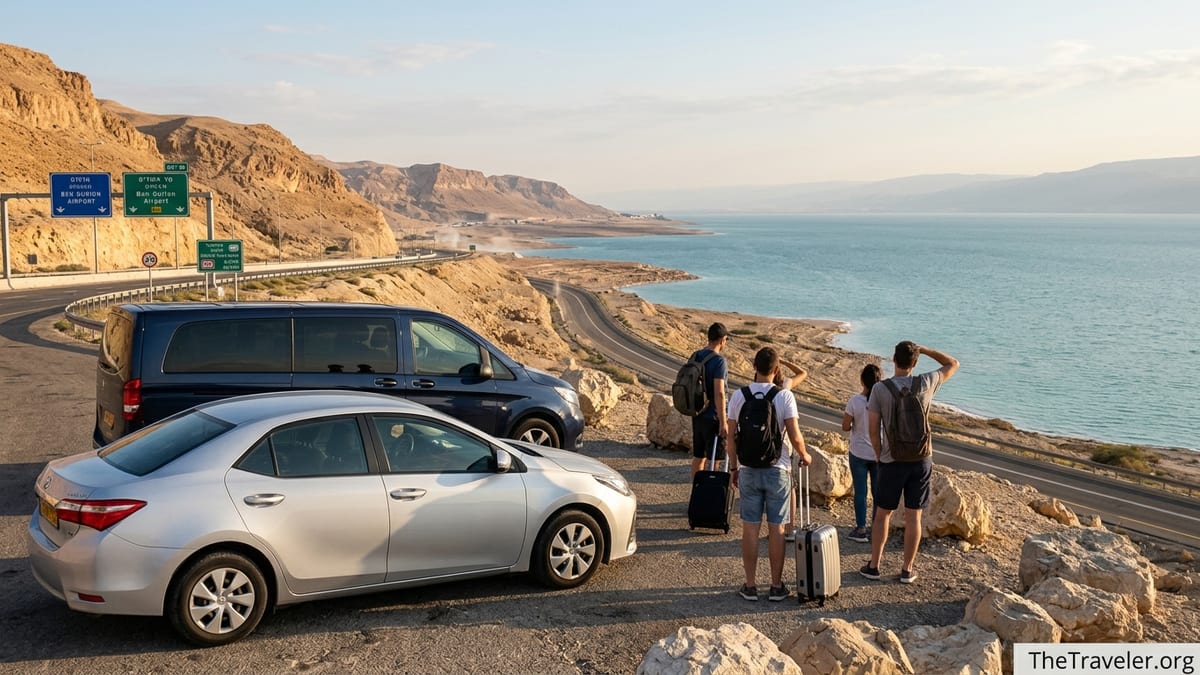
Understanding the Route from Ben Gurion to the Dead Sea
Ben Gurion Airport sits between Tel Aviv and Jerusalem, while the main Dead Sea hotel area at Ein Bokek is roughly a 2 to 2.5 hour drive away under normal traffic. Most routes use Highway 1 toward Jerusalem and then drop down through the Judean Desert to meet Route 90, the main north–south highway along the Dead Sea. You are essentially crossing from Israel’s coastal plain into the desert in a single drive, which means sharp elevation changes, winding sections and, in summer, very high temperatures.
In practical terms, travelers end up choosing between two variations of the same basic road: either driving via Jerusalem directly to the Dead Sea, or going first into Tel Aviv or Jerusalem for a night and then continuing the next morning. Online transfer companies commonly list the distance at around 150 to 160 kilometers from Ben Gurion to Ein Bokek, with advertised driving times of about 1 hour 45 minutes in light traffic, though 2 to 2.5 hours is more realistic once you account for congestion around the airport and on Highway 1.
The final stretch along Route 90 runs parallel to the Dead Sea itself. It is visually spectacular but has a reputation as one of Israel’s more accident-prone roads, mainly because of speeding and overtaking. Drivers unfamiliar with desert roads should factor this in when deciding whether to tackle the trip straight after an overnight flight or late at night.
Most first-time visitors head either to Ein Bokek, which is a purpose-built resort strip with large hotels and public beaches, or to the smaller spa cluster around Neve Zohar a few minutes further south. Your exact hotel location will only change the journey by 10 to 20 minutes, but it makes a difference when booking transfers or checking bus stops, so have the full hotel name ready at the airport.
Private Transfers Direct from Ben Gurion Airport
For many travelers, especially after a long-haul flight, a private transfer from Ben Gurion directly to the Dead Sea is the most straightforward option. Several international and local operators offer pre-booked cars with an English-speaking driver waiting in arrivals. Typical quoted times are about 1 hour 45 minutes from Terminal 3 to Ein Bokek in low traffic, though 2 hours or more is common during the daytime when Highway 1 is busy.
Prices vary with vehicle size and provider, but as of 2026 many airport transfer companies list one-way rates from roughly 330 to 400 US dollars for a standard car or small van for up to three passengers, with larger vans and minibuses scaling up from there. Some international booking platforms display prices in the range of just under 400 US dollars for a private sedan from Ben Gurion to the Dead Sea hotel strip, while Israeli taxi specialists often quote around 800 to 900 shekels for a regular taxi on this route, depending on time of day and surcharges. These are broad indicators rather than fixed fares, but they give a realistic order of magnitude.
Where private transfers shine is in handling luggage and logistics. Most drivers will meet you at the arrivals hall with a sign, assist with bags, and drive you directly to your exact hotel entrance in Ein Bokek or Neve Zohar. This avoids hauling suitcases through train and bus stations, which can be especially valuable if you are carrying bulky spa gear, medical supplies, or simply multiple suitcases for a longer trip. Some companies will also incorporate short scenic stops, for example at a Judean Desert lookout, if agreed in advance and time allows.
The main downsides are cost and inflexibility. If your flight is significantly delayed or you are held up at passport control, you may incur waiting fees unless the company tracks flights and explicitly includes delays in its policy. It is worth checking the small print when booking and confirming that the car is large enough for both passengers and luggage, particularly for families bringing strollers or hard-shell cases.
Driving Yourself: Rental Cars and Route Choices
Renting a car at Ben Gurion and driving yourself to the Dead Sea gives you maximum freedom and can be cost-effective for couples or families staying several days. All major rental brands have desks in the terminal area, and many travelers pick up their car within an hour or two of landing. Daily rates fluctuate strongly by season and demand, but compact cars are often priced in the range of a typical Western European rental, with added costs for one-way drop-offs or extra drivers.
The most common self-drive route is to follow signs from the airport to Highway 1 toward Jerusalem, then continue past the main Jerusalem exits and descend into the Judean Desert, joining Route 90 near the northern basin of the Dead Sea. From there you drive south along the shoreline to Ein Gedi and further on to Ein Bokek. Navigation apps like Waze are widely used in Israel and particularly recommended, as they tend to reflect current roadworks, closures and traffic police checks more accurately than many international mapping apps.
Drivers should be aware that Route 90, particularly the Dead Sea section, is a long, relatively isolated road with limited shade, occasional flood closures in winter, and a history of serious accidents. Israeli and international road safety organizations highlight it as a route where speeding and risky overtaking are a problem. In practice this means sticking strictly to speed limits, avoiding unnecessary overtaking and planning fuel and rest stops ahead of time. The scenery is beautiful but concentration is essential, especially if you are tired from an overnight flight.
On the positive side, having your own car makes it easy to combine Dead Sea time with side trips to places like Masada National Park or the Ein Gedi nature reserve. For example, a traveler landing at Ben Gurion in the morning might pick up a rental car, drive to Masada for an afternoon visit, and then continue 20 minutes south to their hotel at Ein Bokek. Parking is generally straightforward at Dead Sea hotels, though daily parking fees may apply at some properties, so it is worth checking this when you book your room.
Via Jerusalem: Train and Bus Combinations
There is no direct public transport from Ben Gurion Airport to the Dead Sea resorts, so budget-conscious travelers typically route via Jerusalem. A frequent modern train connects Ben Gurion’s Terminal 3 to Jerusalem’s main railway station at Yitzhak Navon in under 30 minutes. From there it is a short walk to the Jerusalem Central Bus Station platforms, where long-distance buses depart for the Dead Sea and Eilat.
Intercity buses operated by Israeli companies run from Jerusalem toward the Dead Sea along Route 90. A common pattern is a bus that starts at Jerusalem Central Bus Station, travels through the Judean Desert, passes the northern Dead Sea area and continues south to stops such as Ein Gedi, Ein Bokek and Neve Zohar. Travel time from Jerusalem to Ein Bokek is often around 1.5 to 2 hours depending on stops and traffic, so from the airport you should expect a total journey of roughly 3 to 3.5 hours when including transfers and waiting times.
Public transport has several caveats. Services do not generally operate from Friday afternoon until after sunset on Saturday due to Shabbat, which can completely remove the train and many bus options during that window. Timetables can also change and may be reduced on holidays, security-related days or during extreme weather. For example, heavy rains in the Judean Desert sometimes trigger flash-flood closures on parts of Route 90, temporarily suspending buses along the Dead Sea. Travelers relying on public transport should always check schedules close to travel day and have a back-up plan, such as staying in Jerusalem overnight.
In terms of comfort, the train from Ben Gurion to Jerusalem is modern and air-conditioned, and long-distance buses to the Dead Sea typically have luggage holds underneath where you can stow large suitcases. You will, however, still need to handle your luggage through stations and bus platforms, and be prepared for the occasional standing-room-only segment leaving Jerusalem on busy days.
Joining Group Tours and Dead Sea Day Trips
Another way to reach the Dead Sea from Ben Gurion is indirectly, by joining an organized day trip that starts from Jerusalem or Tel Aviv. Many tour operators offer combined Masada and Dead Sea excursions, with hotel pickups in the two cities and a schedule that includes the desert ascent to Masada in the morning, followed by floating time and spa facilities at the Dead Sea in the afternoon.
If your flight lands early, one practical strategy is to travel first from the airport into Jerusalem or Tel Aviv, check into your hotel for at least one night, and then let a tour company handle the logistics to the Dead Sea the next day. Typical tours include bus or minivan transport, an English-speaking guide, entry to Masada, and access to a Dead Sea beach or spa hotel. While exact prices shift with season and inclusions, per-person rates often sit in the moderate range for a full-day excursion, with optional upgrades for smaller groups.
Some operators can arrange airport pickups that connect directly to their Dead Sea tours, especially for private or semi-private groups. For example, a family of four could be met at Ben Gurion, driven to Jerusalem, drop off main luggage at a hotel and then continue with the same vehicle to Masada and Ein Bokek before returning to Jerusalem in the evening. These arrangements are highly customizable but need to be booked well in advance and will cost significantly more than standard group tours starting in the city center.
The big advantage of joining a tour is peace of mind. You do not need to worry about desert driving, parking at Masada, or finding a public beach that offers showers and changing rooms. For travelers visiting Israel for the first time or those with limited mobility, this can make the experience noticeably smoother. The trade-off is a fixed timetable: you will have less freedom to linger at a viewpoint or extend your soak in the Dead Sea beyond what the group schedule allows.
Luggage, Arrival Timing and Going Direct After Landing
A key decision is whether to travel straight from Ben Gurion to the Dead Sea after landing or to overnight in Tel Aviv or Jerusalem first. In theory, going direct is appealing: you can float in the Dead Sea on day one and wake up to desert sunrise. In practice, it works best when your flight arrives in the morning or early afternoon, you are not severely jet-lagged, and you have arranged a private transfer or are comfortable with a desert drive in daylight.
Consider a typical long-haul arrival from North America landing around 8:00 or 9:00 in the morning. By the time you clear passport control, collect luggage and pick up a rental car or find your transfer driver, it may be close to 10:30. A daytime drive of 2 to 2.5 hours puts you at Ein Bokek around early afternoon, which is ideal for checking into your hotel and enjoying a first float before sunset. In this scenario, going direct from the airport can be an efficient use of your first day.
The calculation changes for late-night arrivals or very long flights. A traveler landing at 22:15 after a 16-hour journey faces a desert drive that would largely take place in darkness, with reduced visibility on Route 90 and a strong risk of fatigue. Even with a private transfer, you will not reach the Dead Sea until after midnight, which can be disorienting and offers no first-day scenery. Many seasoned visitors in this situation prefer to sleep near the airport or in Tel Aviv and continue to the Dead Sea the following morning when they are rested and can appreciate the views.
Luggage handling is another factor. If you are carrying heavy or multiple suitcases, a direct private transfer that goes from airport arrivals to your hotel door is the least stressful. With public transport, you must navigate station escalators, train platforms and bus bays with your bags, which can be challenging after a red-eye flight. Families with young children or older travelers often find the extra cost of a transfer worthwhile purely to simplify the first few hours on the ground.
Safety, Seasonality and Practical Tips on the Ground
When planning any route from Ben Gurion to the Dead Sea, it is important to keep both road safety and regional security in mind. Official travel advisories for Israel are updated frequently and note that the security situation can change quickly. Travelers should review the latest guidance from their own government before departure and stay informed about any incidents or road closures that might affect Highway 1 or Route 90.
From a road-safety perspective, the main concern on the Dead Sea section of Route 90 is aggressive driving. Local drivers sometimes overtake on curves or exceed posted speed limits, and accident statistics over the last two decades show a higher-than-average rate of serious collisions along parts of this highway. The practical takeaway is to drive defensively, avoid overtaking unless absolutely necessary and legal, and build extra time into your schedule so you do not feel pressured to rush, especially when descending from the highland near Jerusalem into the desert.
Season also matters. In summer, temperatures around the Dead Sea can climb well above 40 degrees Celsius in the afternoon. Cars left in the sun heat up rapidly, and breakdowns become more uncomfortable and potentially risky. Ensure your rental has effective air conditioning, carry extra water in the vehicle and, if possible, schedule your drive in the cooler morning hours. In winter, the issue is not cold but sudden desert rainstorms that can trigger flash floods in the wadis crossing Route 90, occasionally forcing temporary closures. Navigation apps, local news and hotel staff can all help you check same-day conditions.
Finally, remember that you are descending to the lowest land point on Earth. Some travelers with respiratory or cardiac conditions report breathing a little easier at the Dead Sea due to the thicker air and higher oxygen content, while others may need time to adjust. Regardless of your health status, use the first day to hydrate, rest and keep your Dead Sea float sessions relatively short until you see how your body responds. Treat the transfer from Ben Gurion as part of this acclimatization, not as a race to tick off another site.
The Takeaway
Traveling from Tel Aviv’s Ben Gurion Airport to the Dead Sea is entirely feasible on arrival day, but the best route depends on your arrival time, budget, comfort with driving and tolerance for logistics after a long flight. A pre-booked private transfer offers the simplest, most seamless option, taking you and your luggage directly to your hotel door in Ein Bokek in roughly two hours of driving. A rental car opens up side trips and flexibility but demands alert, confident driving on desert roads that are beautiful yet unforgiving.
For budget travelers, routing through Jerusalem by train and bus is a viable plan, provided you avoid Shabbat hours and are prepared to manage your bags through multiple transfers. Organized tours from Jerusalem or Tel Aviv work well if you prefer to let someone else handle the driving while you focus on the experience of Masada and the Dead Sea, even if that means delaying your first float until day two.
Above all, be realistic about fatigue and safety. A late-night arrival followed by a long desert drive rarely makes for a relaxing start to a holiday. If in doubt, spend the first night closer to the airport or in one of the main cities, then head to the Dead Sea the next morning when daylight, coffee and clear roads work in your favor.
FAQ
Q1. How long does it take to get from Ben Gurion Airport to the Dead Sea?
In light traffic, a direct drive usually takes around 2 to 2.5 hours from Ben Gurion to the Ein Bokek hotel strip, not including any stops.
Q2. Is it safe to drive from the airport to the Dead Sea at night?
It is possible but not ideal, especially after a long flight. Route 90 has a history of accidents and unfamiliar drivers may find night driving on desert roads tiring and stressful.
Q3. Are there direct buses from Ben Gurion Airport to the Dead Sea?
As of 2026 there are no regular direct buses from the airport to the Dead Sea resorts. Most public transport routes require going via Jerusalem or Tel Aviv first.
Q4. What is the most comfortable option right after landing?
A pre-booked private transfer is generally the most comfortable, with a driver meeting you in arrivals, helping with luggage and taking you door to door to your Dead Sea hotel.
Q5. Can I take the train from Ben Gurion Airport all the way to the Dead Sea?
No. The train only runs as far as cities like Jerusalem or Tel Aviv. To reach the Dead Sea you must switch to a bus, private transfer, tour or rental car.
Q6. Is renting a car at the airport a good idea for visiting the Dead Sea?
Yes, if you are confident driving in a new country and on desert highways. A rental car gives flexibility for side trips to Masada and Ein Gedi, but demands careful, alert driving.
Q7. How much does a private transfer from Ben Gurion to the Dead Sea cost?
Prices vary by company and vehicle size, but many providers quote roughly the equivalent of several hundred US dollars for a standard private car from the airport to Ein Bokek.
Q8. Should I go straight to the Dead Sea after an overnight flight?
It can work if you land in the morning, feel reasonably rested and travel in daylight. For very late or exhausting flights, many travelers prefer to sleep in Tel Aviv or Jerusalem first.
Q9. What about luggage if I travel via Jerusalem by public transport?
You will need to handle your own bags on trains and buses, but long-distance coaches usually have under-floor luggage holds, and stations have elevators or escalators in most areas.
Q10. Are group tours a good way to reach the Dead Sea from Ben Gurion?
Indirectly, yes. You typically transfer to Jerusalem or Tel Aviv first, then join a Masada and Dead Sea tour. It is a convenient option if you prefer not to drive yourself.