


Tel Aviv’s Ben Gurion Airport has a reputation for having some of the strictest and most sophisticated aviation security in the world. For first-time visitors, the process can feel intense, personal and very different from what you might know from airports in Europe or North America. With a bit of preparation, though, it becomes much more predictable. This guide walks you step by step through arrival and departure security at TLV, explains why it feels different, and offers practical tips for solo travelers, families and business passengers.
Get the latest updates straight to your inbox!
Why Ben Gurion Security Feels So Different
The first thing that makes Ben Gurion stand out is its philosophy. Instead of concentrating only on what is in your bags, Israeli security puts strong emphasis on who you are, where you have been and why you are traveling. That is why you will encounter detailed questioning and multiple layers of checks long before you board your flight. Even seasoned travelers who breeze through security at airports like Heathrow or JFK often find TLV more probing and personal.
Another striking difference is how visible security is in public areas. At Ben Gurion you will likely see armed guards at the road entrance, cameras and sensors around the terminal, and plainclothes staff observing passenger behavior. This layered defense starts before you even step out of your taxi. Many travelers describe how their driver’s car may be briefly stopped at a gate outside the terminal, where guards visually inspect vehicles or ask in a casual tone where you are flying that day.
Technology also plays a major role. Ben Gurion uses an integrated system for screening checked bags and carry-on luggage, and the airport authority describes automatic inline baggage screening that happens after you hand over your suitcase at check-in. For you as a passenger this usually feels seamless, but it explains why some bags are pulled aside later for additional inspection or interviews at the gate.
The overall result is an experience that can feel both more personal and more controlled than elsewhere. Travelers often leave with the sense that staff are actually trying to understand them, not just rush them through an X-ray machine. That human focus is what many frequent flyers say they remember most about security at TLV.
Arriving at Ben Gurion: First Security Impressions
For most visitors, security on arrival is relatively light compared with departure, but it still feels different from many other airports. After your plane lands, you disembark and follow the standard route to passport control. On the way you might notice cameras and security personnel watching the flow of passengers. Occasionally, officers may pull aside passengers from specific flights or routes for short questions before they reach immigration.
At passport control, the interaction can be straightforward, especially if you are coming for tourism or business and hold a passport from North America or Western Europe. Israel currently uses an entry card system instead of stamping most passports. The border officer typically scans your passport, may ask a few questions such as where you will be staying in Israel, how long you plan to visit, or whether you have visited certain countries recently, and then prints a small blue or white entry slip with your photo which you must keep with you during your stay.
Some travelers, however, experience more detailed questioning. This is more likely if you have visited destinations that Israel considers higher risk, if your travel plans look unusual, or if your answers are vague. For example, a backpacker who spent several months in countries across the Middle East might be invited to a separate desk, where another officer asks about their route, people they met and exact places they stayed. This can add 20 to 40 minutes to the arrival process, so travelers with tight onward connections should keep the possibility of delay in mind.
Once you pass passport control, you collect your bags and walk through customs. Random bag checks do occur, but most passengers simply walk through the green channel without being stopped. Outside the customs doors, security presence is less visible and the focus shifts to standard airport services such as ATMs, car rental counters and the Ministry of Tourism information desk.
Departure Security: From Curbside to Gate
The most distinctive part of the Ben Gurion experience begins when you depart Israel. Security starts before you even enter the terminal building. As your taxi, shared shuttle or private car approaches Terminal 3, expect to pass through a vehicle checkpoint. Guards may look into the car, ask where you are flying and check IDs, especially during periods of heightened alert. Many passengers encounter only a quick wave-through, but at busy times there may be short queues of cars.
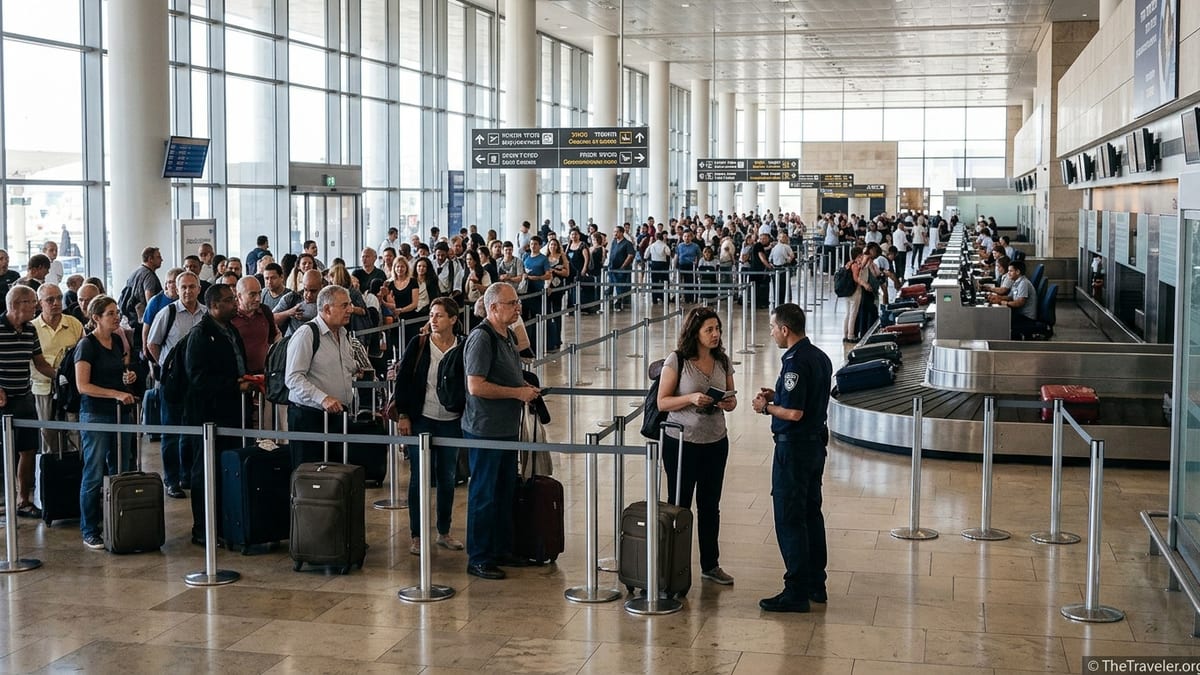
Once inside the terminal, most international passengers head to the large departures hall. Unlike many airports where you can check in online and head straight to security, at TLV the security questioning usually happens before check-in or right beside the check-in desks. You will see separate security stations, sometimes marked by lines of stanchions with staff directing passengers to interview points. An agent may call you forward, look at your passport and ticket, and begin asking questions about your stay in Israel and your travel history.
After questioning, your luggage receives an initial screening. At busy times you might be directed to place checked bags on a separate belt where they are scanned before you proceed to the airline counter. In other cases, your suitcase may go straight to the conveyor belt after check-in, where it enters the automatic hold baggage screening system operated by the airport. If something triggers additional interest, staff might call you back to open your bag in a nearby inspection room. Travelers report that this is relatively common if you carry professional camera equipment, musical instruments or dense electronics.
Only after this first security step can you move on to passport control and the main carry-on screening area. Boarding passes are checked again, and you go through a more familiar process of metal detectors and X-ray machines. However, even here staff may ask further questions, and random deep inspections of laptops, camera bodies and even books or notebooks are common. It is not unusual for a security officer to swab electronics for traces of explosives or to scroll briefly through a laptop to confirm it is a functioning device.
Security Questioning: What You Are Likely to Be Asked
For many travelers, the face-to-face interview is the most stressful part of flying from Ben Gurion. Security agents are trained to ask open questions and notice inconsistencies or nervous behavior. Their tone can range from very friendly to quite brisk, but the goal is always to understand whether you and your luggage match a normal, low-risk profile.
Questions frequently focus on the purpose of your trip. A typical exchange might start with, “Why did you come to Israel?” followed by “Where did you stay?” and “Did anyone else have access to your luggage?” Tourists staying at a well-known Tel Aviv hotel or a booked apartment in Jerusalem can often answer in a sentence or two. If you mention staying with friends or volunteering, expect follow-up questions about where your hosts live, how you know them and whether you met anyone new through them.
Agents also look closely at your travel history. A German backpacker who spent a week in Jordan before entering Israel might be asked which border crossing they used, whether they visited Petra or Wadi Rum, and if anyone in Jordan gave them a package to bring. Someone with recent stamps from countries like Lebanon or Iran can face more in-depth questioning and possibly a secondary screening area, where a more senior officer continues the conversation.
The key for passengers is to answer calmly, honestly and specifically. Vague responses like “I stayed with some people I met online” or “I just walked around” almost always lead to further questions. Bringing printed confirmations of hotel reservations, tour bookings, or conference invitations can be very helpful. Business travelers often find that presenting a letter on company letterhead outlining the purpose of their trip helps the interview move faster.
Timing Your Arrival and Managing Long Lines
Because of the multi-layered process, you should plan more time at Ben Gurion than you would at most other international airports. Airlines and the Israel Airports Authority commonly recommend arriving three hours before departure for international flights. In busy periods such as major Jewish holidays, summer school vacations or large events in Israel, many frequent travelers intentionally arrive three and a half to four hours before departure to be safe.
Consider a real example. A morning flight to Europe leaving around 09:00 might see waves of passengers arriving between 05:00 and 06:30. At that time, the line for initial security questioning can stretch across part of the terminal. Passengers with only carry-on baggage and online check-in still have to pass through this interview point, which means your minimal luggage does not reduce the time spent in line as much as it would in other airports.
On the other hand, late-night departures to North America can experience sporadic peaks and lulls. Some travelers report sailing through questioning, check-in and screening in under 40 minutes when arriving just after a rush period. Since you cannot perfectly predict crowd levels, build in a buffer. It is better to have an extra hour airside to browse duty free or have a coffee than to risk missing your flight because you were delayed at a security checkpoint.
Families with small children, elderly travelers and those with disabilities can often access dedicated lines or receive help from staff, especially at passport control and the carry-on screening area. If someone in your group needs extra time or uses mobility aids, mention it early to an agent. The airport provides assistance services that must usually be arranged through your airline in advance, but on the day staff will still try to guide you through in a manageable way.
Luggage Screening, Electronics and Special Items
Luggage screening at TLV is comprehensive. Checked bags are scanned by an automated system that looks for suspicious shapes or densities. Most passengers never see this process, but its impact becomes clear when an airline agent calls someone back to open their suitcase, even though it has already disappeared behind the conveyor belt. Items such as heavy power tools, large quantities of batteries or tightly packed electronics are common triggers for extra checks.
Carry-on baggage passes through standard X-ray machines after the main security interview and check-in. However, security staff pay very close attention to electronics. Travelers almost universally report being asked to remove laptops and tablets from their bags, and many also have to take out camera lenses, external hard drives, microphones or even e-book readers. It is wise to pack your cabin bag so that these items are easy to access and repack quickly.
Some categories of items attract particular scrutiny. A solo traveler carrying multiple smartphones, for example, may be asked who each phone belongs to and why they need them. Musicians with guitars or violins in hard cases should be prepared to open the instrument and sometimes play a few notes while staff watch, simply to confirm there is nothing hidden inside. Professional photographers sometimes find that staff inspect every lens carefully and may swab equipment for explosive traces.
Liquids follow international rules similar to Europe: generally small containers in a transparent plastic bag. Security officers at TLV tend to enforce the regulations strictly. A half-finished 500 ml bottle of water will almost certainly be thrown away at screening, and large bottles of local wine need to go into checked luggage unless purchased after security in duty free. When in doubt, pack liquids into checked bags or be ready to discard them.
Solo Travelers, Families and “Sensitive” Profiles
Solo travelers often feel more exposed during questioning at Ben Gurion, simply because there is no group to blend into. A lone backpacker who has been couchsurfing or moving between hostels, for instance, may attract more curiosity than a couple on a package tour staying at a beach resort. This does not mean solo travelers are treated unfairly, but they should be prepared with clear, confident explanations of their routes and accommodation.
For example, a solo American digital nomad who spent a month working from cafes in Tel Aviv might be asked how they supported themselves, which coworking spaces they used and whether they knew anyone locally. Answering in simple, concrete terms, such as “I work remotely for a software company in New York, I used a coworking space in Rothschild Boulevard, and I rented an apartment in Florentin through a booking platform” usually satisfies the officer quickly.
Families with children often receive a different tone. Officers may ask parents if they packed everyone’s bags and whether any gifts for the children were given by friends. Teenagers can be questioned directly about where they went during the trip or whether they left their bags unattended. In separated or blended families, be ready with documents showing parental responsibility if only one adult is traveling with children, as staff sometimes ask about the relationship between adults and minors.
Travelers whose backgrounds intersect with politically sensitive areas, such as journalists, activists or people with extensive travel in neighboring countries, should assume they may face longer interviews and more detailed bag inspections. Many journalists, for example, describe being asked to power on laptops and hand over camera gear for detailed checks. Being patient, polite and completely straightforward is usually the best strategy, even if the process feels intrusive.
Documents, Visas and Things Worth Printing Out
Unlike some airports where staff barely glance at anything beyond your passport and boarding pass, at Ben Gurion it often helps to have a fuller folder of documents. Proof of onward travel is important. Airlines and security staff may ask to see your return or onward ticket, especially if you are on a one-way itinerary. Having that confirmation easily accessible on your phone or printed can save time.
Accommodation details are another key element. A printed hotel confirmation showing your name, dates and address in Tel Aviv, Jerusalem or elsewhere in Israel can quickly answer a whole series of questions. If you are staying with friends or family, at least know their full names, neighborhood and a working phone number. Some travelers have been asked to give a local contact’s number so security can call to confirm details, although this is not routine for everyone.
Business travelers should consider carrying a brief invitation letter from the Israeli company or organization they are visiting, or from their own employer stating the purpose and dates of the trip. Conference attendees might print the registration email or event badge confirmation. These small pieces of paper can turn a long, exploratory conversation into a short verification step.
Visa requirements depend on your nationality, but for many Western visitors, Israel grants entry on arrival for short tourist stays. Keep the entry card you receive when you arrive, as staff may ask for it when you depart. If you have any kind of special permit, multi-entry visa or authorization to visit Palestinian territories, carry it physically. Documents stored only in an email inbox can be hard to retrieve quickly on a weak airport Wi-Fi connection.
The Takeaway
Security at Tel Aviv Ben Gurion Airport is more personal, layered and time-consuming than at most airports, but it is also highly organized. Understanding what to expect, from the vehicle checkpoint outside the terminal to the detailed questions before check-in, makes the process much less intimidating. The system is designed around people as much as bags, which explains why agents focus so strongly on your story, your route and who you met along the way.
For travelers, the most effective approach is simple preparation. Arrive early, pack electronics and special items where they can be easily inspected, keep key documents close at hand and answer all questions calmly and specifically. Solo travelers and those with complex itineraries should plan for extra time and be ready to explain their journey in clear, straightforward terms.
Thousands of passengers pass through Ben Gurion every day without problems, even if they experience a few extra questions or bag checks. With realistic expectations and a bit of patience, you can move through TLV’s unique security system smoothly and start or end your trip to Israel with far less stress.
FAQ
Q1. How early should I arrive at Ben Gurion Airport before my flight?
Most airlines and the airport recommend arriving about three hours before international departures. In busy holiday periods or if you have complex travel history, consider three and a half to four hours to allow for detailed questioning or extra baggage checks.
Q2. Are security questions at Ben Gurion really more intense than elsewhere?
Yes, many travelers find the questions more personal and detailed than at European or North American airports. Officers may ask about your route, people you met, where you stayed and your job. The goal is to understand your overall profile, not to intimidate you.
Q3. What kinds of questions will they ask me during security screening?
Common questions include why you came to Israel, where you stayed, whether anyone gave you a package to carry, and if anyone else had access to your bags. If you visited neighboring countries, expect specific questions about where you went and how you crossed borders.
Q4. Will I be questioned again at the gate before boarding?
Sometimes. On certain flights, staff conduct additional random interviews or bag checks at the gate, especially on routes considered higher risk. You might be asked a short series of repeat questions or have your carry-on opened again before being allowed to board.
Q5. Is Ben Gurion Airport safe for solo travelers?
Yes. Solo travelers are very common at TLV. They may get more detailed questions simply because their itineraries can look more flexible, but security staff are used to backpackers, digital nomads and business travelers crossing alone. Being organized and clear about your plans helps a lot.
Q6. Can security officers search my phone or laptop?
They can and sometimes do ask you to power on devices or show that they are real working electronics. Deep inspections of personal data are not routine for everyone, but some passengers, especially those with complex travel histories or sensitive professions, report closer checks of laptops or cameras.
Q7. What happens if my checked bag is flagged during screening?
If the automatic system detects something unusual in your checked luggage, staff may call you back from the check-in area or the departure hall to open your suitcase. They will usually explain what item concerns them, inspect it with you present and then clear or remove it as needed.
Q8. Are there special procedures for families with children?
Families generally go through the same security steps, but officers often adapt their tone for children and may question teenagers directly about where they went or who packed their bags. If only one parent is traveling, staff might ask for clarification of the relationship, so having documents that show parental responsibility can be helpful.
Q9. What documents should I have ready for security at TLV?
Keep your passport, boarding pass, proof of onward travel and accommodation details handy. Business travelers should carry an invitation or company letter, and anyone with special permits or visas should bring physical copies. Having printed confirmations as backup can speed up questioning.
Q10. How can I reduce stress when flying out of Ben Gurion?
Arrive early, pack neatly with electronics easy to remove, answer questions calmly and truthfully, and allow extra time for potential secondary checks. Accepting that the process may take longer than at other airports goes a long way toward making the experience feel manageable.