


More news on this day
Thailand’s long-anticipated expansion of U-Tapao Airport on the country’s eastern seaboard is gaining fresh momentum, with a revived multibillion-baht maintenance hub led by Thai Airways set to anchor a wider aviation and logistics “Eastern Aviation City” that could significantly reshape travel and aircraft flows across Southeast Asia.
Get the latest news straight to your inbox!
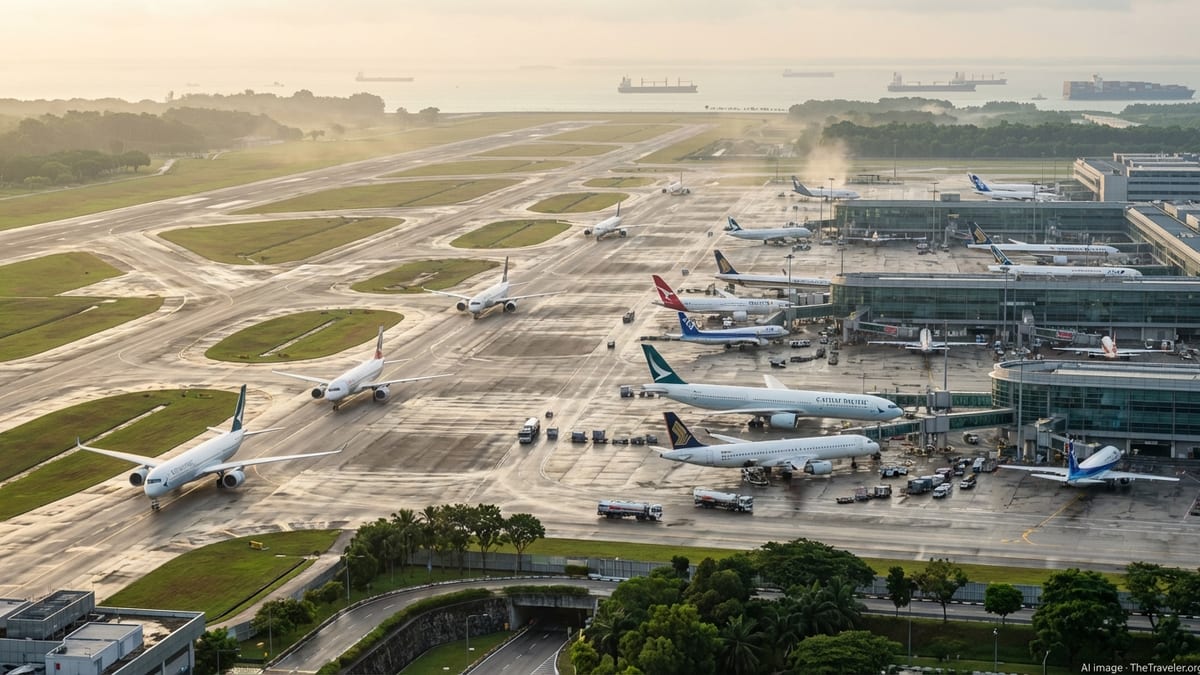
From Delayed Mega Project To Renewed Aviation Push
U-Tapao Airport, shared between the Royal Thai Navy and civilian operators near Pattaya, has been at the center of Thailand’s plan to build a third major gateway alongside Bangkok’s Suvarnabhumi and Don Mueang airports. Publicly available planning documents describe the U-Tapao and Eastern Aviation City scheme as a multi-phase, multi-hundred-billion-baht development that combines runway upgrades, terminals, logistics parks and commercial zones within the Eastern Economic Corridor.
Construction timelines have repeatedly shifted over the past five years, in part because of the pandemic’s impact on air travel and in part because of delays to the high-speed rail link that is intended to connect U-Tapao with Bangkok’s two main airports. Project summaries indicate that the initial passenger capacity target for the first phase has been scaled back from around 6 million travelers per year to roughly half that level until rail demand is proven and key infrastructure is in place.
Despite those headwinds, recent project updates show that enabling works for the broader airport city are now underway, with reports from the Eastern Economic Corridor Office pointing to the official start of full construction works on the airport and surrounding developments in 2026. For airlines, investors and travelers, this marks a transition from years of concept planning and stalled tenders to tangible ground activity on Thailand’s eastern seaboard.
Central to this renewed momentum is the decision to move ahead with a large-scale aircraft maintenance, repair and overhaul facility at U-Tapao. After multiple attempts to structure the project, the government-backed Eastern Economic Corridor framework has now cleared a path for Thai Airways to take a leading role.
Thai Airways Revives Landmark MRO Hub After Airbus Exit
The U-Tapao maintenance hub was initially envisioned as a high-profile joint venture between Thai Airways and Airbus. That plan was put on hold in 2020 as the European manufacturer pulled back in the middle of the global aviation downturn, leaving one of Thailand’s flagship Eastern Economic Corridor projects in limbo. Subsequent efforts focused on rebidding the concession and rethinking how the complex would be financed and operated.
Over the past year, Thai Airways has re-emerged as the anchor investor, with its restructuring largely complete and passenger traffic recovering sharply. Company presentations to investors and recent local business coverage indicate that the airline has earmarked more than 10 billion baht in capital expenditure for a new-generation MRO center at U-Tapao, under a long-term lease arrangement within the Eastern Economic Corridor area.
Reports from Thai business media describe the revived project as a “smart maintenance hub” spanning more than 30 hectares, designed to accommodate multiple widebody and narrowbody lines, heavy maintenance checks and cabin retrofits. The facility is projected to generate several billion baht in annual revenue once fully ramped up, serving both Thai Airways’ growing fleet and third-party customers across the region.
Recent coverage from financial news outlets in Bangkok further notes that Thai Airways has formally notified the U-Tapao concessionaire consortium that it intends to proceed on the original site allocated for the MRO center. The timeline now being discussed publicly points to construction starting around 2027, with phased operations beginning before the end of the decade as hangars and workshops are completed.
Eastern Aviation City Aims To Rewire Regional Flows
The MRO complex is just one piece of a much larger transformation envisioned for U-Tapao and its surroundings. According to material published by the Eastern Economic Corridor Office, the broader U-Tapao and Eastern Aviation City scheme combines an expanded dual-use airport with cargo and logistics hubs, free-trade and industrial zones, and commercial development targeting tourism, conferences and high-value manufacturing.
For travelers, the most immediate impact over the next several years is expected to come from increased connectivity along Thailand’s eastern seaboard. As new terminals and apron space are completed, U-Tapao is positioned to absorb more leisure and charter traffic for Pattaya and nearby beach destinations, relieving pressure on Bangkok’s congested gateways while offering airlines lower operating costs and easier slot access.
In the longer term, integration with the planned high-speed rail link between Don Mueang, Suvarnabhumi and U-Tapao would effectively create a three-airport system, allowing passengers and cargo to move more seamlessly between Thailand’s capital and the Eastern Economic Corridor. Travel analysts following the project suggest this could shift some regional transfer flows away from other Southeast Asian hubs, particularly for routes linking Northeast Asia, India and secondary cities across the Mekong region.
For neighboring countries, a fully developed Eastern Aviation City at U-Tapao could provide a new option for aircraft maintenance, parts storage and technical training, reducing reliance on existing heavy maintenance centers in Singapore and Malaysia. That, in turn, may influence where airlines choose to base aircraft overnight, position crews and schedule layovers, gradually reshaping regional traffic patterns.
What The New MRO Center Means For Airlines And Travelers
As Thailand’s flagship carrier emerges from court-supervised rehabilitation with a modernizing fleet, the pivot to in-house heavy maintenance capacity is seen as strategically significant. Investor reports and industry commentary highlight that Thai Airways has been sending a sizable share of its maintenance work overseas, exposing it to currency swings and capacity shortages at third-party facilities.
By building a high-capacity center at U-Tapao, Thai Airways aims to capture more of that work domestically, shorten aircraft downtime and open a new revenue stream by marketing services to other operators. The facility is expected to be tailored to new-generation aircraft now being introduced to the airline’s fleet, including single-aisle and widebody types used on both regional and intercontinental routes.
For travelers, the link between an MRO project and the passenger experience can seem indirect, but the implications are substantial. Additional maintenance capacity in Thailand can help reduce schedule disruptions caused by long waits for heavy checks or modifications abroad. Over time, locally based maintenance and engineering teams can also support aircraft cabin upgrades, connectivity installations and other product improvements that directly affect comfort on board.
Regional carriers using U-Tapao for overnight parking or turnarounds may also benefit from having major technical services on site. That can make it easier for airlines to consider adding new routes into Thailand’s eastern seaboard, confident that engineering support is within reach. The combined effect of expanded airport facilities and a full-scale MRO cluster could therefore support more point-to-point services linking U-Tapao with cities across ASEAN, South Asia and Greater China.
Key Timelines And What To Watch Next
While precise schedules remain subject to regulatory approvals and commercial negotiations, a clearer roadmap for U-Tapao is starting to emerge from publicly available material. Recent updates indicate that preparatory works for the airport and Eastern Aviation City stepped up in 2026, with the goal of gradually increasing passenger handling capacity in line with demand and progress on the high-speed rail connection.
On the maintenance side, Thai Airways has outlined a multiyear investment program that anticipates construction of the U-Tapao smart maintenance hub beginning around 2027, with core hangars expected to be ready near the end of the decade. Industry coverage suggests that Thai Airways and partner airlines will continue to refine the exact configuration of lines and capabilities as fleet plans evolve and as regional demand for heavy checks becomes clearer.
Travelers and aviation observers will be watching several milestones closely over the next few years. These include further contract milestones between the U-Tapao concessionaire and the Eastern Economic Corridor Office, progress on the three-airport high-speed rail link, and the release of updated route plans from Thai Airways and other carriers that may increasingly treat U-Tapao as a base rather than simply a secondary field.
If these elements align, Thailand’s eastern seaboard could transition from an industrial backstop to a primary aviation node for Southeast Asia, with U-Tapao’s upgraded runways, terminals and maintenance city reshaping how aircraft move, where passengers connect and which hubs dominate regional skies.