


Agoda often shows very attractive room rates in search results. Yet many travelers only discover the real cost of their stay, or strict rules on refunds and changes, after they have already clicked Book. Understanding how Agoda displays taxes, fees, and policies can save you from surprise charges at checkout or at the hotel desk.
Get the latest updates straight to your inbox!
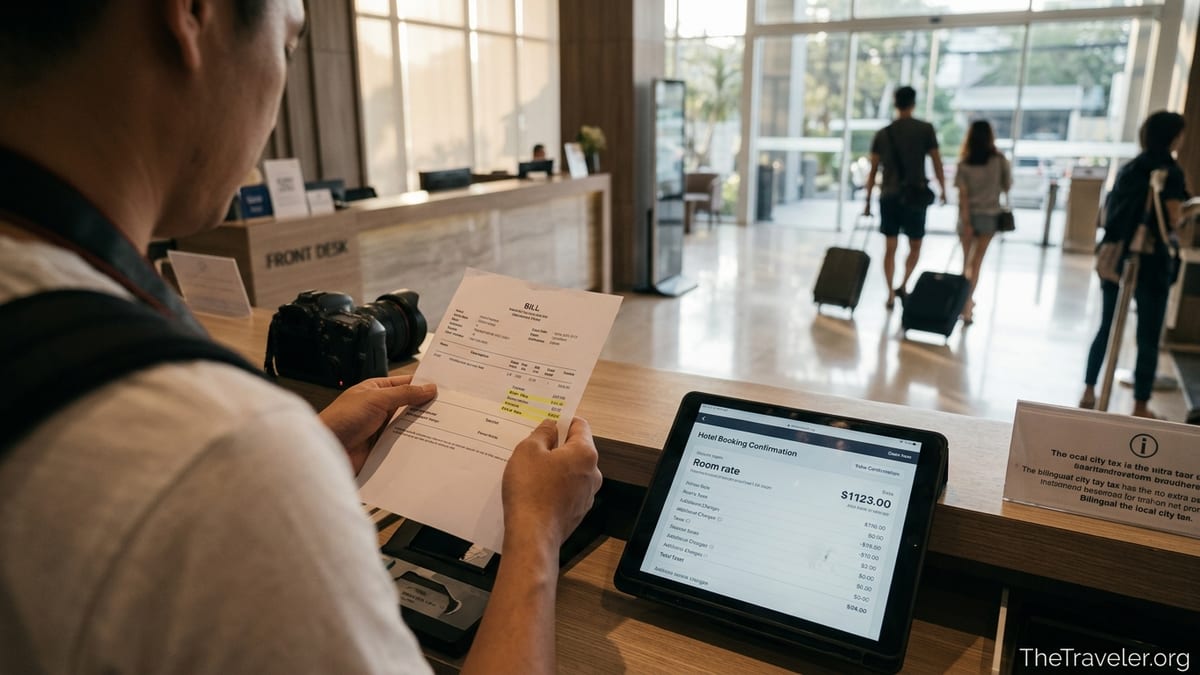
Why Agoda Prices Look So Low at First
Agoda is designed to surface headline-grabbing prices in search results, especially in competitive markets like Bangkok, Bali, or New York. On the first screen, you might see a room at 95 dollars per night in central Bangkok and assume that is close to your final price. Often it is not. The base rate in bold type may exclude some taxes, local city charges, or property-specific fees that are only fully revealed when you open the room details and scroll to the fine print just above the Book Now button.
For example, a traveler looking at a 3-star hotel in Brussels might see 80 euros per night in the initial search. By the time they reach the payment page, the summary can show 80 euros for the room plus an extra line that reads Taxes and fees 8 euros and a note that a city tax of about 4 to 10 euros per night, per room, must be paid directly at the hotel. In practice, that turns an 80 euro night into closer to 92 to 98 euros, depending on the local rules and how many guests are staying.
This pattern is common wherever local taxes are charged per person or per night and cannot be easily folded into a single all-in price. In destinations like Tokyo or Kyoto, Agoda may show that the rate includes taxes and fees but then highlight in a separate sentence that a local accommodation tax is still payable at the property. The structure is technically disclosed but easy to overlook if you are only focused on the bold nightly rate.
Regulation also plays a role. In some regions such as parts of Europe and Australia, consumer protection rules effectively force sites to show the full price including mandatory charges on the first page. However, if you view the same hotel from a different country site or currency, you may still see a lower pre-tax base, with the true total only appearing in the breakdown just before you confirm payment.
Taxes, Resort Fees, and Local Charges That Slip Through
Beyond the base room rate, Agoda allows properties to configure a range of fees, some of which Agoda collects up front and some the hotel collects on arrival. Mandatory surcharges that Agoda collects, such as certain resort or service fees, are typically included in the Total price you see on the payment page, but they may be buried in a single Taxes and fees line without a detailed label explaining what you are paying for.
Consider a beachfront resort in Phuket showing a room at 120 dollars per night. In the price breakdown, Agoda may list 120 dollars room rate and 18 dollars taxes and fees. Digging into the room details, you might find that part of that 18 dollars is a daily resort fee that covers things like pool towels or a shuttle bus, and part is VAT and local hotel tax. If the resort also charges a 3 percent fee for card payments taken at the front desk, that extra amount will not appear in the Agoda total and will instead show up when you check out in person.
In city-center hotels in places like New York or Las Vegas, resort or destination fees can be even more substantial, sometimes higher than the base room rate itself. Agoda typically shows these as mandatory fees in the price calculation, but the way they are labeled can differ by region and by how the hotel has configured them. Travelers report situations where an apparently cheap 90 dollar room in a major U.S. city turns into a bill that includes 90 dollars for the base rate, another 35 to 50 dollars per night in resort or destination fees, plus sales and occupancy taxes on top.
There are also truly local taxes that Agoda often lists only as payable at the property. Examples include tourist taxes in many European cities, Japanese accommodation taxes per person per night, and environmental fees in certain island destinations. A guest who books two people for three nights in Kyoto might see a note that an additional city tax is payable locally, which could add roughly several hundred yen per person per night. Ignoring that small line can leave you surprised when the front desk asks for cash at check-in.
Agoda’s Cancellation, No-Show, and Refund Rules
Agoda’s official policies state that cancellations and no-shows are governed by the cancellation policy shown for each specific rate. Many travelers miss that these policies can differ significantly even for rooms in the same hotel on the same dates. A non-refundable room might be just 5 to 10 percent cheaper than a flexible one but lock you into paying the full amount whether you show up or not.
On a typical listing in Paris, you might see two options for a standard double room. The cheaper option might say Non-refundable with a warning that if you cancel, modify, or no-show, you will be charged the full total. The slightly more expensive option might say Free cancellation until 23:59 on a particular date with No prepayment needed. If you cancel before that time, Agoda’s own policy indicates it usually does not charge a processing fee, and you should receive a full refund of what you paid within roughly 10 days, depending on your bank and the currency conversion.
No-show rules are often misunderstood. If you simply fail to arrive without cancelling, properties can report you as a no-show through Agoda. Under many rate plans, this allows them to keep at least the value of the first night and sometimes the entire stay. For instance, if you booked a three-night non-refundable stay in Rome for 450 euros and do not show up, the hotel can typically retain the full 450 euros according to the terms linked to your rate. For partially flexible rates, a no-show might still incur a minimum of one night’s charge, even if later nights could have been cancelled without penalty if you had notified Agoda in time.
Refunds also depend on who collected the payment. For Agoda Collect bookings, where Agoda charges your card itself, the refund usually comes from Agoda. The company’s terms specify that if you cancel a refundable booking within the permitted window, it will refund the amount you paid regardless of exchange rate movements between the date of booking and date of refund, though your own bank’s fees can still affect what you receive. For Pay at Hotel bookings, it is the property that processes the card and issues any applicable refund, which can mean slower processing times or different practices on pre-authorizations.
Pay Now, Pay Later, and Pay at Hotel: Why It Matters
Agoda distinguishes between several payment models that can influence what you pay in the end and how problems are handled. Pay now or Agoda Collect bookings are charged by Agoda at the time of reservation or on the payment date shown during checkout. The amount shown as Total is what Agoda will bill your card. In many cases, this includes taxes and Agoda-collected fees, though local property-collected charges can still appear at check-in.
Book now, pay later looks attractive for travelers who want to hold a rate without paying immediately. Under Agoda’s terms, you agree to have your card charged on a specified future payment date. This means you need to make sure the card remains valid and has sufficient credit by that date. Some travelers have been surprised when a forgotten booking was charged weeks later because they did not cancel in time before the payment deadline. If you no longer need the reservation, you must cancel before the date and time indicated in the cancellation policy and in your confirmation email or app screen.
Pay at Hotel or property collect bookings add another layer. With these, Agoda sends your details to the property, but the hotel or host actually charges your card at check-in or check-out. Agoda’s terms make clear that certain additional amounts, such as a separate Agoda service markup in some regions, do not apply to Pay at Hotel bookings. At the same time, this model means the hotel may apply its own currency conversion, card surcharge, or deposit rules. For example, a guest booking a Tokyo business hotel in U.S. dollars on Agoda might find that at check-in, the front desk charges in Japanese yen at the hotel’s chosen exchange rate and also takes a temporary deposit for incidentals.
The distinction also affects dispute resolution. If Agoda collected the payment, you generally deal with Agoda regarding billing issues. If the hotel charged you, Agoda may refer you to the property since it did not process the transaction. Understanding the payment type on your confirmation is critical when something goes wrong, such as duplicate charges or an unexpected fee added by the hotel.
Currency Conversion, Bank Fees, and Price Fluctuations
Another commonly missed cost comes from currency conversion. Agoda often lets you display prices in your home currency, such as U.S. dollars for an American booking a stay in Japan or Europe. However, your card may ultimately be charged either in that displayed currency or in the hotel’s local currency depending on the payment model and region. Your bank can then add foreign transaction fees, typically around 1 to 3 percent of the amount, and use its own exchange rate, which might differ from Agoda’s estimate.
Imagine you are booking a three-night stay in Lisbon that shows as 300 U.S. dollars total on Agoda. When Agoda charges your card in euros at its own rate, the bank later converts that euro amount back to dollars at a slightly different rate and adds a 3 percent foreign transaction fee. The final figure on your card statement might be closer to 309 or 312 dollars. If you cancel, Agoda’s refund is based on the actual amount it charged in the original transaction currency, but your bank may once again apply its conversion spread and, in some cases, keep the original foreign transaction fee.
Dynamic pricing and cookies can also make Agoda rates appear inconsistent. Travelers occasionally report seeing a lower price in an incognito browser window or when accessing Agoda from a different device or location. For example, a frequent user logged into their account might see a Bangkok hotel at 35 euros per night, while an incognito browser from another country might show 29 euros for the same dates and room type. Factors such as targeted promotions, local currency conversions, and experimental pricing can explain some of these discrepancies, but it underscores the importance of refreshing comparisons across devices before you commit.
In certain markets, using a localized version of Agoda, such as an Australian or European country site, can cause prices to display with more of the taxes and mandatory fees baked into the initial figure, offering a clearer comparison across platforms. However, that is not guaranteed, so reviewing the detailed breakdown on the payment page remains the most reliable way to know your real cost.
Extra Guest, Cleaning, and Other Property-Level Fees
Many Agoda listings, especially apartments, villas, and vacation rentals, include fees that are determined by the individual host or property manager. These can include cleaning fees, charges for additional guests beyond a certain number, linen fees, or fees for early check-in and late check-out. While Agoda provides fields for hosts to enter mandatory surcharges, the way they are described and when they appear in the flow varies.
A typical example is a two-bedroom apartment in Barcelona that shows 150 euros per night in the search results. When you enter two guests, the total might show 450 euros for three nights. If you later change the number of guests to four adults, a small note can appear indicating that an additional guest fee is applied, increasing the total to, say, 510 euros. In other cases, the host might require a one-time cleaning fee of 50 euros, which is shown in the breakdown on the final booking screen but not obvious at first glance.
Some hosts also charge deposits or fees on arrival for items like key cards, towels, or parking permits. These are often labeled in the house rules section or in the small text under Important information, rather than in the main price line. A traveler arriving late at night at a coastal guesthouse in Italy might find a handwritten sign indicating a 10 euro late check-in fee after a certain hour, which was mentioned only once deep in the listing and not included in the Agoda total.
Because these property-level fees are configured by thousands of independent hosts and small hotels, consistency is limited. Agoda’s partner documentation makes clear that mandatory surcharges should be included in the booking total where possible, but not every property uses the system correctly. That means the burden still falls on the traveler to scroll through all sections of the listing, especially for non-hotel accommodations, to see if any extra amounts are mentioned as payable at the property.
How to Read Agoda’s Fine Print Before You Click Book
Given the range of taxes, fees, and policies at play, the simplest way to avoid surprises is to slow down on the last screen before payment. Agoda generally summarizes three key elements on this page: a price breakdown, a cancellation policy, and important property information. Each of these requires more than a quick glance.
In the price breakdown, watch for lines such as Taxes and fees, City tax payable at property, or Mandatory service charge. If the breakdown only shows a single combined number, tap or click any small information icon that may reveal a more detailed explanation. Compare the final total with the original nightly rate you saw in search results. If there is a large gap, investigate why. For resorts or big city hotels, expect that some portion of the difference is likely a resort or destination fee.
Next, read the cancellation policy word for word. Note the cut-off date and time, the timezone it references, and what happens if you cancel after that deadline. Look for phrases such as Non-refundable, Cancellable with full refund until, or Partial refund. For example, a policy stating that cancellations within 72 hours of check-in incur a one-night fee means that if you cancel two days before arrival for a four-night stay, you will still be charged at least one night. If you see multiple lines referring to Agoda’s policy and the hotel’s policy, assume the stricter one will apply.
Finally, scan the property information and house rules for anything that mentions additional charges, deposits, age restrictions, or requirements like cash-only payments for certain fees. This is where you may find references to tourist taxes, cleaning fees, towel rental, or surcharges for pets. If something is unclear, consider messaging the property through Agoda’s platform to confirm in writing before you commit, so you have a record if a dispute arises later.
The Takeaway
Agoda can be a useful tool for finding competitive hotel and rental rates worldwide, but its combination of base prices, taxes, and a patchwork of property-level fees means the number you see first is rarely the full story. Travelers most often get caught by resort and destination fees, local city or tourist taxes payable at the property, rigid cancellation and no-show penalties, and currency or bank charges that quietly increase the final bill.
To protect yourself, always compare the initial search result price to the final total on the payment page, read the cancellation policy in full, and check the small print for mentions of extra charges. Be especially cautious with non-refundable rates and with Book now, pay later options that can charge your card weeks after you first searched. When in doubt, consider contacting the property through the platform to confirm how taxes and fees are handled.
Planning an international trip involves enough variables without last-minute price shocks. A careful five-minute review of the details on Agoda before checkout is often all it takes to turn a tempting headline rate into a stay that actually matches your budget and expectations.
FAQ
Q1. Does Agoda always include all taxes and fees in the first price I see?
Not always. The initial price often reflects the base room rate and sometimes some taxes, but additional charges like city taxes or resort fees may only appear in the final breakdown or be listed as payable at the property.
Q2. Why is my Agoda total higher at checkout than in the search results?
Between search and checkout, Agoda adds applicable taxes, mandatory service or resort fees, and sometimes per-person charges. These extra items are shown in the price breakdown on the last page, which can significantly increase the total compared with the headline nightly rate.
Q3. What is the difference between Agoda Collect and Pay at Hotel?
With Agoda Collect, Agoda charges your card and usually includes its portion of taxes and fees in the total. With Pay at Hotel, the property charges you directly at check-in or check-out, which can mean additional local surcharges or different exchange rates than those shown during booking.
Q4. If my booking is marked non-refundable, can I ever get my money back?
Non-refundable rates generally mean you will be charged the full amount if you cancel, modify, or no-show. In rare cases, properties may be flexible for serious emergencies, but there is no guarantee, and Agoda and the hotel are entitled to keep the payment under the agreed terms.
Q5. How can I avoid surprise city or tourist taxes when using Agoda?
Before booking, look for any text in the listing or on the payment page that mentions city tax, tourist tax, or local accommodation tax payable at the property. Add those amounts to your budget, and if the wording is vague, message the property through Agoda for an exact figure per person, per night.
Q6. Will my bank charge extra fees on top of what Agoda shows?
It is possible. If your card is charged in a foreign currency, your bank may add a foreign transaction fee and use its own exchange rate. This can make the final amount on your statement slightly higher than the total you saw on Agoda.
Q7. What happens if I do not show up for my Agoda booking?
If you do not arrive and do not cancel in time, most properties treat this as a no-show. Depending on the rate’s policy, they may charge you at least one night or the full stay. Agoda passes on or facilitates these charges according to the agreed terms.
Q8. Are Agoda’s book now, pay later deals riskier than paying immediately?
They can be if you forget about them. With book now, pay later, your card is charged automatically on a future date. If you no longer need the room but miss the free cancellation deadline, you can be billed in full even though you never stayed.
Q9. How do I see a full breakdown of charges on Agoda before confirming?
On the final payment page, look for a detailed price summary or breakdown. Expand any collapsible sections that list room rate, taxes and fees, and notes about additional charges at the property. Review each line to understand exactly what is included and what is not.
Q10. What should I do if a hotel charges an unexpected fee not mentioned on Agoda?
First, ask the front desk to explain the fee and show where it is stated in their policies. If it still seems inconsistent with your Agoda confirmation, keep all receipts and screenshots and contact Agoda customer support through the app or website, providing evidence so they can review the case.