


Most people who make it to Panormos Beach in Mykonos remember one thing: the glamorous, bohemian sprawl of Principote, where sunbeds line the sand and chilled rosé arrives faster than the tide. Yet the real magic of Panormos sits beyond the neatly arranged loungers and Instagram-ready cabanas. This wide, wind-shaped bay on the island’s north coast still hides a raw, almost secret side that many visitors never bother to explore.
Get the latest updates straight to your inbox!
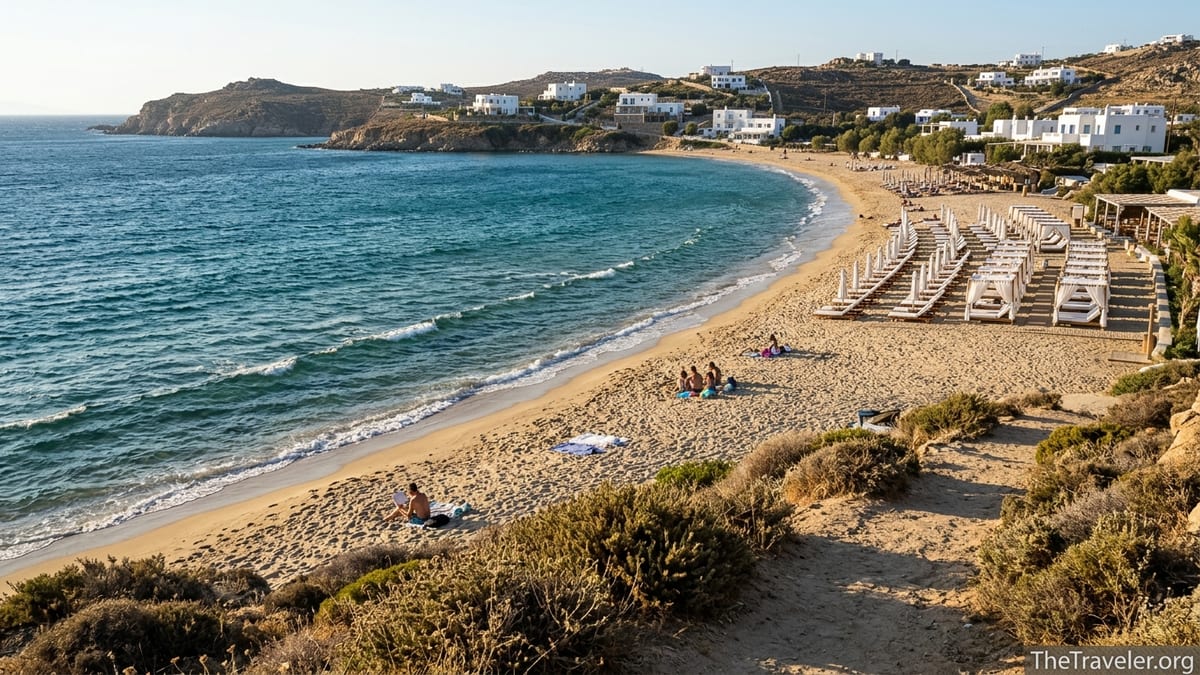
The One Thing Most Visitors Miss: Panormos Beyond the Sunbeds
Panormos has a reputation as the polished playground of Principote, the beach club that turned this once unscripted bay into a high-end day destination. With its whitewashed loungers, linen-draped pergolas and Mediterranean menu, it is easy to see why many guests arrive by taxi, check in with the host, and never leave the club’s footprint on the sand. For a lot of visitors, Panormos becomes synonymous with table minimums and bottle service.
What most people miss is that Panormos is also one of Mykonos’s last long, partly natural stretches of sand. Walk a few minutes away from the club toward the quieter end of the bay and the music fades into the wind. The daybeds thin out, the shoreline opens up, and you suddenly find a free, public beach where towels replace teak, and people come to actually swim, walk, or sit with a paperback instead of a price list.
This contrast is not immediately obvious when you arrive by taxi right at the club entrance or when a driver drops you only at the organized section. Many first-timers never realize that they can simply keep walking and have a very different Panormos experience. The one thing most visitors miss is that this beach lets you choose between two Mykonos worlds in the same bay: club-crafted luxury at one end, raw Cycladic simplicity at the other.
Spending time in both on the same day is what makes Panormos feel bigger than the brand name that dominates the hashtags. It turns a standard Mykonos beach day into something that actually feels like you’ve discovered a corner of the island, not just another lounge chair.
A North-Coast Bay Shaped by Wind and Light
Part of Panormos’s character comes from geography. The bay sits on the north coast of Mykonos, roughly a 15-minute drive from Chora, facing directly toward the Aegean. On calm mornings, the water is glassy and clear, ideal for long swims parallel to the shore. By afternoon, especially on meltemi days in July and August, the wind can pick up, sending whitecaps across the bay and turning the sea into a livelier, more athletic swim.
On these breezy afternoons you can feel why Panormos never became as uniformly manicured as south coast spots like Psarou or Ornos. The north wind lifts the dry sand, ruffles umbrellas, and, some days, sends club guests retreating to sheltered cabanas. Meanwhile, further along the beach, you might see locals wading in at waist depth, timing their dips between gusts, or windsurfers and paddleboarders using the chop for a more energetic session.
The changing conditions are part of what visitors often overlook. Many arrive expecting the gentle, Instagram-ready waters typical of south-facing beaches, then leave disappointed if the afternoon turns wavy. The locals and regulars treat it differently: they use the wind forecast as a planning tool. When the meltemi is strong, they might start with a swim at Panormos before noon, then head back toward more sheltered coves after lunch. This “wind-aware” way of using the beach is key to enjoying it, yet it is almost never mentioned in glossy marketing or cruise-ship briefings.
Even the light behaves differently here. Without the line of big hotels that back the south coast, Panormos still feels remarkably open. Late afternoon sun lays a long sheen across the bay, and on clear days you can see the small uninhabited islet at the mouth of the bay as a pale, rocky presence offshore. Sit on the free section of sand with a simple beach mat and that view, and Panormos stops feeling like a club product and starts feeling like the Aegean again.
How to Find the Quiet, Untouched Corners
To experience the part of Panormos that most visitors miss, you need to walk. If you arrive by taxi or transfer arranged through Principote, you will be dropped right behind the club. Instead of heading straight for the host stand, walk along the shoreline away from the loungers. Within five to ten minutes, the organized beds give way to open sand where anyone can lay a towel for free.
On a typical July day, the difference is stark. Closer to the club, every lounger might be reserved by late morning, with tables filling up for 2 pm lunch, and DJ-led playlists setting a low, constant soundtrack. At the quieter end, you are more likely to find a small group of friends sharing a supermarket picnic of fruit, water, and simple pastries bought in town, or solo travelers reading under their own umbrellas. You may still hear faint music carried by the wind, but it no longer dictates the mood; the pace is set instead by the sound of waves hitting the shore.
If you are comfortable exploring further, there are dirt tracks and footpaths on the low hills surrounding the bay that reveal additional vantage points. A short climb up the slope behind the sand leads to viewpoints where you can look back over the curve of Panormos, the white geometry of the beach club at one end, and the untouched fringe of sand at the other. Very few day visitors take these paths, but they reward you with a sense of the bay as landscape, not just as venue.
The more you walk, the more Panormos changes. The scent of sunscreen and grilled octopus from the restaurant gives way to thyme and sun-warmed scrub plants underfoot. Flip-flop prints on the sand fade into the paw tracks of local dogs walked in the early morning. In those details lies the side of Panormos that does not appear in marketing, yet defines the place for people who use the beach year after year.
From Bus Stops to Bottle Service: Getting There Without Losing the Plot
Reaching Panormos is straightforward, but the way you get there shapes what you see. Public buses from Mykonos Town run on a seasonal schedule from the northern bus station, and in high summer you may find services toward Panormos listed alongside routes to Ano Mera and Kalafatis. Even when buses are running, departures to the north coast are less frequent than to the busy south, and the timetable may only offer a handful of round trips per day. Single fares are typically just a few euros, making the bus the most budget-friendly option if the timing works.
Many visitors opt for taxis or pre-arranged transfers instead. In peak season, a taxi from Chora to Panormos can run in the region of 25 to 40 euros one way, depending on traffic and demand. Hotel-arranged transfers and private drivers may cost more, particularly if they include waiting time or a guaranteed slot for the return journey. These options often drop you at the main beach club entrance, which has the side effect of making the club feel like the only available experience.
Renting a scooter or small ATV introduces another layer of freedom. With day rates that can range from around 35 to 60 euros for a basic scooter in high season, plus fuel, this is not necessarily cheaper for short stays, but it allows you to treat Panormos as one stop among several. You can roll up early, take a swim at the quiet end, then drive on to nearby Agios Sostis or loop inland to Ano Mera for a late lunch at a taverna on the square rather than eating at the beach club.
Whichever way you arrive, the trick is psychological as much as practical. If you step off the bus or climb out of a taxi expecting that your only options are a daybed package with a minimum spend or going back to town, you will miss what Panormos actually offers. If you arrive with the mindset that the bay is public first and the club is simply one organized section of it, you unlock the full range: you can mix a modest coffee at the bar with a free day on the sand, or splurge on a special meal without committing your entire visit to the curated environment.
Two Beaches in One: Club Culture and Local Rituals
On any given summer afternoon it is possible to stand mid-beach at Panormos and watch two different cultures playing out at once. At the club end, servers move in practiced lines delivering seafood platters and iced bottles, guests pose for photos against artfully placed driftwood installations, and loungers are adjusted to match the sun’s angle like a well-rehearsed choreography. It is a lively, cosmopolitan scene, drawing visitors from Europe, the Middle East, North America, and beyond.
Walk away from the music, though, and you will see another rhythm. Local families arrive later in the afternoon when the sun is lower, spreading simple cotton towels directly on the sand. Older islanders stand in the shallows, chatting waist-deep in the water. A couple who clearly know the coastline well might arrive with their own collapsible chairs and a small cooler packed with water and sliced peaches. No one is checking a reservation list here; the currency is time, not table spend.
Regular visitors to Mykonos often build rituals around this lesser-known side of Panormos. Some return each year to swim laps along the quiet end of the bay before the afternoon wind picks up, then drive into Ano Mera for an early dinner at a family-run taverna where grilled local fish may cost less than a single club cocktail. Others use Panormos as a base to walk the coastal paths toward more remote spots, treating the bay as a gateway rather than a final destination.
That coexistence is exactly what makes Panormos unusual on an island where many beaches have tipped entirely in one direction or the other. Here, the club economy sits beside a still-accessible patch of Cycladic coastline. To see that clearly, you have to step out of the manicured zone, at least for an hour, and notice how differently people use the same water and sand.
Using Panormos as a Gateway to a Wilder North Coast
Another thing many visitors miss is that Panormos connects naturally to some of the wildest, least commercial corners of Mykonos. A short drive further along the road brings you to Agios Sostis, a famously unorganized beach with no rows of sunbeds, no built-up promenade, and a steep staircase leading down to the sand. Above it sits a small, rustic taverna known for simple grilled dishes, which regularly attracts locals even when the more famous party beaches are in full swing.
Between Panormos and Agios Sostis, faint footpaths cut across low, scrubby hills, linking hidden coves that rarely appear on mainstream tourist maps. One such path leads to a tiny pocket of sand tucked between rocks, a spot locals sometimes use for quiet swims or snorkeling when conditions are calm. With clear water and minimal boat traffic, these small coves feel worlds away from the more tightly managed beachfronts elsewhere on the island.
Spending a day that strings these places together changes your relationship with Panormos. Instead of seeing it purely as a destination beach club, you can treat it as a starting point for a north-coast circuit: an early swim on the quieter end of Panormos, a mid-morning walk or quick drive to Agios Sostis, and then a late lunch at the hilltop taverna overlooking the sea. On the way back, you might stop again at Panormos for a final dip in the late-afternoon light when the crowd has thinned.
This kind of day trip is exactly the sort of itinerary that does not appear in package brochures or on cruise excursion sheets, which tend to prioritize a single “beach stop” and a fixed lunch venue. Yet for travelers who value a sense of discovery over a single polished venue, using Panormos as a hinge between more and less developed stretches of coast is where the island starts to feel like a real place rather than a backdrop.
Practical Tips to Actually Experience Panormos, Not Just See It
To tap into the side of Panormos that most visitors miss, timing matters. Aim to arrive by mid-morning on summer days if you want calm water for swimming and a choice of space on the free section of sand. Bring your own lightweight shade, such as a compact beach umbrella or a travel sunshade, as the unorganized end has no built-in shelters. A simple foldable mat or Turkish towel is enough for comfort on the sand and packs easily in a day bag from town.
Budget-wise, think in layers. You might plan for one shared splurge, such as a seafood platter or a couple of well-made cocktails at the club bar, while keeping the rest of your day low-cost by using the public beach. Many travelers pick up water, fruit and bakery snacks in Mykonos Town before heading north, which can easily save the equivalent of a taxi fare if you are traveling as a pair or small group. This approach lets you enjoy the setting and service of the club without feeling locked into an all-day minimum spend.
Footwear is another small but important detail. While the sand itself is fine and comfortable underfoot, the walks to more remote corners and the paths up into the low hills are best tackled in sturdy sandals or trainers rather than flimsy flip-flops. With proper shoes, it is easy to climb to viewpoints, follow goat tracks across the scrub, or walk the short but steep approaches to neighboring bays without worrying about loose stones.
Finally, keep an eye on the weather, especially the wind. Popular weather apps will show wind speed and direction for Mykonos; if you see strong northerlies predicted, consider making Panormos a morning stop and saving more sheltered beaches for the afternoon. Local staff at your hotel or guesthouse can often suggest the best combination for a given day, and they will frequently steer you toward or away from north-facing bays like Panormos based on real-time conditions. Listening to that local knowledge is one of the simplest ways to turn a standard Mykonos beach visit into something more memorable.
The Takeaway
Panormos Beach is widely known for its glamorous club scene, but what most visitors miss is that the bay remains, at heart, a generous, public stretch of Cycladic coastline with room for very different kinds of days. A short walk away from the curated loungers reveals open sand where towels, not table reservations, set the rhythm. A short drive further along the road leads to even wilder beaches that show Mykonos as an island rather than a brand.
By paying attention to wind, timing, and how you move around the bay, you can experience Panormos in a way that combines comfort with a sense of discovery. Swim in the morning calm, explore the hills and neighboring coves, then decide how much of your afternoon you want to spend in the structured embrace of a beach club. In doing so, you will come away with a sense of Panormos as a living landscape, not just another name on a reservation sheet.
The one thing most visitors miss is simple: Panormos is not just a beach club, it is a whole bay. Treat it that way, and you will understand why those who know Mykonos well still carve out time for this north coast curve, even in summers crowded with options.
FAQ
Q1. Is there a free area at Panormos Beach, or do I have to pay for a sunbed?
Yes, there is a substantial free area at Panormos Beach. If you walk a few minutes along the sand away from the organized section, you will find open public beach where you can lay your own towel without charge.
Q2. How do I get from Mykonos Town to Panormos Beach without a car?
In summer, there are usually public buses from the northern bus station in Mykonos Town toward Panormos, though they run less frequently than routes to the south coast. Otherwise, taxis and hotel-arranged transfers are common options, and some travelers rent scooters or ATVs for the flexibility to visit multiple beaches in a day.
Q3. Is Panormos Beach very windy?
Panormos is on the north coast, so it can be breezy when the seasonal meltemi wind blows. Mornings are often calmer and better for swimming, while afternoons can bring choppier water and stronger gusts. Checking the wind forecast before planning your beach day helps you choose the best time to visit.
Q4. Can I visit Panormos Beach on a budget, or is it only for high-end travelers?
You can absolutely visit Panormos on a budget. Bring your own towel and simple picnic for the free section, then, if you wish, treat yourself to a single drink or coffee at the beach club rather than a full daybed package. Transport costs and occasional indulgences will be your main expenses.
Q5. Are there restaurants other than the main beach club near Panormos?
Most of the immediate beachfront dining is connected to the organized section, but within a short drive you can reach inland villages like Ano Mera with traditional tavernas, as well as neighboring Agios Sostis, where a rustic hilltop taverna overlooks the sea. Many visitors pair a swim at Panormos with a meal at one of these more local spots.
Q6. Is Panormos Beach suitable for children and families?
Families often enjoy Panormos, especially the quieter end of the bay where there is more space to play on the sand. However, the north wind can make the sea choppy at times, so parents should keep a close eye on children in the water and may prefer to visit earlier in the day when conditions are calmer.
Q7. What should I pack for a day at Panormos if I want to explore the quieter areas?
Pack a light towel or mat, sun protection, plenty of water, and a simple snack if you plan to stay on the free section. Sturdy sandals or trainers are useful if you want to walk to viewpoints on the hills or continue on to nearby coves and beaches such as Agios Sostis.
Q8. Can I combine a visit to Panormos with other nearby beaches in one day?
Yes, many travelers combine Panormos with nearby Agios Sostis in the same day, using a scooter, car or ATV to move between them. A typical itinerary might include a morning swim at Panormos, then a short drive and walk down to Agios Sostis for a more untamed, unorganized beach experience.
Q9. Do I need to book in advance if I want a sunbed at the beach club section of Panormos?
In high season it is wise to book in advance, especially for front-row loungers or specific lunch times. Same-day walk-ins may still find space, but availability is not guaranteed during peak summer weekends or on days when cruise arrivals are high.
Q10. When is the best time of year to experience the quieter side of Panormos Beach?
The shoulder months of late May, early June, September and early October tend to be quieter than peak summer. During these periods you are more likely to find ample space on the free section of sand, milder temperatures, and a calmer overall atmosphere while most services are still operating.