


For frequent travelers shuttling between European cities, very light jets promise to turn long travel days into quick hops. Austrian operator GlobeAir, which has built the continent’s largest fleet of Cessna Citation Mustang very light jets, markets itself as a fast, relatively accessible way to go private on routes that airlines often serve poorly. But is GlobeAir actually worth it for short-haul private flights around Europe, and for whom does the model really make sense?
Get the latest updates straight to your inbox!
What GlobeAir Actually Is in Today’s Market
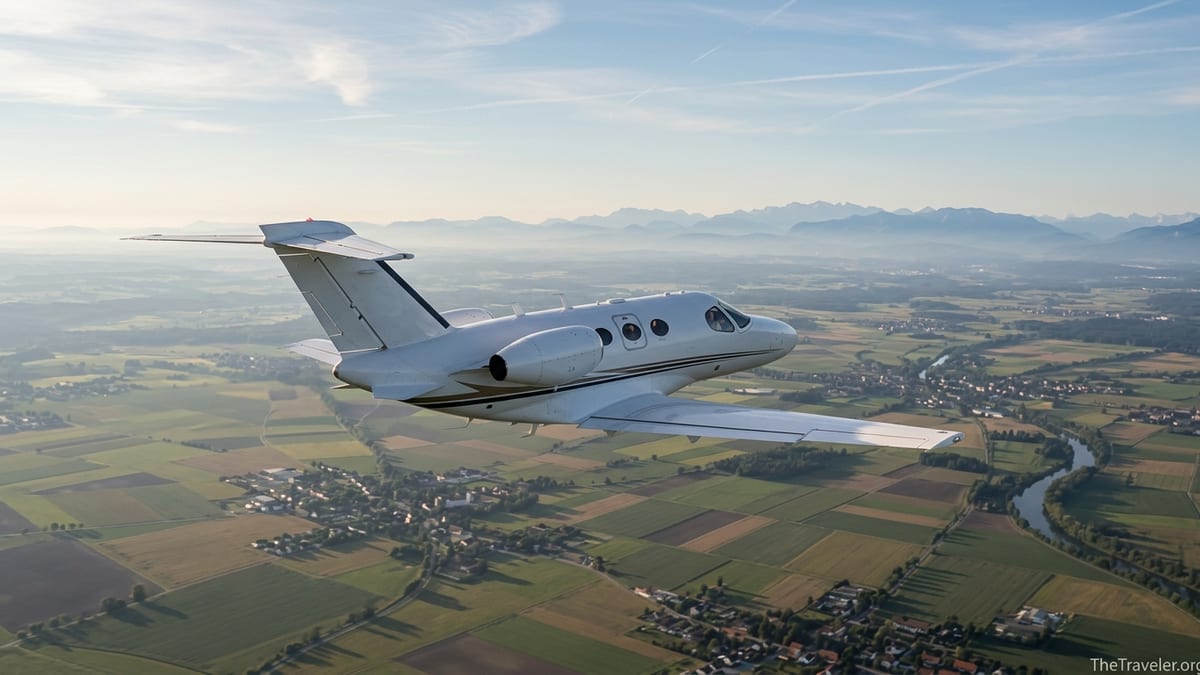
GlobeAir is a Linz-based private jet operator focused almost entirely on one aircraft type: the Cessna Citation Mustang, a four-seat very light jet designed for short sectors. The company has grown since its founding in 2008 to become the leading player in Europe’s very light jet segment, operating what partners and industry profiles describe as the world’s largest Mustang fleet, with roughly 17 to 20 aircraft active at any given time. Unlike many brokers that match passengers with third-party operators, GlobeAir owns and operates its jets, which allows it to standardize service and pricing across its network.
The Mustang itself is purpose-built for the sort of trips many executives and wealthy leisure travelers take within Europe. Typical cruise speed is around 340 knots and range is in the region of 1,100 to 1,200 nautical miles under real-world conditions, enough for sectors such as Paris to Milan, London to Geneva, or Munich to Rome without a fuel stop. The aircraft seats four passengers plus pilots and is certified for operation into many smaller regional and secondary airports, where runway length or operating costs might keep larger jets away.
GlobeAir positions this focused fleet as an “air taxi” concept for the European market. You do not buy fractional ownership or long-term leases; instead you book point-to-point flights as needed, either on-demand or through pre-purchased hours via a Jet Card. The company emphasizes short notice availability, with marketing material highlighting the ability to organize flights with just a few hours’ lead time between major European business and leisure hubs.
In practice, that means GlobeAir is competing less with ultra-long-range and large-cabin jet operators and more with airlines’ business class, high-speed rail and regional private operators that fly light jets or turboprops. Whether it is worth it rests on how its pricing and network compare to those alternatives on the routes you actually fly.
How Pricing Works: Realistic Numbers for Common Routes
Exact charter prices fluctuate based on demand, positioning flights, airport charges and season, so no operator can quote firm universal numbers. However, public information from private aviation consultants and charter brokers that analyze GlobeAir’s model, along with typical Mustang operating economics, gives a useful ballpark. Industry discussions place very light jet charter in Europe in the region of roughly 2,000 to 3,000 euros per flight hour for an operator-owened aircraft such as the Citation Mustang, with GlobeAir usually targeting the lower end of that light jet spectrum on shorter hops.
Take a popular business route like London Luton to Geneva. Flight time on a Mustang is around 1 hour 30 minutes in normal conditions. By the time you add taxi, climb and reserves, you may be billed for something close to 1.8 to 2.0 hours of utilization. At a notional 2,500 euros per hour all-in, the final price could sit somewhere around 4,500 to 5,000 euros one way for up to four passengers. In peak winter weekends when Geneva is full of ski traffic, that could be somewhat higher; midweek shoulder dates might be a little lower if an aircraft is already positioned nearby.
On shorter leisure routes the same logic applies. For Nice to Olbia, a popular summer hop to Sardinia that might represent about 50 minutes of airborne time, the charged block time could be around 1.3 hours. With typical light jet pricing, you might expect a ballpark of 2,500 to 3,000 euros all-in for the aircraft, again shared across up to four people. The smaller the group, the more expensive it feels on a per-head basis, but split between three or four adults the cost may not be wildly beyond last-minute flexible business class tickets in high season.
GlobeAir’s Jet Card option is intended to smooth these fluctuations. The company publicly promotes fixed hourly rates on the Mustang within a defined European service region through pre-purchased hour packages, with transparent zoning supplements for flights that fall partly outside the core area. For a traveler who knows they will fly, for instance, 25 to 50 hours per year between cities such as Zurich, Milan, Paris, London, Vienna and Ibiza, locking in that fixed hourly rate can avoid unwelcome surprises when demand spikes.
Where GlobeAir Works Best: Routes, Airports and Use Cases
GlobeAir’s model is structurally optimized for short segments linking dense business and leisure corridors in Europe. The company highlights popular pairings such as London to Nice, Geneva to Ibiza, Zurich to Olbia and Milan to Cannes, where flight times sit nicely in the one to two hour window that plays to the Mustang’s strengths. These routes often involve airports that are poorly connected by point-to-point airline schedules, or where flight timings do not match tight business itineraries.
One major advantage is access to smaller airports. The Citation Mustang is capable of operating from relatively short runways, which opens up fields such as Sion in the Swiss Alps or Bolzano in northern Italy that are closer to ski resorts than the big hubs. A traveler flying from Munich to Sion for a weekend in Verbier, for example, might compare a direct private hop of just over an hour against a commercial journey involving a hub connection, airport transfers and a long road or rail leg up the valley.
Similarly, on the Mediterranean coast, GlobeAir can use secondary fields like Cannes Mandelieu or Ibiza’s limited private jet infrastructure to bring passengers closer to resorts and marinas than larger commercial airports. A group bound for a yacht charter in Porto Cervo might fly from Geneva directly to Olbia Costa Smeralda, avoiding tight connection banks and long check-in times at congested hubs during peak summer Saturdays.
These operational advantages also appeal to executives with multi-city itineraries. A chief executive needing to visit factories near Linz and Turin on the same day could charter a GlobeAir Mustang from Vienna to Turin Caselle, then back to Linz, completing in one day a round of meetings that might otherwise require a night or two on the road and multiple commercial flights. In such scenarios, the value is measured less by the sticker price and more by how many productive working hours the trip saves.
What You Get Onboard: Comfort, Cabin Experience and Limits
Compared with large-cabin business jets, the Citation Mustang is compact. GlobeAir has invested in refurbishing and standardizing its interiors, promoting Italian-crafted leather seats, modern cabin finishes and thoughtful details such as adjustable lighting, USB power and a small refreshment center. For sectors of 60 to 90 minutes, most travelers find the four-seat club layout comfortable enough, especially if the passenger group is just two or three people rather than four adults plus luggage.
Cabin height is limited, and no one other than the pilots can stand fully upright. Passengers will be seated for the entire flight except for brief movement to retrieve items or use a discreetly integrated lavatory on some configurations. That is acceptable for hops such as Paris to Zurich or Milan to Nice, but it is less attractive if you routinely fly two and a half to three hours, when stepping up to a larger light jet such as an Embraer Phenom 300 or Cessna Citation CJ series may materially improve comfort.
Luggage capacity is another constraint. The Mustang’s external and internal baggage holds can handle typical business trip loads and weekend bags for a small group, but the aircraft is not designed for sets of golf clubs for four, multiple large hard-sided suitcases or extensive sports gear all at once. On a winter trip from London to Innsbruck with four passengers, for instance, GlobeAir’s team may encourage soft-sided bags and careful packing. For heavy ski equipment, travelers may either need to trim their packing list or explore a larger aircraft category.
In terms of onboard service, GlobeAir functions more like a high-end air taxi than a fully bespoke ultra-long-range jet operation. You can expect a dedicated account manager, coordinated ground transfers on request and light catering appropriate to the sector length. However, you are not booking a wide-body business jet with a flight attendant and full hot meal service. Many travelers view this as an acceptable trade-off: the selling point is speed and convenience between European points, not over-the-top opulence.
How GlobeAir Compares With Airlines, Rail and Other Private Options
The most useful way to judge whether GlobeAir is “worth it” is to compare it with specific alternatives on actual journeys. On a route like London to Zurich on a Tuesday in February, you could choose a scheduled airline business class ticket, a first class rail ticket via Paris and Basel, a charter with a very light jet operator like GlobeAir, or a different private solution via a broker that might place you on a turboprop or light jet sourced from another operator.
Commercial airlines usually win on raw price. A return business class fare booked a few weeks in advance may run to several hundred euros per person, far less than the several thousand euros needed to charter your own jet. They also offer frequent departures on trunk routes. However, airlines begin to lose their advantage when your itinerary involves remote airports, awkward timings, last-minute changes or multi-stop trips. For example, flying commercially from Milan to Sion often requires a connection and a ground transfer of several hours, where a GlobeAir Mustang could deliver you directly in little more than an hour of flight time.
High-speed rail can be an attractive alternative on corridors such as Paris to Lyon or Milan to Rome, where journey times are competitive and city-center station locations reduce transfer time. For solo travelers or couples, the economics of private jets are usually hard to justify on these routes. But when four executives need to shuttle between Cologne and Lyon for a time-sensitive meeting and return the same evening, a direct Mustang charter might in fact be cost-competitive with four flexible business fares, hotel nights, per diem costs and the lost productivity of overnight stays.
Against other private aviation models, GlobeAir’s single-fleet approach has pros and cons. Brokers like LunaJets or other pan-European charter specialists can access a wide spectrum of aircraft types, from turboprops such as Pilatus PC-12 to larger super-midsize and long-range jets, and can cherry-pick aircraft based on availability and price. That sometimes allows them to undercut fixed-fleet operators on certain city pairs or to better accommodate special luggage or cabin needs. Yet this loose network model can also mean less predictability: aircraft age and onboard experience may vary from trip to trip. GlobeAir, by contrast, offers a consistent Mustang product at relatively predictable pricing in the very light jet niche.
Who GlobeAir Is Best Suited For
GlobeAir tends to make the most sense for a particular profile of traveler. The sweet spot is typically small groups of up to four passengers making short to medium hops across Europe where airline options are poor, schedules are tight and time has a high value. Examples include executive teams visiting multiple plants across Germany, Austria and northern Italy in a single day, or families connecting between smaller cities and Mediterranean resorts on time-sensitive itineraries.
For a law firm based in Frankfurt whose partners frequently need to appear in Zurich, Milan and Vienna on short notice, combining a GlobeAir Jet Card with on-demand charters can deliver flexibility that conventional airlines simply cannot. The firm might value being able to decide at 6 p.m. to hold a client meeting in Milan the following morning, confident that a Mustang can depart at 7 a.m., clear smaller private terminals quickly and return the same day without overnight costs.
Leisure travelers sometimes find GlobeAir compelling for seasonal patterns. A family from London splitting their winter between the Alps and a home in the south of France might use GlobeAir for London to Sion or Innsbruck flights in peak ski season when commercial prices and crowding soar, then again in August for London to Olbia or Nice when airline cabins are full and delays frequent. In such real-world situations, the relative premium over first or business class is softened by the value of direct routings, privacy and easier logistics for children or older relatives.
By contrast, solo travelers, couples on leisurely city breaks, or price-sensitive flyers generally do not extract full value from a product like GlobeAir. When schedules are flexible and there is no need to connect to tight meetings, high-speed trains and mainstream airlines almost always offer better value. Similarly, larger groups of six to eight passengers may be better served by stepping up to a bigger aircraft category where the per-seat cost remains reasonable even if the total charter price rises.
Key Limitations and When to Consider Alternatives
Despite its strengths, GlobeAir is not a universal solution. Its purposeful focus on the Citation Mustang means it is not ideal for every mission profile. Long sectors approaching the edge of the aircraft’s range, such as London to Athens or Dublin to Larnaca, may require fuel stops or careful planning around payload and weather, diminishing the time savings versus airlines. In such cases, a light or midsize jet with greater range might be more appropriate, even if booked through a different operator or broker.
Weather and airfield restrictions can also impact operations more noticeably for very light jets. While the Mustang is a capable aircraft, some challenging alpine airports impose performance requirements that narrow the operating window during certain conditions. If your winter itinerary repeatedly involves marginal weather into short mountain strips, you may find that a larger, more powerful jet or even a turboprop with excellent short-field performance, such as the Pilatus PC-12, offers greater dispatch reliability.
There is also the question of geographic scope. GlobeAir’s core strength lies in Western and Central Europe. If your travel quickly expands to long-haul transatlantic segments or to regions such as the Middle East or North Africa, you will likely find yourself turning to broader charter networks or fractional providers that can supply everything from heavy jets to VIP airliners. GlobeAir can sometimes coordinate beyond its core through partnerships, but its own metal remains firmly in the very light jet, intra-European space.
Finally, travelers who place a premium on onboard space, full stand-up cabins and in-flight service may feel constrained by the Mustang’s compact dimensions. For them, paying more for a midsize jet with a flight attendant and spacious galley, especially on flights longer than two hours, might deliver a level of comfort that better matches expectations, even if it sacrifices some of GlobeAir’s cost-efficiency for very short hops.
The Takeaway
GlobeAir has carved out a clear niche as Europe’s reference operator for short-haul private flights using the Cessna Citation Mustang. Its strengths are straightforward: predictable pricing structures, a standardized and well-maintained very light jet fleet, access to smaller airports and the flexibility to arrange flights at short notice between many of Europe’s key business and leisure destinations. For travelers whose time is exceptionally valuable and whose itineraries do not align neatly with airline schedules, those attributes can easily justify the premium over commercial options.
On real-world routes such as London to Geneva, Zurich to Olbia or Munich to Sion, especially when flying with three or four passengers on tight schedules, GlobeAir’s offering can be compelling. The combination of direct routings, private terminal convenience and modest but comfortable cabins often turns multi-leg commercial journeys into quick point-to-point hops. Businesses that need to cover multiple regional offices in a day, or families shuttling between ski chalets and coastal villas, are typical beneficiaries.
Yet GlobeAir is not a catch-all answer to European private aviation needs. Its compact Mustangs impose clear limits on range, passenger numbers and luggage; comfort is optimized for one to two-hour flights, not half-continental hauls. Travelers who often carry bulky sports equipment, fly with larger groups or demand spacious, stand-up cabins may find that a broader charter broker or a provider with a mixed fleet serves them better, even at higher hourly rates.
Ultimately, GlobeAir is worth it when your trips fit neatly inside its design envelope: short-haul, intra-European routes with up to four passengers, high time sensitivity and a preference for smaller airports closer to your final destination. If that describes your typical travel pattern, it is well worth obtaining sample quotes based on actual routes and dates, and comparing them with premium airline fares and other charter offerings. If it does not, GlobeAir remains a useful benchmark, but not necessarily your default choice.
FAQ
Q1. What kind of aircraft does GlobeAir operate? GlobeAir focuses on the Cessna Citation Mustang, a four-passenger very light jet optimized for short European hops and small airports, providing a standardized cabin and flight experience across its fleet.
Q2. How many passengers can fly on a GlobeAir jet? The Citation Mustang configuration used by GlobeAir is designed for up to four passengers, making it best suited to individuals, couples and small groups rather than larger parties.
Q3. What is the typical range of a GlobeAir flight? In real operating conditions, the Mustang’s practical range is well suited to flights of about one to two hours, covering routes such as Paris to Milan, London to Geneva or Zurich to Olbia without a fuel stop.
Q4. How much does a short GlobeAir flight usually cost? While prices vary, many one to two-hour European sectors fall into an approximate range of several thousand euros per leg for the entire aircraft, with the cost shared across up to four passengers.
Q5. How does a GlobeAir charter compare with business class on airlines? Airline business class is usually cheaper on major trunk routes, but GlobeAir can be competitive when you factor in time savings, direct access to smaller airports and the value of flexible, last-minute scheduling.
Q6. Can GlobeAir fly to smaller regional or alpine airports? Yes, one advantage of the Citation Mustang is its ability to use shorter runways, allowing GlobeAir to serve many regional and alpine airports that bring travelers closer to ski resorts or remote business locations.
Q7. Is there a membership or Jet Card option with GlobeAir? GlobeAir offers Jet Card programs where you purchase a block of flight hours at a fixed hourly rate within a defined service region, providing more predictable pricing and priority access to its fleet.
Q8. How much luggage can I bring on a GlobeAir flight? The Mustang’s baggage capacity comfortably handles typical business and weekend bags for up to four passengers, but carrying multiple large suitcases or bulky sports equipment may require careful planning or a larger aircraft.
Q9. Does GlobeAir provide catering and ground transfers? GlobeAir includes light catering suited to short flights and can arrange ground transfers or hotel bookings on request, positioning itself as a full-trip facilitator rather than just an aircraft provider.
Q10. When is GlobeAir not the best option? GlobeAir is less suitable for long-range flights, large groups, or travelers who require spacious, stand-up cabins and extensive luggage, in which cases larger jets or alternative operators may offer better value.