


Passeig de Gràcia is Barcelona’s most elegant boulevard and one of the easiest places to feel overwhelmed. Between Gaudí masterpieces, other modernista mansions, luxury boutiques, rooftop views and busy traffic, it is surprisingly simple to walk the entire avenue and still come away feeling like you missed the best parts. This guide walks you, block by block, through how to visit Passeig de Gràcia without skipping its most famous landmarks, with concrete timing, ticket, and navigation tips drawn from how locals and frequent visitors actually use the street.
Get the latest updates straight to your inbox!
Getting Oriented: What Passeig de Gràcia Actually Is
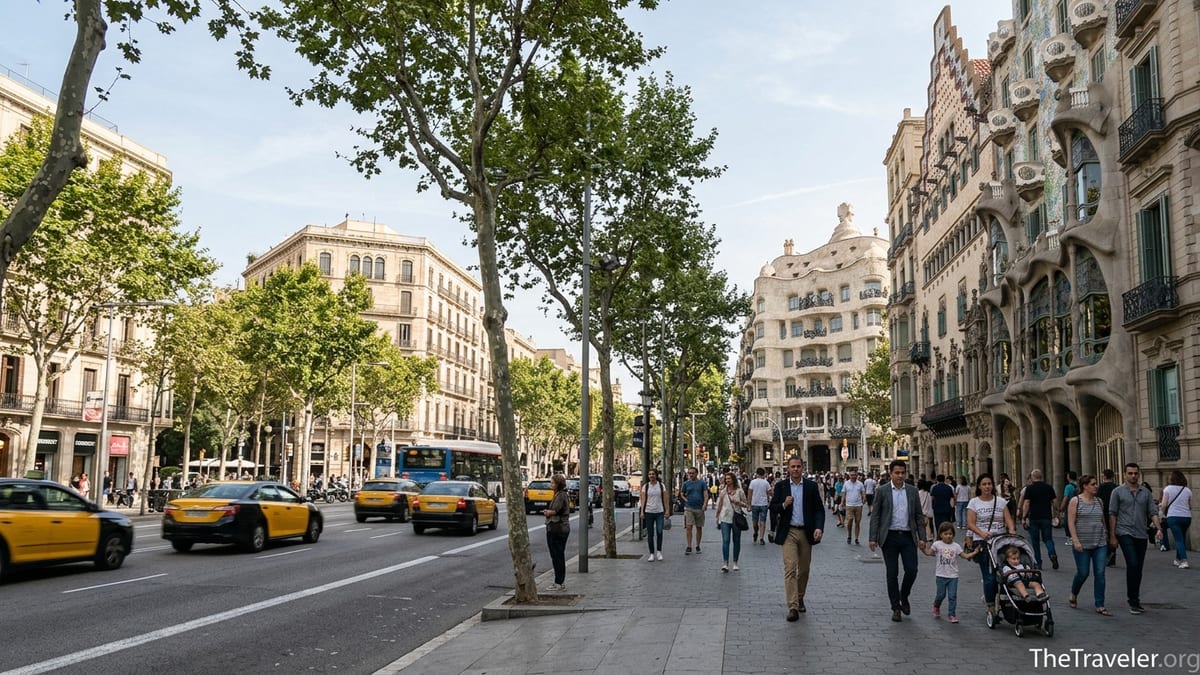
Passeig de Gràcia runs roughly north from Plaça de Catalunya into the Eixample district, a straight, tree-lined avenue flanked by monumental apartment buildings, banks converted into flagship stores, and some of the most celebrated architecture in Spain. It is not a pedestrian street like La Rambla; expect wide sidewalks, heavy car traffic, and constant movement. Knowing this helps you plan realistic walking times and understand why some crossings feel hectic when you are trying to photograph a façade.
Most visitors mentally divide the avenue into three sections. The lower section runs from Plaça de Catalunya to about Carrer d’Aragó and is heavy on flagship stores, hotels, and the underground train and metro hub. The middle stretch, between Aragó and Diagonal, is where you will find the “Block of Discord” with Casa Batlló, Casa Amatller and Casa Lleó Morera, plus a dense cluster of cafes and terraces. The upper section, beyond Diagonal, is more residential and business focused, with La Pedrera (Casa Milà) anchoring the area and quieter side streets radiating out toward Gràcia.
The beauty of Passeig de Gràcia for a first timer is that almost everything you want to see sits on one straight line. You could walk end to end in 25 to 30 minutes without stops, but to do the avenue justice you should plan at least half a day, and a full day if you intend to visit the interiors of both Casa Batlló and La Pedrera. A smart strategy is to treat the street as your spine for a day in Barcelona, moving up and down it between morning, afternoon and evening activities.
From a practical standpoint, Passeig de Gràcia is also a transport anchor. The underground station of the same name is served by several metro and suburban train lines, and regional trains stop here as well, meaning you can arrive directly from many neighborhoods and even from Barcelona Airport with just a single change or on the airport train itself.
Arriving Smart: Metro, Train and Airport Connections
The simplest way to arrive is by metro to Passeig de Gràcia station, which is served by lines L2 (purple), L3 (green) and L4 (yellow). If you are staying near Sagrada Família, for example, you can be on Passeig de Gràcia in about 10 minutes by taking L2 two stops. From the Gothic Quarter, L3 gets you there quickly from Liceu or Drassanes. Metro trains run roughly every few minutes throughout the day, making it easy to time your arrival for early morning openings at the big Gaudí houses.
If you are coming directly from Barcelona Airport Terminal 2 with light luggage, the R2 Nord commuter train is particularly convenient because it stops at Passeig de Gràcia in about 25 to 30 minutes. The station at the airport is a short, covered walk from Terminal 2. From there, you simply board any R2 Nord service heading toward the city and get off at Passeig de Gràcia. For Terminal 1, you would first take the free shuttle to Terminal 2 before using the train. This option avoids traffic and drops you right in the heart of the city, a few minutes’ walk from Plaça de Catalunya.
Within the station complex, follow the color-coded signs carefully; transfers between metro and suburban trains can involve long corridors and multiple escalators. Aim to exit toward Passeig de Gràcia itself or Gran Via de les Corts Catalanes rather than side streets if you want to orient yourself easily. As you emerge, take a moment to note your nearest landmark, such as a major hotel on the corner or a recognizable store, so you can find the same entrance again later in the day.
Taxis and ride-hailing services are also straightforward. A ride from the central cruise port to Passeig de Gràcia typically takes 15 to 25 minutes depending on traffic and costs roughly what you would expect for a short urban taxi journey in a major European city, often similar to the cost of airport shuttles per person when shared between two or three travelers. If you plan to shop for bulky items or travel with small children, consider arriving by taxi and then using the metro to leave once you are tired and carrying bags.
The Essential Landmarks: What You Must Not Miss
The two absolute non-negotiables on Passeig de Gràcia are Casa Batlló and La Pedrera (Casa Milà), both designed by Antoni Gaudí and both UNESCO World Heritage sites. Casa Batlló, located at number 43, is instantly recognizable by its scaled roof and bone-like balconies. Even if you do not go inside, you should budget at least 15 minutes to study the façade in different light and step back across the street for photos. Many visitors choose an evening or “magic” visit ticket here, which costs significantly more than the basic daytime entry but includes light projections and a more theatrical experience.
About ten minutes’ walk uphill, at number 92, La Pedrera presents an entirely different vision of Gaudí’s work, with undulating stone, wrought iron balconies and an exceptional rooftop. A standard daytime visit with audio guide is one of the best ways to understand how these wildly imaginative spaces actually functioned as apartments. Combined tickets that cover both Casa Batlló and La Pedrera are widely sold and can save you both money and queuing time; buying in advance is highly recommended during high season or on weekends.
On the same block as Casa Batlló you will find two more modernista gems. Casa Amatller, directly next door, has a stepped, almost Dutch-looking roofline and richly decorated entrance. It offers smaller, more intimate tours of the original interiors, which appeal to visitors who like detailed historic interpretation and quieter spaces. A few doors away stands Casa Lleó Morera, another exquisite façade with floral stonework and stained glass. Today it is typically viewed only from outside, but its presence completes what locals call the “Block of Discord,” where different architects competed for attention.
At the lower end of Passeig de Gràcia, near Plaça de Catalunya, look up to admire the grand hotels and civic buildings that frame the square, many of which have rooftop terraces. At the upper end, near Diagonal, the avenue opens slightly and you will see La Pedrera dominating one corner; around it, upmarket shops and cafes fill former palaces and residential buildings, giving you plenty to explore between landmark visits.
Planning a Half-Day or Full-Day Route
For a focused half-day that still covers the essentials, start around 8:30 or 9:00 in the morning at La Pedrera. Book the first time slot to experience the roof terrace when it is still relatively uncrowded and the light is soft. A typical visit takes 60 to 90 minutes, more if you enjoy reading all of the exhibit material. Once finished, walk slowly down Passeig de Gràcia toward Casa Batlló, stopping occasionally to photograph iron lamp posts, tiled benches and the terrazzo-like pavement, which carries a Gaudí-inspired hexagonal pattern.
Around mid-morning, aim for a time slot at Casa Batlló. The most popular ticket types today tend to bundle an audio guide and some form of augmented or immersive elements, so plan for at least 75 to 90 minutes inside. After your visit, step back out onto the street and take in the full “Block of Discord” façade row; this is an ideal moment to compare Gaudí’s organic curves with the more rectilinear but equally ornate Casa Amatller and Casa Lleó Morera.
If you opt for a full day on Passeig de Gràcia, you can slow the pace considerably. Begin again at La Pedrera, but add a coffee before or after at one of the nearby cafes on the side streets toward Gràcia, where you will find more local clientele and slightly lower prices than directly on the main avenue. After visiting La Pedrera, stroll south stopping at whichever boutiques or design shops catch your eye, then schedule Casa Batlló for early afternoon, leaving time for a late lunch on or just off the boulevard.
In the late afternoon, you can dedicate an hour to exploring the lower end of Passeig de Gràcia near Plaça de Catalunya. This can include a quick pass through a department store for Spanish brands, a look inside a historic bank building now housing a major tech retailer, or a cocktail on a hotel rooftop with views back up the avenue. By evening, the façades are beautifully lit; if you have the energy, circle back to see Casa Batlló and La Pedrera again at night, even from the outside only, to appreciate how different they feel.
Where to Pause: Cafes, Shopping and Rooftops
Passeig de Gràcia is one of Barcelona’s prime shopping streets, with international luxury houses like Louis Vuitton, Chanel and Gucci rubbing shoulders with Spanish brands such as Loewe, Mango and Massimo Dutti. Window shopping here can easily consume an hour. Even if you are not buying, stepping briefly into a high-end boutique to appreciate the architecture and interior design can be an experience of its own. For more down-to-earth purchases like clothing basics or travel replacements, look for large multi-story fashion chains located closer to Plaça de Catalunya.
Cafes and bakeries are scattered all along the avenue, but many of the best options are just off Passeig de Gràcia on side streets such as Carrer de Provença or Carrer de València. A common strategy among locals is to leave the main boulevard by half a block to find a bar that serves a proper menú del día at lunch, often including a starter, main, dessert and drink at a price far lower than a single main dish on the avenue. This approach also places you around more office workers than tourists, which tends to mean quicker service and more authentic daily specials.
For a memorable pause with a view, consider one of the hotel rooftop terraces accessible for the price of a drink. Several hotels along Passeig de Gràcia open their terraces to non-guests in the afternoon and early evening, especially in warm months. A glass of cava or a coffee with a direct sightline to Casa Batlló or across to Tibidabo hill is a pleasant way to rest your feet. Check opening hours and dress expectations in advance, as some rooftops lean more toward casual daytime lounging while others expect smarter evening attire.
If you need a quieter break, slip into one of the interior courtyards or arcades off the main drag, where smaller concept stores, design studios and gourmet food shops often cluster. These spaces are ideal for picking up Catalan-made gifts such as ceramics, chocolate, or textiles that fit easily into a carry-on bag, avoiding the bulk of large souvenirs.
Beating Crowds and Staying Safe
Passeig de Gràcia is busy year-round, but crowd levels shift significantly by hour. The quietest windows for enjoying the façades are usually early morning before 10:00 and the late afternoon lull between about 14:30 and 16:30 when many people are at lunch or resting. Late evening, after 21:00 in summer, also offers a calmer atmosphere, though interior visits will be closed or running special night programs only. Schedule your photography and unhurried strolling for these times, and use the late morning rush for indoor visits where timed entries smooth the flow of people.
Like most major European shopping avenues, Passeig de Gràcia has a visible police presence and is generally safe, but pickpocketing and bag snatching do occur, particularly around metro entrances, ATMs, and outside luxury boutiques where thieves may watch people coming out with shopping bags. Practical, low-stress precautions go a long way: keep your phone in a zipped pocket or crossbody bag instead of in your hand when walking, use bags that close fully, and avoid hanging handbags on the back of café chairs. Consider carrying only one credit card and a modest amount of cash on your person, with backups locked in your accommodation safe.
Street distractions are a common tactic. If someone spills something on you, offers free bracelets, or insists on showing you a “petition” to sign while stepping close, simply step away and decline without engaging. On the metro platforms beneath Passeig de Gràcia, be especially mindful in the few moments when trains arrive, doors open, and people surge toward exits; this is when many travelers discover later that their wallet or phone is missing. Traveling with a small, anti-theft style day pack worn on your front in crowded moments is common and does not look out of place.
At night, Passeig de Gràcia itself remains lively and lit, with restaurants and hotel bars in full swing. The main concern is not violent crime but opportunistic theft from those who are tired, distracted or have been drinking. If you plan a late dinner near the avenue, consider using a taxi back to your hotel rather than wandering unfamiliar side streets with valuables on display, especially if you are carrying luxury shopping bags or expensive cameras.
Practical Ticket, Timing and Money Tips
Most major landmarks on Passeig de Gràcia now use dynamic pricing and timed tickets. While exact prices change, a standard adult ticket to visit the interior of La Pedrera or Casa Batlló often costs a substantial portion of a typical day’s travel budget. Combined tickets that include both houses can be a good value if you plan to see both within a day or two, especially when purchased online in advance. Booking directly with official sites allows you to choose precise entry times, which helps you structure your day and avoid long queues in the sun.
Try to group paid entrances logically. One approach is to treat one Gaudí house as your “main” immersive visit with all the extras, and the other as a simpler, shorter visit. For example, you might book a premium immersive evening experience at Casa Batlló, with projections and live music, and then choose a standard morning visit at La Pedrera focusing on its rooftop and attic exhibition. This balances cost and time while still giving you two very different perspectives on Gaudí’s work.
For transport savings, consider a multi-day public transit card if you expect to use the metro and buses several times per day. Riding from your hotel to Passeig de Gràcia, then out to Sagrada Família, and back again can add up quickly if bought as single tickets. Prepaid cards or tourist transport passes typically reduce the per-ride cost markedly and eliminate the need to fumble for change at ticket machines, which is helpful when you are watching bags and family members at the same time.
When it comes to food and shopping along the avenue, simple habits keep costs under control. Check prices before sitting at terrace tables on the main drag, where a cappuccino or soft drink can easily cost double what you would pay one block away. For souvenirs, resist buying everything in the first shop you see; many items like mosaic-style trinkets or generic Barcelona T-shirts appear in multiple stores with wide price differences. Prioritize higher quality, locally made items from smaller shops, even if that means bringing home fewer things; your suitcase and your budget will thank you.
The Takeaway
Seeing Passeig de Gràcia properly is less about racing from sight to sight and more about moving through the avenue with a loose but deliberate plan. If you know where the key landmarks sit, how long interior visits realistically take, and when the sidewalks are least crowded, you can comfortably fit both Casa Batlló and La Pedrera into a single day while still leaving time for coffee, shopping and simply watching Barcelona glide by.
Arriving by metro or train to the central station lets you step out directly into the heart of the boulevard, while an early start and pre-booked tickets help you sidestep long lines. A few common-sense safety habits keep the focus where it should be: on architecture, light and atmosphere instead of on your bag. Whether you devote a morning, a full day, or several evenings to the street, Passeig de Gràcia will reward slow attention, from its famous Gaudí silhouettes down to the patterned tiles beneath your feet.
FAQ
Q1. How much time do I need to see the main landmarks on Passeig de Gràcia?
Most visitors should plan at least half a day to see Casa Batlló and La Pedrera from the outside and visit the interior of one of them. A full day allows you to tour both houses inside at a relaxed pace, add coffee or a rooftop drink, and wander the rest of the avenue without rushing.
Q2. In what order should I visit Casa Batlló and La Pedrera?
A practical route is to start at La Pedrera near Avinguda Diagonal in the morning when the rooftop is quiet, then walk downhill to Casa Batlló mid-morning or early afternoon. This follows the natural slope of the street and leaves you near Plaça de Catalunya for shopping or onward transport at the end.
Q3. Do I really need to buy tickets in advance for the Gaudí houses?
Advance tickets are strongly recommended, especially in high season, on weekends, and for evening or rooftop experiences. Same-day tickets can sell out for popular time slots, and buying at the door often means waiting in a separate queue that eats into your sightseeing time.
Q4. Is Passeig de Gràcia safe to walk at night?
Passeig de Gràcia is generally considered safe in the evening, with good lighting, active restaurants and visible police presence. The main risk is opportunistic theft, not violent crime, so keep phones and bags secure, avoid setting valuables on café tables, and consider using a taxi for late-night returns to outlying neighborhoods.
Q5. How do I get to Passeig de Gràcia from Barcelona Airport?
From Terminal 2, you can take the R2 Nord commuter train directly to Passeig de Gràcia station in about half an hour. From either terminal, you can also use the airport bus to Plaça de Catalunya and walk a few minutes up the avenue, or take a taxi door to door if you have bulky luggage or arrive late at night.
Q6. What is the best time of day to photograph Casa Batlló and La Pedrera?
Early morning offers softer light and fewer people in your shots, especially for La Pedrera’s rooftop. Late afternoon and early evening are excellent for the façades, as the sun drops and artificial lighting begins to highlight details, though sidewalks will be busier at these times.
Q7. Can I visit Passeig de Gràcia with children or a stroller?
Yes. The sidewalks are wide and mostly flat, and both Casa Batlló and La Pedrera accommodate families, though some rooftop areas include steps and uneven surfaces. Plan for breaks in nearby parks or cafés, keep children close in metro stations and at busy crossings, and factor in extra time for elevators and restrooms.
Q8. Are there good budget food options near Passeig de Gràcia?
Absolutely. While many restaurants on the avenue itself are priced for tourists and business travelers, you will find more affordable options one or two blocks away on side streets. Look for small bars with a menú del día chalkboard at lunchtime, bakeries selling sandwiches, or casual tapas spots frequented by office workers.
Q9. Is it worth going inside both Casa Batlló and La Pedrera?
If your budget and schedule allow, visiting both offers a richer understanding of Gaudí’s architecture, as each house has a distinct style and interpretation. If you must choose one, consider La Pedrera for its rooftop and structural explanations, or Casa Batlló for its more theatrical, immersive storytelling and color.
Q10. What should I watch out for regarding pickpockets on Passeig de Gràcia?
Be especially alert around metro entrances, crowded crosswalks near Plaça de Catalunya, and outside luxury boutiques. Keep bags zipped and worn in front in busy spots, avoid leaving phones or wallets on café tables, and be wary of staged distractions such as someone bumping into you, asking for signatures, or offering unsolicited help with ticket machines.