


On a map, Vatican City is little more than a dot inside Rome. In reality, this walled enclave of less than half a square kilometer receives several million visitors a year, with the Vatican Museums alone welcoming around 6.8 million people in 2024. For many travelers it is a spiritual goal, for others an art-history pilgrimage, and for most it is an essential stop on any serious visit to Rome. Understanding why this tiny state continues to attract such enormous crowds helps you plan a more meaningful, and more manageable, visit of your own.
Get the latest updates straight to your inbox!
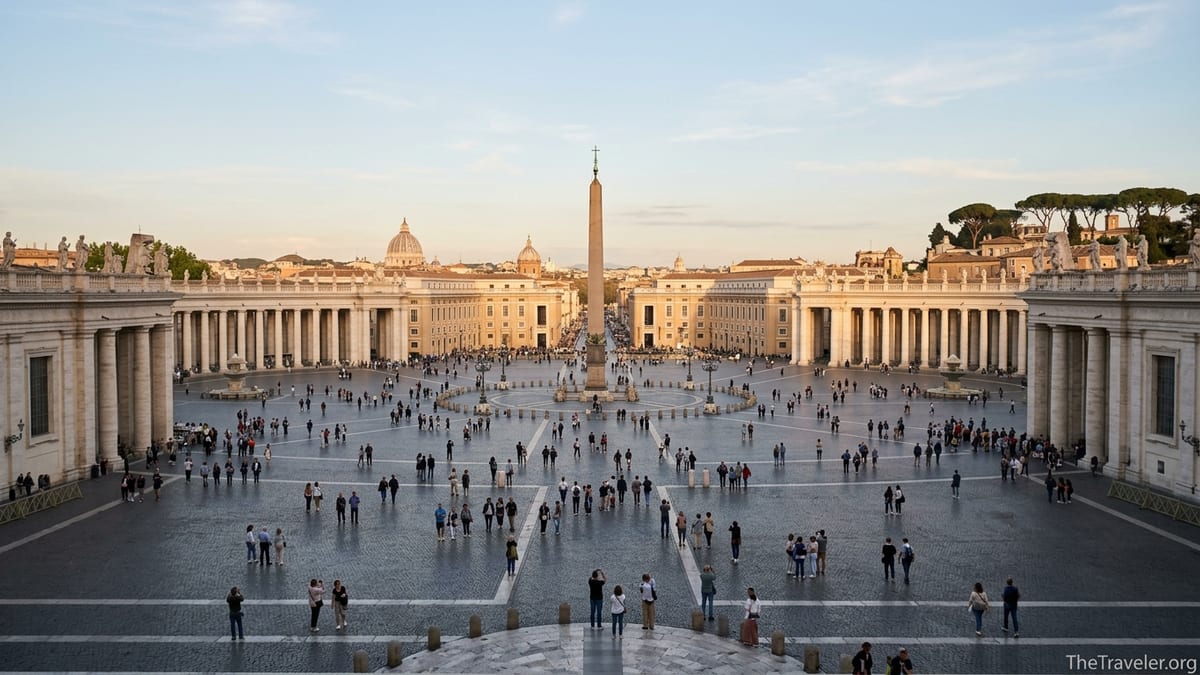
The Unique Magnetism of the World’s Smallest State
Part of Vatican City’s appeal is simple curiosity. It is the smallest independent state in the world, with fewer than 1,000 residents, its own post office, security force and radio service. Yet on a busy summer day the cobblestones of St Peter’s Square can hold more people than actually live in the country by several thousand times. Visitors walk just a few steps from Italy into an entirely separate state, often without even noticing an official border crossing beyond a discreet line in the pavement and Swiss Guards in Renaissance-style uniforms.
Unlike many European microstates, Vatican City is not built around casinos, shopping or beaches. It is built around a living institution that influences over a billion Catholics worldwide. That institutional presence gives even casual sightseeing a distinctive atmosphere. When you stand in St Peter’s Square on a Wednesday morning and hear the Pope address the crowd, you are experiencing an event broadcast globally and discussed that evening on networks such as Reuters and AP. The sense that decisions made here ripple far beyond Rome adds a subtle layer of drama to an otherwise normal day of touring.
The setting itself is another draw. Vatican City sits on a low hill on the right bank of the Tiber, framed by the pale travertine colonnades of Gian Lorenzo Bernini and the enormous dome of St Peter’s Basilica designed in part by Michelangelo. In practice this means your first glimpse of the Vatican is often the dome rising above a tangle of Roman rooftops as you emerge from the Ottaviano or Cipro metro stations. That view alone has sent many travelers straight to their cameras before they have even reached the security lines.
Art and Architecture on a Scale Few Places Can Match
Many visitors are drawn primarily by art. The Vatican Museums hold one of the most important collections in the world, ranging from ancient Egyptian sarcophagi to 20th century religious art. In 2024, approximately 6.8 million people filed through its 54 galleries, despite timed entries and extended opening hours designed to spread out the crowds. A standard adult ticket purchased at the door costs about 20 euros, while buying online through the official Vatican Museums system adds a 5 euro reservation fee but spares you from unpredictable walk-up queues.
The highlight for most is the Sistine Chapel. After more than an hour of navigating sculpture courts, map galleries and tapestry halls, visitors finally reach the small, almost understated doorway that opens into the chapel. Inside, Michelangelo’s ceiling frescoes and the Last Judgment fill every inch of space above eye level. Guards remind people to keep silent, yet there is often an audible collective intake of breath as new groups enter and tilt their heads back. The fact that this chapel is not only an art treasure but also the room where cardinals elect new popes gives it a double significance that few museums can replicate.
Elsewhere, the Raphael Rooms provide another form of artistic pilgrimage. Painted for Pope Julius II in the early 1500s, these chambers include the famous School of Athens, where philosophers such as Plato and Aristotle are depicted debating under classical arches. Standing in the crowd, you will likely see tour guides pointing out a small self-portrait of Raphael in the corner, a detail many visitors would otherwise miss. The experience feels less like strolling through a standard gallery and more like being invited into the private apartments of the Renaissance papacy.
Beyond the museums, St Peter’s Basilica is an architectural statement on a monumental scale. Entry is free, though you must pass airport-style security and often wait in a line that snakes around parts of the square, especially in peak summer months and around Easter. Inside, the space is so vast that the bronze canopy over the main altar, itself nearly 29 meters tall, can initially be mistaken for a modest decorative piece until you compare it with the people walking underneath. The polished marble floors, gilded chapels and Michelangelo’s Pietà behind its protective glass all contribute to an impression of overwhelming, almost theatrical splendor.
Faith, Pilgrimage and Living Catholic Tradition
For practicing Catholics, Vatican City is far more than a museum complex. It is a major pilgrimage destination, particularly during Holy Week, Christmas, canonizations of new saints and special Holy Years. During the Ordinary Jubilee that began in December 2024 and filled the calendar through 2025, tens of millions of pilgrims traveled to Rome and the Vatican to pass through the Holy Door of St Peter’s Basilica and attend special Masses and events. Many arrived on low-cost European flights or pilgrimage buses, booked simple guesthouses run by religious orders, and built entire itineraries around attending a specific papal celebration.
Even outside a Jubilee, weekly and seasonal rituals shape the visitor experience. On most Wednesday mornings when the Pope is in Rome, a general audience is held either in St Peter’s Square or the Paul VI Audience Hall. Tickets are free but must be reserved in advance through Church channels, and security opens as early as 7:30 am. It is not unusual to see pilgrims from multiple continents arrive before dawn, wrapped in flags and scarves from their home countries, singing hymns while they wait for the Pope’s motorcade. For many, a brief wave from the popemobile or a blessing in their own language is the emotional high point of a European trip.
Religious travelers also come to pray at the tombs of popes, including Saint John Paul II and Pope John XXIII, whose resting places inside the basilica often draw quiet queues of visitors. Early morning Masses in side chapels, conducted in Italian, Spanish, Polish and other languages, allow small groups to celebrate the liturgy just steps away from Michelangelo’s dome. While these ceremonies are simple, there is a palpable sense of continuity: the same prayers said here today have echoed in one form or another within these walls for centuries.
An Accessible Stop on the Classic Rome Itinerary
Vatican City’s practical convenience also helps explain its enduring popularity. Most international visitors first arrive in Rome via Fiumicino or Ciampino airports, then base themselves in neighborhoods like Prati, Trastevere or the historic center. From many of these areas, the Vatican is a straightforward journey by metro line A to Ottaviano, by bus along Via della Conciliazione, or on foot from landmarks such as Castel Sant’Angelo. This ease of access makes it a natural inclusion even on short stays of two or three days.
Once there, travelers find that much of the Vatican experience clusters tightly around St Peter’s Square and the museum entrance near Viale Vaticano. You can move from touring the basilica in the morning to an afternoon museum visit with only a 10 to 15 minute walk around the walls. Local businesses have adapted accordingly. Streets just outside the borders are lined with espresso bars offering quick cappuccinos for a few euros, souvenir shops selling rosaries and papal calendars, and mid-range trattorias where a sit-down lunch of pasta and house wine typically costs less than a Vatican Museums ticket.
This dense concentration of sights means multi-generational groups can split up according to energy levels. Grandparents might attend a quiet Mass in the basilica and then rest in the colonnades, while younger travelers queue for the dome climb, which involves about 320 steps even if you take the elevator to the terrace level. Families with limited time in Rome often book combination tours that bundle the Vatican Museums, Sistine Chapel and St Peter’s into a single half-day, trading a higher per-person cost for the logistics of timed entries and guided commentary.
Managing Crowds in the Age of Mass Tourism
With several million visitors each year compressed into a tiny state, crowd management has become an essential part of the Vatican experience. Official ticketing policies now encourage online reservations for the museums, with many dates in high season selling out days or weeks in advance on the official platform. Standard adult tickets are priced around 25 euros when booked online, including the reservation fee, while discounted youth tickets cost less and must be supported by valid ID at the entrance.
When regular admission slots are sold out, some travelers turn to third-party platforms selling “skip the line” packages, often bundled with guided tours. These can cost two or three times the standard ticket price, especially for small-group or early-entry options. For example, a basic self-guided ticket from a reseller might run 50 to 60 euros per person, while a more comprehensive guided tour including St Peter’s Basilica can easily exceed 150 euros. Budget-conscious visitors increasingly watch the official site carefully when new time slots are released, or adjust their Rome itinerary to match whatever museum entry time they can secure directly at face value.
Inside the museums, extended opening hours help spread visitor flow. Entry windows typically begin in the early morning and extend into early evening on most days, with last entry in the late afternoon. Yet key chokepoints remain. Narrow staircases leading into the Raphael Rooms and the doorway into the Sistine Chapel can feel extremely crowded by mid-morning. Travelers who arrive for the earliest entry times or choose late afternoon slots often report more breathable conditions and at least some moments of relative quiet in secondary galleries such as the Pinacoteca or the Etruscan collection.
Overtourism also affects the wider neighborhood. Residents in the adjacent Prati district must navigate increased bus traffic and lines of tour groups, while city authorities adjust bus routes and pedestrian zones around large papal events, especially during Holy Week and Jubilees. For visitors this can mean temporary security barriers and bag checks on Via della Conciliazione, or limited vehicle access near the square on major feast days. Those who plan ahead, checking event calendars through official Church channels and allowing extra transit time, generally find the inconvenience outweighed by the rare chance to witness large-scale liturgies in person.
Why Vatican City Still Feels Surprisingly Human
Despite its ceremonial grandeur and global role, Vatican City can feel disarmingly human at close range. Early in the morning, before most tour buses arrive, you might see Vatican employees in ordinary work clothes cycling across the cobbles or entering discreet side doors along the walls. In the afternoon, Swiss Guards chat quietly at their posts, tourists sit on the steps under Bernini’s colonnades to rest their feet, and priests hurry between offices carrying laptop bags and paper coffee cups. It is this mixture of the sacred and the everyday that gives the place an unusual texture.
People also encounter the Vatican in very personal ways. A couple on a honeymoon might book a special blessing of their marriage at a papal audience, leaving with framed parchment bearing the papal seal. A student of art history may stand transfixed in front of a single fresco in the Borgia Apartments, barely noticing the crowd pressing past. A family traveling with children might focus less on theology and more on the simple thrill of mailing postcards from the yellow Vatican post boxes, which often deliver mail to foreign addresses more quickly than the Italian system just outside the border.
Moreover, many visitors describe a sense of continuity that cuts through the commerce surrounding the Vatican. Yes, there are souvenir stands selling T-shirts with the Pope’s face, and cafés that charge premium prices for tables directly on Via della Conciliazione. Yet step a few meters into the basilica during sung vespers, or pause to watch the faithful light candles at a side altar, and the centuries of tradition beneath the surface become harder to ignore. The constant flow of people from every corner of the world gives the impression of a slow, ongoing procession that never quite stops.
The Takeaway
Vatican City continues to attract millions of visitors each year because it offers something rare: a compact place where world-class art, active religious practice and living history converge. Travelers come to see masterpieces like the Sistine Chapel, to stand beneath the dome of St Peter’s, to catch a glimpse of the Pope at a weekly audience, or simply to experience the atmosphere of a tiny state that looms large in global affairs. Even as ticket systems change, crowds swell and security measures evolve, the essential draw remains the same.
For anyone planning a trip to Rome, the Vatican rewards both advance planning and an open mind. Secure museum tickets early, check the calendar for major liturgical events, and be prepared for security checks and crowds. At the same time, allow space in your itinerary for quieter moments: an early morning walk across an almost empty St Peter’s Square, a pause in front of a single work of art that speaks to you, or a few minutes sitting under the colonnades watching the rhythms of this unusual city-state unfold. In those pauses, you will begin to understand why people keep coming back.
FAQ
Q1. Do I need a ticket to enter Vatican City or St Peter’s Square? No, entry to Vatican City’s open areas and St Peter’s Square is free, and you do not need a ticket or passport check to cross the border from Rome.
Q2. How much does it cost to visit the Vatican Museums and Sistine Chapel? A standard adult ticket bought online through the official Vatican Museums system is roughly 25 euros, including the reservation fee, while discounted tickets for youths and some categories cost less with valid ID.
Q3. How far in advance should I book Vatican Museums tickets? In busy months such as April, May, June, September and October, it is wise to check availability as soon as your Rome dates are set, because the most popular time slots often sell out days or weeks in advance.
Q4. Can I see St Peter’s Basilica without visiting the museums? Yes, the basilica is separate from the museums and has its own entrance on St Peter’s Square; access is free, though you must pass security and may wait in line.
Q5. What is the best time of day to avoid crowds at the Vatican? The first entry slots of the morning and late afternoon entries on non-holiday weekdays tend to be less crowded than mid-morning, but even then you should expect significant numbers of visitors in peak season.
Q6. How do I attend a papal audience or Angelus prayer? Weekly Wednesday audiences require free tickets obtained in advance through Church channels, while the Sunday Angelus at noon generally does not require tickets and can be watched from St Peter’s Square.
Q7. Is there a dress code for visiting the Vatican? Yes, visitors to the basilica and museums must have shoulders and knees covered; sleeveless tops, very short shorts and hats inside churches are usually not permitted, and staff can turn people away for not complying.
Q8. How long should I plan for a Vatican visit? Many travelers spend about three hours inside the museums and at least another hour in St Peter’s Basilica, not counting security lines, so a half-day is a practical minimum and a full day allows a more relaxed pace.
Q9. Can I climb the dome of St Peter’s Basilica? Yes, for an additional fee paid on-site you can take an elevator and then climb stairs to viewing platforms on the dome, where you get panoramic views over St Peter’s Square, Rome and the Vatican Gardens.
Q10. Are Vatican Museums tickets sold by street vendors and resellers reliable? Some licensed tour companies resell tickets as part of guided visits, but there are also aggressive touts and inflated prices, so it is safest to buy through the official Vatican Museums system or reputable, well-reviewed operators.