


In a city crowded with masterpieces, the Baptistery of San Giovanni can be easy to treat as a quick add-on to a Duomo ticket. Yet this compact, octagonal building on Piazza del Duomo is one of Florence’s oldest religious spaces and a cornerstone of the city’s artistic identity. From medieval baptisms and glittering mosaics to Ghiberti’s bronze doors and ongoing restoration campaigns, the baptistery still shapes how Florence understands faith, civic pride, and beauty today.
Get the latest updates straight to your inbox!
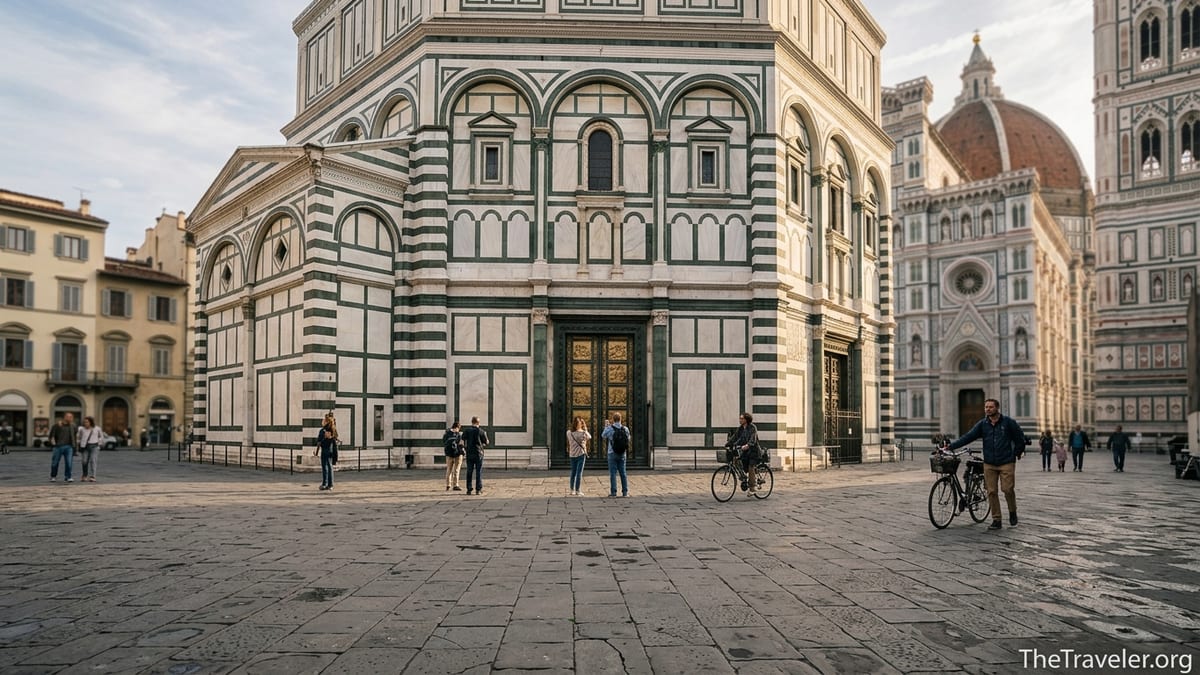
An Ancient Sacred Heart of Florence
Long before Brunelleschi’s dome defined Florence’s skyline, worshippers were already gathering at the Baptistery of San Giovanni. The building’s core likely dates to the 11th century, built over earlier Christian structures, and for centuries it functioned as the city’s official baptistery. Florentines were not simply baptized here as a matter of convenience. This was where you became a citizen in both a religious and civic sense, formally entering the community under the patronage of John the Baptist, Florence’s protector saint.
Up until the 19th century, babies were typically brought here rather than to their local parish church. Imagine a Renaissance family from Oltrarno crossing the Arno at dawn, carrying an infant wrapped in linen, shuffling into the octagonal space where dozens of other families waited around the great marble font. Baptism here was both intimate ritual and public event. Today’s visitors still see parents quietly lighting candles and older Florentines pausing in the shadows, treating the building as something more than a museum stop.
For travelers, this living continuity is palpable. Even with the crowds and photography, you may notice locals stepping in briefly on their way to work, or a priest leading a small group in prayer near the altar. Rather than a relic frozen in time, the baptistery remains a working sacred space that anchors Florence’s calendar of religious celebrations, especially around the feast of Saint John on June 24, when the city holds processions, fireworks, and special liturgies tied back to this building.
Because it is smaller and self-contained, many visitors find that the baptistery provides a more focused spiritual experience than the vast Duomo. You can stand in the center of the floor, look up, and take in almost the entire interior at once. The space invites you to think about beginnings: of Christian life, of medieval Florence, and of the artistic languages that would lead into the Renaissance.
Mosaics That Tell a Medieval Theology in Gold
The most dramatic reason the baptistery still matters is overhead. Its dome and upper walls are covered with Italo-Byzantine mosaics created roughly between the 13th and early 14th centuries. These mosaics, made from tens of thousands of glass and gold tesserae, translate complex medieval theology into picture cycles ordinary people could understand at a glance. The colossal figure of Christ the Judge dominates one side of the dome, his outstretched arms separating the blessed from the damned in vivid detail.
Today, even visitors unfamiliar with Christian iconography respond instinctively to the scene: angels rolling up the heavens like a scroll, the resurrected standing from their graves, and, in one striking register, the carefully ordered torments of hell. These images were not abstract symbols. A 14th‑century Florentine merchant being baptized here would have understood that this was both a warning and a promise. Art historians often note how the mosaics echo political realities of medieval Florence, with sharp contrasts between order and chaos mirroring anxieties about factional violence in the city.
Recent conservation work has underlined the mosaics’ continuing importance. A multi-year restoration project, still active in 2026, has involved complex scaffolding inside the dome to stabilize loose tesserae and clean centuries of grime from the golden backgrounds. On current visits, you may find parts of the vault partially obscured or covered by protective structures, but conservation teams sometimes leave small “windows” where cleaned and uncleaned sections sit side by side. The difference is striking: the restored gold fields reflect light so intensely that the entire interior feels brighter and more legible.
For travelers, this means you are not simply looking at a finished masterpiece but at an artwork mid-career, still being cared for and debated. Guides often explain how restorers choose between preserving patina and revealing original colors. Standing beneath the dome, you witness the ongoing negotiation between past and present: how much should we intervene, and what does authenticity mean when dealing with an 800‑year‑old mosaic created by many hands over generations?
Ghiberti’s Doors and the Birth of the Renaissance
Outside, the baptistery’s bronze doors tell another story central to Florence’s artistic history. In the early 15th century, the city’s cloth merchants’ guild held a competition to design new doors, attracting young artists eager to prove themselves. Lorenzo Ghiberti’s winning reliefs for what became the North Doors were praised for their elegance and technical mastery. This competition is often cited in art history textbooks as a catalyst for Renaissance sculpture, showcasing new interest in naturalism, classical drapery, and perspective.
The later East Doors, completed by Ghiberti and nicknamed the “Gates of Paradise,” intensified this revolution. Their ten large panels compress complex Old Testament narratives into richly layered scenes where architecture, landscape, and figures interact in believable three-dimensional space. Michelangelo’s famous remark that the doors were worthy of paradise captures how radically new they looked to his contemporaries. For centuries, processions from the cathedral would turn toward these doors, visually underlining their role as a symbolic threshold between earthly Florence and the heavenly Jerusalem.
Most travelers are surprised to learn that the doors on the building today are high-quality replicas. The originals, badly damaged by weather and the 1966 flood, have been painstakingly restored and are now displayed in the Museo dell’Opera del Duomo just behind the cathedral. When you step into the museum’s large, white gallery and see Ghiberti’s panels up close, details that disappear on the piazza suddenly emerge: tiny animals in the foreground grass, subtle expressions on patriarchs’ faces, and experimentation with linear perspective that anticipates later painters.
Visiting both the baptistery and the museum in one day gives a fuller sense of why these doors matter. On the piazza, you experience how they functioned in public devotion and civic ritual; inside the museum, you see them as physical objects shaped by craft, time, and conservation. It is an excellent example of how Florence presents its heritage today: leave replicas in place to preserve the original function of a space, and move the fragile masterpieces inside where they can be studied, conserved, and appreciated in detail.
How to Visit Today: Tickets, Time of Day, and Current Conditions
Practically speaking, the baptistery is part of the broader Duomo complex managed by the Opera di Santa Maria del Fiore. As of mid‑2026, you typically access it with a combined pass such as the Brunelleschi Pass or similar multi-day tickets sold through the cathedral’s official system. These passes usually cover the baptistery, the cathedral museum, the crypt of Santa Reparata, Giotto’s bell tower, and, in some cases, the dome climb, and are valid for three calendar days from your chosen start date. Prices change periodically, but travelers can expect to pay roughly the cost of a mid-range restaurant meal per adult for a full-complex pass, with reduced rates for children.
The baptistery keeps extended daytime hours, often opening in the morning and closing in the early evening, but specific times fluctuate with liturgical needs and restoration work. Before choosing a time slot, check the latest schedule and any notes about restricted access, especially during major feasts or when scaffolding is being moved. Residents of the metropolitan area of Florence sometimes benefit from special free-entry days, particularly on the first Sunday of the month, which can make the building busier than usual; for international visitors, these days are interesting but not essential, since the cost of entry is already bundled into broader passes.
Lines for the baptistery are generally shorter than those for the dome climb or the cathedral’s free entrance, but they do build up in peak months like May, June, and September. Many travelers find it efficient to visit the baptistery either early in the morning, just after opening, or late in the afternoon when day-trip groups have thinned. If you plan to combine it with the museum on the same day, one good strategy is to start with the baptistery to see the context, then head into the museum for air-conditioning and a closer look at the bronze doors and original sculptures removed from the façade and campanile.
Current restoration of the interior mosaics means the experience can change year to year. At times, protective coverings or scaffolding may block certain viewpoints, while at other moments temporary platforms offer unusually close views of upper sections. Travelers who visited several years ago sometimes return and are surprised by how much brighter the interior looks after cleaning campaigns. From a visitor’s point of view, this is part of the building’s story: you are seeing an artwork in flux, shaped by twenty-first-century science and funding decisions as much as by medieval guilds.
Civic Identity, Politics, and the Stories Told in Stone
The baptistery is not only a religious monument; it is also an expression of Florence’s civic identity. In the Middle Ages, powerful trade guilds took responsibility for commissioning and maintaining its decoration, using the building to project their wealth and refine their influence. Choosing John the Baptist as the city’s patron emphasized moral renewal and individual responsibility, virtues that fit a republic governed by merchants rather than kings. The building’s refined white and green marble exterior, echoing ancient Roman forms, communicates a deliberate link between Florence and the classical past.
Inside, the mosaic programs weave together biblical stories with subtle commentary on power and justice. The Last Judgment scene, for example, places rulers and bishops among the ranks of those being judged, not above them. In a city where political factions frequently exiled their rivals and where sermons were used to sway public opinion, these images reminded citizens that earthly authority was temporary. Art historians often point out that the mosaic cycles were installed over decades that saw the rise of the guild-based government, conflicts between Guelphs and Ghibellines, and economic expansion linked to banking and textiles.
For modern travelers, these layers can feel remote until a guide points them out using concrete comparisons. One might explain, for instance, that commissioning a new bronze door was roughly the equivalent of a city today funding a major civic museum or stadium: a multi-decade, multimillion-euro project involving competitions, public debates, and long-term maintenance. Standing in front of Ghiberti’s panels or under the mosaics, you begin to realize that art here functioned as political messaging as much as religious teaching, shaping how Florentines saw themselves and their place in the wider Mediterranean world.
Even the building’s survival into the present reflects local politics and community priorities. After the devastating 1966 Arno flood, which damaged artworks across Florence, international and local groups poured money and expertise into saving the baptistery’s doors and interior. Recent restoration projects, funded by a mix of ticket revenues, donors, and foundations, continue this pattern, showing that Florence still considers the baptistery central to its brand and identity in the age of mass tourism.
The Baptistery in Dialogue With the Duomo and Museum
Part of what makes San Giovanni so compelling today is how it interacts with the neighboring cathedral and museum. Piazza del Duomo is effectively an open-air textbook of architectural history, with the Romanesque mass of the baptistery, the Gothic lines of the cathedral, and the vertical elegance of Giotto’s bell tower arranged within a few meters of each other. Walking around the piazza, you can see how the baptistery’s simple, balanced geometry and striped marble influenced the later buildings, which echo its patterning on a larger scale.
Inside the Museo dell’Opera del Duomo, curators have staged a kind of conversation between original elements from all three monuments. Ghiberti’s doors face a full-scale reconstruction of the cathedral’s medieval façade, while sculpted prophets, sibyls, and Madonna figures that once stood on the exterior now line pristine white galleries. Nearby, you will find fragments connected to the baptistery’s early structure and decoration, including works by artists like Donatello who moved fluidly between religious and civic commissions.
Travelers who give themselves at least half a day to explore the ensemble often come away with a deeper understanding of Florence’s artistic evolution. You might start in the baptistery, seeing the medieval synthesis of theology and image, then move to the museum to trace how perspective, anatomy, and emotion develop in later centuries. Finishing with a climb up the dome or bell tower, you look down at the small octagon of the baptistery and recognize it as the seed from which much of Renaissance Florence grew.
This dialogue also influences how Florentines use the space today. Major liturgical events sometimes involve processions that move between the cathedral and baptistery, reactivating historical routes. On the feast of Saint John, for example, civic officials, clerics, and confraternities still participate in ceremonies that highlight the baptistery as the spiritual “front door” of the city, even if most baptisms now take place in parish churches.
The Takeaway
For many visitors, the Baptistery of San Giovanni begins as a photo backdrop beside the more immediately imposing Duomo. Yet a closer look reveals why this relatively small building continues to matter so profoundly in Florence’s religious and artistic story. It is where generations of citizens were initiated, where medieval theology glittered in gold tesserae, and where a bronze-door competition helped launch Renaissance sculpture.
Today, the baptistery stands at the intersection of worship, tourism, conservation, and civic identity. Ongoing restoration work on its mosaics shows that Florence still invests heavily in this space, treating it as a living artwork rather than a static relic. Paired with the cathedral and the Opera del Duomo Museum, it offers travelers a concentrated lesson in how cities use sacred architecture to express values, negotiate power, and imagine their future.
If you plan a visit, budget real time for San Giovanni: stand in the center under the dome, circle the marble walls slowly, then seek out the original doors in the museum. In doing so, you connect not only with centuries of Florentines who entered adulthood here, but also with the broader story of how faith, art, and urban ambition combined to make Florence a city that still captivates the world.
FAQ
Q1. Where is the Baptistery of San Giovanni located in Florence?
The baptistery stands on Piazza del Duomo directly in front of Florence Cathedral, a few steps from Giotto’s bell tower in the historic center.
Q2. Do I need a separate ticket to enter the baptistery?
Usually you enter with a combined Duomo complex pass that includes the baptistery, museum, crypt, and other sites; standalone baptistery tickets are uncommon.
Q3. How much time should I plan for a visit?
Most travelers spend 20 to 40 minutes inside, but if you are interested in the mosaics and details, allowing a full hour is more comfortable.
Q4. Are the mosaics fully visible during restoration work?
Restoration scaffolding may partially cover sections of the dome, but key parts remain visible, and cleaned areas often appear noticeably brighter.
Q5. Can I take photos inside the baptistery?
Non-flash photography is generally allowed for personal use, but tripods and professional equipment are normally restricted without special permission.
Q6. Are the famous “Gates of Paradise” doors still on the building?
No, the original bronze doors are preserved in the nearby cathedral museum; high-quality replicas now stand on the baptistery exterior.
Q7. Is the baptistery accessible for visitors with mobility issues?
The entrance is at ground level with a slight step and relatively flat interior, but extremely crowded times can make movement more difficult.
Q8. What is the best time of day to visit?
Early morning or late afternoon usually offers softer light on the mosaics and smaller crowds than the busiest midday hours.
Q9. Is the baptistery still used for religious ceremonies?
Yes, although most baptisms now occur in parish churches, the baptistery is still used for special liturgies and remains a consecrated space.
Q10. Why is the Baptistery of San Giovanni considered so important in art history?
Its mosaics and Ghiberti’s bronze doors mark crucial steps from medieval to Renaissance art, influencing generations of Florentine painters and sculptors.