


Carved into the southern slope of the Acropolis, the Theatre of Dionysus is where Athenian drama first took shape and where plays by Aeschylus, Sophocles and Euripides were performed before thousands of spectators. Today, it sits just below the Parthenon and a few minutes’ walk from Acropolis metro station, making it one of Athens’ most accessible ancient sites. This guide explains exactly where it is, how to reach it from the metro, the best walking routes around the south slope, nearby monuments and practical advice to plan a smooth visit.
Get the latest updates straight to your inbox!
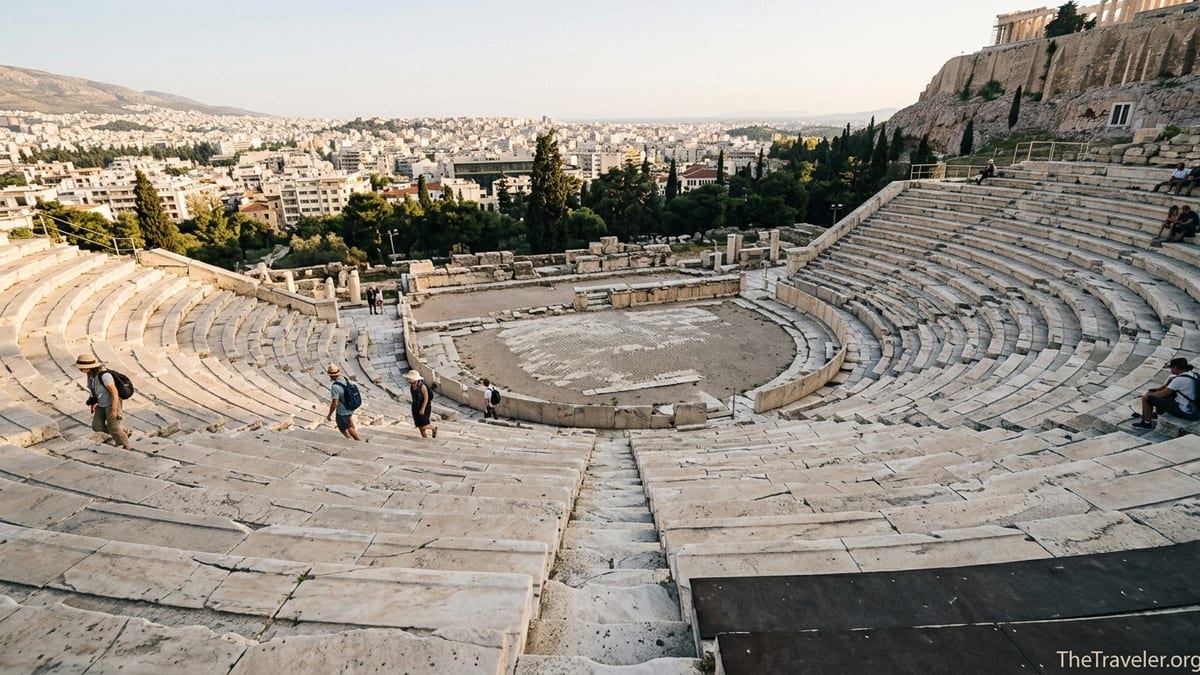
Where the Theatre of Dionysus Sits on the Acropolis
The Theatre of Dionysus lies on the south slope of the Acropolis hill, directly below the main plateau and roughly in line with the Parthenon above. It forms part of the wider south-slope archaeological zone, which also includes the Sanctuary of Dionysus Eleuthereus, the Stoa of Eumenes and, further west, the Roman-era Odeon of Herodes Atticus. When you stand in the cavea looking uphill, you are literally looking toward the sacred rock that defined classical Athens.
From street level, the theatre is reached via the South Slope Entrance to the Acropolis complex, also called the Dionysus Gate, on Dionysiou Areopagitou pedestrian street. This gate sits opposite the lower side of the Acropolis Museum and a short walk from Makrygianni Street, which is where many visitors first emerge from Acropolis metro station. The location makes it easy to combine the theatre with the museum, the Parthenon, Plaka and the Temple of Olympian Zeus in a single day.
The theatre itself consists of a semi-circular seating area cut into the hillside, a flat performance space (the orchestra) and fragments of the stage buildings. While much of the seating survives only in part, rows of stone seats, including elaborately carved thrones for officials, still give a clear sense of the original scale. In its classical form, it could seat many thousands of Athenians gathered for the great festivals of Dionysus.
Getting There from Acropolis Metro Station
The nearest metro stop is Acropolis station on Line 2 (the red line) of the Athens Metro. This station sits just southeast of the Acropolis Museum and opens onto Makrygianni Street and Dionysiou Areopagitou, putting you within a 5 to 7 minute walk of the theatre entrance. If you are staying in central neighborhoods such as Syntagma, Omonia or Neos Kosmos, you can usually reach Acropolis with a direct ride on Line 2 or a simple transfer.
When you step off the train at Acropolis station, follow the signs for the exits toward the Acropolis Museum and Dionysiou Areopagitou. At street level you will emerge either onto Makrygianni Street or right beside the museum’s glass facade. From there, head toward the wide pedestrian avenue lined with street performers and kiosks; that is Dionysiou Areopagitou. Walking west along this avenue, with the Acropolis hill on your right, you will soon see signs for the South Slope or Theatre of Dionysus entrance after roughly 300 to 400 meters.
Travelers arriving by metro typically budget around 30 minutes total from central Syntagma Square to being inside the south-slope site, including walking and security. For example, a visitor leaving a hotel behind Syntagma at 08:00 could ride Line 2 for two stops, exit at Acropolis at 08:10, walk to the Dionysus Gate by 08:17 and be inside the archaeological area shortly after opening. This kind of timing matters in summer, when the site gets hot and crowds build quickly.
Walking Routes from the South Slope Entrance
Once you pass through the South Slope Entrance on Dionysiou Areopagitou, you enter the broader sanctuary zone on the southern flank of the Acropolis. The first path curves gently upward through low pine trees and scattered foundations. Within a few minutes, you will reach the Theatre of Dionysus on your right. Many visitors stop here first, before continuing uphill, which is a practical way to see the theatre while energy levels are high and before the sun climbs overhead.
A typical route for first-time visitors is to enter via the south side, explore the theatre from its lower level, then climb the internal paths that lead around the cavea and up toward the Stoa of Eumenes. From there, the path continues west along the slope, eventually rejoining the main ascent path toward the Propylaea and the Parthenon terrace. This creates a natural loop: South Slope Entrance to Theatre of Dionysus, onward past the stoa and other ruins, then up to the summit, and finally down via either the west or south paths depending on how busy each exit is.
If you are mainly interested in the theatre and not the top of the Acropolis, you can keep your walk shorter. After entering the South Slope zone, stay close to the lower paths and spend more time in and around the orchestra and front rows, then return to Dionysiou Areopagitou by the same gate. This is useful for travelers with limited mobility or young children, since it avoids the steeper, more exposed climb to the main plateau but still gives a rich experience among major monuments.
Nearby Sites on the South Slope
The South Slope is one of the most rewarding areas of the Acropolis complex because several important, but often less crowded, sites cluster here. Just uphill from the Theatre of Dionysus you can see remains of the Sanctuary of Dionysus Eleuthereus, the original religious precinct dedicated to the god of wine and theatre. Fragments of walls and foundations outline where temples and altars once stood, tying the theatre directly to its cultic context rather than framing it only as an entertainment venue.
Continuing west along the slope, you will pass the long line of foundations known as the Stoa of Eumenes, a Hellenistic colonnaded walkway built as a shelter for theatre-goers. Farther along, the impressive stone tiers of the Odeon of Herodes Atticus come into view. Although access inside the odeon is usually restricted except during performances, the exterior view from the path gives a strong sense of how this later Roman theatre reused and complemented the same hillside.
Outside the fenced archaeological area, Dionysiou Areopagitou itself is a destination. Before or after your visit, you can stroll along this pedestrian avenue, where you will find small kiosks selling cold water, fresh orange juice and simple snacks, as well as a few cafes on adjacent streets such as Makrygianni. Many visitors pick up a bottle of water and a hat here before heading through the gate, since prices inside the archaeological zone tend to be higher and shade is limited.
Tickets, Opening Hours and Practical Planning
The Theatre of Dionysus is not a separate standalone ticketed attraction. Entry is included in standard Acropolis archaeological site tickets and in the combined multi-site ticket sold by the Hellenic heritage authorities. This means that the same paper or digital ticket that gets you into the Parthenon plateau will also be scanned at the South Slope Entrance, allowing you to walk through the theatre, the sanctuary area and on up to the top.
Ticket prices and opening hours are adjusted seasonally, with reduced entry for certain categories such as EU students and senior citizens and free days at specific times of year. In high season, the Acropolis complex typically opens early in the morning and closes at sunset, which can be as late as early evening in July. A realistic planning example is to reserve a timed entrance slot for the morning, arrive at Acropolis station 20 to 30 minutes beforehand, and aim to be at the Theatre of Dionysus soon after the gates open to enjoy it before the main tour groups move down from the summit.
There are a few practical considerations worth noting. Surfaces around the theatre are uneven, with a mix of stone steps, loose gravel and sometimes slippery marble. Good walking shoes with closed toes and a firm sole are strongly recommended over sandals. In summer, daytime temperatures on the exposed slope can quickly become uncomfortable, so many travelers aim for early morning or late afternoon visits, carrying at least one liter of water per person and a light hat. Photography is generally allowed for personal use, although tripods and commercial equipment may require special permissions.
Combining the Theatre with the Acropolis Museum and Plaka
Given its position opposite the Acropolis Museum and a short walk from Plaka, the Theatre of Dionysus fits naturally into a full or half-day walking itinerary. One effective pattern is to start with the archaeological site in the early morning. Take the metro to Acropolis station, enter via the South Slope Entrance, spend around 30 to 45 minutes at the Theatre of Dionysus itself, then continue up to the Parthenon and the rest of the hill. After descending, exit again on the southern side and cross over to the museum for a late-morning visit in air-conditioned galleries.
A different approach, especially in hotter months, is to visit the Acropolis Museum first, perhaps reserving a mid-morning entrance. After viewing the sculptures and models that explain the topography of the hill, you can walk out onto Dionysiou Areopagitou in the late afternoon and enter the south slope as the light softens. From the theatre, you may choose either to climb up to the main plateau if opening hours permit, or to treat the south slope as a self-contained experience and leave before closing time to reach nearby restaurants around Makrygianni or Plaka.
Plaka and the neighboring areas of Koukaki and Makrygianni provide many practical bases for visitors who want to be close to both the theatre and the metro. Hotels and guesthouses in these districts often advertise walking times of 5 to 15 minutes to Acropolis station. A traveler staying at a small guesthouse on a side street off Makrygianni, for example, can step out after breakfast, stroll to the station to top up a metro card, cross Dionysiou Areopagitou to enter the south slope and still be back in their room by midday for a rest, before heading out again for evening views.
Accessibility, Crowd Levels and Safety
The paths around the Theatre of Dionysus involve gradients, steps and rough surfaces that can be challenging for those with limited mobility. While Acropolis station itself has elevators and the route along Dionysiou Areopagitou is flat and paved, the moment you cross into the archaeological zone you encounter unpaved paths and stone. Visitors using walking poles sometimes find them helpful on the gravel sections. If mobility is a concern, consider focusing on the lower seating tiers and the orchestra, avoiding the steepest side paths that lead higher up the hillside.
Crowds fluctuate throughout the day and season. In spring and autumn shoulder seasons, the south slope often feels calmer than the main western approach, especially in the first hour after opening and later in the afternoon. In July and August, you can expect large tour groups moving between the theatre, the stoa and the path upward, but these often arrive in waves. A practical way to experience a quieter atmosphere is to pause for an extra ten minutes on one of the higher rows of seating once a group has left, rather than moving in lockstep with the flow.
Basic common-sense safety applies. Keep valuables in a zipped bag or money belt rather than open pockets, especially on the metro and along Dionysiou Areopagitou where street performers and crowds naturally draw attention. Drink water regularly and wear sunscreen, as there is limited shade in and around the theatre. The local authorities occasionally restrict access to the Acropolis complex, including the south slope, during periods of extreme heat or high fire risk, so it is wise to check for any same-day advisories before setting out.
The Takeaway
The Theatre of Dionysus is one of Athens’ most evocative ancient spaces, set into the south slope of the Acropolis within easy reach of the metro and the city’s historic core. Its location beside the South Slope Entrance makes it both a natural starting point for an ascent to the Parthenon and a worthwhile stand-alone visit for those who prefer a shorter, less strenuous experience.
By using Acropolis metro station as your anchor, following the clear signs to Dionysiou Areopagitou, allowing for the short walk to the Dionysus Gate and planning your timing around heat and crowd patterns, you can experience the theatre in relative comfort. Whether you sit quietly on the worn stone seats imagining festival crowds or link the site to its artifacts in the nearby museum, a well-planned visit turns a pile of ruins into a vivid encounter with the origins of theatre itself.
FAQ
Q1. How do I get to the Theatre of Dionysus from Acropolis metro station?
Exit Acropolis station following signs for the Acropolis Museum, walk to Dionysiou Areopagitou pedestrian street, then turn right and continue a few minutes to the marked South Slope or Theatre of Dionysus entrance.
Q2. Is the Theatre of Dionysus included in the standard Acropolis ticket?
Yes. The Theatre of Dionysus is part of the Acropolis archaeological site, so entry is included in standard Acropolis tickets and in the official combined multi-site ticket.
Q3. How long should I plan to spend at the Theatre of Dionysus itself?
Most visitors spend about 30 to 45 minutes at the theatre, which allows time to explore the seating rows, orchestra and views, and take photographs without rushing.
Q4. Can I visit only the Theatre of Dionysus without climbing to the top of the Acropolis?
Yes. You can enter via the South Slope Entrance, visit the theatre and nearby sanctuaries, then return the same way without continuing up to the main plateau if you prefer a shorter visit.
Q5. When is the best time of day to visit the Theatre of Dionysus?
Early morning and late afternoon are usually the most comfortable times, with lower heat and softer light. Midday in summer can be very hot and busy on the exposed slope.
Q6. Are there facilities or cafes inside the Theatre of Dionysus area?
Facilities on the south slope are limited. It is wise to use restrooms and buy water near Acropolis station or along Dionysiou Areopagitou before entering the archaeological zone.
Q7. Is the Theatre of Dionysus suitable for visitors with limited mobility?
The approach from the metro to the entrance is step-free and level, but inside the site paths are uneven and sloped. Visitors with limited mobility may find it easier to remain on the lower levels near the orchestra.
Q8. Can I sit on the ancient seats of the Theatre of Dionysus?
In many areas you are allowed to sit briefly on the stone seating, though some sections may be roped off. Always respect barriers and follow any instructions from site staff.
Q9. Is it possible to visit the Theatre of Dionysus and the Acropolis Museum on the same day?
Yes. The two are a short walk apart. Many travelers visit the theatre and south slope in the morning, then cross Dionysiou Areopagitou to tour the museum later in the day.
Q10. Are guided tours available that include the Theatre of Dionysus?
Many Acropolis walking tours include the south slope and Theatre of Dionysus in their itineraries. If this is important to you, check the route description before booking to confirm inclusion.