


On the southern slope of the Acropolis, below the queues for the Parthenon and the selfie sticks, a broken semicircle of stone benches overlooks a shallow stage. It can be easy to walk past the Theatre of Dionysus on a hot Athens afternoon, but this hollow in the rock is where Western theatre began. Here, in front of as many as 15,000 to 17,000 Athenians, the tragedies of Aeschylus, Sophocles and Euripides and the comedies of Aristophanes first thundered into life. Visiting today is not just another archaeological stop: it is a chance to stand in the place where a city’s politics, religion and creativity combined to change theatre history.
Get the latest updates straight to your inbox!
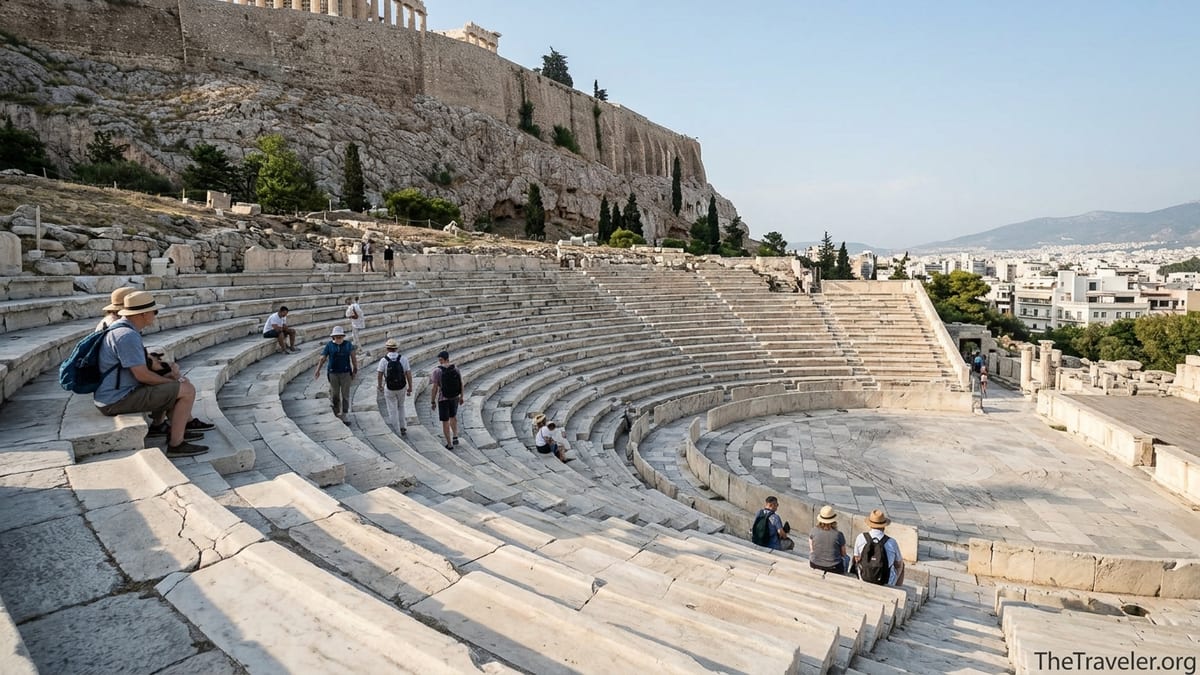
The Birthplace of Theatre on the Slopes of the Acropolis
The Theatre of Dionysus clings to the south slope of the Acropolis, a few minutes’ walk from the main entrance that most visitors use for the Parthenon. Archaeologists date the first performance space here to the sixth century BC, when it was little more than a flat dancing floor and wooden seating built into the hillside. By the fourth century BC the Athenians rebuilt it in stone and marble, creating a permanent theatre with tiered seating and a sweeping view over the city. At its peak it could hold tens of thousands of spectators, arranged in stone benches that you can still sit on today.
Modern visitors usually enter the south slope area with a combined Acropolis ticket, walk past the small sanctuary of Dionysus and then emerge into the fan of marble seats. The first rows, closest to what was once the orchestra, include carved thrones reserved for priests and officials, with one particularly ornate seat believed to be for the priest of Dionysus himself. Standing at the bottom and calling to a friend high in the cavea gives a sense of the exceptional acoustics that allowed a single masked actor to address a whole city without amplification.
Unlike many later Roman theatres, the Theatre of Dionysus was not built as a neutral entertainment venue. It sat within a religious precinct dedicated to Dionysus Eleuthereus and was directly tied to festivals in his honor. When you walk across the orchestra today, you are crossing the sacred performance space where ritual, politics and art overlapped. This is where the Athenians institutionalized theatre as a civic duty and a powerful tool of public debate, rather than a private diversion.
The ruins also speak to the theatre’s long life. You can trace stages of rebuilding in different stonework, from the rougher early tiers to later Roman additions. Informational panels on site help you imagine the wooden stage building that once stood behind the orchestra, decorated with painted panels and props. For a modern traveler, it is worth pausing here before hurrying on to the Parthenon: without this site, the way we tell stories on stage and screen would look very different.
Festivals, Processions and the City Dionysia
Theatre in Athens grew out of the cult of Dionysus, the god of wine, ecstasy and transformation. By the sixth century BC, the city’s leaders had woven his worship into the civic calendar, creating major festivals in his honor. The most important for drama was the City Dionysia, held each spring. During this multi day event, a grand procession carried an image of Dionysus into the theatre district, sacrifices were offered and then, over several days, tragedies, comedies and satyr plays competed for official prizes. Every citizen male who could attend was expected to do so, and the city even subsidized tickets for poorer Athenians so that participation was as broad as possible.
For a traveler trying to imagine the atmosphere, think of Athens during a modern cultural festival, such as the Athens Epidaurus Festival in summer, when the city’s contemporary theatres and open air venues run packed programs of plays and concerts. In classical times, however, there were no long commercial runs. A new tragedy by Aeschylus or Sophocles would premiere only once at the City Dionysia, in front of the full civic body, with judges and official archons overseeing proceedings. Winning at the festival meant political prestige for the playwright and also for the wealthy citizen sponsor, the choregos, who had funded chorus training, costumes and musicians.
The Lenaia, a smaller winter festival also held in Athens, emphasized comedy more strongly. Aristophanes premiered some of his biting political comedies at the Lenaia, before they appeared again at the City Dionysia. Taken together with the Rural Dionysia in the countryside of Attica, these festivals meant that an Athenian year was punctuated by concentrated bursts of theatrical performance, rather than a steady trickle of shows. Travel in January or February today and you will not see an ancient festival, but you can still find modern Greek productions of Aristophanes in venues around the city, especially in smaller theatres in neighborhoods such as Exarchia and Kypseli.
When you visit the Theatre of Dionysus, try to picture the festival schedule that once animated this now quiet ruin. On one day of the City Dionysia, three tragic playwrights would each present a trilogy of tragedies followed by a satyr play, in a marathon of performance from morning into evening. The audience sat in their stone seats through hours of poetry, choral dance and debate, reacting vocally to what they saw. This intense, communal experience, repeated year after year, is what allowed theatre to evolve so rapidly in Athens and laid the groundwork for everything that followed.
Tragedy: Aeschylus, Sophocles and Euripides in Their Home Theatre
The Athenians considered tragedy the most serious and prestigious dramatic form. Tragedies took stories from myth the fall of Oedipus, the sacrifice of Iphigenia, the vengeance of Orestes and turned them into searching examinations of justice, fate and human responsibility. Aeschylus, Sophocles and Euripides, whose surviving plays are still staged from London and New York to Tokyo, all wrote for competition at the Theatre of Dionysus. When you sit on the worn marble of the front rows, you are quite literally taking the place of spectators who first heard “Oedipus Tyrannus,” “Antigone” or “Medea” performed.
Aeschylus, active in the early fifth century BC, is often called the father of tragedy. He is credited with adding a second speaking actor to what had previously been solo performances with a chorus, creating real dialogue and dramatic tension. His surviving trilogy “The Oresteia,” with its themes of blood guilt and the birth of legal justice, won first prize at the City Dionysia in 458 BC. Sophocles, slightly younger, then added a third actor, allowing more complex scenes and psychological conflict. His “Oedipus at Colonus” and “Electra” were crafted for this very theatre, with the chorus of fifteen moving and singing in the orchestra while masked actors stood on the stage above.
Euripides, writing later in the century, pushed tragedy in a more questioning, sometimes unsettling direction. His “Medea,” in which a mother murders her children, and “The Bacchae,” where the god Dionysus himself punishes a city that resists his cult, must have had particular force when staged in the god’s own sanctuary. Many modern directors first encounter these plays in paperback editions and university seminar rooms, but in Athens you can see them returned to open air theatres every summer. For instance, the restored Odeon of Herodes Atticus, just a short walk uphill from the Theatre of Dionysus, regularly hosts contemporary stagings of Sophocles or Euripides during the Athens Epidaurus Festival, with ticket prices generally starting around the cost of a mid range restaurant meal in the city.
For today’s visitor, one way to connect with tragedy’s Athenian roots is to read or watch a play before you arrive, then walk the theatre with specific scenes in mind. If you have seen a modern production of “Antigone,” imagine her defiance of Creon played out against the backdrop of the Acropolis. Many guided tours of the south slope now include short readings or explanations drawn from these tragedies, helping travelers connect the broken stones with the living texts that began here.
Comedy and Satyr Plays: Aristophanes and the Lighter Side of Dionysus
Athens did not only invent serious drama. Alongside tragedy developed comedy and the satyr play, which allowed audiences to laugh at their leaders, their gods and themselves. Old Comedy, represented above all by Aristophanes, thrived in the same Theatre of Dionysus and at the same festivals. His surviving plays, including “Lysistrata,” “The Clouds” and “The Frogs,” use fantasy, slapstick and sharp political satire to comment on everything from war policy to the fashionable intellectuals of the day. When “The Knights” mocked the powerful politician Cleon, it did so in front of the very citizens whose votes he depended on.
Satyr plays, which followed a trilogy of tragedies in the festival schedule, blended mythic stories with bawdy humor. The chorus in these pieces consisted of actors dressed as satyrs companions of Dionysus with horse tails and exaggerated, comic features. They danced, sang and cracked jokes while still engaging with heroic tales. Sadly only one complete satyr play, Euripides’ “Cyclops,” survives, but ancient descriptions and vase paintings show that this lighter form was an important part of the overall Dionysian experience. For an Athenian spectator, a day in the theatre meant moving from solemn moral dilemmas in the morning to ribald parody in the afternoon.
Modern Athens often celebrates this legacy through playful contemporary performances. In summer, you might find an Aristophanic comedy staged in the courtyard of a neoclassical building in Plaka or in a small open air venue in the suburbs, advertised on posters in the metro. Productions frequently update the jokes to target current politicians and European institutions, just as Aristophanes once parodied the Peloponnesian War and demagogues. For English speaking visitors, look out for performances with surtitles or choose a production in the more touristed venues where companies sometimes offer bilingual programs.
Spending time at the Theatre of Dionysus can enrich your experience of these modern shows. When you see the chorus in “Lysistrata” debate the foolishness of war, it is striking to remember that in the fifth century BC such arguments were first made in front of citizens who had just come back from real campaigns. Comedy in Athens was not an escape from politics but one of the city’s ways of thinking aloud about itself, using laughter as a critical tool.
Why Athens Became the Center of Ancient Theatre
Many Greek cities had festivals for Dionysus and built open air theatres, but Athens became the unquestioned center of drama. Several factors came together to make this possible. First, classical Athens in the fifth century BC was a powerful and wealthy democracy, with a large citizen population, a thriving port at Piraeus and tribute coming in from its allies. This economic base allowed the city to fund choruses, maintain large festivals and provide subsidies so that poorer citizens could attend performances. When you stand in the Theatre of Dionysus and look out over the city, you are seeing the physical expression of a society that chose to spend public money on mass cultural participation.
Second, institutions in Athens gave theatre an extraordinary civic role. Plays were not private entertainment but part of the official religious calendar, organized by elected archons and judged by panels selected from the citizenry. Political and legal questions that affected the whole community were explored on stage through myth. When Aeschylus staged “The Eumenides,” which dramatizes the founding of a homicide court, he was effectively contributing to debates about how justice should function in the democracy. That kind of engagement, backed by public funds and observed by the city’s leaders, gave playwrights both responsibility and influence.
Third, Athens attracted and retained an impressive pool of talent. Playwrights, actors, musicians and chorus trainers developed craft traditions that were passed down from one generation to the next. Aristotle later credited Aeschylus with pioneering the use of a second actor and Sophocles with introducing a third, technical innovations that emerged from the practical challenges of staging stories for a huge audience. The city rewarded success at the festivals with prestige and often with commemorative monuments; travelers today can still see the Street of the Tripods, just east of the Acropolis, where wealthy sponsors set up victory tripods in ornate bases after their choruses won.
For visitors, one way to grasp Athens’ centrality is to compare the Theatre of Dionysus with later venues elsewhere. The famous theatre at Epidaurus, for example, is larger and better preserved, and many tourists choose to see a summer performance there on a day trip from Athens. Yet the scripts performed in Epidaurus and in Roman theatres across the Mediterranean began life in the Athenian festivals. If your time in Greece is limited, prioritizing the Theatre of Dionysus helps you understand not only Athenian history but the roots of the entire Western theatrical tradition.
Visiting the Theatre of Dionysus Today
Practically, the Theatre of Dionysus is one of the easier ancient sites to include in an Athens itinerary. It sits within the southern archaeological zone of the Acropolis and is typically accessible with the combined Acropolis ticket that also covers the Parthenon and other nearby sites. Entry procedures and prices change over time, but as a rule of thumb, expect the combined ticket to be one of the higher priced single purchases of your trip, in line with a good dinner for two in a mid range taverna. It is money well spent if you are interested in culture and history, especially since you can revisit the Acropolis area over a few days on the same ticket when regulations allow.
The best times to visit are early in the morning or late in the afternoon, particularly in the hotter months from June to September. The theatre is largely unshaded, and the south facing slope can be punishing at midday. Wear sturdy shoes, as the marble can be slippery and uneven, and bring water, which you can buy at kiosks around the Acropolis perimeter. Most travelers start at the south slope entrance on Dionysiou Areopagitou street, where musicians, souvenir sellers and street performers often add a contemporary soundtrack to your walk into the ancient precinct.
Once inside, give yourself time to sit and simply look. Find a place in the mid level seats, where you can see both the orchestra and the Acropolis walls above. Try speaking at a normal volume and note how your voice carries; this acoustic design, achieved without modern technology, is part of what made long days of performance possible. Information boards in English and Greek outline the theatre’s building phases and its relationship to the sanctuary of Dionysus. Audio guides from reputable tour companies often include segments recorded on site, and several local guides specialize in theatre history tours that weave in readings from Aeschylus, Sophocles, Euripides and Aristophanes.
To deepen the experience, consider pairing your visit with time in the Acropolis Museum, a short walk away. There you can see reliefs, inscriptions and small artifacts linked to the Dionysian festivals and to theatre in general. Some displays explore how masks were used in performance and how choregic monuments commemorated victory. Seeing these objects before or after you sit in the Theatre of Dionysus helps ground the stories you have read in guidebooks in physical reality, making the connection between ancient festival and modern tourism more vivid.
The Takeaway
Standing in the Theatre of Dionysus, it becomes clear that Athens did not just build the first great stone theatre. It invented a new way for a city to think aloud about itself. Tragedy, comedy and satyr plays developed here as part of a living religious and civic culture, supported by festivals that brought together thousands of citizens and gave extraordinary prominence to poets and performers. The plays of Aeschylus, Sophocles, Euripides and Aristophanes are not museum pieces but the surviving fragments of a vibrant performance tradition rooted in this specific hillside.
For travelers, visiting the theatre is a chance to connect your own cultural experiences with this deep past. Whether you are used to Broadway musicals, fringe experimental shows or streaming dramas, their DNA runs back to the innovations tested on this stage. Planning your time in Athens to include the south slope of the Acropolis, reading a play or even catching a modern production while you are in the city, can transform a standard sightseeing stop into one of the most meaningful moments of your trip. In the echo of your footsteps on the stone benches, you may catch a faint sense of the chorus that once danced here in honor of Dionysus.
FAQ
Q1. Where exactly is the Theatre of Dionysus in Athens?
The Theatre of Dionysus lies on the south slope of the Acropolis hill, a short walk from the main Acropolis entrances and close to the Acropolis Museum.
Q2. Can I visit the Theatre of Dionysus on the same ticket as the Acropolis?
In most cases yes, the Theatre of Dionysus is included in the combined Acropolis archaeological ticket, though ticketing policies and prices can change over time.
Q3. What types of plays were first performed at the Theatre of Dionysus?
The Theatre of Dionysus hosted the earliest performances of Greek tragedies, comedies and satyr plays, including works by Aeschylus, Sophocles, Euripides and Aristophanes.
Q4. Why was Athens so important in the history of theatre?
Athens combined wealth, democratic institutions and strong religious festivals, funding large scale performances that gave playwrights and actors a central role in civic life.
Q5. What is the difference between tragedy, comedy and satyr plays?
Tragedies treated serious mythic stories, comedies used humor and satire to comment on politics and society, and satyr plays mixed heroic tales with bawdy, lighthearted choruses.
Q6. Are there modern performances near the Theatre of Dionysus today?
While the ancient theatre itself is usually a monument rather than an active venue, nearby spaces such as the Odeon of Herodes Atticus regularly host performances of Greek drama in summer.
Q7. How long did ancient Athenian theatre festivals last?
Major festivals like the City Dionysia ran for several days, with mornings and afternoons packed with successive performances of tragic trilogies, satyr plays and, later, comedies.
Q8. Did women attend performances at the Theatre of Dionysus in antiquity?
Scholars debate the extent of female attendance, but the majority of documented spectators were male citizens, while all ancient actors and chorus members were men.
Q9. What should I wear or bring when visiting the Theatre of Dionysus?
Wear comfortable, non slip shoes and bring sun protection and water, as the stone seats and exposed slope can become very hot and bright, especially around midday.
Q10. How can I better appreciate the site before I go?
Reading one Greek tragedy or comedy, or watching a subtitled film adaptation, before your trip will help you picture how the plays once unfolded on this hillside stage.