


Photographing the Theatre of Dionysus can be surprisingly tricky. The site is fragmented, the marble is bright, and many visitors are not even sure which theater they are looking at. Yet with a bit of planning, this slope beneath the Acropolis can yield some of the most atmospheric images in Athens, from close studies of ancient seats to wide shots of the Parthenon above. This guide focuses on practical, real-world tips to help you find the best angles, work with the light, avoid crowds and, crucially, avoid mixing it up with the much more famous Odeon of Herodes Atticus.
Get the latest updates straight to your inbox!
Understanding the Theatre of Dionysus and How to Access It
The Theatre of Dionysus sits on the south slope of the Acropolis, a short walk uphill from the Acropolis Museum and the pedestrian Dionysiou Areopagitou street. It was the main stage of classical Athens, where plays by Aeschylus, Sophocles, Euripides and Aristophanes were first performed, but what you see today is a partial stone reconstruction with worn marble seating and a low orchestra area. Despite its importance, many visitors breeze past it on their way up to the Parthenon without realizing how photogenic it can be once you start looking for angles.
Access is via the Acropolis archaeological park. As of 2026, a standard Acropolis single ticket is around 20 euros in high season, while the 30 euro combined ticket is valid for several days and includes the Slopes of the Acropolis, which cover the Theatre of Dionysus. Ticketing is now time-slotted, so photographers aiming for specific light should reserve an early or late entry slot rather than simply turning up. Entering through the south slope gate near the museum saves time and brings you directly to the theatre within a few minutes’ walk, which is helpful if your main goal is to shoot it with soft morning light.
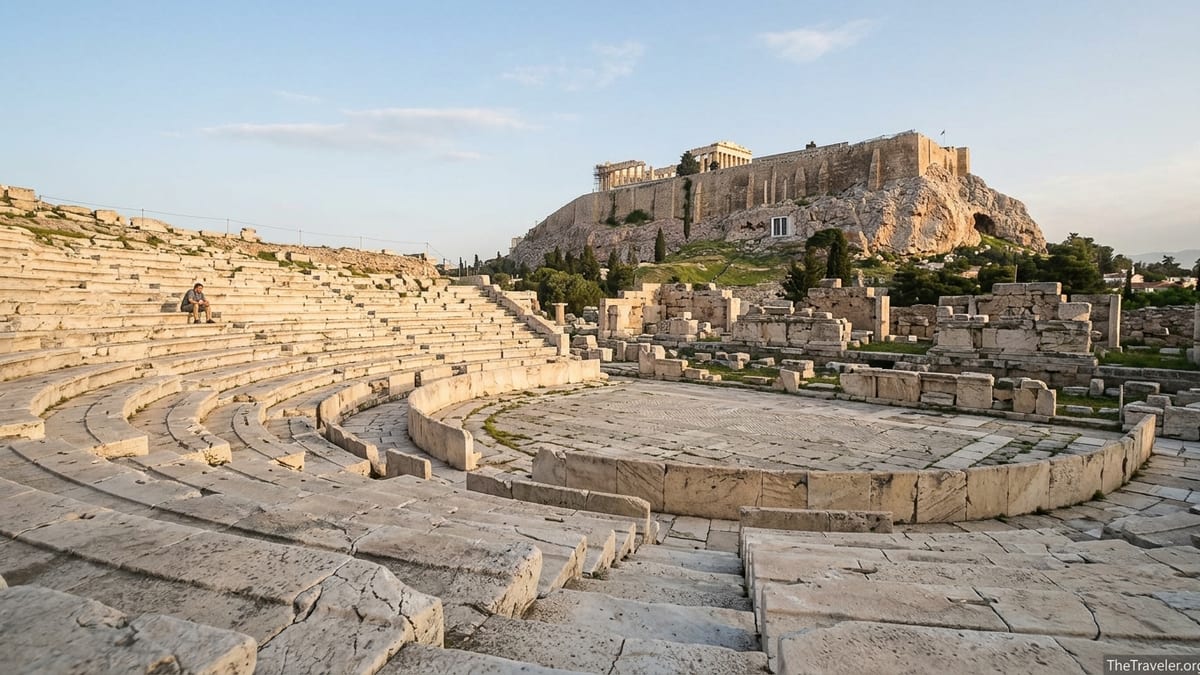
The site itself is not large, but there are several distinct vantage points: from the lower edge of the orchestra looking back at the rows of seats and the Acropolis hill, from mid-level seats looking across the semicircle, and from the higher paths that give you partial views toward the Parthenon. Because you are on a slope, small changes in position make a big impact on your framing, especially if you want the Acropolis walls or the Parthenon peeking over the rim of the theatre.
For gear, a standard zoom in the 24 to 70 millimeter range on a full-frame camera covers most compositions here, from tighter architectural details of the carved seats to wider context shots. Smartphone cameras are perfectly workable too, but if you have one, a phone with a proper 2x or 3x telephoto lens lets you compress the seating rows and isolate clusters of tourists or specific carved thrones without distortion.
Morning vs Afternoon Light on the South Slope
Theatre of Dionysus faces broadly south, but the Acropolis rock rises behind it, which means the play of light changes quickly during the day. In most months, the best photographic conditions are in the first two hours after opening and the last 90 minutes before closing. Early morning, when the gates open around 8 am in summer, typically brings soft light from the east and a cooler overall color temperature. This is ideal if you want even illumination on the stone seating without harsh shadows in people’s faces.
In practice, that might mean reserving an 8 am or 8:30 am time slot and walking straight from the south gate to the theatre before continuing up to the Parthenon. At this hour in high season, you will often find just a handful of visitors spread across the seats, making it much easier to capture empty-looking rows or a single subject in a vast stone bowl. The marble is still relatively cool, and the sun low enough that details in the carved thrones and steps are not washed out.
By late morning and early afternoon, the sun is high and the white marble becomes extremely reflective. This is when auto-exposure on phones struggles, and skies near the Acropolis can easily blow out. If you must shoot then, dial exposure compensation down a notch or tap to meter on the brightest part of the stone rather than on a shaded area. Polarizing filters can help deepen the sky and control reflections on camera lenses, but be cautious with very wide focal lengths to avoid uneven skies.
Late afternoon on the south slope can be beautiful on days when heat is manageable. The light warms, textures stand out and you can sometimes catch the upper Acropolis walls glowing gold behind the theatre. However, in July and August, standing on bare marble in late afternoon can be punishingly hot. On such days, prioritize safety over photos, carry water and a hat, and keep your sessions short. Shoulder seasons like April, May, late September and October are more forgiving, and an after 4 pm visit can balance warm light with bearable temperatures.
Best Angles and Compositions Inside the Theatre
One classic angle begins at the lower edge of the orchestra, slightly off-center. Stand a few meters to the left or right of the central axis, point your camera toward the seating, and tilt slightly upward so the rows form a rising fan of lines. With a 28 to 35 millimeter focal length, you can fill the frame with the curve of seats, and by waiting for a single person in a bright shirt to sit midway up, you add scale without clutter. This is the sort of shot that ends up on guidebook covers, but it is surprisingly easy to achieve early in the morning when the theatre is still quiet.
From mid-level seats on either side, you can build diagonal compositions. Climb about halfway up the cavea and walk toward one of the wings. From there, aim across the theatre so the rows slice your frame from bottom left to top right, with the orchestra and fragments of the stage buildings below. This works well in side light, either in early morning or late afternoon, when the stone relief between steps is emphasized. Photographers with a 50 to 70 millimeter lens can pick out sections of rows and play with repeating patterns interrupted by occasional visitors.
Another rewarding angle focuses on the ornate marble thrones in the front row, traditionally reserved for priests and officials. Move close and frame one or two of them at around 35 to 50 millimeters, with the regular seating fading into soft focus behind. Because these thrones are fenced, you will need to shoot from behind the barrier, but slightly crouching and placing the seat against a clean patch of marble behind avoids messy backgrounds. In flat midday light, you can still get appealing results here, since the focus is on detail rather than broad contrast.
If you are comfortable shooting handheld at slower shutter speeds, consider a lower ISO and narrower aperture to keep both foreground and background sharp. For example, at f/8 and around 1/125 second, a 24 to 35 millimeter lens will render both the nearest steps and the far rim of the theatre in focus, ideal for documentary-style images that show the structure’s form. On phones, use the wide camera and tap to keep both near and far elements in a similar exposure, then adjust shadows later in editing apps.
Using the Acropolis as a Backdrop
One of the main photographic payoffs of visiting the Theatre of Dionysus is the chance to incorporate the Acropolis walls and, in places, the Parthenon into your compositions. From several points on the higher paths above and behind the theatre, you can angle your camera upward so that the curve of the seats occupies the lower part of the frame while the fortification walls crown the horizon. A 24 millimeter lens or the ultra-wide camera on a phone helps here, especially if you want to exaggerate the sweep of stone leading the eye up to the plateau.
To include the Parthenon itself, walk the path that skirts above the theatre and look for openings where the monument appears between trees or above the walls. You may need to crouch or shift a meter or two along the path so stray branches frame rather than obscure the temple. In the best cases, you can align a diagonal of seats with the Parthenon on the upper right, producing a layered image that tells a story about performance below and sacred architecture above.
Weather can make or break these views. On clear days after rain, Athens air feels noticeably cleaner, and distant detail on the Parthenon is crisper. If you are in the city for several days, keep an eye on forecasts and choose your Theatre of Dionysus session for a post-shower morning or evening when possible. Even in hazy conditions, however, you can lean into the softness by exposing slightly to the right and letting the background temple fade, focusing attention on the carved foreground stone.
Visitors who want a different take on the relationship between the theatre and Acropolis can also shoot from outside the fenced area along Dionysiou Areopagitou, especially in the blue hour after the site has closed. You will not capture the seating interior, but you can work with the illuminated rock above the darker slope, then later juxtapose those shots with daylight images from inside the theatre in a photo essay or social media carousel.
Avoiding Crowds and Managing Visitor Flow
Although the Theatre of Dionysus is far less crowded than the Parthenon itself, its location on the main south slope path means there can still be pulses of tour groups, especially mid-morning when cruise excursions arrive. Guides often pause here to give a short explanation before moving on, so the number of people can jump from a dozen to fifty within a couple of minutes. Rather than fighting that, use the rhythm of groups to your advantage by planning short, focused shooting bursts in the quieter intervals.
The simplest strategy is timing. In peak season from roughly June to early September, aim for the very start of the day, booking the earliest possible entry and walking directly up from the south gate before groups have dispersed from the main entrance at the west. In shoulder months like April, May or October, a late afternoon slot after many tours have finished can also work well. Independent travelers often leave the site by then, and the theatre may be down to a scattering of visitors.
When you do encounter crowds, think in terms of selective framing rather than waiting for complete emptiness. Move closer and shoot details that fill the frame, such as a subsection of seats, the curve of a stair, or the inscription on a throne. Use people as scale instead of seeing them as obstacles: a lone visitor looking down from high in the seats can provide a focal point in an otherwise abstract pattern of stone. If you use a camera with a wide aperture, shooting at f/2.8 or similar lets you blur the background and isolate a single head or hand resting on ancient marble.
Practical crowd management also includes where you stand. The paths that run along the top of the theatre are narrow and can feel congested when groups are passing. If you want to shoot from there, step aside into one of the wider pull-outs and work from the edges rather than blocking the main flow. On sunny days, you will also find that people naturally cluster in small shaded patches, leaving large portions of the seats empty. Use that to find cleaner compositions instead of insisting on a perfect central view where everyone else is standing.
How Not to Confuse the Theatre of Dionysus with the Odeon
One of the most common mistakes in Athens photography is labeling the Odeon of Herodes Atticus as the Theatre of Dionysus. The two are only a few hundred meters apart on the south slope of the Acropolis, and even image libraries and postcards sometimes misidentify them. For travelers hoping to caption their photos accurately, or simply understand what they are shooting, it helps to learn a few quick visual cues.
The key difference is that the Theatre of Dionysus is more open and ruinous, with low remnants of stage buildings and a bowl of worn marble seats that fade into earth and vegetation. The Odeon, by contrast, has a much more intact semicircular arrangement, a high multi-arched stone backdrop and a modern stage used for performances. If your photo shows a tall wall behind the stage with a rhythm of arches, it is almost certainly the Odeon, not the Theatre of Dionysus.
Location also offers clues. Approaching from Dionysiou Areopagitou and the Acropolis Museum, the first large theatre you reach after entering the south gate and walking a short distance uphill is the Theatre of Dionysus. The Odeon of Herodes Atticus lies further west, closer to the main Propylaea entrance, and is typically reached later in a standard uphill loop. If you remember the sequence of your walk, you can often reconstruct which theatre is which when reviewing photos back at your hotel.
If in doubt on site, check the information panels. The Theatre of Dionysus boards refer to the sanctuary of Dionysus Eleuthereus and highlight its role in the birth of drama. The Odeon panels mention Herodes Atticus, Roman-era construction and modern performances. Taking a quick snapshot of the nearest sign along with your main images can save you confusion later. This is especially valuable if you plan to share images in articles or presentations where accuracy matters.
Practical Shooting Tips: Gear, Safety and Site Rules
The Acropolis complex is photography friendly, but there are boundaries. Tripods and large light stands are often restricted or require advance permission, especially in high season, since they can create tripping hazards and block movement. For most travelers, a handheld setup or a small travel tripod used discreetly away from busy paths is sufficient. Monopods and compact tabletop tripods that can sit on a step or low wall are less obtrusive and usually easier to fit into day bags.
Footwear matters more than many photographers expect. The marble surfaces around the theatre and on the paths above it can be extremely smooth and slippery, especially after rain. Sturdy shoes or sandals with good grip not only keep you safe but also give you the confidence to move into more creative shooting positions, such as crouching low on a step to exaggerate foreground texture. Avoid backing up while staring through a viewfinder; instead, pause, look around, then shift to your next position.
Battery life and storage can be surprisingly tight on full days around the Acropolis. Shooting in RAW for flexibility in handling highlights, or recording 4K video clips from multiple angles, can fill memory cards quickly. Bring a spare card and at least one extra battery or power bank for your phone. Many visitors underestimate how long they will spend wandering between the Theatre of Dionysus, the Odeon, the summit monuments and the nearby museum, and it is frustrating to find the best light of the day just as your camera dies.
Respect for the site is also part of responsible photography. Do not climb on fragile remains, cross barriers, or sit on carved thrones, even if you see others doing it for a quick photo. Guards are present and may intervene, but more importantly, the marble has survived for many centuries and continued wear can cause lasting damage. Clean, well-composed images that show visitors engaging respectfully with the space are both more authentic and more likely to age well than staged shots that ignore basic preservation rules.
The Takeaway
The Theatre of Dionysus rarely gets top billing in Athens travel plans, yet for photographers it offers a rewarding mix of historical weight, manageable scale and varied viewpoints. With careful attention to morning or late afternoon light, an understanding of how to position yourself on the slope and a willingness to work around occasional bursts of visitors, you can come away with images that feel far richer than a quick snapshot from the path.
Think of the theatre not just as a ruin, but as part of a larger visual conversation with the Acropolis above and the city below. Use its curves to lead the eye, its carved seats as intimate details, and its openness to frame the fortress rock and Parthenon. Pair those daytime images with wider city views from nearby hills or street scenes along Dionysiou Areopagitou, and you can construct a complete photographic story of Athens’ cultural heart.
Above all, slow down. Spend twenty or thirty minutes exploring different steps, watching how light moves across the marble, and noticing where people naturally pause. The best photographs from the Theatre of Dionysus tend not to be rushed hero shots, but the quieter frames that emerge once you have allowed the space to reveal its character.
FAQ
Q1. Is the Theatre of Dionysus included in the standard Acropolis ticket? The Theatre of Dionysus sits within the Acropolis archaeological park, so access is included with both the standard Acropolis ticket and the combined multi-site ticket currently sold for the Athens monuments.
Q2. What is the best time of day to photograph the Theatre of Dionysus? Early morning within the first two hours of opening usually offers the softest light and the fewest crowds, while late afternoon can provide warm, textured light if temperatures are not extreme.
Q3. Can I use a tripod at the Theatre of Dionysus? Small, discreet tripods or monopods are sometimes tolerated, but full-size tripods and light stands may be restricted, especially in busy periods, so it is safest to plan for handheld shooting or confirm rules on arrival.
Q4. How can I tell if my photo is of the Theatre of Dionysus or the Odeon of Herodes Atticus? If your image shows a high, arched stone wall behind the stage, it is almost certainly the Odeon; if the backdrop is low ruins with a more open, weathered bowl of seats, it is likely the Theatre of Dionysus.
Q5. Do I need special camera gear to get good photos there? No, a smartphone or a simple zoom lens in the 24 to 70 millimeter range is enough for strong images; the key is timing, composition and working with the available light rather than advanced equipment.
Q6. Are there good Acropolis views from inside the Theatre of Dionysus? Yes, from higher paths and certain seating positions you can frame sections of the Acropolis walls and even the Parthenon above the curve of the theatre, especially with a wider lens.
Q7. What should I wear and bring for a photo session on the south slope? Wear grippy shoes suitable for smooth marble, a hat and sunscreen for sun exposure, and carry water, a spare memory card and extra battery or power bank so you can stay on site as light improves.
Q8. Is the Theatre of Dionysus very crowded compared to the Parthenon? It typically sees far fewer people than the summit area, but as it lies on the main south slope path, short bursts of tour groups are common, especially late morning, so patience and flexible framing help.
Q9. Can I visit only the Theatre of Dionysus without going up to the top of the Acropolis? Once you are inside the Acropolis archaeological park you are free to choose how far you go; many visitors spend time at the Theatre of Dionysus and nearby slopes even if they do not continue all the way to the summit.
Q10. Are there good nearby spots to photograph the theatre from outside the fence? From Dionysiou Areopagitou and the pedestrian areas near the south entrance you can get partial side views of the slope and Acropolis above, which pair well with interior shots taken during your time inside the park.