


Perched on the southern slope of the Acropolis, the Theatre of Dionysus looks, at first glance, like a broken shell of stone seats and scattered ruins. Yet this is the birthplace of European drama, where the plays of Aeschylus, Sophocles, Euripides, and Aristophanes were first performed for thousands of Athenians. The real question for modern travelers is simple: is it worth your limited time in Athens?
Get the latest updates straight to your inbox!
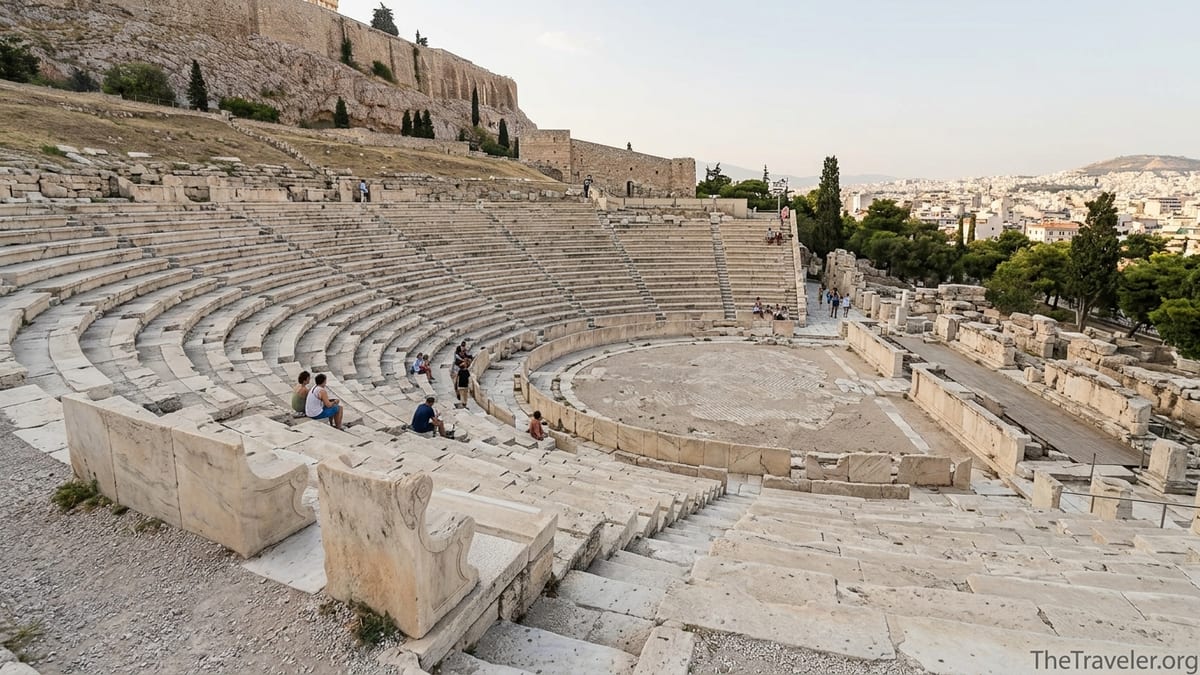
What the Theatre of Dionysus Actually Looks Like Today
Modern visitors often arrive at the Theatre of Dionysus with mental images of a perfectly preserved amphitheater. What you will find instead is a large, evocative ruin carved into the hillside, with enough structure intact to imagine the ancient performances, but not so polished that it feels like a stage set. Sweeping tiers of stone seating curve around a central orchestra, and the site opens outward on one side toward the city, with Athens spreading into the distance.
The lower rows are the most striking. Here you can still see the marble thrones of honor that once seated priests and dignitaries, including an elaborately carved “throne” for the priest of Dionysus, complete with armrests and decorative reliefs. Many visitors walk straight past these, but sitting on one of the plain stone benches just behind them and looking down toward the orchestra gives you a good sense of where the elite and the general public would have watched the plays.
The orchestra itself is a wide, flat area that once held the chorus. What survives today is a patchwork of stone and earth, but you can clearly recognize the circular performance space, framed by fragments of low walls and steps. Behind it rise the remains of a later Roman stage building. You will notice carved decorative figures and a partially preserved semi-circular façade. These elements date from the Roman remodeling of the theater and are some of the most photogenic details, especially in late afternoon light when shadows pick out the relief carving.
Much of the upper seating is damaged or missing, and access is restricted to protect the remains. Paths and low fences keep you to specific viewpoints. For some travelers accustomed to fully restored venues like the Odeon of Herodes Atticus just up the slope, this can feel underwhelming. For others, the theatre’s worn stones, uneven tiers, and partial conservation work create a powerful sense of age. Managing your expectations is crucial: this is not a spotless, reconstructed monument, but a ruin that rewards imagination and historical interest.
What You Can Still See and Experience on the Ground
The Theatre of Dionysus is best appreciated by moving slowly and noticing specific features, rather than treating it as a quick photo stop. Near the front rows, look closely at the first ring of seats. Many are carved from marble with backs and armrests; a number still bear ancient inscriptions naming the officials or priesthoods who sat there. Spotting the Greek letters is a small thrill, especially if you have even basic familiarity with the alphabet.
From the main viewing area, you can clearly see the curvature of the cavea, the mass of seating carved into the hillside. Standing halfway up, near the central axis, gives you one of the most atmospheric views: the orchestra and stage remains below, the Acropolis rising behind you, and the contemporary city framed beyond the theater’s edge. In the quieter shoulder seasons, it is possible to find a spot to sit for several minutes, listen to the city noise drifting up, and picture festival crowds of perhaps ten or fifteen thousand Athenians filling the rows.
Conservation work is ongoing, so you may notice sections cordoned off with ropes or low barriers, stacks of carefully numbered stone blocks, or discreet scaffolding on certain visits. Rather than spoiling the experience, this often highlights how archaeologists are still stabilizing and studying the site. Informational panels (usually in Greek and English) help you interpret what you are seeing, from the sanctuary of Dionysus that once stood adjacent to the theater, to the successive Greek and Roman phases of construction.
The immediate surroundings are part of the appeal. Just along the slope you can glimpse the long line of the Stoa of Eumenes and, further west, the more intact Odeon of Herodes Atticus, which still hosts concerts in summer. If you walk the south-slope path from the Theatre of Dionysus toward the main Acropolis summit, you follow roughly the route ancient festival-goers would have taken, turning a simple ruin visit into a walk through layers of Athenian history.
How Much Time You Need and How to Plan Your Visit
For most travelers, 20 to 40 minutes is enough time to see the Theatre of Dionysus thoroughly. If you are pairing it with a standard Acropolis visit, allow around two hours for the entire Acropolis and slopes, including the Parthenon, Erechtheion, and viewpoints, then add another 20 minutes if you know you will linger at the theater for photographs or quiet contemplation.
In practical terms, you do not buy a separate ticket just for the Theatre of Dionysus. As of mid-2026, the standard “Acropolis & slopes” ticket (around the price point you would expect for Athens’ flagship monument) includes access to the theatre, the south slope monuments, and the summit. You choose a timed entry slot for the Acropolis when purchasing your ticket online; within that slot you can explore both the top of the hill and the slopes below as part of a single visit.
Many visitors use the southern entrance, sometimes called the Dionysus Theatre entrance, located below the pedestrian street Dionysiou Areopagitou. Entering here brings you first past the Theatre of Dionysus and the other south-slope remains before you climb to the Parthenon. This layout makes it easy to spend your first 30 minutes at ground level with fresher legs and fewer crowds, then ascend when ready. It also helps late-afternoon visitors, who might prefer to enjoy golden-hour light on the summit after seeing the theater earlier.
In peak summer months, plan around the heat as much as the crowds. An early entry slot, roughly in the first hour of opening, means cooler temperatures and softer light over the stone seats. Late afternoon slots, especially in July and August, can still be hot but are usually gentler than midday. In winter and the cooler shoulder seasons, you have more flexibility; the theater can be wonderfully atmospheric on clear, low-sun days from late autumn through early spring.
Who Will Really Enjoy the Theatre of Dionysus
Some travelers will find the Theatre of Dionysus unforgettable; others will walk past quickly on the way to the Parthenon. Knowing which type you are will help you decide how much attention it deserves in your itinerary. If you care deeply about theater, literature, or classical history, this site is close to sacred ground. Standing where Sophocles’ tragedies or Aristophanes’ comedies were first performed carries a charge that no museum label can replicate.
Academics, drama students, and avid theatergoers often describe the visit as one of the emotional highs of their time in Athens. A modern playwright from London, for instance, might plan an early morning visit, sit quietly halfway up the seating, and read a page from Oedipus Rex or Lysistrata while listening to city sounds echo in the hollow. Even for non-specialists, the realization that entire genres of Western drama developed here, outdoors and in daylight, can change how you picture ancient culture.
Travelers who enjoy slow, imaginative exploration of ruins tend to appreciate the theatre more than those who prefer polished, “Instagram-ready” monuments. If you loved wandering the less-restored sections of sites like the Roman Forum, Pompeii’s quieter backstreets, or the more ruined temples at Paestum, you will likely respond well to the Theatre of Dionysus. The partial reconstruction and ongoing conservation invite you to mentally rebuild the space, rather than passively consume a finished monument.
Families with older children who are studying Greek myths or have encountered Greek plays at school may also find the visit rewarding, especially if you prepare with a brief story beforehand. Younger children with limited patience for ruins may be less engaged; in that case, treating the theater as a short stop along the way to the summit, rather than a main attraction, is usually wiser.
When It Is Safe to Skip or Keep Brief
Despite its significance, the Theatre of Dionysus is not essential for every traveler. If you have only one full day in Athens and you are already feeling overloaded by ancient sites, you can afford to keep your time at the theater very short. A five-minute pause to look over the seating and orchestra from the main path, a couple of photographs, and then a continued climb to the Parthenon is perfectly acceptable for many visitors.
If your primary interest in the Acropolis is visual spectacle and panoramic views rather than historical detail, you may find the more intact Odeon of Herodes Atticus higher up the south slope more immediately impressive. Its reconstructed marble seating and modern stage, often set up for the Athens and Epidaurus Festival in summer, give a clearer sense of an amphitheater in use today. In that context, the Theatre of Dionysus can feel like a less photogenic cousin.
Mobility and heat sensitivity are also important considerations. While the main path around the Theatre of Dionysus is relatively gentle compared to the final climb to the summit, the stone surfaces can be uneven and slippery, especially after rain. Visitors with limited mobility or those using canes may choose to focus their energy on the more iconic monuments at the top. On extremely hot days, some travelers will sensibly prioritize shaded breaks on the pedestrian street or at the nearby Acropolis Museum cafe over lingering at an exposed ruin.
Finally, expectations matter. If you are imagining a fully reconstructed, towering amphitheater similar to modern venues, you risk disappointment. Travelers who read a bit beforehand, understand they are visiting a ruin with important surviving details rather than a complete structure, and approach with curiosity are far more likely to feel the stop was worthwhile.
Pairing the Theatre of Dionysus With the Acropolis
The Theatre of Dionysus is not a separate outing; it is part of the broader Acropolis experience. The most satisfying way to see it is as the opening chapter of your Acropolis visit. Enter through the southern gate, walk slowly past the theater and other south-slope remains, then continue up to the sacred plateau with the Parthenon. This route roughly mirrors the movement of ancient festival processions and ties the site into a coherent story.
In practice, many visitors will buy a timed Acropolis ticket online for a morning slot, arrive via the southern entrance, and spend the first half hour exploring the Theatre of Dionysus and pausing for photographs. From there, you can follow the path past the Stoa of Eumenes and the Odeon of Herodes Atticus, gradually climbing to reach the main Propylaea gate for your first full view of the Parthenon. Done at a relaxed pace, this gives you about two hours total on the hill, with the theater framing your sense of how Athenians used the slopes and summit together.
If you are particularly interested in performance or religious history, you can extend this by visiting the Acropolis Museum either before or after your time on the hill. The museum displays sculptures and objects from the sanctuary and Theatre of Dionysus, including reliefs that once decorated the stage area. Seeing the remains in situ and the finer carvings in the museum on the same day helps you visualize the theater as a working sacred space rather than just a shell of stone seats.
For travelers with more time in Athens, it can be rewarding to connect the Theatre of Dionysus to other performance venues in the city. An evening concert at the Odeon of Herodes Atticus, viewed from modern seating carved into the same hillside, creates an evocative contrast to the daytime ruins of Dionysus’ theater. In Piraeus, summer performances at the Veakeio Municipal Theater, another hillside open-air venue, further underline how Athens has continued the tradition of outdoor performance spaces through the centuries.
The Takeaway
The Theatre of Dionysus is not the best-preserved monument in Athens, nor is it the most visually dramatic from a distance. Yet for travelers who value historical depth, imagination, and a sense of place, it is one of the most meaningful spots on the Acropolis slopes. The surviving marble thrones, the curve of the seating, and the remnants of the Roman stage are enough to summon the presence of ancient crowds and the first performances of plays that are still read and staged today.
If your time in Athens is extremely tight, a quick look at the theatre on your way to or from the Parthenon is perfectly reasonable. However, if you have even a modest interest in theater, literature, or how ancient Athenians actually gathered and spent time together, try to give the site at least twenty quiet minutes. Sit, look, and listen; let your mind fill in the missing tiers and painted scenery.
Ultimately, the Theatre of Dionysus is worth visiting as part of a well-planned Acropolis itinerary, not as a standalone destination. Approach it with the right expectations, pair it with the south-slope walk and, ideally, the Acropolis Museum, and it will likely become one of the places where Athens’ layered history feels most alive.
FAQ
Q1. Is the Theatre of Dionysus included in the standard Acropolis ticket?
Yes. As of 2026, the standard “Acropolis & slopes” ticket includes access to the Theatre of Dionysus along with the south slope monuments and the summit of the Acropolis.
Q2. How long should I plan to spend at the Theatre of Dionysus?
Most visitors are satisfied with 20 to 40 minutes at the theater, usually as part of a two-hour visit to the Acropolis and its slopes.
Q3. Which entrance should I use if I want to see the Theatre of Dionysus first?
Use the southern entrance to the Acropolis, often called the Dionysus Theatre or south-slope entrance. It brings you directly past the theatre before you ascend to the summit.
Q4. Is the Theatre of Dionysus suitable for children?
Older children studying Greek myths or history may find it interesting, especially with a short story or explanation in advance. Very young children may be less engaged and might prefer a brief stop on the way to the Parthenon.
Q5. What is the best time of day to visit the Theatre of Dionysus?
Early morning and late afternoon generally offer the best light and more manageable temperatures. In high summer, avoid the midday heat when the stone seats can become very hot.
Q6. How well preserved is the Theatre of Dionysus compared to other theaters in Athens?
The theatre is partially preserved: key features like the front-row marble thrones, the orchestra, and parts of the stage remain, but much of the upper seating is damaged. The nearby Odeon of Herodes Atticus appears more intact and is still used for modern performances.
Q7. Can people still sit in the ancient seats?
You can sit on many of the stone benches in the lower and middle sections, though certain areas and the most delicate thrones are protected. Always follow signs and barriers to help preserve the site.
Q8. Is the Theatre of Dionysus accessible for visitors with limited mobility?
Access around the theater involves uneven stone paths and some slopes. Visitors with mobility challenges may find it manageable only in part and might choose to conserve energy for the more iconic monuments on the summit.
Q9. Do I need a guided tour to appreciate the Theatre of Dionysus?
A guide or audio tour can add useful context, especially about the festival of Dionysus and the history of Greek drama. However, information panels on-site, combined with a bit of reading beforehand, are enough for many independent travelers.
Q10. Is the Theatre of Dionysus worth visiting if I am not especially interested in theater?
If you are mainly drawn to big views and iconic postcard scenes, you may prefer to keep your visit brief. But even without a strong interest in theater, spending a short time here enriches your understanding of how Athenians used the Acropolis slopes and how public life unfolded in the city.