


On the quieter, sun warmed side of the Arno River, Florence’s Pitti Palace rises like a stone cliff above its square. Behind its severe Renaissance facade lies a world of Medici splendor, royal apartments, fashion collections, and leafy gardens that once set the standard for courts across Europe. Today the palace is Florence’s largest museum complex and one of the city’s grandest landmarks, a place where visitors can walk through five centuries of power, taste, and everyday life at court in a single afternoon.
Get the latest updates straight to your inbox!
From Banker’s Mansion to Grand Ducal Powerhouse
Pitti Palace began in the mid 15th century as the ambitious home of Luca Pitti, a wealthy Florentine banker who wanted a residence to rival the Medici. Built on the slope of the Boboli hill, just beyond the city center on what is now the Oltrarno, the original palace was more modest than the vast structure visitors see today, but even then its rusticated stone facade and monumental scale made a bold statement. Local guides still like to point out how its enormous ground floor windows were deliberately designed to be larger than the main doorway of the Medici’s town palace across the river, a measure of Pitti’s competitive pride.
That rivalry did not last. In 1550 the Medici family bought the unfinished palace and turned it into their main residence, leaving their earlier seat at Palazzo Medici Riccardi. Cosimo I de’ Medici and his wife Eleanor of Toledo transformed the building into a grand ducal palace, expanding the structure toward the gardens and commissioning the creation of the Boboli Gardens behind it. Within a few generations, Pitti Palace was no longer a private home but the beating heart of Tuscan political power, where ambassadors were received, marriages arranged, and new works of art commissioned to underline Medici prestige.
The story did not stop with the Medici. When that dynasty died out in the 18th century, the Habsburg Lorraine family inherited the palace and kept it as the residence of the grand dukes of Tuscany. Later, between 1865 and 1871, when Florence briefly served as the capital of the newly unified Kingdom of Italy, Pitti Palace even became the royal seat of the House of Savoy. Walking through its state rooms today, visitors are effectively moving through three overlapping courts, each leaving its mark in furnishings, artworks, and small details like the arrangement of private rooms and service corridors.
In 1919 the last king to occupy it, Victor Emmanuel III, donated Pitti Palace and its contents to the Italian state. The following year it opened fully to the public, cementing its status as one of Europe’s great museum palaces. For modern travelers, this means an unusual degree of access: more than 100 rooms are accessible on standard tickets, including spaces that once saw council meetings, diplomatic receptions, and intimate family life at the highest levels of European society.
Why Pitti Palace Is One of Florence’s Grandest Landmarks
Florence is not short on famous buildings. The Duomo, Ponte Vecchio, and Palazzo Vecchio are all architectural icons. Yet Pitti Palace holds a special place among them, both for its size and for the density of experiences it offers. It is the city’s largest museum complex and one of the most extensive palace museums in Italy, with multiple institutions layered under a single Renaissance roof. For many visitors, it is the only place in Florence where they can see royal apartments, Old Master paintings, fashion history, and princely treasures in one visit.
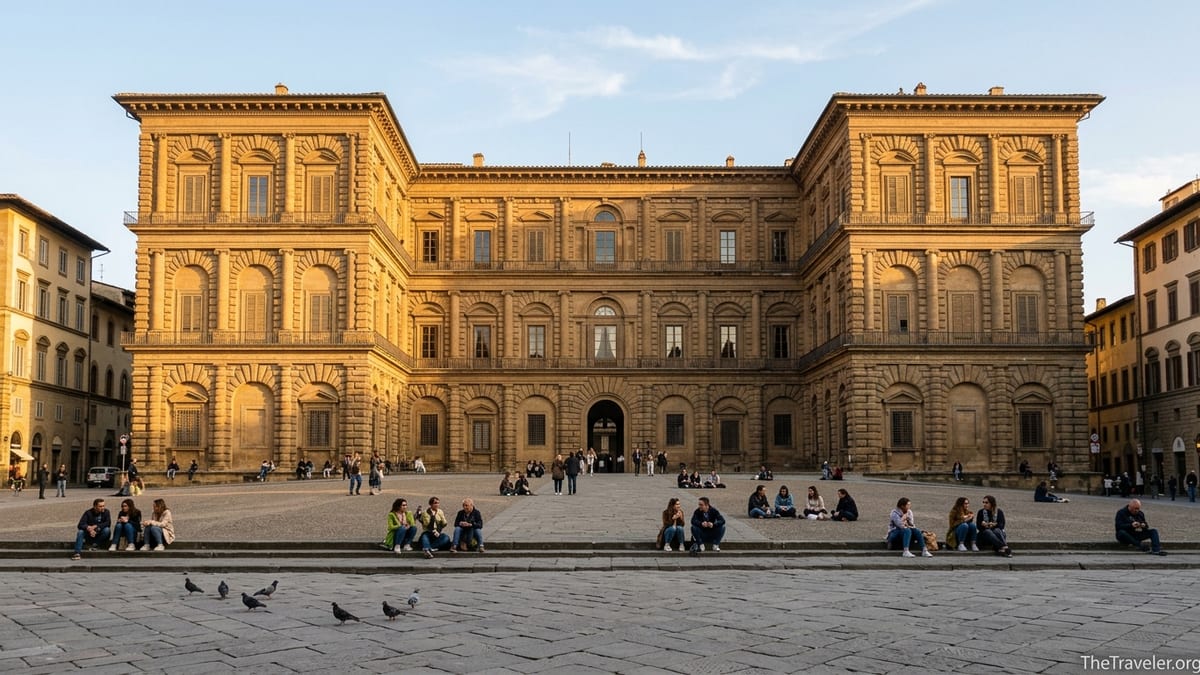
The facade alone gives a sense of scale. The main front stretches across almost the entire breadth of Piazza Pitti, presenting three stories of massive, rusticated stone. Instead of ornate sculpture niches and delicate tracery, the design leans on sheer mass. Travelers who first see it after emerging from the narrow streets of the Oltrarno often remark that it feels more like a fortress than a palace. This monumental severity sets it apart from the more decorative facades of Florence’s other landmarks and leaves a lasting first impression, especially when viewed in late afternoon light as the stone turns honey colored.
Behind that facade lies an extraordinary accumulation of art and decorative objects. While the Uffizi Gallery is better known internationally for its curated story of Renaissance painting, the collections inside Pitti Palace rival it in both quality and richness. Visitors encounter Raphael and Titian canvases hung floor to ceiling in gilded frames, stuccoed and frescoed ceilings, marble fireplaces, inlaid tables, and glittering cabinets of hardstone and ivory. Many originals remain in situ, so you see paintings and furnishings much as the Medici and later rulers did, rather than as isolated museum pieces. This sense of walking straight into an intact court interior is what makes Pitti stand out among Florence’s landmarks.
The palace’s position also contributes to its appeal. Set just across the Arno from the busiest tourist streets, it anchors a slightly quieter quarter filled with artisan workshops and small cafes. A visitor might spend the morning amid the crowds at the Duomo, cross the Ponte Vecchio at midday, and then find a relative calm in Piazza Pitti, where children play on the sloping pavement and locals sit on the steps in the evening. The combination of monumental grandeur and lived-in neighborhood atmosphere makes the palace feel less like a detached monument and more like a central character in everyday Florentine life.
A Palace of Five Museums Under One Roof
Today Pitti Palace is home to a constellation of museums rather than a single institution. On a typical visit, travelers encounter the Treasury of the Grand Dukes and the Museum of Russian Icons on the ground floor, the Palatine Gallery and Imperial and Royal Apartments on the first floor, and the Gallery of Modern Art plus the Museum of Costume and Fashion on the second. Each of these spaces tells a different chapter of Florentine and Italian history, and the variety helps keep a long visit engaging.
The Treasury of the Grand Dukes occupies what were once the Medici summer apartments. Here the atmosphere is intimate and jewel like. Display cases hold carved cameos, gold and silverwork, lapis lazuli and agate vessels, and ornate ivory objects. Many pieces come from the celebrated collection of Lorenzo de’ Medici and from later acquisitions such as Salzburg’s ecclesiastical silver, brought to Florence by the Habsburg Lorraine grand dukes. Visitors who might feel overwhelmed by large paintings often find this collection approachable because it rewards close looking: tiny mythological scenes carved into gemstones, delicate gold mounts around ancient vases, and 18th century porcelain services used at court banquets.
Upstairs, the Palatine Gallery fills a suite of grand state rooms along the first floor. Unlike modern galleries that group works by artist or period with plenty of blank wall, the Palatine preserves the dense “salon” hanging favored in the 17th and 18th centuries. About 500 paintings are packed into ceiling high displays, including major works by Raphael, Titian, Rubens, and Pietro da Cortona. Visitors might, for example, find Raphael’s “Madonna of the Grand Duke” hanging above a doorway, framed by decorative stucco and heavy draperies. The result is less like a didactic museum space and more like wandering through a lived-in palace where masterpieces simply occupy the nearest empty spot on the wall.
Further along the same level, the Imperial and Royal Apartments introduce the more personal side of palatial life. These rooms were refitted in the 19th century for the Habsburg Lorraine and Savoy families and are furnished accordingly with damask wall coverings, crystal chandeliers, and period furniture. On a summer afternoon you might look into a high ceilinged bedroom and see embroidered bed hangings caught in a shaft of light, or walk through a reception hall still set with gilded chairs for an imperial audience. Audioguides and guided tours help visitors imagine court protocol, but simply moving through this circuit provides a strong sensory impression of life at the top of the social pyramid.
Art Highlights: From Raphael to Modern Italian Masters
For art lovers, Pitti Palace is a destination in its own right. The Palatine Gallery alone holds one of the world’s richest concentrations of High Renaissance and Baroque painting collected by a single dynasty. Many key works arrived as part of Medici marriages, notably the dowry of Vittoria della Rovere, whose Urbino inheritance brought important Raphael and Titian canvases to Florence. For a modern visitor, that history translates into entire walls hung with luminous Madonnas, mythological narratives, and portraits of princes and popes.
Recognizable highlights include Raphael’s “Madonna of the Grand Duke,” a small and deeply intimate image that was once kept in private Medici rooms, and Titian’s portraits and mythological scenes, which hang amid richly stuccoed frames. Unlike at the Uffizi, where masterpieces are often given their own carefully lit wall, here they compete for attention with other paintings, fragments of ceiling frescoes, and glints of gilt. Many travelers report that their favorite moments in the Palatine Gallery come not from hunting for familiar names but from looking up into corners and discovering an unexpected detail: a trompe l’oeil balcony, a hidden self portrait in a crowd scene, or a small still life tucked between larger canvases.
On the uppermost floor, the Gallery of Modern Art offers a change of mood and style. This museum focuses primarily on Italian art from the late 18th to early 20th centuries, including Macchiaioli painters who anticipated Impressionism with their loose brushwork and interest in outdoor light. After the visual density of the Palatine rooms, the modern galleries feel more spacious. A visitor might move from a patriotic 19th century history painting to a quiet Tuscan landscape painted in broad, sketchy touches. From some windows, you catch glimpses over the roofs of the Oltrarno or down into the Boboli Gardens, reinforcing the connection between the art on the walls and the world outside.
The Museum of Costume and Fashion adds yet another dimension. Located in the Palazzina della Meridiana wing that opens onto the gardens, it is one of Italy’s most important institutions dedicated to fashion history. Its rotating displays draw on a collection that spans from 16th century court garments to 20th century Italian haute couture. Depending on when you visit, you might see richly embroidered Medici dresses, silk gowns worn by Habsburg archduchesses, or designs by names like Emilio Schiaparelli and Valentino. For many travelers, this museum makes the lives hinted at in the royal apartments suddenly tangible: the weight of heavy brocade, the constriction of corsets, and the glitter of jewels that once swept through the palace’s ballroom.
Boboli Gardens: The Green Backdrop to Medici Splendor
Behind Pitti Palace, the hillside opens into the Boboli Gardens, one of Europe’s defining examples of 16th and 17th century Italian garden design. Laid out primarily for Eleanor of Toledo and later expanded by the Medici, the gardens were never an ornamental afterthought. Instead they functioned as an outdoor extension of the palace, a setting for court festivals, fireworks, and private promenades. From the start, their terraced lawns, axial paths, and strategically placed fountains were intended to project power and taste as clearly as any interior fresco.
Today, many visitors experience Pitti Palace and Boboli Gardens together, buying a combined ticket or using a multi day Uffizi Pass that includes both. After several hours indoors, stepping into the gardens can feel like entering a different world. Gravel avenues lead past clipped hedges, shaded groves, and unexpected vistas: a Neptune Fountain with mythological sculpture, a faux grotto encrusted with stalactite shapes and shell work, and distant views back over the city’s domes and towers. On warm evenings, locals often stroll the higher terraces, pausing on benches to watch the light fade over the Arno valley.
For travelers, the gardens offer practical advantages as well. Families with children can let them run off energy on the lawns; photography enthusiasts can capture changing light and shadow on stone staircases and statues; and those needing a break from dense museum going can simply sit on a bench framed by cypress trees. In midsummer, it can be hot and exposed in the middle of the day, so many visitors choose to explore the palace galleries earlier and save Boboli for late afternoon, when the light softens and the crowds thin.
Within Boboli, smaller attractions add depth to a visit. The Porcelain Museum, housed in a hilltop pavilion, displays fine tableware used at court, including Meissen, Sèvres, and Italian Doccia porcelain. Even travelers who do not linger over every plate often enjoy the short climb for its panoramic view of Florence’s skyline and the surrounding Tuscan hills. Together, palace and gardens form a single cultural landscape that has helped earn Florence’s historic center its place on the UNESCO World Heritage list.
Planning Your Visit: Tickets, Timing, and Practical Tips
Because Pitti Palace is part of the Uffizi Galleries network, it benefits from relatively clear ticketing options, but the variety can look confusing at first glance. As of mid 2026, most visitors choose between a single Pitti Palace ticket, a combined ticket that covers Pitti and the Boboli Gardens, or a multi day pass that includes the Uffizi, Pitti, and Boboli. Prices shift slightly between high and low season, but in broad terms a standalone Pitti ticket tends to cost a bit less than a mid range restaurant meal in Florence, while the multi site passes are comparable to what you might spend on a guided walking tour. For many travelers planning two or more museum days, the multi day pass offers good value.
Tickets can be bought at counters directly in Piazza Pitti, but in busy months such as May, June, September, and October, advance purchase is strongly recommended to avoid long queues. Official online sales usually allow you to choose an entry date and time slot, after which you can move more freely inside the complex. Many recent visitors report that morning slots around 9 to 10 am offer a calmer experience in the Palatine Gallery, while late afternoon can be pleasant for those wanting to finish in the Boboli Gardens when the light is best for photography.
Pitti Palace typically opens around 8:15 am and closes in the late afternoon or early evening, with shorter hours in winter and closures most Mondays and on some major holidays. Boboli Gardens maintain similar opening times but stay open later in summer. Because exact schedules can change due to maintenance or weather alerts, especially in the gardens, it is wise to confirm hours shortly before your visit using official museum information or at your hotel’s reception desk. Real world examples from recent seasons include temporary closures of some garden paths after heavy rain and reduced access to specific interior rooms during restoration campaigns.
Inside the palace, expect airport style security at the entrance and plan to check large backpacks. Basic services include restrooms, a small bookshop, and limited seating in some galleries. There is a cafe near the Boboli entrance rather than a full restaurant inside the palace, so many visitors schedule a coffee break in nearby streets instead. For instance, it is common to tour the Palatine Gallery for about 90 minutes, exit briefly for an espresso in the Oltrarno, and then return using the same ticket to explore the modern art or fashion sections, provided it is still the same day and you cleared arrangements with staff.
How Pitti Palace Compares to Other Florentine Icons
When planning a few days in Florence, many travelers wonder whether Pitti Palace is essential if they are already visiting the Uffizi or the Duomo complex. In practice, Pitti offers a complementary experience rather than duplicating what you see elsewhere. While the Uffizi is primarily a painting gallery housed in a former office building, Pitti is a lived in royal residence that still feels like a palace first and a museum second. If you want to understand how the Medici and their successors actually lived, entertained guests, and used art to project their image, Pitti is the place where those stories are most vividly staged.
Architecturally, Pitti Palace also stands apart. The Duomo’s striped marble and Brunelleschi’s dome showcase the city’s religious aspirations, and Palazzo Vecchio’s crenellated tower speaks of medieval civic power. Pitti, by contrast, expresses Renaissance and Baroque court culture on a monumental, almost austere scale. Its stone blocks and tiered arcades form a backdrop for ceremonial life, especially when viewed from the sloping square in front. Comparisons are often made to other European royal complexes such as Vienna’s Hofburg or the Louvre’s later palace courtyards, but Pitti’s unbroken rusticated surface and hillside gardens give it a distinctively Florentine character.
In terms of visitor experience, Pitti can feel less crowded than headline attractions on the north bank of the Arno, particularly outside peak hours. Someone who finds the Uffizi’s narrow corridors overwhelming may appreciate the more varied rhythms of Pitti: a dense, frescoed gallery followed by a quieter modern room, then a stroll in the gardens. Families sometimes report that children enjoy Pitti more, because they can alternate between indoor art and outdoor exploration without leaving the site. On the other hand, travelers with very limited time or a strong focus on early Renaissance masterpieces might reasonably prioritize the Uffizi and cathedral complex first.
Many seasoned visitors to Florence ultimately describe Pitti Palace as the place where the city’s layers come together. In one visit you encounter banking ambition, Medici court life, Habsburg taste, Savoy kingship, modern Italian art, and the evolution of fashion, all grounded in a building that has watched Florence shift from city state to tourist magnet. That breadth is what qualifies Pitti not just as another museum but as one of Florence’s true anchor landmarks.
The Takeaway
Pitti Palace is far more than a handsome stone facade across the Arno. It is a living archive of how power, art, and everyday life intertwined in Florence from the 1400s to the 20th century. Within its walls, visitors move seamlessly from Medici treasure rooms to royal bedrooms, from Raphael Madonnas to 19th century landscapes, and from historic court gowns to views over a garden that shaped European landscape design. Few sites in the city offer such a comprehensive, multi sensory account of Florence’s past in a single location.
For travelers willing to cross the river and devote at least half a day, Pitti Palace rewards curiosity with rich detail. A carefully chosen ticket can combine its museums with the Boboli Gardens and even the Uffizi, turning a stay in Florence into a more nuanced exploration of court culture and artistic patronage. Whether you come as an art enthusiast, a history buff, or simply someone drawn to grand spaces and quiet corners, Pitti Palace stands ready to show why it remains one of Florence’s grandest and most revealing landmarks.
FAQ
Q1. What exactly is Pitti Palace today?
Pitti Palace is Florence’s largest museum complex, housing several museums and royal apartments, and serving as the main entrance to the Boboli Gardens behind it.
Q2. How much time should I plan for a visit?
Most visitors spend between two and four hours inside the palace, and another one to two hours in the Boboli Gardens if they include the outdoor areas.
Q3. Is Pitti Palace suitable for children?
Yes, especially if you combine shorter visits to the galleries with time in the gardens, where children can move more freely and enjoy the open space.
Q4. Do I need to book tickets in advance?
In busy seasons such as late spring, summer, and early autumn, booking ahead is highly advisable to avoid queues and ensure your preferred entry time.
Q5. What is the difference between Pitti Palace and the Uffizi?
The Uffizi is primarily an art gallery organized by school and period, while Pitti Palace is a former royal residence where artworks sit within intact historical interiors.
Q6. Can I see everything in one visit?
You can see the main highlights in a single visit, but fully exploring all museums and the gardens in detail would realistically take the better part of a full day.
Q7. Are there guided tours available inside Pitti Palace?
Yes, there are official guided tours and audioguides that cover key areas such as the Palatine Gallery and the Royal Apartments, often available in multiple languages.
Q8. Is Pitti Palace accessible for visitors with reduced mobility?
The palace offers elevators and reserved routes for visitors with reduced mobility, though some historic sections and parts of the gardens include slopes and uneven ground.
Q9. What is the best time of day to visit?
Mornings generally offer quieter galleries, while late afternoon is ideal if you want to end your visit with softer light in the Boboli Gardens.
Q10. Can I visit Pitti Palace and Boboli Gardens with one ticket?
Combined ticket options are usually available, allowing entry to both the palace and the gardens, and sometimes forming part of multi day passes that include the Uffizi as well.