


More news on this day
Thunderstorms rolling across Colorado’s Front Range on Tuesday triggered significant disruptions at Denver International Airport, with a ground stop and subsequent traffic-management measures delaying hundreds of flights and stranding passengers throughout the afternoon and evening.
Get the latest news straight to your inbox!
Storms Sweep Across the Front Range
The latest round of convective storms built rapidly over the Denver metro area on Tuesday, with heavy rain, lightning and strong, shifting winds moving directly across the airfield. Publicly available aviation forecasts had flagged Denver as one of several major hubs at risk for thunderstorm-related delays, and by midafternoon those expectations materialized with storm cells parked near key arrival and departure corridors.
Weather briefings indicate that thunderstorms in and around the airport produced hazardous conditions for departures and arrivals, including reduced visibility, wind shear potential and storm cells aligned along the primary approach paths. As storms intensified, air traffic managers limited the number of aircraft that could safely land and take off, prompting a rapid buildup of traffic on the ground and in surrounding airspace.
The unsettled pattern mirrored several recent episodes in late spring and early summer when thunderstorms over eastern Colorado forced temporary pauses in Denver operations. Tuesday’s storms again underscored how quickly conditions on the Front Range can deteriorate, even after seemingly routine summer mornings.
Ground Stop and Traffic Management Programs
As the storms moved over the region, the Federal Aviation Administration’s traffic management system implemented a ground stop for flights bound for Denver, temporarily halting some departures from other airports while the worst of the weather passed. Ground stops are used to prevent additional aircraft from launching toward an airport when arrival capacity is sharply reduced, and they often ripple through the national network.
Once the most intense cells began to shift away from the field, the ground stop transitioned into ground delay and other traffic-management programs, which meter arrivals into Denver at set intervals. Advisories show that thunderstorms were listed as the primary cause of the delays, with average holding times stretching beyond typical summer slowdowns.
These steps helped maintain safety margins around the storms but significantly constrained the number of operations per hour. Aircraft already en route to Denver faced holding patterns or diversion decisions, while flights scheduled to depart the airport waited for clearance as controllers balanced runway use, storm movement and remaining arrival backlogs.
Hundreds of Flights Affected
By early evening, data from flight-tracking services indicated that hundreds of flights into and out of Denver International Airport had been delayed, with additional cancellations accumulating as the disruption stretched on. Many delays extended well beyond an hour, especially for aircraft that had been scheduled to operate multiple legs through Denver over the course of the day.
The hub’s role as a major connecting point amplified the impact. When thunderstorms cut into Denver’s capacity, flight banks are pushed back in quick succession, affecting travelers not only starting or ending their journeys in Colorado but also those transiting between other regions. Passengers connecting through Denver on Tuesday reported misaligned itineraries, missed onward flights and rebookings deeper into the week as the system worked through limited spare capacity.
The knock-on effects were expected to linger into the nighttime schedule and possibly into early Wednesday, as aircraft and crews ended the day out of position. Recent storm-related disruptions at the airport have shown that even short weather events can translate into a full day of schedule adjustments before operations fully stabilize.
Passenger Experience Inside the Terminal
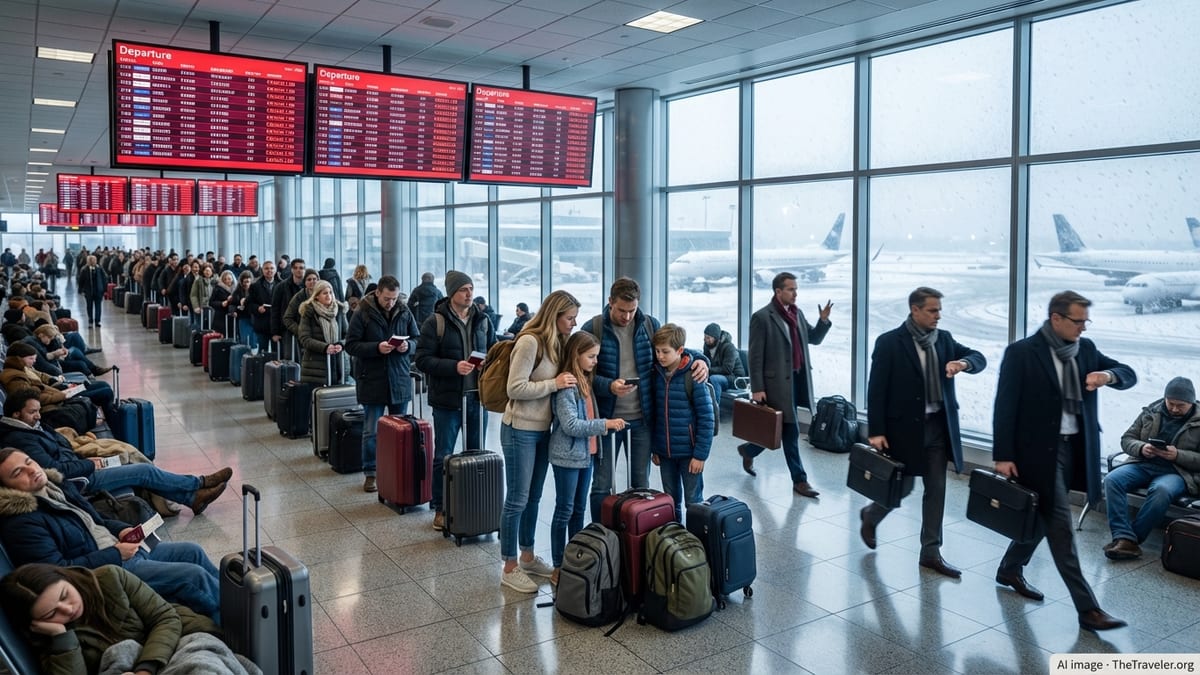
Inside Denver International’s concourses, travelers described long lines at customer service counters as airlines worked to rebook missed connections and reroute passengers whose flights were canceled outright. Social media posts from the terminal showed crowded gate areas, with some flights repeatedly updating departure times as traffic managers adjusted slot allocations into and out of Denver.
Restaurants and concessions appeared to be busier than usual for a midweek afternoon, a pattern that has emerged during previous extended weather delays. Airport planning documents outline procedures for sheltering and customer service during severe weather, and recent disruptions have illustrated how concessionaires and terminal staff often become the face of the operation for stranded passengers while airfield work remains constrained by conditions outside.
Travelers with flexibility were encouraged by airlines and travel advisers to consider later departures or alternative routings once it became clear that Tuesday’s thunderstorm impacts would not dissipate quickly. Others opted to wait out the delays in the terminal, monitoring departure boards as airlines adjusted schedules in response to updated forecasts.
Part of a Broader Pattern of Weather-Related Disruption
Tuesday’s thunderstorm delays fit into a broader seasonal pattern in which convective weather repeatedly disrupts operations at large U.S. hubs. In recent weeks, the FAA’s daily air traffic outlook has frequently highlighted thunderstorms as a potential source of delays at Denver alongside airports in Atlanta, Chicago and major Florida and Northeast markets.
Research on extreme weather and aviation has documented how thunderstorms can sharply reduce airport throughput, forcing rerouting, lengthier taxi times and substantial passenger delays. Studies also note that disruptions at large connecting hubs like Denver propagate across the national network, with missed connections and aircraft repositioning sometimes proving more disruptive than the initial weather event itself.
At Denver International, a series of spring and early summer storms has already prompted multiple ground stops and delay programs, from hail-producing systems to fast-moving evening thunderstorms that roll off the mountains onto the plains. Tuesday’s episode reinforces expectations that summer travelers through Denver should build extra time into their itineraries during active weather periods and remain prepared for last-minute changes when thunderstorms form near the airport.