


More news on this day
U.S. air travel faced another turbulent day as a line of strong thunderstorms sweeping across the Midwest and Mid-Atlantic triggered 4,633 flight delays and 124 cancellations nationwide, with significant disruption reported around Chicago, Detroit and Washington’s Reagan National Airport.
Get the latest news straight to your inbox!
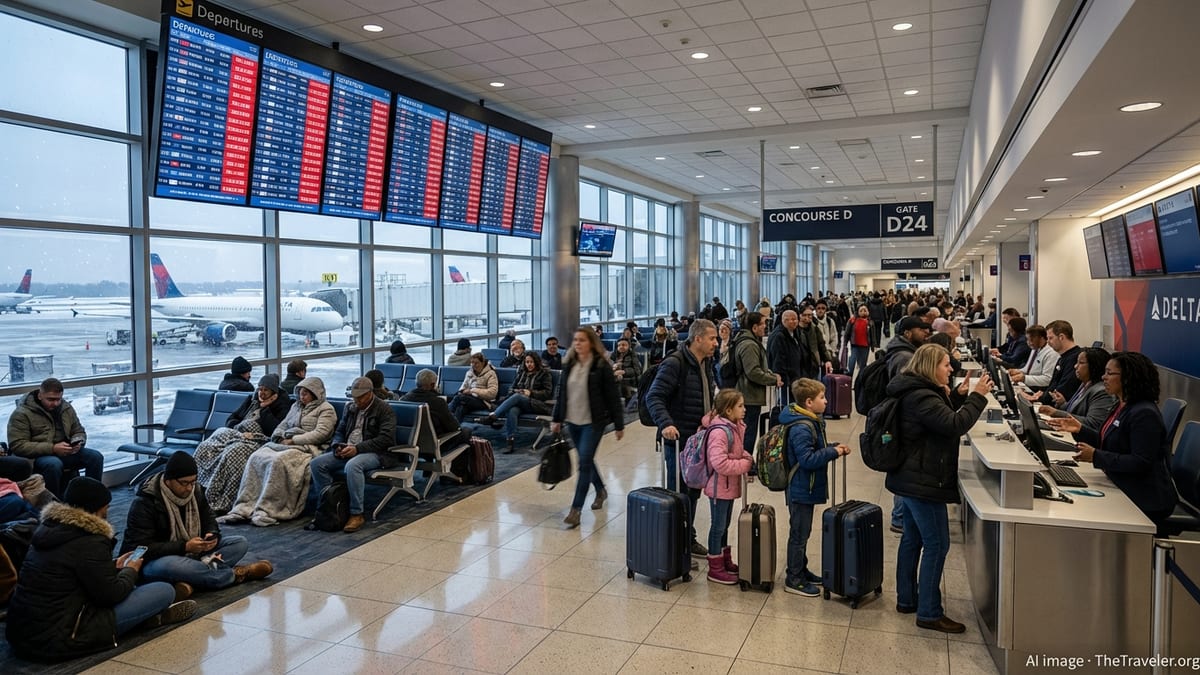
Storm Cells Converge on Key Midwest and East Coast Hubs
Publicly available aviation and weather data show that slow-moving thunderstorms built through the afternoon over the Great Lakes and mid-Atlantic corridors, directly affecting some of the country’s busiest hubs. Chicago O’Hare and Midway, Detroit Metropolitan Wayne County, and Ronald Reagan Washington National all experienced weather-related constraints as storm cells moved across approach and departure paths.
According to published coverage tracking systemwide performance, the storms coincided with at least 4,633 delayed flights and 124 cancellations across the United States, affecting both large network carriers and low-cost airlines. The disruption was concentrated at airports where convective weather triggered ground delay programs, extended arrival spacing and slower departure rates.
Federal aviation traffic outlooks for the day highlighted the risk of thunderstorm-induced delays at Chicago, Detroit and Washington-area airports including Reagan National, noting that convective activity could force reroutes and temporary flow restrictions. These conditions limited the volume of aircraft controllers could safely move, a familiar pattern during peak summer storm season.
Meteorological alerts from the National Weather Service indicated strong cells with heavy rain and lightning in the Chicago region, while a separate band of storms impacted southeastern Michigan and the nation’s capital region. As the systems pulsed through, they repeatedly disrupted arrival banks and departure waves at the three focal airports.
Chicago, Detroit and Reagan National See High Delay Rates
Operational snapshots from flight-tracking and disruption-monitoring platforms point to elevated delay and cancellation rates at the three highlighted hubs. Chicago O’Hare, a key connecting point for both United and American, reported hundreds of delayed flights as ground stops and arrival metering were implemented when thunderstorms moved into the terminal area. Local media reports noted that earlier storm-related ground stops at O’Hare and Midway quickly cascaded into crowded gates and extended taxi times.
Detroit Metropolitan Wayne County Airport, a major hub for Delta Air Lines, saw its own wave of disruptions as storms passed over southeastern Michigan. Industry data aggregators tracking individual airports showed Detroit among the top U.S. facilities for weather-related delays, with a sizable share of departures pushed back as crews waited for safe departure windows and rerouted traffic to clear.
In the Washington area, Reagan National recorded a notable concentration of schedule changes as storms and related traffic management measures slowed operations along the Potomac corridor. Public reporting on airport performance indicated that a significant proportion of flights touching Reagan National experienced delays, and a smaller but visible share were canceled outright as airlines reshuffled schedules to match available slots.
Travel-industry coverage summarizing the day’s performance listed Chicago O’Hare, Detroit Metro and Reagan National among a broader group of U.S. airports facing “heavy disruptions,” alongside other large hubs such as Atlanta, Boston, New York LaGuardia and Philadelphia. These cross-referenced data sets underline how isolated storm systems over a few cities can quickly ripple through the national network.
Nationwide Ripple Effects Hit Connections and Evening Departures
Although the most acute weather was centered on Chicago, Detroit and the Washington region, impact was felt nationwide as the day progressed. Hub-and-spoke scheduling means that a delayed aircraft or crew in one city often arrives late to its next origin, with subsequent flights departing behind schedule even after storms have cleared locally.
Data from real-time disruption dashboards show that once the storm line became established, delays began stacking most heavily in the afternoon and early evening, the period when connecting banks and after-work departures typically peak. Passengers on transcontinental and connecting itineraries faced missed connections and involuntary rebookings, with some routings pushed to the following day when aircraft and crew availability could be reset.
According to airline-performance analyses and consumer-rights organizations, thunderstorm days regularly produce some of the highest volumes of delays during the U.S. summer travel season. Recent case studies of nationwide storm events have documented thousands of affected flights in a single day, illustrating how even routine convective systems can overwhelm already tight schedules at key hubs.
Once delays reach into the late evening, recovery becomes more difficult because of airport curfews, crew duty-time limits and constrained overnight maintenance windows. Analysts note that on days like this, carriers often focus on preserving long-haul and last-bank departures while canceling lower-demand frequencies to rebalance aircraft and crew.
What the Disruption Means for Summer Travelers
For travelers, the latest wave of storm-related delays underscores how vulnerable peak-season itineraries can be when weather converges on major hubs. Aviation experts consistently recommend booking earlier departures where possible, noting that morning flights are less exposed to the cumulative effects of afternoon thunderstorms and rolling delays across the network.
Consumer-advocacy resources also highlight the importance of checking flight status frequently on days with convective forecasts, since traffic management initiatives such as ground delay programs and reroutes can be implemented with little advance notice. Many airlines provide push alerts through their mobile apps when departure or arrival times shift, but airport departure boards and flight-tracker sites can offer additional context about broader patterns.
When thunderstorms drive disruptions, airlines typically classify delays and cancellations as weather-related, which can limit compensation options under most U.S. carrier policies. However, publicly available guidance encourages travelers to review each airline’s customer-service plan to understand rebooking practices, meal vouchers and hotel accommodations when irregular operations stretch into overnight hours.
Analysts also point out that storm-driven delays add pressure to an already busy summer for U.S. aviation, with passenger volumes in many markets approaching or surpassing pre-pandemic levels. On days when weather, high demand and tight staffing intersect, even modest storms over Chicago, Detroit or the Washington area can quickly translate into a challenging travel experience far beyond those cities.
Airlines and Airports Adjust to a Storm-Heavy Season
The latest disruption comes amid a season marked by frequent convective weather events across major U.S. corridors. Industry reports on previous storm days this summer, including large-scale disruptions affecting thousands of flights nationwide, reflect how quickly scattered thunderstorm forecasts can evolve into systemwide challenges as storms intensify over hub airports.
In response, airlines have been refining schedule buffers, swapping aircraft and preemptively trimming some frequencies on high-risk days in an effort to create more recovery space. Publicly available industry testimony and operational updates point to efforts to improve crew scheduling flexibility and coordination with federal air traffic managers when thunderstorms threaten multiple hubs simultaneously.
Airport operators at facilities such as Chicago O’Hare, Detroit Metro and Reagan National have also emphasized the role of passenger communication during weather events, using terminal displays, social media channels and automated announcements to direct travelers toward updated gate information and rebooking resources. While these tools cannot eliminate storm-induced delays, they can shorten lines at service desks and help passengers adjust plans more quickly.
With forecasts indicating that convective weather will remain a factor through the heart of the summer travel period, analysts expect further weather-related disruption days across the national system. For now, the combination of 4,633 delays and 124 cancellations tied to the latest round of thunderstorms stands as another reminder that even localized storms over a handful of key cities can reverberate across U.S. air travel in a matter of hours.
Travel And Tour World: U.S. delays and cancellations overview