


More news on this day
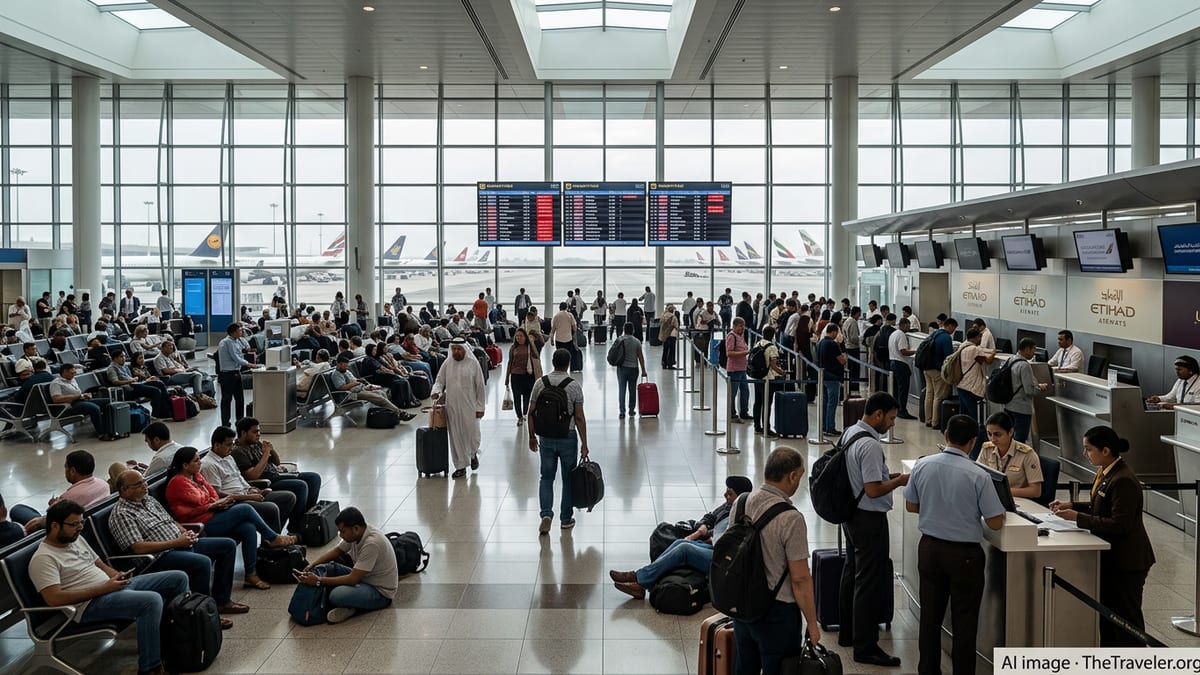
Rolling delays and pockets of disruption are affecting flights at Dubai and Abu Dhabi airports in early September 2026, as airlines and regulators continue to adjust schedules and routings in response to lingering security risks from the US–Iran confrontation and the recent Iran conflict across the Gulf.
Get the latest news straight to your inbox!
From Full Airspace Closures to Targeted Schedule Cuts
Passenger disruption in the United Arab Emirates during 2026 has unfolded in waves rather than as a single event. In late February and early March, missile and drone strikes linked to the Iran conflict prompted a temporary and partial closure of UAE airspace, halting departures and arrivals at major hubs including Dubai International (DXB) and Abu Dhabi International (AUH). Published government and diplomatic notices at the time described the measure as an exceptional precaution intended to protect passengers and crew amid rapidly escalating regional security developments.
The initial shutdowns led to widespread cancellations, diversions and turn-backs for flights crossing the Gulf. Coverage from regional media and foreign ministries indicates that carriers were forced to suspend some passenger operations altogether during the height of the strikes, with advice for travelers to monitor airline channels and avoid going to the airport until services restarted.
By early May, the General Civil Aviation Authority (GCAA) issued a safety alert confirming a full return to normal air navigation operations within UAE airspace, lifting the emergency restrictions introduced during the conflict. Aviation-focused reporting notes that the decision followed a coordinated review of operational and security conditions and marked the formal end of blanket airspace closures, although regulators emphasized that real-time monitoring of the threat environment would continue.
Even after the resumption of normal air traffic control procedures, the earlier disruption left a clear imprint on passenger numbers. Dubai Airports reported a double-digit decline in first-quarter 2026 traffic compared with the previous year, attributing the drop largely to the weeks of regional airspace restrictions and rerouting that affected transfer flows through DXB.
Why Flights Are Still Being Delayed in September 2026
Despite the lifting of nationwide restrictions in May, travelers in early September are still encountering rolling delays and selective cancellations at Dubai and Abu Dhabi. Recent airline updates collated by local business media describe a “mixed picture” of operating, delayed and canceled services on routes that overfly sensitive parts of the Gulf or connect to Iran-adjacent airspace. Large UAE carriers such as Emirates, Etihad Airways, flydubai and Air Arabia are continuing to run key schedules, but with adjustments on certain sectors and short-notice changes to departure times.
Risk assessments by international aviation bodies help explain the persistent volatility. The European Union Aviation Safety Agency recently revised its conflict-zone advisories for the Middle East, noting that although a ceasefire and de-escalation steps have taken effect, the broad region remains exposed to spillover hazards from high-altitude air defense activity, cruise and ballistic missile inventories and the possibility of miscalculation. Separate open-source briefings on the security environment point to ongoing monitoring of missile and drone threats and emphasize the need for operators to be able to react quickly to any deterioration.
Specialist airspace tracking resources also highlight the UAE’s experience earlier in the year, when air traffic movements temporarily fell from thousands of daily flights to just a few dozen at the peak of the conflict. Analysts there now characterize the situation as one of managed risk: the Emirates Flight Information Region remains open, but airlines are expected to maintain contingency plans and route flexibility, while foreign operators are urged to exercise increased caution when planning entries into Emirati FIRs.
For passengers, this translates into a pattern of rolling disruption rather than a total shutdown. Flights are operating, and both DXB and AUH continue to function as global hubs. However, schedules may be re-timed to avoid specific air corridors, aircraft rotations can slip when upstream legs are delayed, and individual departures may be canceled or consolidated when demand or routing constraints make them hard to operate reliably.
How Dubai and Abu Dhabi Airports Are Managing the Backlog
Operational information published by Dubai Airports shows that DXB has entered what it describes as a recovery phase, focusing on rebuilding capacity after the early-2026 crisis. As airspace restrictions eased in late spring, the hub began progressively ramping up daily movements, working with domestic and international airlines to restore their pre-conflict networks. The operator emphasizes that DXB maintained core connectivity even through the most intense period of disruption, then used the gradual reopening of routes to increase frequencies and reintroduce suspended destinations.
Behind the scenes, the UAE’s air navigation services have been adjusting to a new normal. Reporting from industry forums indicates that the GCAA and the Sheikh Zayed Air Navigation Center have refined civil–military coordination processes to keep the airspace open where possible, while still allowing rapid implementation of contingency routes when required. Lessons from the 2025 and 2026 security events, including earlier partial closures triggered by regional conflict, have fed into updated emergency procedures and capacity-planning models.
Abu Dhabi International, home base for Etihad Airways, has been following a similar pattern. While detailed daily statistics for September are not yet consolidated, media and traveler reports point to instances of longer-than-usual connection times, extended ground holds and occasional last-minute gate changes as airlines juggle aircraft and crew across time zones affected by shifting airspace advisories. Airport operators continue to signal that they are prepared to offer rebooking options and ground support in coordination with each airline’s own policies.
The result for transiting passengers is that the overall hub experience remains functional but less predictable. Those with tight onward connections, especially on itineraries crossing multiple regions with elevated security risk, are more likely to encounter missed links or unplanned overnight stays than during stable periods.
Traveler Guidance Amid US–Iran Tensions
Travel advisories from foreign ministries and aviation authorities issued throughout 2026 consistently urge passengers heading to or transiting through the UAE to follow airline communications closely and to check flight status before departing for the airport. Some governments highlight the possibility of sudden schedule changes in the event of new missile or drone incidents, even after the formal lifting of UAE-wide airspace restrictions.
Airlines themselves are mirroring this message. Recent public updates encourage customers to monitor mobile apps, email notifications and airport display boards on the day of departure. Carriers also reiterate that tickets on affected services can often be rebooked without penalty or, in some cases, refunded, depending on fare rules and the scale of disruption. Many operators advise arriving at the airport early, particularly for long-haul flights that transit or overfly parts of the Gulf region where risk assessments remain under regular review.
Independent aviation safety platforms recommend that travelers give themselves additional buffer time when planning connections through Dubai or Abu Dhabi in the coming weeks. Where possible, choosing slightly longer layovers, selecting flights earlier in the day and ensuring that contact details are up to date with the airline can reduce the impact of rolling delays. Passengers concerned about heightened geopolitical risk may also wish to consult their home government’s latest travel advice for the Gulf before finalizing itineraries.
While the current phase of US–Iran tensions has not triggered a new blanket closure of UAE airspace, the experience of early 2026 shows how quickly conditions can change. For now, the picture at Dubai and Abu Dhabi is one of cautious normalization: busy terminals, largely intact global networks, but schedules that remain sensitive to developments far beyond the airport perimeter.
Outlook for UAE Hubs Through the Remainder of 2026
Looking ahead to the final quarter of 2026, most available forecasts see UAE hubs gradually regaining lost traffic as long as the ceasefire environment holds and regional tensions do not escalate into renewed large-scale strikes. The easing of European conflict-zone bulletins covering parts of the Middle East supports this view, reflecting a broad, if fragile, improvement in risk assessments for high-altitude civil aviation in the Gulf.
At the same time, analysts caution that airlines are likely to retain conservative scheduling practices for sectors most exposed to any flare-up in US–Iran friction. This could mean continued use of longer routings to avoid sensitive airspace, a preference for operating widebody aircraft on trunk routes where demand justifies the risk, and a focus on maintaining schedule resilience rather than stretching fleets to pre-crisis utilization levels.
For the traveling public, the implications are nuanced. Fares on some high-demand corridors may remain elevated compared with 2025 as airlines factor in additional fuel costs, operational buffers and insurance considerations. Conversely, the UAE’s determination to keep its airspace open where safely possible suggests that DXB and AUH will continue to compete aggressively for connecting traffic, potentially driving promotional pricing on select markets as confidence returns.
In practical terms, travelers planning itineraries through Dubai or Abu Dhabi over the coming months can reasonably expect their flights to operate, but should remain prepared for schedule changes. The pattern of 2026 so far indicates that while the era of blanket airport closures linked to the Iran conflict has receded, the possibility of rolling delays will remain a feature of Gulf aviation for some time.
UAE temporarily, partially closes airspace as exceptional precautionary measure
GCAA Safety Alert 2026-02 on return to normal operations within UAE airspace
Dubai Airports update on DXB operations as airspace restrictions ease
Gulf News coverage of UAE flight cancellations and delays amid Iran tensions