


Few places capture the story of Istanbul as completely as Topkapı Palace. Once the nerve center of the Ottoman Empire, today it is one of the city’s most visited sites, with soaring ticket prices, big crowds, and an extraordinary concentration of history. This 2026 guide gives you clear, current and practical advice on how to visit Topkapı Palace without feeling overwhelmed or overcharged, so you can focus on the courtyards, tiles, and treasures in front of you.
Get the latest updates straight to your inbox!
Essential Facts: What Topkapı Palace Is (and Isn’t)
Topkapı Palace was the primary residence and administrative headquarters of the Ottoman sultans for roughly four centuries after the conquest of Constantinople. It sits on the Seraglio Point headland above the Bosphorus, within Istanbul’s old city walls, a short walk uphill from the Hagia Sophia and the Blue Mosque. Rather than a single grand building, it is a sprawling complex of pavilions, kitchens, gardens, mosques, and courtyards layered across a fortified hilltop.
Today, Topkapı is a museum complex managed by Turkey’s cultural authorities and dedicated largely to Ottoman court life and religious relics. You will not find a single linear “palace tour” the way you might at Versailles in France or Schönbrunn in Vienna. Instead, you move between distinct areas such as the Harem apartments, the imperial kitchens, the treasury collection, and the Pavilion of the Holy Relics, often doubling back through courtyards as you go.
For a first-time visitor, this can feel confusing without context. The palace is more about atmosphere, patterns, and objects than about one showpiece room. Travelers who arrive expecting only a quick “photo stop” are often surprised that, even with a focused route, a meaningful visit with the Harem included usually takes 3 to 4 hours.
Most of the complex is indoors or semi-covered, which makes Topkapı a reliable choice in both summer heat and winter rain. However, the courtyards are exposed and can be windy; on cold days by the Bosphorus it can feel several degrees cooler than on the surrounding streets of Sultanahmet.
Opening Hours, Closures and Best Times to Visit in 2026
In 2026, Topkapı Palace follows the typical pattern for major Istanbul museums: it is open every day except Tuesday. The main visiting window is from about 09:00 to 18:00, with last ticket sales usually ending an hour before closing. The official ticket office commonly stops issuing new tickets around 17:00, and security begins directing visitors toward the exit shortly before 18:00, so plan to arrive no later than early afternoon if you want an unhurried visit.
The palace can become extremely busy on cruise-ship days and during high season (roughly April to October). On a popular Saturday in May, it is not unusual to see the security line at the main outer gate stretching back toward the Hagia Sophia gardens by mid-morning. If you are traveling in summer 2026, aim to be at the first security checkpoint by 8:45 to be among the first wave inside at 9:00.
Mornings generally see fewer large tour groups in the Harem, which makes the tight corridors and tiled halls more comfortable to explore. Another relatively calm window is late afternoon after about 16:00, when many tour groups have already moved on to Bosphorus cruises. In winter months, shorter days and colder weather keep crowds lower overall, but school holiday weeks in Europe can still be busy.
During major religious holidays (Ramadan Bayram and Kurban Bayram), opening hours may shift slightly, and the first day of a holiday can see partial or full closures. If you are visiting Istanbul around those dates in 2026, check the latest announcements through your hotel, a local tour operator, or directly at the museum’s information desk in Sultanahmet the day before you plan to go.
Tickets, Prices and Passes: What You’ll Really Pay
Ticket prices for Topkapı Palace have risen sharply in recent years, and in 2026 you should expect to pay substantially more than pre-2020 guidebooks suggest. As of mid‑2026, foreign visitors are typically charged around 2,300 to 2,500 Turkish lira for a full Topkapı ticket that includes the main palace complex, the Harem section, and access to Hagia Irene. That is roughly comparable to 45–50 euros, depending on currency fluctuations at the time of your trip.
The important detail for 2026 is that the Harem is generally included in the main foreigner ticket rather than being sold as a small extra at a separate booth. Many older articles and social media posts still describe buying a basic palace ticket plus a smaller Harem ticket at a second entrance. If you are reading anything that quotes a Harem add‑on like 300–350 lira, assume it is out of date and verify at the official ticket gate in Sultanahmet when you arrive.
The popular Museum Pass Istanbul and Museum Pass Türkiye are widely used by culture-focused travelers who plan to visit several state-run museums and archaeological sites. As of 2025 and early 2026, the Istanbul pass for foreign visitors has hovered in the low three‑figure euro range (often quoted around 100 to 110 euros). Whether it is good value depends heavily on your itinerary. For example, if across four days you plan to see Topkapı Palace, the Istanbul Archaeology Museums, Galata Tower’s museum section, and several lesser-known Ottoman sites, a pass can offer meaningful savings versus buying individual tickets.
By contrast, if you only plan to see Topkapı plus one or two other major sites, paying separately is often cheaper. A practical approach some 2026 visitors have used is to price out a realistic list of what they can see in three days, add the current published ticket costs in lira, convert that total to euros, and then compare with the current Museum Pass price at a local tourism office or hotel concierge. Remember that many third‑party “Istanbul tourist cards” are not official museum passes and may bundle in services like airport transfers or private tours that you do not need.
Buying Tickets and Avoiding Long Lines
The simplest way to enter Topkapı Palace in 2026 is to buy your ticket at the official ticket booths just inside the main outer gate. These are located after airport-style security screening but before you step fully into the first courtyard. Payment is typically accepted by major international bank cards and cash in Turkish lira. Because prices for foreigners are now several times higher than for Turkish citizens and residents, signs at the ticket windows clearly distinguish between “foreign” and “local” prices; this is official policy rather than a scam.
Waiting times at the ticket windows fluctuate. On a quiet January weekday, you might be served in under 10 minutes. On a busy July morning, it is not unusual to queue for 30 to 45 minutes just to buy a ticket. For travelers who want to minimize uncertainty, a skip‑the‑line or “guided entry” product sold by reputable local partners can make sense, even when it adds around 25 to 40 euros per person on top of the base ticket. These typically gather at a landmark in Sultanahmet, such as the German Fountain, and walk you through security as a group, with an official guide staying with you for the first 45–60 minutes.
What you should treat with caution are resellers advertising extremely cheap “Topkapı + Harem” or “all Istanbul museums” deals from street stands around Sultanahmet Square. Some of these are legitimate tour companies, but a few simply take you to the official ticket gate, buy your ticket at face value using your payment, and pocket a “service fee” that they did not clearly disclose. A realistic 2026 guided visit including admission to Topkapı and the Harem will almost never be priced below the official ticket cost itself; if it sounds too cheap, ask for an exact breakdown of what is and is not included before agreeing.
To avoid long lines without paying for a tour, aim to reach the palace shortly before opening or in the last 90 minutes before ticket sales close on a non‑holiday weekday. Having your bag organized for quick security screening also helps; separate your camera and metal objects so security staff can see them clearly on the x‑ray belt, preventing delays and secondary checks.
Getting There and Navigating the Layout
Topkapı Palace is located at the eastern tip of Istanbul’s historic peninsula in the Fatih district. The easiest public transport option for most visitors is the T1 tram line. You can ride the tram to Sultanahmet station, then walk about 5 to 7 minutes uphill past the Hagia Sophia and through the gardens toward the palace entrance. Another nearby stop, Gülhane, brings you out at the lower edge of Gülhane Park; from there it is a slightly longer but scenic uphill walk through the park to the same main gate.
In 2026, a single Istanbulkart tram ride typically costs the equivalent of less than one euro, and reusable Istanbulkart travel cards are easy to buy at machines near major stations. Taxis can drop you near the Sultanahmet Square or along the road behind the palace walls, but cannot drive you directly through the pedestrian security perimeter. In heavy traffic around the Grand Bazaar and Sirkeci areas, the tram is often faster than a taxi for reaching Topkapı in the busy middle of the day.
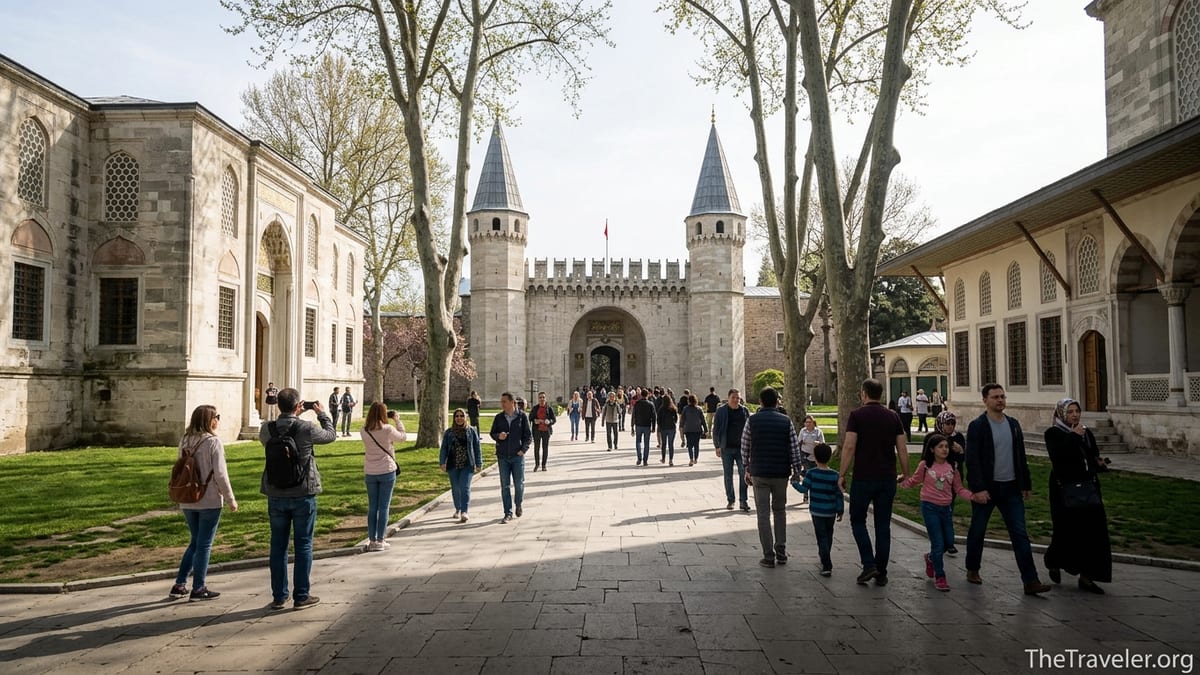
Once inside the outer walls, you pass through a sequence of four main courtyards. The First Courtyard, just after security, feels like a large park with trees and lawns; ticket checks are ahead near the second gate. The Second Courtyard holds the imperial kitchens, stables, and the entrance to the Harem. The Third Courtyard is more intimate and contains the Audience Chamber, the treasury pavilions, and various exhibition halls. Beyond that, the Fourth Courtyard leads you to gardens and kiosks overlooking the Bosphorus and the Golden Horn, with some of the best city views in the complex.
The Harem has a separate entry point off the Second Courtyard and essentially its own one‑way circuit. Corridors can be narrow, and some rooms have low light to help preserve tiles and frescoes. If you are traveling with small children or elderly relatives, discuss in advance whether they are comfortable with stairs, modestly crowded passageways, and the absence of modern handrails in some spots. Elevators are limited; visitors with mobility challenges may wish to consider a guided visit that specifically addresses accessibility, as many general group tours move quickly through stair-heavy sections.
What Not to Miss Inside: Highlights and Suggested Routes
Even with half a day, you will not see every corner of Topkapı Palace in detail, so it helps to prioritize. Many visitors choose to begin at the Harem, both to beat the crowds and to anchor the rest of the visit with a sense of how the private side of palace life functioned. Inside the Harem, rooms such as the Apartment of the Queen Mother and the tiled halls surrounding the Courtyard of the Concubines are particularly striking, with dense Iznik tilework and carved marble fountains.
After the Harem circuit, heading into the Third Courtyard puts you near the Audience Chamber, where sultans once received ambassadors. Depending on current restorations, treasury collections here may include jeweled thrones, ceremonial weapons, and ornate objects of court life. Labels often emphasize symbolism more than narrative history, so travelers who like context may benefit from a guide or a good audio guide application that connects objects to specific sultans and historical episodes.
One of the most affecting areas for many visitors is the Pavilion of the Holy Relics, which typically displays items that believers regard as connected to the Prophet Muhammad and early Islamic history. Regardless of personal beliefs, the atmosphere here is markedly more hushed than in other parts of the palace, and visitors are expected to move slowly and speak quietly. Modest dress is especially appreciated in this part of the complex; shoulders covered and knee‑length clothing are a wise default for any visit to Topkapı in 2026.
For a balanced route, plan roughly 60–90 minutes for the Harem, a similar amount of time for the Third Courtyard and treasury areas, and another 30–45 minutes to enjoy the Fourth Courtyard’s gardens and Bosphorus views. On a clear day, standing near the Mecidiye Pavilion or the outer terrace you can see the Asian side of Istanbul across the water, as well as the mouth of the Golden Horn and, further out, container ships lining up for the Bosphorus passage.
Practical Tips: Dress Code, Photography, Money and Facilities
There is no formal strict dress code at Topkapı Palace in 2026, but you will be most comfortable in modest, breathable clothing that covers shoulders and knees. Istanbul summers are hot and often humid, and the palace courtyards offer limited shade. Lightweight long trousers or a calf‑length skirt plus a loose shirt work better than tight jeans and sleeveless tops. Comfortable, non‑slip walking shoes are essential; many floors are polished stone that can be slick if it rains.
Photography is allowed in most outdoor courtyards and many exhibition halls, but flash is frequently prohibited inside rooms with sensitive artworks or textiles. Tripods and professional lighting gear are not permitted without special permission, and security staff may ask you to put away large camera rigs. A practical 2026 setup for most travelers is a smartphone and, if you are keen on photography, a small mirrorless camera with a wide-to-normal zoom lens, such as a 24–70 mm equivalent, which handles both architecture and interior scenes well.
There are basic café options within the complex where you can buy bottled water, soft drinks, tea, coffee, and light snacks such as simit (sesame bread rings) or borek. Expect all of these to be more expensive than at neighborhood bakeries outside the palace walls; a simple tea that costs 20 to 25 lira in a local café might be closer to 40 to 50 lira inside the grounds. If you are budget-conscious, consider eating breakfast or lunch in the streets around Sultanahmet or in nearby Sirkeci before you enter.
Toilets are available in several locations around the courtyards, but long lines can form at peak times, especially near the Harem. Bringing a small packet of tissues and hand sanitizer is sensible. Official museum shops sell high‑quality books, postcards, and reproductions; prices can feel steep compared with souvenir stalls in the Grand Bazaar, but the quality of printing and design is usually notably higher. If you want a single, reliable reference book about the palace to take home, the main museum shop near the exit is a good place to find it.
Combining Topkapı with Nearby Sights in One Day
Topkapı Palace sits at the heart of the Sultanahmet sightseeing triangle, which makes it easy to combine with other major monuments. A very full but realistic 2026 day could look like this: early entrance to Topkapı at opening time, focusing on the Harem and main courtyards until around 12:30; a late lunch in the back streets behind the Blue Mosque; then an afternoon visit to the Istanbul Archaeology Museums, which are only a short walk away downhill from the palace complex.
If you prefer a slightly lighter day, you might pair Topkapı with just one additional major site. One common pattern is to visit Hagia Sophia very early in the morning as a place of worship, then walk to Topkapı for a late‑morning and early‑afternoon palace visit, leaving the late afternoon free for a Bosphorus ferry ride from nearby Eminönü. Another option is to flip the order, starting at Topkapı, taking a lunch break in Gülhane Park, and finishing with a quieter visit to the Spice Bazaar.
Remember that each of these sites has its own ticket requirements and potential security lines. If you plan to use a Museum Pass, check carefully which attractions are included. It is common in 2026 for passes to cover Topkapı Palace and the Istanbul Archaeology Museums but not certain privately run attractions or separate experiences like underground cisterns managed under different arrangements.
Those traveling with young children may want to keep palace time at 2 to 3 hours and plan playground or park time nearby afterward. Gülhane Park, just below Topkapı, is ideal for this: it has open lawns, seasonal flower beds, and local families strolling in the evenings. Grabbing an ice cream from a vendor at the park entrance after a dense morning of history is a small but memorable detail for many family trips.
The Takeaway
Topkapı Palace in 2026 is both a masterpiece of Ottoman architecture and a mirror of modern Istanbul’s tourism reality: intense demand, dynamic prices, and a swirl of online information that is not always up to date. If you arrive knowing that a full ticket for foreigners is a premium purchase, that the Harem is now typically included, and that Tuesdays are closure days, you are already ahead of many first‑time visitors.
Plan to give the palace half a day, aim for an early or late‑afternoon entry to soften the crowds, and choose in advance whether you want the added context of a guided visit or prefer to wander at your own pace with an audio guide and a good map. Combine the palace with a nearby site that matches your energy level, and leave time simply to sit in one of the upper gardens looking out over the Bosphorus.
Above all, remember that Topkapı is less about a single postcard view and more about layers: the sound of footsteps in tiled corridors, sea wind carrying the call to prayer across the courtyards, tiny details in ceramics and calligraphy that reveal the empire’s priorities. With a little planning and realistic expectations about cost and crowds, a visit here can remain one of the most rewarding experiences of an Istanbul trip in 2026.
FAQ
Q1. Is the Harem included in the Topkapı Palace ticket in 2026?
The most up-to-date practice is that the main foreign visitor ticket generally includes access to the Harem, rather than selling it as a separate small add-on. Always confirm at the official ticket window on the day of your visit, as policies can be adjusted without much advance notice.
Q2. How much time do I need to visit Topkapı Palace properly?
Most travelers find that 3 to 4 hours is ideal if you want to see the Harem, treasury areas, holy relics, and the upper gardens without rushing. If you have only 2 hours, focus on the Harem, one or two key exhibition sections, and the Bosphorus-view terraces.
Q3. What is the approximate ticket price for foreign visitors in 2026?
By mid-2026, foreign visitors typically pay in the range of 2,300 to 2,500 Turkish lira for a comprehensive ticket covering the main palace complex, the Harem, and Hagia Irene. Exchange rates change frequently, but this is often comparable to roughly 45 to 50 euros.
Q4. Is the Museum Pass Istanbul valid at Topkapı Palace?
Official Museum Pass products commonly include Topkapı Palace, but details can change as offers are updated. Before you purchase a pass for 2026, check the current list of included museums with an official tourism office, your hotel concierge, or the printed materials that come with the pass.
Q5. Which day is Topkapı Palace closed?
Topkapı Palace is usually closed on Tuesdays for cleaning, maintenance, and staff work. If your time in Istanbul is short, avoid planning your Sultanahmet sightseeing day for a Tuesday to prevent confusion and disappointment at the gate.
Q6. What is the best time of day to visit to avoid crowds?
The first hour after opening, roughly 09:00 to 10:00, and the last 60 to 90 minutes before ticket sales close are generally the least crowded. Mid‑morning and early afternoon are the busiest, especially on weekends and during peak months from April to October.
Q7. Is there a dress code inside Topkapı Palace?
There is no strict formal dress code, but modest clothing that covers shoulders and knees is recommended, particularly for visiting the Pavilion of the Holy Relics. Light, breathable outfits and comfortable walking shoes will make a big difference in Istanbul’s summer heat.
Q8. Can I take photos inside Topkapı Palace?
Photography is allowed in most courtyards and many rooms, but flash is often prohibited in areas with delicate artworks, and tripods or professional gear require special permission. Always check signs at room entrances and follow staff instructions; when in doubt, turn off your flash.
Q9. Is Topkapı Palace suitable for children and older visitors?
Yes, but some planning helps. There are many stairs, uneven stone surfaces, and narrow corridors in the Harem. Families often find that 2 to 3 hours is the right upper limit for young children, with a break afterward in Gülhane Park, while older visitors may appreciate a slower-paced guided tour that avoids too many backtracks.
Q10. Do I need a guided tour, or can I visit on my own?
You can absolutely visit on your own, and many travelers enjoy exploring independently with an audio guide or a detailed map. However, a good local guide can bring the courtyards and rooms to life with stories that are not on the display labels, which some visitors feel justifies the additional cost, especially on a first trip to Istanbul.