


More news on this day
As rail links between India and Nepal expand, interest is rising in the Bharat Nepal Aastha tour, a themed rail package that combines cross-border train travel with organized pilgrimage stops in both countries. For travelers hoping to ride this spiritual corridor by rail, understanding how the tour operates and how to book a seat has become just as important as choosing the right temple or shrine to visit.
Get the latest news straight to your inbox!
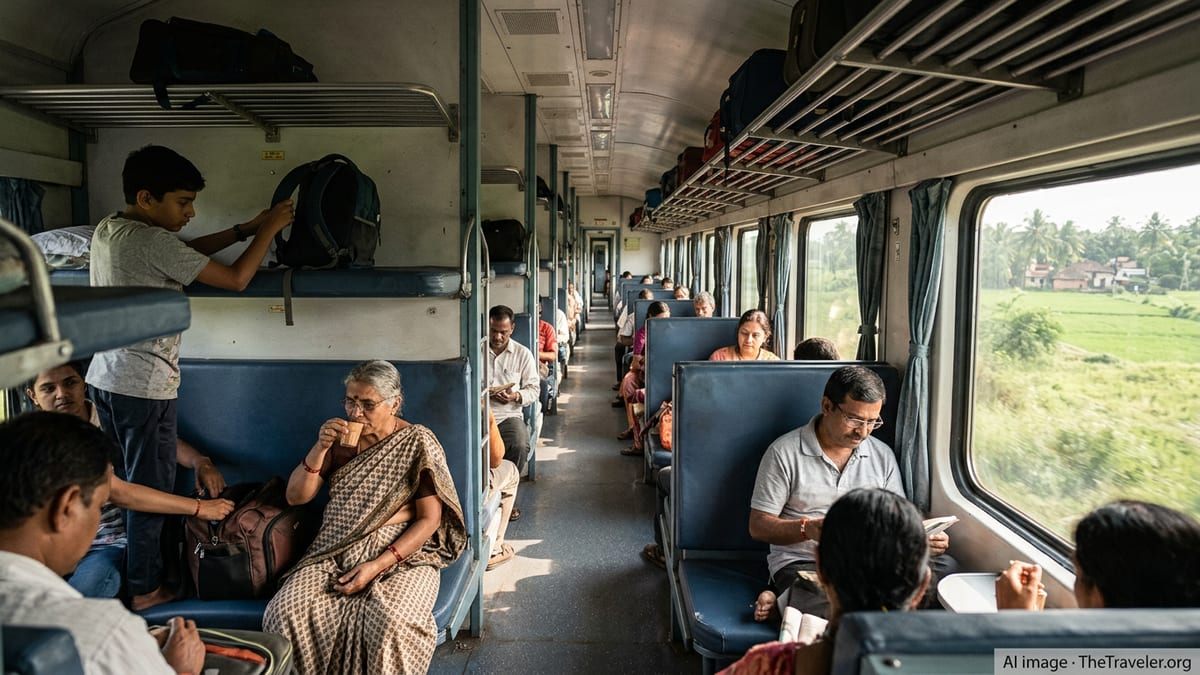
What the Bharat Nepal Aastha Tour Rail Actually Is
The Bharat Nepal Aastha tour is structured as a rail-based pilgrimage package that uses a Bharat Gaurav tourist rake rather than a regular passenger service. The concept, reflected in recent tourism offerings, is to run a special train with pre-booked berths, fixed itineraries and bundled services, typically over nine to ten days. The train acts as a moving base, carrying pilgrims from Indian departure points to major religious sites in India and onward to Kathmandu and other destinations in Nepal.
Package descriptions in the market indicate that the tour is designed to reinforce cultural and religious links between the two countries, with routes commonly featuring Ayodhya, Varanasi and Prayagraj on the Indian side and Pashupatinath and other sites around Kathmandu on the Nepal side. Accommodation, meals, local transfers and guided sightseeing are normally wrapped into a single fare, positioned as a relatively affordable alternative to arranging each leg of the trip independently.
Unlike the daily cross-border Jaynagar to Bijalpura services operated as standard passenger trains, these Aastha-branded tours run on selected dates and are marketed as limited-capacity departures. That means seats are not available through general counters at stations in India or Nepal. Instead, the tours are sold as complete packages, with organized boarding points, scheduled excursion buses and a tour-management team accompanying the train for the duration of the journey.
The result for travelers is a product that feels closer to a cruise than a regular intercity train. Once on board, participants follow a shared itinerary, sleep in the same coach for the length of the tour and disembark together for temple visits and border-crossing formalities.
Current Cross-Border Rail Context Between India and Nepal
The renewed focus on Bharat Nepal Aastha-style rail journeys comes as the physical rail network between the two countries grows. The rehabilitated Jaynagar to Kurtha cross-border line, opened to regular passenger traffic in 2022, marked the first modern broad-gauge passenger link from India into Nepal. Services have since been extended beyond Janakpur to Bijalpura, creating a roughly 52 kilometre route used daily by local travelers.
Additional construction is under way to push the line farther within Nepal, with work in progress on the Bijalpura to Bardibas section. When complete, this will create a continuous broad-gauge corridor from Bihar’s Jaynagar to Bardibas in Nepal, adding capacity for both commuter trains and future tour-focused services. For now, however, most long-distance Indian tourists bound for Kathmandu and Pashupatinath still rely on special tourist trains that cross the border under dedicated arrangements rather than hopping onto everyday local services.
On the Indian side, the Bharat Gaurav tourist train framework has become the main platform for these long-distance themed journeys. Recent itineraries branded around Nepal have used deluxe air-conditioned coaches, pantry and service cars and on-board staff to manage group travel. Operators present the Nepal-linked Aastha tours as extensions of this model, tailored to pilgrims who want structured cross-border travel with minimal planning on their own.
For prospective passengers, this landscape means there are now two distinct ways to experience rail across the India–Nepal frontier: local cross-border trains that can be combined with buses and taxis to reach Kathmandu, and all-inclusive religious tour trains like the Bharat Nepal Aastha packages. The booking process, prices and level of comfort differ sharply between these options.
How Booking Works for the Bharat Nepal Aastha Tour
Booking a seat on a Bharat Nepal Aastha tour does not follow the typical pattern of buying a regular train ticket by searching a train number in a standard reservation system. Instead, the process resembles purchasing a package holiday. Travelers are expected to select a specific departure date listed for the tour, choose a service category such as standard or superior class, and then pay for the entire package in a single transaction.
Published package information shows that operators allocate a fixed number of berths on the dedicated Bharat Gaurav rake, sometimes dividing capacity evenly between standard and higher-priced superior categories. Prices are quoted per person and vary for single occupancy, double or triple sharing, and children in the five-to-eleven age bracket. The cost typically covers train accommodation, vegetarian meals, road transfers at pilgrimage stops, hotel stays where required and sightseeing as per the itinerary.
Seats are sold on a first-come, first-served basis, and there is no “open” ticket that allows passengers to board part of the route at will. Once the tour reaches capacity, bookings generally close for that departure. Because of this, potential passengers are often advised through public information channels to monitor announced dates and secure bookings well in advance, especially for peak pilgrimage seasons and school holiday periods when demand tends to spike.
Importantly, these tours are not designed for short hops between two stations. A traveler cannot typically use a Bharat Nepal Aastha booking simply to travel from Ayodhya to the Nepal border and disembark, as the product is sold as a complete pilgrimage circuit. Anyone looking for point-to-point travel still needs to rely on regular express trains and local cross-border services rather than the Aastha-branded tourist rake.
Step-by-Step: Booking Your Cross-Border Rail Package Today
Travelers planning to buy a Bharat Nepal Aastha tour as of mid-2026 need to start by checking which operator is listing current departures. In many cases, official tourism arms of the railways or authorized travel partners publish fresh schedules several months ahead, outlining departure city, dates, routing, on-board class options and per-person pricing. Recent coverage indicates that departures may be offered from key northern Indian cities, with overnight rail segments linking to onward road travel into Kathmandu.
Once a suitable departure is identified, the next step is to review the detailed itinerary. Prospective passengers should confirm which Indian cities are covered, how many nights are spent on the train versus in hotels, and which sites are visited on the Nepal side. While Pashupatinath and central Kathmandu feature prominently across most tour descriptions, some itineraries also include additional shrines or city sightseeing, which can affect both pricing and total travel time.
With an itinerary selected, travelers proceed to the booking interface used by the package operator. This may be an online tourism portal linked to the railways or the website of an authorized agency that has secured a block of berths on the Bharat Gaurav rake. During booking, passengers enter personal details, choose their preferred class and occupancy, and agree to the tour’s cancellation and refund terms before making payment using standard digital methods such as cards, UPI-based services or net banking options popular in India.
After payment, passengers receive a package confirmation that lists their coach and berth category rather than a typical point-to-point ticket. It is advisable to save both a digital and printed copy, as these documents generally need to be shown at the designated boarding station along with valid identification. Travelers joining the tour from Nepal should pay particular attention to the specified boarding points in India and plan their overland travel to reach the start city on time.
Practical Checks Before You Board the Bharat Nepal Aastha Train
Because the Bharat Nepal Aastha tour involves an international border crossing, passengers must verify their travel documents well before departure. Indian citizens traveling into Nepal typically benefit from simplified entry rules compared with other nationalities, while Nepalese citizens joining in India enjoy reciprocal arrangements. Even so, current identification and any documentation required by immigration authorities at the time of travel remain essential.
Health and mobility considerations are also important. The itinerary often includes early-morning temple visits, long days of sightseeing and multiple nights on a moving train. Travelers with limited mobility or specific medical needs may want to review whether sleeper berths, on-board facilities and hotel arrangements are suitable for them. Many package descriptions note that personal medical requirements, wheelchairs and other support equipment are the responsibility of the passenger and should be organized in advance.
Luggage limits and packing recommendations usually mirror those of other long-distance rail tours. Soft bags that can be stowed under berths are preferred over hard suitcases, as space in cabins and corridors may be tight when a full complement of pilgrims is on board. Passengers are typically encouraged to carry essentials such as medications, a light shawl or blanket, reusable water bottles and modest clothing suitable for temple visits in both India and Nepal.
Finally, staying informed about any last-minute schedule changes can make the difference between a smooth start and a missed departure. Tour operators routinely update timetables, boarding times and coach allocations as the departure date approaches. Keeping contact details up to date during booking and checking for updates in the days before travel helps ensure that passengers are on the right platform, at the right station, when the Bharat Nepal Aastha tour train pulls in to begin its cross-border journey.