


For many travelers, Topkapı Palace is one of the most visually stunning yet mentally overwhelming stops in Istanbul. Courtyards, pavilions, the famed Harem, and dimly lit treasury rooms can blur into a beautiful but confusing maze. That is why more visitors now rely on audio guides and smartphone apps to turn scattered impressions into a coherent story. Used well, these tools do far more than recite dates. They help you choose the right ticket, design a route that fits your energy, and understand what you are actually looking at in each room.
Get the latest updates straight to your inbox!
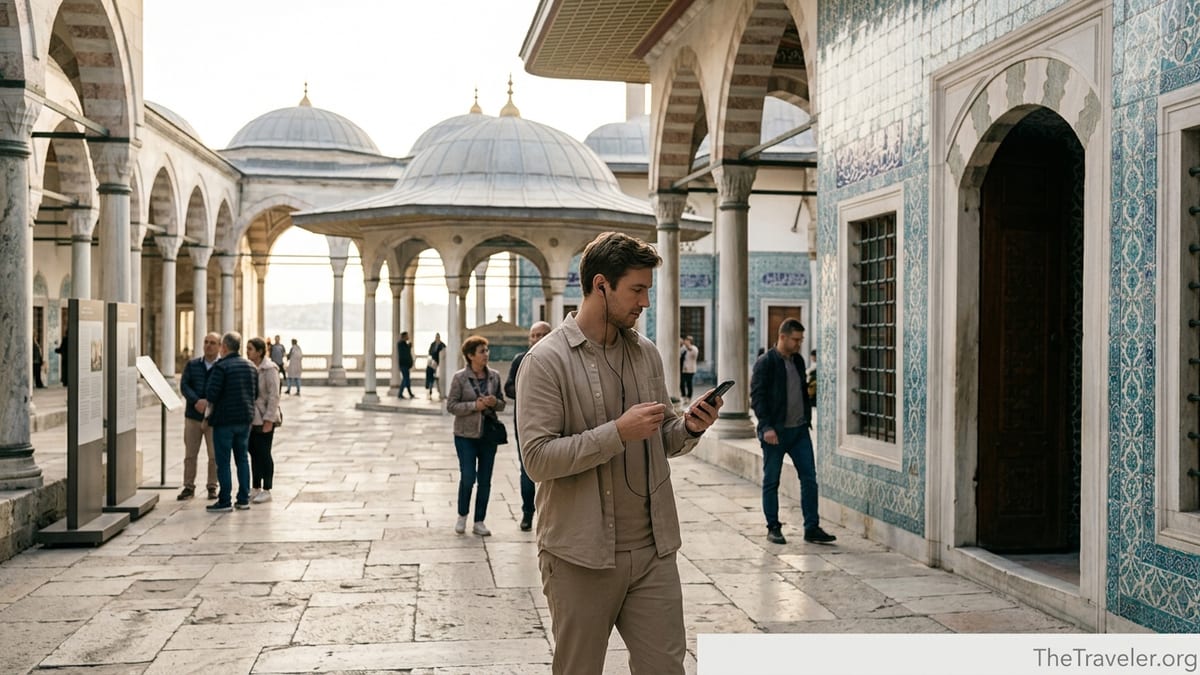
Why Audio Guides Matter So Much at Topkapı Palace
Topkapı Palace is not a single building but a sprawling complex of courtyards, kitchens, pavilions, archives, a mosque, the Harem, and the treasury. Signage inside is improving but still limited and often crowded by tour groups taking photos in front of the most important panels. Travelers who walk in without context frequently describe the experience as visually impressive but intellectually thin, especially in the more austere rooms where treasures are displayed in low light.
That is where audio guides change the experience. Recent ticket options typically bundle palace entry with a multilingual audio guide app that functions on your own smartphone. Instead of simply seeing a jeweled sword in a glass case, you hear a two or three minute explanation of who carried it, which sultan commissioned it, and how it fit into the rituals of the Ottoman court. Visitors often say this is the difference between “a lot of old objects” and a palace that feels like a lived-in world.
The benefit is especially obvious in the Harem and the Fourth Courtyard. Without commentary, many travelers wander quickly through, not realizing that they are passing the private apartments of the sultan’s mother, the princes’ school rooms, and the tiny passageways where eunuchs guarded the royal family. With audio guidance, you begin to understand how tightly choreographed life here once was, and why each doorway and tiled niche mattered.
Choosing Between Official Audio Guides, Apps, and Guided Tours
Today most visitors encounter three main options: the audio guide bundled with a ticket purchased online, the official-style smartphone audio guide promoted by specialist Topkapı information sites, and classic small-group guided tours. Each suits a different traveler type and budget. As of mid 2026, combined entry plus smartphone audio guide tickets from reputable resellers typically run in the range of about 35 to 55 US dollars per adult, often including the Harem and a brief 15 to 20 minute orientation with a host before you explore on your own.
Independent travelers who dislike being herded in large groups often prefer the hosted skip-the-line ticket plus audio guide. A local staff member meets you near the Imperial Gate, escorts you past the ticket counter queue, helps you clear security, and ensures the audio app is installed before leaving you to roam freely. Families with teenagers, in particular, appreciate the flexibility: parents can linger in the Sacred Relics collection while teens move ahead to the courtyards, all staying loosely in sync because they have the same audio content on their phones.
On the other hand, travelers who know they learn best through conversation still gravitate to human-guided tours. A typical small-group Topkapı and Harem tour, lasting 2.5 to 3 hours, might cost around 50 to 80 US dollars per person and often includes the same basic palace ticket. Many visitors combine both: they join a short guided tour for the overview, then stay inside afterward and use an audio guide to revisit favorite sections in more depth at their own pace.
How the Smartphone Audio Guide Actually Works
Most current Topkapı Palace audio solutions run as smartphone apps designed to work offline once installed. Travelers usually receive a download link or app name in their booking confirmation, then connect to hotel Wi-Fi in Istanbul the night before to download the full content. This step matters, because once you pass the Imperial Gate, mobile data reception becomes patchy in thick-walled areas such as the Harem and the Sacred Relics rooms, and the palace does not offer public Wi-Fi.
Once inside, the app typically opens to an interactive map of the palace divided by zones: First Courtyard, Second Courtyard with kitchens and council hall, Third Courtyard with the Audience Chamber and Enderun School, the Harem, the Treasury, and the outer pavilions of the Fourth Courtyard. Many apps are GPS- or location-triggered, so when you walk into the Imperial Council chamber or the Baghdad Kiosk, the relevant track is suggested automatically. You can also tap manually on a room name if the signal is weak.
Travelers report that this setup is especially useful in crowds. If you enter a gallery where groups are already gathered under a small wall label, you can stand off to the side and listen to the same information plus more context, instead of trying to squeeze close enough to read a panel. Some apps add short “bonus” tracks that point out details you might easily miss, such as the small grilled windows where the sultan listened secretly to council meetings, or calligraphy bands high on the walls of the library.
Language coverage is another reason these guides are popular. Many current Topkapı-specific apps and bundled tickets offer commentary in at least English, German, Spanish, French, and Italian, with some also covering Russian, Arabic, Korean, Japanese, or Romanian. For travelers who are not comfortable following a fast-talking English guide in a crowded group, the ability to pause, rewind, or re-listen in their own language is valuable.
Designing a Smarter Route With the Audio Guide
A common mistake is to treat the palace as something you must cover “completely” in one push. In reality, even seasoned travelers find that a focused 2 to 3 hour visit built around an audio guide is more rewarding than a six-hour marathon. The flexible structure of most apps makes this easy. You can choose a shorter “highlights” route or a more detailed track covering lesser-known corners.
One practical example: a couple arriving at 10:30 in the morning with a hosted ticket and audio app might follow a suggested 120-minute route. They start with the Second Courtyard, listening to a brief introduction to Ottoman court rituals outside the council chambers. From there the audio guide leads them through the palace kitchens, where commentary points out the enormous chimneys, porcelain collections, and the logistics of feeding thousands of people each day. By the time they reach the Third Courtyard, they already understand why this inner zone felt so restricted and ceremonial.
Families often customize the route even more. Parents with small children might skip some of the longer narrative tracks in the treasury and focus instead on short, visually striking stops: the enormous emerald-studded thrones, the famous Spoonmaker’s Diamond, or tiles decorated with tulips and carnations in the Harem. The audio guide becomes a tool for triage: you can see from the map which areas are coming up, decide whether your group still has energy for another set of rooms, then either cut across a courtyard or continue deeper if attention levels are still good.
In hot weather, travelers also use the app to build in breaks. Many tracks suggest viewpoints such as the terrace overlooking the Bosphorus or quieter pavilions where you can sit in the shade while still listening. Instead of zoning out on a bench, you might listen to a three minute segment explaining diplomatic receptions in the Revan or Baghdad kiosks, effectively resting and learning at the same time.
Common Traveler Mistakes and How Audio Guides Help Avoid Them
Regular visitors and local guides frequently point to a few patterns that sabotage Topkapı visits. The first is underestimating the time needed. Many tourists attempt to pair a full Topkapı visit with Hagia Sophia and the Basilica Cistern in one day, only to rush through the palace in under an hour. Having an audio guide with an estimated duration for each section helps set realistic expectations before you even pass security.
Another recurring issue is confusion about ticket coverage, particularly around the Harem. In recent years, the main combined Topkapı ticket has typically included both the palace and the Harem, but older guidebooks and blogs still talk about separate Harem tickets. Travelers checking details in their audio app or ticketing companion site before arrival are less likely to buy redundant or incomplete packages from aggressive touts outside the gates. Many audio-based products also clarify that skip-the-line usually means bypassing the ticket office queue, not the mandatory security line, which prevents disappointment at the entrance.
A third mistake is technical. Some travelers arrive with phones on low battery, no wired or Bluetooth earphones, and no pre-downloaded content. They either disturb others by playing audio on speaker or give up using the guide after the first courtyard. Seasoned visitors now treat Topkapı like any other major museum: they charge phones fully the night before, pack a small power bank, and bring simple in-ear headphones. They also download the entire audio package on hotel Wi-Fi so that no mobile data is needed once inside.
Finally, a number of people report that they only turn the audio guide on inside galleries, missing useful context outside. The best apps now include short tracks for the queue itself, the Imperial Gate, and each courtyard, explaining how processions worked and who was allowed to stand where. Listening to these as you move between buildings can quietly transform the long walking stretches from dead time into some of the most atmospheric parts of the visit.
Real-World Traveler Experiences Inside the Palace
Travel stories from recent years show how different visitors use audio guides in practice. One solo traveler from Germany described buying a mid-morning skip-the-line ticket that came with a multilingual app. After a quick orientation talk, her host helped her choose the “Treasures and Power” route inside the app, which focused on the Imperial Council chamber, treasury, and Sacred Relics. She spent nearly twenty minutes listening to the Harem introduction alone, pausing often to look closely at tiles and wooden shutters, something she said she would never have done without the structured commentary.
A family of four from Canada shared a different pattern. Knowing their children, aged 9 and 12, would not tolerate long speeches, they used the app’s ability to jump between shorter tracks. In the kitchens, instead of listening to every detail about porcelain styles, they played only the one explaining how many loaves of bread were baked daily and how the sultan’s meals were carried to the Harem. The kids enjoyed these concrete, almost cinematic details, and the parents later went back on their own headphones to listen to the longer art history segments while the children sat with an ice cream in the courtyard.
Couples celebrating anniversaries or honeymoons often mention the romance of exploring the Fourth Courtyard in the late afternoon with an audio guide. The commentary explains how sultans used the pavilions as summer retreats, where they watched the sunset over the Bosphorus or received favored guests. One pair of visitors used their app’s bookmark feature to save several tracks, then replayed them that evening over dinner in Sultanahmet, using the audio to relive their highlights of the day.
Practical Tips to Get the Most from Your Audio Guide
To really benefit from an audio companion at Topkapı Palace, planning starts before you pass through the security checkpoint. Install the required app a day or two in advance, update your phone’s operating system if needed, and test that the sample track plays with your chosen headphones. This small rehearsal avoids the all-too-common scene of travelers fumbling with downloads in the bright morning sun outside the palace as groups stream past.
Once inside, give yourself permission not to listen to everything. The best audio guides are modular: if you are more interested in political history than porcelain, skip the longest ceramics tracks and invest that time in the council chamber, the Audience Hall, or the stories of power struggles in the Harem. Likewise, if art and design are your passion, prioritize segments that discuss tilework motifs, Koranic calligraphy, and the layering of Ottoman, Persian, and European influences in the interiors.
Be considerate of others. Topkapı’s rooms can be tight, especially in the Harem, and many galleries are intentionally quiet. Wearing headphones or a single earbud keeps sound from echoing through the chambers. When a track encourages you to turn around or look up, step to the side rather than stopping abruptly in a doorway. Several visitors have noted that simply following the suggested “pause points” in the app helps stop people bunching in front of a single display case.
Finally, combine old and new. Printed maps or orientation panels at the entrance are still useful for a bird’s-eye view of the complex. Many travelers find it helpful to glance at a physical map before each new courtyard, then use the audio guide for the deep dive. That way the palace remains a coherent whole in your mind, not just a string of narrated rooms.
The Takeaway
Topkapı Palace rewards patience, context, and curiosity. Without those, it can become an exhausting shuffle through courtyards and darkened rooms, more obligation than highlight. Audio guides, especially the latest smartphone-based systems bundled with tickets, give independent travelers the tools that only private guides once provided: a clear route, structured explanations, and stories that connect one pavilion to the next.
Used thoughtfully, they help you avoid common mistakes, stretch your energy, and focus on what matters most to you, whether that is political intrigue in the council chambers, domestic life in the Harem, or craftsmanship in the treasury. They are not a perfect substitute for an inspired human guide, but for many visitors they turn a confusing historic complex into one of the most memorable experiences in Istanbul.
FAQ
Q1. Do I really need an audio guide to enjoy Topkapı Palace?
Many travelers complete a visit without one, but most who use an audio guide say it dramatically improves their understanding, especially in the Harem and treasury where labels are sparse or crowded and the stories behind objects are not obvious.
Q2. Is the audio guide included in my Topkapı Palace ticket?
It depends on how you buy your ticket. Some online skip-the-line options bundle a smartphone audio guide with entry, while basic gate tickets may not. Check your confirmation to see if a downloadable app or separate code is mentioned.
Q3. Can I use my own phone for the audio guide?
Yes. Most current audio solutions at Topkapı Palace are app-based and designed to run on visitors’ own smartphones. Bring charged devices and headphones, and download the content in advance using Wi-Fi at your hotel or accommodation.
Q4. How long should I plan for Topkapı Palace with an audio guide?
Allow at least two to three hours if you plan to listen to commentary in the main courtyards, treasury, Harem, and a few pavilions. Travelers who like to absorb every detail or take many photographs often stay closer to four hours.
Q5. Are the audio guides available in multiple languages?
Yes. Many Topkapı-focused audio apps and bundled tickets currently offer several major languages such as English, German, Spanish, French, and Italian, with some also providing options like Russian, Arabic, Korean, Japanese, or Romanian.
Q6. Do the audio guides work offline inside the palace?
Most modern apps are designed to function offline once fully downloaded. This is important because mobile data reception is often weak or unreliable in the thick-walled interiors of the Harem, treasury, and Sacred Relics rooms.
Q7. What if I prefer a human guide instead of an audio app?
You can book a small-group or private tour that includes a live guide, usually for a higher price than audio-only options. Some travelers choose a short guided tour for orientation and then continue exploring on their own using an audio guide afterward.
Q8. Will an audio guide help me avoid crowds?
An audio guide cannot remove crowds, but it can help you manage them. You can listen from quieter corners instead of clustering around labels, and some apps suggest alternative starting points or routes to skirt the busiest galleries.
Q9. Is it suitable to use an audio guide if I am traveling with children?
Yes, especially if you cherry-pick shorter, more vivid tracks. Many families skip overly technical segments and focus on stories about palace life, feasts, royal ceremonies, and a few standout treasures that capture children’s imaginations.
Q10. What should I bring to make sure my audio guide works smoothly?
Bring a fully charged smartphone, simple wired or Bluetooth earphones, and a small power bank if you have one. Download the audio content in advance and test a sample track before leaving your hotel so you do not lose time at the entrance.