


Flying into Toronto today increasingly means making a choice before you even buy your ticket: the huge global hub at Toronto Pearson International Airport (YYZ) or the compact, downtown-adjacent Billy Bishop Toronto City Airport (YTZ). Both can work well for trips focused on the city, but they offer very different experiences in terms of access, fares, airlines and routes, especially if your priority is getting to and from the downtown core efficiently.
Get the latest updates straight to your inbox!
Big Hub vs Downtown Boutique: What Each Airport Does Best
Toronto Pearson is Canada’s busiest airport, handling tens of millions of passengers a year and connecting Toronto with more than 160 destinations worldwide on over 50 airlines. It is the natural choice if you are arriving on a long-haul international flight from Europe, Asia, South America, or if you need a wide range of domestic and transborder options on carriers such as Air Canada, WestJet, United, Delta and American. The trade-off is that Pearson sits roughly 25 kilometres northwest of downtown, in Mississauga, so every itinerary includes a ground‑transport leg into the city.
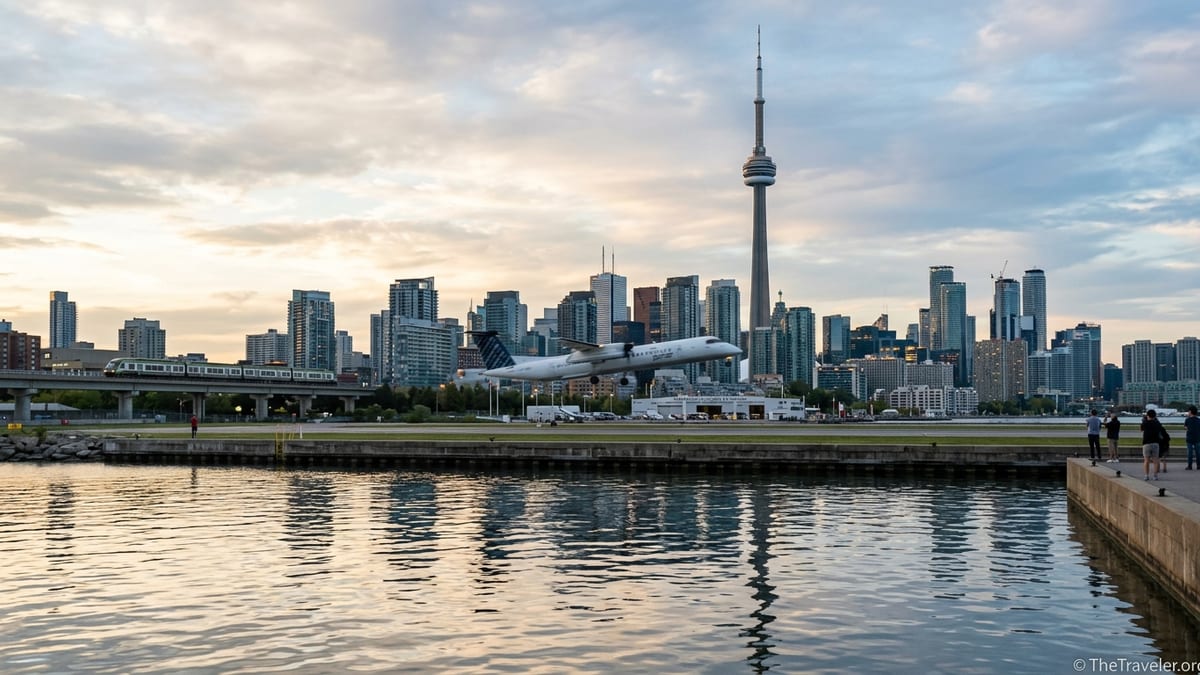
Billy Bishop, by contrast, is a compact airport on the Toronto Islands, just off the downtown waterfront. It is heavily focused on short-haul traffic, particularly the Montreal–Ottawa corridor and a growing set of U.S. cities served by airlines like Porter Airlines and Air Canada. Recent schedule data shows routes from YTZ to major U.S. business destinations such as New York, Boston, Chicago and Washington rolling out through spring 2026, alongside dense frequencies to Montreal and Ottawa. This makes YTZ especially attractive for business travelers shuttling between downtown financial districts.
Functionally, you can think of Pearson as Toronto’s global gateway and Billy Bishop as a premium in-city airport. A traveler flying from London Heathrow, Frankfurt or Tokyo almost certainly lands at Pearson; someone commuting for a day trip from Toronto’s financial district to Ottawa’s government quarter may well choose Billy Bishop to avoid a 45‑minute trek to the suburbs each way.
For many visitors, the decision hinges less on runway length and route maps and more on a practical question: “How fast and how conveniently can I get from the plane to my hotel near Union Station or the Entertainment District?” On that metric, Billy Bishop punches far above its size.
Getting Downtown: Time, Cost and Real-World Scenarios
The single biggest advantage Billy Bishop has over Pearson is proximity to downtown Toronto. After landing at YTZ, passengers walk through a short pedestrian tunnel or take a quick ferry to the mainland. From there, a free shuttle bus typically runs between the airport and a stop outside the Fairmont Royal York Hotel, directly opposite Union Station. In normal traffic, the shuttle ride is around 10 to 15 minutes, and many travelers report reaching a downtown office or hotel within 25 minutes of wheels‑down, including baggage pickup.
By contrast, Pearson relies on a mix of rail, public transit and road traffic. The dedicated Union Pearson Express train links Pearson’s Terminal 1 with Union Station in about 25 to 28 minutes. As of mid‑2026, an adult one‑way standard fare between Pearson and Union is advertised at around 12 to 13 Canadian dollars, with a discounted rate of roughly 9 to 10 dollars for riders using a PRESTO transit card, and children under 12 ride free. Trains typically depart every 15 minutes throughout most of the day. When everything runs smoothly, a solo traveler can be at Union Station in roughly 45 minutes from clearing customs.
Taxis and ride‑hail services such as Uber and Lyft are the main alternatives. Recent fare guidance from local outlets indicates a typical licensed taxi from Pearson to a hotel near Union Station runs in the region of 65 to 80 Canadian dollars, depending on traffic and company, with some private limousine operators quoting flat rates of around 90 to 100 dollars to or from downtown. In light traffic late at night, the drive can be as quick as 20 to 25 minutes. In peak rush hour or during bad weather, travelers regularly report 45 minutes or more and substantial variability in arrival times.
A practical example illustrates the difference. A solo business traveler landing at Pearson at 5:30 p.m. on a weekday, clearing customs around 6:15 p.m., can be on the 6:30 p.m. UP Express and at Union by around 7 p.m., spending under 15 dollars. A colleague landing at Billy Bishop at the same time could walk through the tunnel, pick up a carry-on bag and be on the downtown shuttle within 15 to 20 minutes, often reaching a Bay Street office before 6:45 p.m. That 15 to 30 minute edge repeatedly adds up for frequent travelers whose meetings start early or run late downtown.
Airlines, Routes and Especially U.S. Travel
For sheer route diversity, Pearson is unmatched. It offers nonstop flights to most major U.S. hubs, including New York’s JFK and LaGuardia, Chicago O’Hare, Boston, Washington, Los Angeles, San Francisco and many others, plus a wide network into the Midwest and Sun Belt. Pearson also serves long‑haul destinations, from London and Paris to Dubai and Hong Kong, on a variety of full‑service and leisure carriers. If your trip involves a complex international itinerary or loyalty considerations tied to global alliances such as Star Alliance or Oneworld, Pearson will almost always give you more options.
Billy Bishop’s network is more compact but highly targeted. Historically dominated by Porter Airlines’ turboprop operations to Ottawa, Montreal, Halifax and other regional cities, YTZ is now seeing new competition and growth. Air Canada’s expansion plan at Billy Bishop includes new nonstop U.S. routes to New York, Boston, Chicago and Washington beginning in 2026, layered on top of increased frequencies to Montreal and Ottawa. Flight‑schedule data for 2026 also indicates YTZ serving roughly two dozen cities in Canada and the United States on a mix of carriers, although frequencies and seasonal adjustments vary.
The key differentiator for U.S.‑bound travelers is preclearance. Since March 2026, Billy Bishop has offered full U.S. Customs and Border Protection preclearance, meaning passengers clear U.S. immigration and customs in Toronto before boarding. On arrival in the United States, these flights are treated as domestic arrivals, allowing travelers to connect more easily and sometimes avoid long immigration queues. Pearson also offers U.S. preclearance in its transborder facilities, so the feature itself is not unique, but having it in a small, downtown‑oriented airport makes Billy Bishop particularly convenient for quick cross‑border business trips.
For example, a Toronto executive heading to a morning meeting near New York’s Midtown can now take a precleared flight from Billy Bishop to LaGuardia, land as a domestic passenger, and be in Manhattan in short order. Meanwhile, someone flying to San Francisco or Dallas will almost certainly depart from Pearson, since long‑haul U.S. and west‑coast frequencies remain concentrated there. In practice, many business travelers now check both airports when searching for flights to Chicago, Boston or New York, choosing between maximum schedule flexibility at Pearson and minimal ground‑transport time at Billy Bishop.
Fares, Fees and Total Trip Cost
Airfares themselves fluctuate daily based on demand, competition and booking windows, so it is not accurate to say that one Toronto airport is always cheaper than the other. However, there are patterns that matter when you calculate the total cost of your trip, including what you will pay to reach downtown. Pearson, with a larger set of competitors and numerous daily flights on key routes, often produces more price variation and last‑minute deals, especially when low‑cost carriers or multiple alliance partners compete on the same city pair.
Billy Bishop, with its smaller number of carriers and more business‑oriented schedule, sometimes shows slightly higher base fares on peak weekday flights between Toronto and cities such as Ottawa or Montreal. Yet when you factor in that ground transport to and from downtown can be almost free, the overall cost difference narrows. A traveler arriving at YTZ and taking the complimentary shuttle to a hotel near Union Station could spend nothing on transport. A solo visitor landing at Pearson who opts for the UP Express spends roughly 25 dollars round trip, while a couple or family using taxis or ride‑hails could see ground‑transport bills of 120 to 200 dollars over a long weekend.
To put this into concrete terms, imagine two travelers flying round‑trip for a three‑day conference near the Metro Toronto Convention Centre. Traveler A finds a Pearson fare that is 60 dollars cheaper than a comparable Billy Bishop flight. However, they then pay about 70 dollars for a taxi into downtown and another 70 for the return trip, wiping out the initial savings and spending more overall than Traveler B, who pays a slightly higher ticket price into Billy Bishop but uses the free shuttle and walks to their hotel. Groups and families feel this effect even more strongly because taxi and ride‑hail costs do not scale linearly per person the way train tickets do.
Airport fees and improvement charges are built into most tickets and vary by carrier and class of service. Pearson, as a major hub with significant capital projects, generally has higher aeronautical fees baked into its fares than Billy Bishop, though passengers experience these costs indirectly. For most travelers comparing YYZ and YTZ on a single route like Toronto–Ottawa, the practical financial question is not line‑item airport fees but the combined effect of airfare plus what it will cost to connect between the plane and downtown Toronto at the times you actually travel.
On-the-Ground Experience, Transfers and Accessibility
Pearson’s size is both a strength and a weakness. The airport offers a wide array of dining, shopping and lounge options across its terminals, which can be a relief on long layovers or during irregular operations. However, its scale means longer walking distances, more complex security and transfer procedures, and a higher risk of congestion at peak times. Many travelers report that connecting between domestic and international flights at Pearson can involve multiple security checkpoints and long corridors, which is worth considering if you are traveling with limited mobility, young children or heavy luggage.
Billy Bishop’s compact footprint leads to a very different feel. Check‑in, security and gates are located within a short walk of each other, and the number of flights at any given time is relatively modest compared with Pearson. Business travelers often highlight the ability to arrive at the airport closer to departure time, particularly for carry‑on‑only trips to Ottawa or Montreal. The recently opened U.S. preclearance facility at YTZ is designed with modern passenger flows in mind, though during peak banks of U.S. departures it can still experience lines, just on a smaller overall scale.
In terms of accessibility to and from the airports, both have made progress, though in different ways. Pearson connects to the broader Toronto transit network via the UP Express, GO Transit regional trains and multiple Toronto Transit Commission bus routes that operate 24 hours a day, including the 900 Airport Express from Kipling subway station and routes along Lawrence Avenue. These options are valuable for budget‑conscious travelers and those staying outside the downtown core. Billy Bishop’s short tunnel, elevators and free shuttle provide step‑free routes between the terminal, the waterfront and Union Station, although periodic disruptions to ferry or shuttle service, such as mechanical issues or major waterfront events, can temporarily complicate access.
Another practical consideration is how each airport fits into a wider travel day. Someone arriving in Pearson on a long‑haul overnight flight might appreciate the ability to stay airside for a few hours in a lounge before a connecting domestic leg. A Billy Bishop arrival, by contrast, is rarely part of a multi‑stop international itinerary; it is more commonly the final leg into downtown, followed by a hotel check‑in or a short walk to an office tower. Matching the airport to the rhythm of your day often matters more than any single amenity.
When Pearson Makes More Sense
There are several scenarios where Pearson clearly works better despite its distance from downtown. The first is long‑haul international travel. If you are flying from Toronto to London, Paris, Frankfurt, Dubai, Hong Kong or most sun destinations, you will almost certainly be using Pearson. The same applies to many transcontinental Canadian routes such as Vancouver, Calgary and Edmonton, particularly on wide‑body aircraft or with multiple daily frequencies.
Pearson is also the better choice if you are connecting onward on a tight schedule to a far‑flung destination. Global alliances cluster their hubs and partner flights at YYZ, making it easier to check bags through and maintain elite benefits. A traveler flying from Halifax to Toronto and on to Sao Paulo, for example, is more likely to find a single‑ticket itinerary through Pearson than through Billy Bishop. If your trip involves complex connections, mileage redemptions or specific cabin products such as premium economy or long‑haul business class, Pearson is where most of the inventory sits.
Family and group travel can also tilt in Pearson’s favour when staying outside the downtown core. If you are visiting relatives in Mississauga, Brampton or the western suburbs, landing at Pearson might mean a 15‑minute drive rather than a 45‑minute trek from the waterfront. Similarly, if you plan to rent a car immediately on arrival and drive to cottage country or Niagara, Pearson’s large on‑airport car rental centre and highway connections are far more convenient than trying to navigate a rental pickup from downtown after landing at YTZ.
Finally, Pearson’s scale gives it a degree of operational resilience. While it certainly sees its share of delays, it can sometimes recover from weather disruptions faster simply because more gates, backup aircraft and alternate routings are available. When storms hit the northeastern United States or central Canada, airlines often consolidate or reroute flights through major hubs like Pearson rather than smaller downtown airports.
When Billy Bishop Is the Smarter Choice
If your trip is laser‑focused on downtown Toronto and the short‑haul corridor, Billy Bishop often provides a smoother overall experience. This is especially true for business travelers heading to offices near Bay Street, King Street West or the financial district. Landing at YTZ, taking the tunnel and shuttle, and walking to a meeting can, in good conditions, put you at a boardroom table within 45 minutes of touchdown. That is difficult to match from Pearson without perfect timing and light traffic.
Billy Bishop also shines for quick trips where every hour matters. A government staffer popping down from Ottawa for a same‑day hearing, a lawyer flying in from Montreal for a cross‑border closing, or a tech founder visiting investors in the Entertainment District can all benefit from the airport’s lower “buffer time.” Many frequent YTZ users routinely arrive at the terminal 60 to 75 minutes before departure with only hand luggage, confident they can clear security and preclearance in time, something they would be more hesitant to attempt at Pearson on a busy morning.
Leisure travelers can benefit too, particularly those staying in downtown hotels or attending events at venues like Scotiabank Arena or Rogers Centre. A weekend visitor from New York or Boston who lands at Billy Bishop on a Friday evening can be checked into a hotel on Front Street and out for dinner in the Entertainment District with minimal friction. On departure day, they can squeeze in a late brunch or waterfront stroll and still reach the airport in time without booking an early taxi or worrying about highway congestion.
The caveat is that Billy Bishop’s operations are more sensitive to localized issues. Waterfront festivals, construction near Bathurst Street, occasional mechanical issues with the ferry, or large sports events can briefly snarl access. During high‑profile events in summer 2026, for example, island access and shuttle operations were temporarily impacted, prompting some travelers to allow extra time or walk to the terminal via the tunnel. These episodes are not everyday occurrences, but if you are catching a critical flight during a major city event, it is wise to check for advisories and add a cushion.
The Takeaway
Choosing between Toronto Pearson and Billy Bishop is less about which airport is “better” in the abstract and more about what works for your specific trip. Pearson is the clear winner for long‑haul international routes, complex connections, and travel that begins or ends in the suburbs or requires immediate highway access. It offers more airlines, more destinations and more schedule flexibility, particularly for transcontinental and overseas journeys.
Billy Bishop excels when your destination is downtown Toronto itself or another core business district in cities like Ottawa, Montreal, New York, Boston or Washington. Its small size, proximity to Union Station and new U.S. preclearance facility make it an efficient choice for short‑haul, carry‑on‑only trips and high‑frequency business travel. Factoring in the free shuttle and minimal taxi requirements, it can also be cost‑competitive once you look beyond the ticket price and consider your entire door‑to‑door journey.
For many travelers, the best strategy is to check both airports whenever your origin and destination allow. Search for fares into and out of YYZ and YTZ, then compare not only prices and flight times but also the real‑world logistics of how you will get between the airport and where you actually need to be in Toronto. With that full picture in mind, you can choose the airport that works better for you, not just for the airline schedules.
FAQ
Q1. Which airport is closer to downtown Toronto, Pearson or Billy Bishop?
Billy Bishop is significantly closer to downtown. It sits on the Toronto Islands just off the waterfront, and a free shuttle typically connects the terminal to a stop opposite Union Station in about 10 to 15 minutes. Pearson is about 25 kilometres from downtown and usually requires a 25 to 45 minute ride by train, bus or car.
Q2. How much does it cost to get from each airport to downtown Toronto?
From Pearson, a one‑way Union Pearson Express train ticket to Union Station is generally in the low‑teens in Canadian dollars, with a modest discount for PRESTO users and children under 12 riding free. A taxi or ride‑hail between Pearson and a downtown hotel often runs around 65 to 80 dollars, more in heavy traffic. From Billy Bishop, the shuttle to the downtown core is free, and many travelers walk or take a short local transit ride, so total ground‑transport costs can be close to zero.
Q3. Which airport is better for U.S. flights to and from Toronto?
Both airports handle U.S. flights with preclearance, but they serve different needs. Pearson offers the widest range of U.S. destinations and frequencies, including west‑coast and southern hubs, and is better for complex connections. Billy Bishop is increasingly strong for short‑haul, business‑focused routes to cities like New York, Boston, Chicago and Washington, with the advantage of a small, downtown‑adjacent terminal and a modern preclearance facility.
Q4. If my hotel is near Union Station, which airport should I choose?
If your flights and budget allow, Billy Bishop is usually the more convenient choice for a hotel near Union Station, the Entertainment District or the financial core. The combination of the short tunnel walk, free shuttle and minimal travel time means you can often be at your hotel within 30 minutes of landing. Pearson can still work well, especially using the UP Express, but you will need to factor in the extra time and cost.
Q5. Is Pearson always cheaper than Billy Bishop for flights?
Not necessarily. Pearson sometimes has lower base fares on popular routes because more airlines compete on the same city pairs, but Billy Bishop can be competitive or even cheaper once you include ground‑transport costs. For example, a modestly higher fare into Billy Bishop can still mean a lower total trip cost if you avoid 120 to 200 dollars in taxis to and from Pearson over a multi‑day visit.
Q6. Which airport should I use for long‑haul international flights?
For almost all long‑haul international routes, Pearson is the practical choice. It handles most flights to Europe, Asia, South America, the Caribbean and many transcontinental Canadian destinations. Billy Bishop is primarily a short‑haul airport focused on regional Canada and select U.S. cities, so it is rarely an option for intercontinental itineraries.
Q7. How early do I need to arrive at each airport before my flight?
General guidance is similar to other major airports: at Pearson, arriving around three hours before an international departure and at least two hours before a domestic or transborder flight is common, especially at busy times. At Billy Bishop, many frequent flyers comfortably arrive 60 to 90 minutes before short‑haul departures, particularly with carry‑on bags, thanks to the airport’s smaller size and simpler layout. However, peak periods, U.S. preclearance and security lines can still lengthen required check‑in times at both airports.
Q8. Are there good public transit options to both airports?
Yes, though they differ. Pearson connects to downtown via the UP Express train and to the wider city through several Toronto Transit Commission bus routes and GO Transit services. This makes it accessible from many suburbs as well as the core. Billy Bishop relies on its free shuttle to the Union Station area and local streetcar routes along the waterfront. For most downtown visitors without heavy luggage, transit and walking options are generally simpler from Billy Bishop.
Q9. Which airport is better if I plan to rent a car?
Pearson is usually better if you want to rent a car immediately on arrival. It has a large on‑airport car rental centre connected to the terminals and direct access to major highways. If you land at Billy Bishop and still need a car, you will typically pick up a rental at a downtown location, which can be less convenient if you are heading straight out of the city toward cottage country or Niagara.
Q10. What should I do if my plans are flexible and I am not sure which airport to pick?
If your dates and destinations allow, search flights into both Pearson and Billy Bishop, then compare not just prices but also total travel time, ground‑transport costs and where you need to be in Toronto. If your primary goal is downtown meetings or sightseeing, Billy Bishop often wins on convenience. If you need long‑haul routes, complex connections, or you are staying in the suburbs, Pearson is more likely to fit your needs.