


More news on this day
Rail passengers faced significant disruption this morning after an emergency incident blocked a key section of track, forcing trains to halt and triggering heavy delays across the wider network.
Get the latest news straight to your inbox!
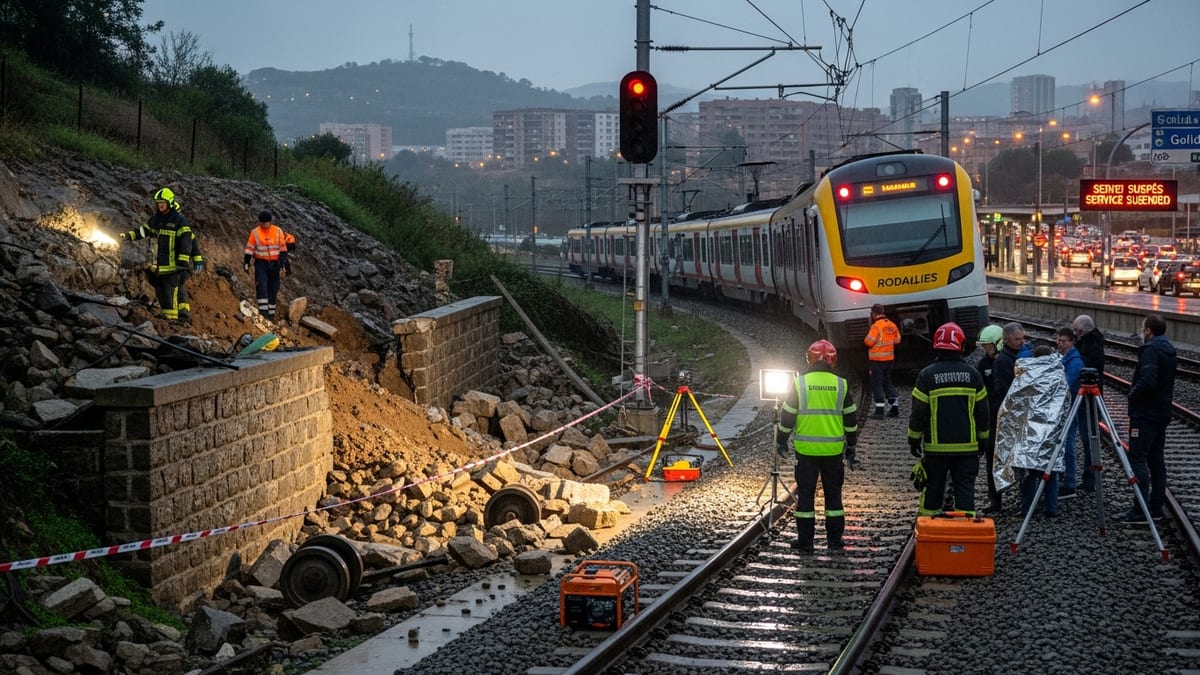
Services halted as incident blocks the line
According to early reports from rail operators and journey planners, trains were brought to a standstill shortly after the start of the morning peak when the line was reported blocked in both directions. Signalling systems stopped services from entering the affected stretch while emergency responders gained access to the tracks.
Passenger information systems began warning of cancellations and “do not travel unless necessary” messages within minutes, as control rooms requested additional time for the incident to be managed safely. Trains already in the area were held at signals or diverted where alternative routes were available, while others were terminated short of their destinations.
Journey planners indicated that disruption quickly spread beyond the immediate area as units and crews were displaced from their scheduled diagrams. As the incident continued, operators warned that delays would persist even after the line reopened, as trains and staff would need time to return to their normal positions.
Rail information channels described the situation as an emergency incident on the track, with the duration initially estimated at several hours. Social media posts from stranded passengers showed busy platforms, overcrowded carriages on diverted services, and departure boards filled with cancellations.
Impact on commuters and wider network
The timing of the incident, coinciding with the busiest part of the weekday rush, meant thousands of commuters were affected. Many passengers reported being held on trains outside stations while rail staff awaited clearance to move, with some services reversing to the nearest stop to allow people to disembark.
Publicly available journey data showed extended delays spreading in both directions from the blocked section as trains queued for access and operators adjusted timetables in real time. Some local stopping services were withdrawn to prioritise limited track capacity for long-distance or intercity trains once partial running resumed.
The knock-on effect reached connecting routes, with missed connections and out-of-sequence rolling stock leading to gaps in service on lines that were not directly involved in the original incident. Passengers reported missing work appointments, medical visits and onward travel plans, with some opting to return home or switch to road transport.
Road congestion around nearby stations increased as taxis, ride-hailing services and local buses absorbed additional demand. In some cases, replacement road transport was difficult to arrange at short notice due to the scale of disruption and the continuing need to keep road access clear for emergency vehicles.
Emergency response and safety protocols
Information published by rail infrastructure bodies and previous incident reports indicate that a full line blockage is the default response whenever an event on or near the track is categorised as an emergency. This approach is designed to create a safe environment for responders and rail staff while the situation is assessed.
Standard procedures require signallers to prevent any further trains from entering the affected section, isolate power where needed, and establish clear communication with response teams on the ground. Only when the railway is confirmed safe to use, and any necessary inspections or repairs are complete, can trains begin moving again, typically at reduced speed to start with.
Rail safety reviews conducted after earlier incidents highlight that response times can be extended if access to the railway is difficult or if specialist equipment is required. In similar cases on busy main lines, published accounts show that lines have remained closed for several hours while teams work to establish the circumstances of the incident and ensure the integrity of the track and signalling equipment.
Industry guidance notes also emphasise the importance of managing passenger welfare during extended incidents, including ventilation on stranded trains, access to water where possible, and clear updates even when there is no immediate change to the situation.
Information and advice for affected passengers
Rail operators advised passengers through public channels to check live journey planners before setting out and to allow for significantly extended travel times. Many tickets were accepted on alternative routes and, in some cases, on other train companies’ services where capacity allowed.
For those who decided not to travel, operators indicated that standard disruption policies would apply, including the possibility of refunds or fee-free changes for tickets dated for travel during the incident period. Passengers are usually asked to submit claims through official customer service channels, supported by evidence of the disruption such as screenshots of journey planner alerts.
Compensation rules differ between operators, but many follow a delay-repay scheme in which payouts are linked to the length of delay to the passenger’s final destination. In significant incidents where delays extend into hours, published policies typically provide for a refund of a substantial portion, and in some cases all, of the ticket cost.
Passengers who experienced accessibility issues, such as being unable to board overcrowded trains or losing step-free access due to diversions, are also encouraged in public guidance to detail their circumstances when submitting complaints or claims, as operators may consider additional support in such cases.
Ongoing disruption expected as services recover
Even after the blocked stretch of line is handed back for use, rail planners warn that the network can take a considerable time to recover fully. Trains and staff may be out of position, depot access can be constrained, and there may be a backlog of services waiting to move through key junctions.
In this morning’s incident, journey planners suggested that some short-notice cancellations and significant delays would continue into the late morning and potentially the early afternoon peak. Trains may run with fewer carriages than planned as operators work to re-form full-length sets.
Published post-incident analyses from previous events underline that the ripple effects can be particularly acute on routes with limited alternative paths and tight turnround times at termini. In such cases, minor issues later in the day can cause renewed disruption if the service pattern has not fully stabilised.
Rail users are being advised to continue checking real-time information, to allow extra time for connections, and to be prepared for changes at short notice while control rooms work to restore the timetable following this morning’s emergency line blockage.