


I thought I knew what I was getting into when I set out on Trillium Gap Trail in Great Smoky Mountains National Park. Thirteen miles round trip sounded demanding but manageable. I had logged plenty of day hikes. Yet somewhere above Grotto Falls, with my calves burning and sweat soaking through my pack straps, I realized this trail was going to push me harder than I expected. Thankfully, the deep, mossy forest and the small surprises along the way kept turning the effort into something that felt a lot like wonder.
Get the latest updates straight to your inbox!
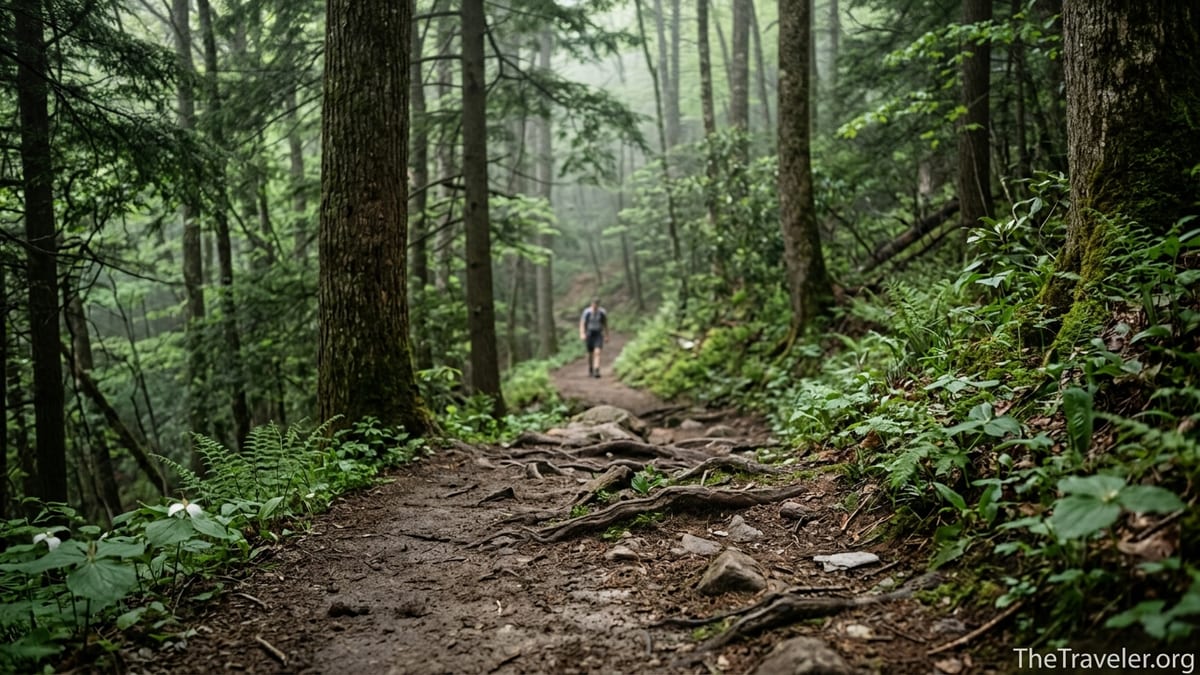
Meeting Trillium Gap Trail Where It Really Begins
Trillium Gap Trail starts quietly enough from a shaded trailhead off Roaring Fork Motor Nature Trail, a narrow one-way road just outside Gatlinburg. By the time you reach the kiosk, you are already in the embrace of steep, folded mountains, but the first steps feel deceptively gentle. The path climbs gradually through an old growth feel of hemlock and mixed hardwoods, with a soft, brown tread underfoot and the chatter of small streams crossing the trail. It is here that many day hikers, lulled by the easy grade and the promise of a short waterfall walk, underestimate what lies beyond.
The early miles are where crowd levels and logistics become very real. On a busy Saturday in late spring, the official parking lot by the trailhead can fill shortly after 8 am, especially now that the park’s paid parking program has made every clearly marked spot more precious. When that happens, you see cars lined along Roaring Fork Motor Nature Trail wherever it is allowed, and hikers hoofing it uphill on the pavement before they even reach the dirt. If you want to experience any sense of quiet on Trillium Gap, an early start on a weekday is more than a nice idea. It is almost a requirement.
The trail’s introductory section gains only a few hundred feet over the first mile and a half. Families with strollers are not in sight, but you will see kids skipping over rocks and couples in running shoes carrying a single bottle of water. The forest, thick with rhododendron and mountain laurel, feels inviting and friendly. At this point, I still believed the day would be an easy, steady climb, a long but comfortable walk to one of the Smokies’ famous viewpoints.
Only when I looked at my watch and realized how little elevation we had actually gained did a small doubt appear. Thirteen miles round trip with more than 3,000 feet of total elevation gain means that the trail must eventually get serious. On Trillium Gap, that moment arrives just after the feature that draws most people: Grotto Falls.
Grotto Falls: Crowd-Pleaser and False Finish Line
At roughly 1.3 to 1.5 miles from the trailhead, depending on which guidebook you read, you hear the steady rush before you see Grotto Falls. The forest opens slightly, and a cool mist drifts across the trail. The waterfall is not huge, about 20 to 25 feet tall, but the charm lies in the way the water drops in a shimmering sheet over a shallow rock ledge. Trillium Gap Trail actually ducks behind the cascade, so you can step into the hollowed-out space and watch the water curtain down just a few feet from your face.
This is where things feel more like a family outing than a mountain ascent. On a June afternoon, there might be a dozen people waiting to walk behind the falls and pose for photos. You will see teenagers scrambling up wet rocks in tennis shoes, parents coaxing kids closer to the spray, and people picnicking on boulders that are sometimes slick with moss. The air temperature at the base of Grotto Falls can feel ten degrees cooler than the parking area, which is a real relief on a humid Tennessee day. If your goal is simply to see the waterfall, this is a pleasant 2.6 mile round-trip hike with an elevation gain that many casual visitors can handle.
But Grotto Falls is also a psychological trap. The trail to this point feels so manageable that it is easy to keep going “just a little farther” without fully accounting for the miles and elevation ahead. I watched several groups decide, on the spot, to continue toward Trillium Gap after Grotto Falls, carrying nothing more than a small bottle of water and maybe a granola bar. The sign that points farther up the mountain does not sugarcoat things, yet the full weight of a 13 mile round trip is hard to picture when your shoes are still dry and your legs feel fresh.
On my own hike, I lingered long enough at Grotto Falls to enjoy the cool spray and a quick snack, then shouldered my pack and stepped through the shallow grotto. On the far side, the trail narrows, the rock underfoot becomes rougher, and the forest grows quieter as many day hikers turn back. In that moment, I understood that whatever came next would be less about waterfalls and more about stamina.
Where the Trail Turns Relentless
Past Grotto Falls, Trillium Gap Trail begins to show its true character. The grade steepens, the switchbacks grow longer, and the roots seem to reach for your ankles. Over the next couple of miles, the trail climbs steadily through a mix of boulder fields, damp seeps, and sections where water has carved channels into the path. After a rain, these stretches can be muddy and slick, though the Smokies’ well-drained soils usually prevent ankle-deep muck. The air grows cooler, but the humidity remains, and sweat evaporates slowly under the canopy.
This is the first place I genuinely felt the trail pushing back. On paper, Trillium Gap is considered a moderately strenuous route compared to its sibling trails up Mount LeConte, like Alum Cave or Rainbow Falls. In practice, how hard it feels depends entirely on your conditioning and what you are carrying. With two liters of water, a packed lunch, rain jacket, and a midweight camera, the climb started to feel punishing. I found myself breaking the ascent into five-minute segments between mental checkpoints: a sharp switchback here, a moss-draped log there, a gap in the trees where I could briefly see a distant ridge.
Altitude is not extreme by western standards. You start around 3,200 feet and top out near 6,500 at the LeConte Lodge area, but the continuous climb with few true flat sections is what wears people down. I passed a couple from Ohio who had turned back after realizing they were only halfway to Mount LeConte but already nursing sore knees. Another group of college students was sprawled on rocks, recalculating how long it would take to reach the summit and still buy dinner back in Gatlinburg before restaurants closed. Trillium Gap does not offer many short-cut exits; once you commit beyond Grotto Falls, you are in for several hours of solid work.
Gear choices become very real here. Lightweight trail runners grip well on the mixed dirt and rock surface and dry quickly after shallow stream crossings, while heavy leather boots can feel overkill unless you rely on them for ankle support. Trekking poles, which look optional at the trailhead, become increasingly attractive as you begin the descent later in the day and feel your quadriceps protest every downhill step.
The Forest That Makes the Struggle Worth It
As the miles accumulate, the real reward of Trillium Gap Trail is less about any single viewpoint and more about how the forest changes around you. Lower down, tulip poplars, hemlocks, and maples dominate, with rhododendron tangling the understory and small streams braiding across the path. In April and May, spring wildflowers like trillium, violets, and bloodroot bloom in the dappled light, carpeting the forest floor in an array that photographers travel specifically to capture.
Higher up, the vegetation subtly shifts toward a cooler, spruce-fir feel. Moss thickens on rocks, and the air takes on a hint of balsam in damp stretches. On my hike, a low cloud layer settled in by midafternoon, and the trees began catching the mist, turning the forest into a quiet, green cathedral. Sound changed, too: the roar of Roaring Fork faded, replaced by the drip of condensation and the occasional call of a distant bird. Despite the burn in my legs, every time I paused to catch my breath, an unexpected detail revealed itself, whether it was an intricate shelf fungus on a dead log or tiny beads of water gathering on spiderwebs along the trail.
This is also where the legendary pack llamas sometimes appear. Trillium Gap is the supply route for the rustic LeConte Lodge near the summit, and on certain mornings, a string of llamas climbs the same path, carrying food and clean linens. Encountering them in the high forest is both surreal and charming: the soft thud of their hooves, the quiet commands of the wranglers, and the way other hikers step respectfully to the side to let them pass. If you time your visit right, usually on scheduled llama pack days posted in the lodge’s seasonal information, this glimpse into the mountain’s working life adds a bit of magic to an already atmospheric forest.
For me, the forest’s mood eventually took precedence over the endpoint. While Mount LeConte’s summit and the LeConte Lodge cabins are iconic goals, it was the hush of the upper spruce stands, the filtered, blue-green light, and the sense of being far from asphalt and souvenir shops that stayed with me. The Smokies are one of the most visited national parks in the United States, but in the long, quiet stretches between Grotto Falls and Trillium Gap, it is still possible to feel alone with the trees.
Reaching Trillium Gap, Brushy Mountain, and Mount LeConte
Trillium Gap itself arrives less as a dramatic pass and more as a subtle saddle in the ridge, marked by a trail junction and changes in slope. From here, a side trail leads out toward Brushy Mountain, a spur that rewards the extra effort with sweeping views toward Mount LeConte’s massive bulk and the valleys that roll away in blue ridges. For hikers who decide that the full climb to LeConte Lodge might be too much, Brushy Mountain can serve as a satisfying alternative high point and turnaround spot.
If you continue straight toward Mount LeConte, expect a final series of long, steady switchbacks as the forest grows darker and the air temperature dips further. Near the top, weather can feel dramatically different from Gatlinburg. A sunny, 80-degree afternoon in town might translate to low 60s, stiff breezes, and fast-moving clouds around the summit. It is not unusual to see hikers in shorts and light shirts shivering at the top because they left their extra layers in the car, misled by the warmth at the trailhead.
LeConte Lodge sits near the summit in a cluster of rustic cabins and a main lodge building, reachable only on foot. Overnight stays must be reserved far in advance and are usually booked for the season, but even day hikers can pause here to rest on benches, refill water from designated sources if available, and soak in the sense of an off-grid mountain community. Short side trails from the lodge lead to overlooks like Cliff Tops and Myrtle Point, where the rewarded view finally matches the effort: overlapping ridges fading into haze, with the valley floor far below and the late-day sun turning the Smokies’ famous blue into a warm gold.
Standing at one of those overlooks, legs quivering slightly, I realized how thoroughly the trail had outmatched my casual expectations. And yet, looking back down the forested slopes we had climbed, my strongest feeling was not exhaustion but gratitude that there was still a place in such a popular park where effort was required and rewarded in equal measure.
Planning the Hike: Timing, Gear, and Safety
For anyone considering Trillium Gap Trail, planning matters more than ambition. The full out-and-back to Mount LeConte is about 13 miles round trip, with more than 3,000 feet of total elevation gain. Even fit hikers should plan 7 to 9 hours for the journey, including breaks, side trips to overlooks, and time at the lodge. In summer, that means starting early enough that you are not racing sunset on the way down, especially if afternoon thunderstorms roll through and slow your pace.
Parking logistics can shape your entire day. Roaring Fork Motor Nature Trail, the one-way road that accesses the main trailhead, is typically open from spring through late fall, but seasonal closures for winter or storm damage are not unusual. Because parking spots at the trailhead are limited and subject to the park’s paid parking requirements, many visitors now build the cost of a daily parking tag into their trip budget. Arriving before 8 am during peak months like June and October can make the difference between parking steps from the trailhead and walking an extra mile along the road.
Weather in the Smokies is famously changeable, so packing layers is not optional. A lightweight rain jacket, even on a blue-sky morning, can turn a potentially cold, miserable downpour into a manageable inconvenience. In shoulder seasons like April or late October, temperatures at the summit can flirt with freezing while the valley sits in the 50s. Trail surfaces can also change quickly, from dry and dusty in mid-summer to slick with wet leaves in autumn or icy patches in late fall. Microspikes are not always necessary, but on colder days they can add a welcome sense of security in shaded, frozen sections near the top.
Water and food often separate enjoyable long hikes from survival marches. There are several small creeks along Trillium Gap Trail, but their flow can vary with rainfall, and you should not rely on them without proper filtration. Carrying at least two liters of water per person on a warm day, plus calorie-dense snacks like nuts, jerky, and energy bars, allows you to adjust if the climb takes longer than expected. As simple as it sounds, pacing yourself from the outset, rather than sprinting to Grotto Falls and then fading, will also make the day feel far more manageable.
Who This Trail Is Really For
The contrast between the crowds at Grotto Falls and the relative quiet beyond raises an honest question: Who should take on the full Trillium Gap Trail, and who might be happier turning around earlier or choosing a different route altogether? In my experience, the trail best suits hikers who are comfortable with long days on their feet, are prepared to climb steadily for hours, and find satisfaction in the journey itself, not just the summit photo.
If you are visiting Great Smoky Mountains National Park with young kids or family members who do not hike often, the Grotto Falls portion makes an excellent goal. It is short enough to complete in a morning, and the novelty of walking behind a waterfall leaves a lasting impression without demanding advanced fitness. For groups that want something challenging but slightly shorter, hikes like Alum Cave to the bluffs or Rainbow Falls offer strong payoffs with less total distance, though they still require solid conditioning.
For travelers staying in Gatlinburg or nearby Pigeon Forge with limited time, it is worth being realistic. A full day on Trillium Gap means sacrificing other attractions: you will not be fitting in Dollywood, outlet shopping, and a leisurely dinner reservation on the same day if you also expect to reach Mount LeConte from this trail. On the flip side, if you are the kind of traveler who would rather collect memories of misty forests and aching calves than arcade wristbands, Trillium Gap offers an antidote to the region’s more commercial side.
Ultimately, the trail pushes you to match its honesty. It does not hide its length or its climb. What it offers in return is less about bragging rights and more about immersion: hours spent inside a living, breathing forest where the light and air feel different at every turn. If that idea excites you more than it scares you, Trillium Gap might be exactly the Smokies experience you are looking for.
The Takeaway
Trillium Gap Trail humbled me in ways that a distance number on a map never could. The climb was longer, the grade steeper, and the fatigue more insistent than I anticipated. Yet every time I wondered why I had signed up for this particular challenge, the forest answered. A patch of wildflowers near a stream crossing, a sudden break in the canopy with a glimpse of layered ridges, the quiet appearance of llamas on a weekday morning, or the cool mist of Grotto Falls on the way back down kept tipping the balance from hardship toward joy.
If you approach this trail with respect, planning enough time, packing thoughtfully, and knowing your limits, it can be one of the most rewarding long day hikes in Great Smoky Mountains National Park. It will probably push you harder than you expect. It may send you home with sore legs, muddy shoes, and a newfound appreciation for just how big these rounded mountains really are. But it will also leave you with something rarer: the memory of moving, step by step, through a forest that feels older and deeper than the busy world waiting at the trailhead.
FAQ
Q1. How long is Trillium Gap Trail and how much time should I plan?
The full out-and-back hike from the Trillium Gap trailhead to the Mount LeConte area is roughly 13 miles round trip. Most hikers should plan 7 to 9 hours, depending on fitness, weather, and how much time they spend at Grotto Falls, LeConte Lodge, and nearby overlooks.
Q2. Is Trillium Gap Trail suitable for beginners?
The first section to Grotto Falls is approachable for many beginners who are reasonably active, as it is about 2.6 miles round trip with moderate elevation gain. The full route to Mount LeConte is better suited to hikers with some experience on longer, sustained climbs and who are comfortable being on the trail most of the day.
Q3. When is the best time of year to hike Trillium Gap Trail?
Late spring through fall is generally the best window. April and May offer wildflowers and cooler temperatures, summer brings long daylight hours but more humidity and crowds, and early to mid-fall typically features colorful foliage and crisper air. Winter conditions can include ice and snow at higher elevations, which makes the trail more demanding.
Q4. Do I need a parking tag or permit for this hike?
Great Smoky Mountains National Park now requires most visitors who park longer than a brief stop to display a paid parking tag. You do not need a separate hiking permit for a day trip on Trillium Gap, but you should purchase and display the appropriate parking tag when you leave your vehicle at or near the trailhead.
Q5. How crowded does Trillium Gap Trail get?
The section to Grotto Falls is often busy, especially on weekends and during summer and fall leaf season. Traffic thins noticeably beyond the waterfall as fewer hikers commit to the long climb toward Mount LeConte. Starting early in the morning and choosing a weekday can significantly reduce crowding.
Q6. Are there bathrooms or water sources on the trail?
There are usually no flush restrooms directly at the Trillium Gap trailhead, though you may find basic facilities at nearby picnic areas or visitor centers before driving in. Natural water sources exist along the trail, but they should not be used without proper filtration or treatment. Many hikers carry all the water they expect to need for the day.
Q7. What kind of gear should I bring?
Sturdy footwear with good traction, such as trail runners or hiking boots, is important due to roots, rocks, and occasional mud. Trekking poles help with both the long climb and the descent. Pack at least two layers for the upper elevations, a lightweight rain jacket, plenty of water, high-energy snacks, a basic first-aid kit, and a headlamp or small flashlight in case the hike takes longer than expected.
Q8. Can I see the llamas that supply LeConte Lodge on this trail?
Yes, Trillium Gap is the route used by pack llamas that carry supplies to LeConte Lodge on certain days of the week during the lodge’s operating season. Their schedule can vary by year, but it is often posted by the lodge or park information sources. If you happen to be on the trail during a llama trip, step aside, give them and their handlers space, and enjoy the unique sight.
Q9. Is Grotto Falls the same as Trillium Gap?
No, Grotto Falls is a waterfall reached on the lower section of Trillium Gap Trail, about 1.3 to 1.5 miles from the trailhead. Trillium Gap is a higher-elevation saddle farther up the mountain, near a junction with the Brushy Mountain Trail. Many visitors hike only to Grotto Falls, while others continue beyond to Trillium Gap and eventually Mount LeConte.
Q10. What should I do if the weather turns bad while I am on the trail?
If storms or heavy rain roll in, move away from exposed viewpoints, tall isolated trees, and ridgelines, and avoid lingering near stream crossings that could rise quickly. Put on your rain layer early, monitor how slippery the trail becomes, and be willing to turn around if visibility or conditions deteriorate. The mountain will still be there for another day, and safety should always come before reaching the summit.