


Mount Le Conte has a reputation that looms almost as large as its 6,593-foot summit. Hikers flock to its ridges by way of Alum Cave, Rainbow Falls, Bullhead and the Boulevard, each route with its own loyal following. Yet one path feels markedly different from the rest: the Trillium Gap Trail. Combining a family-friendly waterfall walk, old-growth forest, a side trip to a separate peak, and even llama trains hauling supplies to LeConte Lodge, Trillium Gap offers a slower, greener ascent that stands apart from the mountain’s more dramatic approaches.
Get the latest updates straight to your inbox!
A Softer, Greener Start Than Other Le Conte Routes
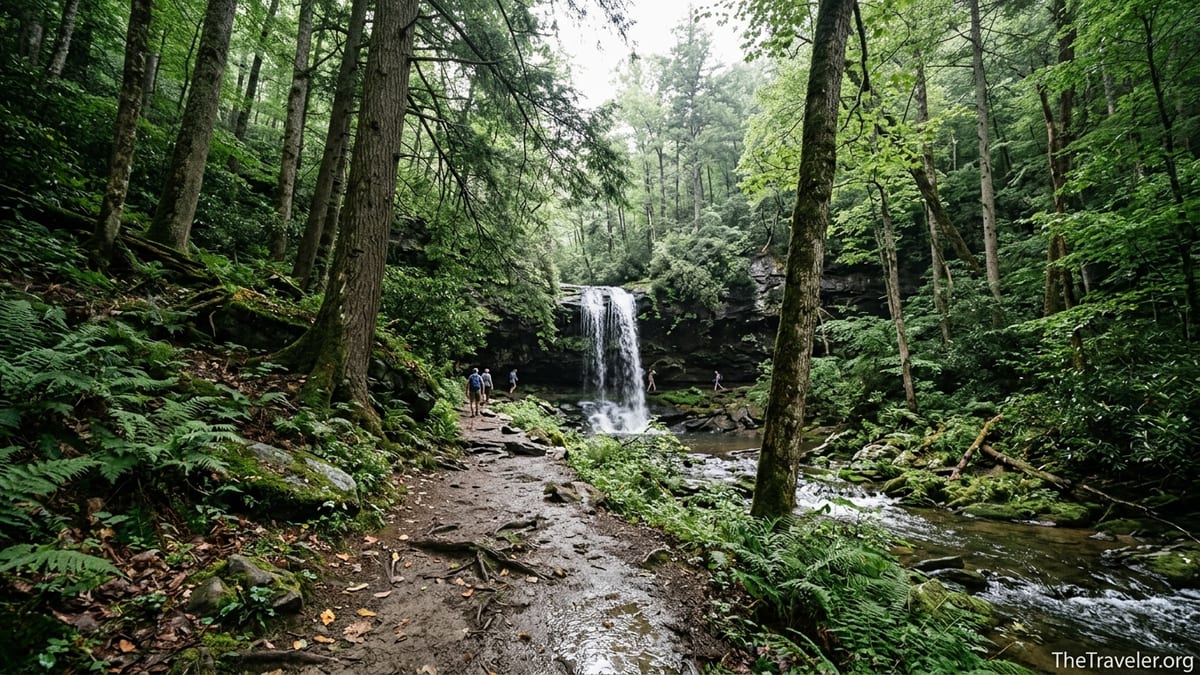
The first thing that sets Trillium Gap apart is how gently it introduces you to Mount Le Conte. While the Alum Cave Trail climbs quickly through narrow rock corridors and stone staircases, Trillium Gap spends its opening miles meandering through cool, shaded forest along the Roaring Fork drainage. From the Trillium Gap trailhead on the Roaring Fork Motor Nature Trail, it is roughly 1.3 miles to Grotto Falls and about 2.6 miles round trip if you turn around at the waterfall. The grade over this lower section rises only a few hundred feet, making it one of the most approachable introductions to Le Conte for new hikers and families.
This contrasts with Alum Cave, where the trail gains more than 1,000 feet in the first few miles and forces you through narrow rock arches and cliffside ledges, or the Rainbow Falls Trail, which climbs steadily and can feel punishing on hot summer days. On Trillium Gap, the path is wider and softer underfoot in its early stretches, with damp soil, roots, and pockets of moss rather than continuous stone steps. For visitors staying in nearby Gatlinburg and hoping to give kids or hesitant hikers a taste of Mount Le Conte without committing to the full summit, this lower segment to Grotto Falls is often the most realistic option.
The forest character also feels different here. Trillium Gap moves through sections of old-growth hemlock and mixed hardwood forest that give the route its name. In spring, you are likely to see carpets of wildflowers such as trillium, violets, and foamflower lining the trail edges. Other Le Conte routes have their own signatures, like the open views from Bullhead or the high-elevation spruce-fir forest along the Boulevard, but they rarely deliver this same long, sheltered stroll through lush, mid-elevation woods right from the start.
Because of that softer beginning, many local guides recommend Trillium Gap as the first Le Conte trail to try if you are uncertain about your fitness. You can hike as far as Grotto Falls and reassess. If the lower trail feels comfortable, you will have a realistic sense of whether continuing toward the summit on a longer day in the future might be within reach.
Grotto Falls: The Only Walk-Behind Waterfall on a Le Conte Route
Grotto Falls alone makes Trillium Gap unlike any other path to Mount Le Conte. Reached after about 1.3 miles from the trailhead and with roughly 500 to 600 feet of elevation gain, this 25-foot waterfall is the only one in Great Smoky Mountains National Park where the maintained trail passes behind the falling water. You can step carefully along the slick rock shelf and feel cool spray on your face as the stream drops in front of you. No other Le Conte route offers a comparable waterfall experience built right into the main trail.
On a typical summer weekend, you might see multi-generational families making this short hike as their primary outing for the day. Children often play in the shallow pools downstream, while older hikers sit on boulders just off the trail eating sandwiches or snacks. Many visitors who never planned to summit Le Conte nonetheless leave with a lasting impression of the mountain thanks to this roadside-accessible introduction. By contrast, Alum Cave’s early highlight is a rock overhang high on the ridge, and Rainbow Falls is a longer, steeper haul to reach its namesake waterfall, with far fewer casual hikers able to manage the full trip.
For summit-focused hikers, Grotto Falls is more than just a tourist stop. It serves as a built-in first milestone and an honest gauge of how the day is going. If you reach the falls in under an hour feeling fresh, you are likely on track for a full ascent. If the climb already feels like a struggle, you can choose to enjoy the waterfall and return to the car, having still seen a major highlight. On more demanding approaches like Bullhead or Rainbow Falls, there are fewer obvious intermediate turnaround points with the same sense of payoff.
Grotto Falls also shapes practical planning. Parking near the Trillium Gap trailhead along the one-way Roaring Fork Motor Nature Trail often fills by late morning in high season, partly because so many people come just for the falls. Some hikers choose to start at dawn to secure a space and enjoy the lower trail in cooler, quieter conditions, knowing that once they pass beyond Grotto Falls, the crowds thin dramatically and the true mountain ascent begins.
Llama Trains and LeConte Lodge Supplies
Perhaps the most endearing feature unique to Trillium Gap is its role as a supply corridor. Three days a week in high season, trained llamas hike the trail to deliver food, linens, and other supplies to LeConte Lodge near the summit. While hikers on Alum Cave or the Boulevard may encounter backcountry rangers or lodge staff, only those on Trillium Gap have a realistic chance of sharing the trail with a llama pack train.
Meeting the llamas in person is a reminder that LeConte Lodge operates without road access. Guests who pay for overnight stays atop the mountain arrive on foot, and their hot meals and clean sheets depend on these animals hauling loads up and down the mountain. On a practical level, hikers are asked to step well off the trail, keep trekking poles and children under control, and allow the llamas to pass without crowding them. The animals are accustomed to people, but lodge staff still treat each encounter with the care you would expect around working stock animals.
This supply role shapes the trail itself. Portions of Trillium Gap between Grotto Falls and the summit are built wide enough to accommodate the llamas, and erosion control work is a visible priority. In wet weather you will often see stone water bars, log cribbing, and other measures that keep the treadway stable under the combined weight of hikers and pack animals. Other Le Conte trails, while maintained, do not carry this same regular pack traffic and therefore develop a different feel underfoot. The Boulevard, for example, can be narrower and rougher in spots, more akin to a typical Appalachian backcountry path than a dual-use corridor.
For families, the llamas offer an unusual motivational boost. Parents sometimes time their hike based on the lodge’s posted pack schedule, hoping children will get to watch the animals pass or rest at a pullout where the llamas take a break. Even if you do not see them, simply knowing that your route is the same one these sure-footed animals use adds a sense of story to the climb that the rockier, more exposed trails lack.
Brushy Mountain Spur and Alternate Perspectives
Another feature that sets Trillium Gap apart from other Le Conte routes is its access to a second summit: Brushy Mountain. A signed spur trail branches off near Trillium Gap itself, allowing hikers to reach Brushy Mountain’s open, heath-covered top. This detour provides wide views toward Mount Le Conte and the surrounding Smokies from a different angle than the main summit, often with fewer people around. For those who find the full ascent to Le Conte too ambitious, Brushy Mountain can serve as a rewarding primary goal on its own.
In practice, hikers commonly build their day in layers. One realistic plan is to walk to Grotto Falls first, then decide whether to continue to the higher forest beyond, and finally determine whether to add the Brushy Mountain spur or push on toward LeConte Lodge. By contrast, routes like Alum Cave or Rainbow Falls are more linear in character: your only real choice is how far up or down the same corridor you are willing to go. Trillium Gap’s branching options give the day more flexibility, which is helpful if the weather shifts or group energy varies.
Brushy Mountain also showcases a different plant community. The exposed heath balds and shrubbier vegetation stand in contrast to the dense hemlock and hardwoods of the lower trail. On a clear day, you can look back toward the mass of Le Conte and see the various ridges and bowls that the other trails climb, gaining a better sense of the mountain’s geology and scale. Hikers who have only climbed Le Conte once via Alum Cave sometimes return specifically to Trillium Gap so they can visit Brushy Mountain and round out their understanding of the peak.
Because of its side options and more varied scenery, Trillium Gap is often recommended as a good second or third Le Conte route for those who already know the mountain from another trail. It shifts the focus from simply “getting to the summit” to exploring the broader Le Conte massif, and that shift alone makes it feel different from the more direct, summit-focused paths.
Comparing Distance, Effort, and Crowds
From trailhead to LeConte Lodge, Trillium Gap is one of the longer routes up the mountain. While exact mileage figures vary slightly among guidebooks, you can expect roughly 6.5 to 7 miles one way, depending on where you start and whether you include spur detours. By comparison, Alum Cave is around 5 to 5.5 miles one way, Rainbow Falls and Bullhead are each in the 6.5- to 7-mile range, and the Boulevard is the longest at roughly 8 miles from Newfound Gap. In other words, Trillium Gap sits in the middle of the pack for distance, but its climb is stretched over a relatively gentle lower section.
That length and profile influence the feel of the day. Many hikers who have done both Alum Cave and Trillium Gap describe Alum as steeper and more intense, especially in its midsection, but shorter. Trillium Gap, with its rolling lower miles, spreads the exertion out. You might still gain a similar total elevation, but your legs often notice it more in the final push above Trillium Gap than earlier on. For people with knee or hip sensitivities, the softer, dirt-heavy tread on Trillium Gap can feel kinder than the more stone-heavy steps of Alum Cave or Rainbow Falls, particularly on the descent.
Crowd patterns are also distinct. The lower Trillium Gap Trail to Grotto Falls is one of the most popular short hikes near Gatlinburg, so you should expect to see families, casual walkers, and photographers along this stretch, especially between April and October. Beyond the falls, the trail gradually empties out. By the time you approach Trillium Gap and the higher forest, you may be walking in relative quiet except for the occasional lodge guest or llama train. On Alum Cave, in contrast, heavy traffic continues well beyond the Alum Cave Bluff itself, and the route remains busy almost all the way to the lodge on peak days.
Seasonal road closures add another practical wrinkle. The Roaring Fork Motor Nature Trail that leads to the Trillium Gap trailhead typically opens in spring and closes in late fall. When it is closed, hikers sometimes start from near the Rainbow Falls parking area or walk a portion of the Roaring Fork road to reach the usual trailhead, adding time and distance. By comparison, trailheads for Alum Cave and the Boulevard at Newfound Gap are usually accessible longer into the shoulder seasons, weather permitting. Travelers planning a late autumn visit need to check current road status before assuming Trillium Gap is the best option.
Forest Atmosphere and Wildlife Encounters
Experientially, Trillium Gap feels more like a forest immersion than a ridgeline conquest. The early miles parallel Roaring Fork, with multiple small creek crossings that can leave your boots damp after rain. The air stays comparatively cool and humid in summer, and the canopy tends to remain thick until you approach the higher reaches. That mix of water and shade creates a rich habitat for salamanders, songbirds, and, in the right season, carpets of blooming wildflowers.
By contrast, sections of Bullhead and the upper Rainbow Falls Trail cross more exposed slopes that were badly burned in the 2016 fires, leaving open views but also sun-baked stretches with limited shade. Alum Cave quickly climbs onto narrow ridges where wind and weather can feel more dramatic. Trillium Gap’s relative enclosure gives it a quieter, more intimate feel, especially on cooler spring mornings when low fog curls through the trees and the waterfall mists the air.
This forested character shapes wildlife encounters. Black bears are found throughout Great Smoky Mountains National Park, but the lush hollows around Roaring Fork are a frequent foraging area, especially when berries or acorns are in season. Hikers on Trillium Gap sometimes see evidence of bears along the trail, such as overturned logs or tracks in mud, and occasional direct sightings from a safe distance. Rangers stress the importance of carrying out all food waste and never approaching animals, since a food-conditioned bear near a popular trail like Grotto Falls can create safety problems for both people and wildlife. The busy ridgeline sections of Alum Cave or the Boulevard may have fewer casual wildlife sightings simply because of higher traffic and exposure.
The combination of moist soil, old trees, and a cooler microclimate also encourages lush mosses and ferns that give the Trillium Gap corridor a near-temperate-rainforest feel in places. Travelers who have hiked in the Pacific Northwest often remark on familiar textures: moss-draped logs, slick rocks near stream crossings, and deep green understory. On clear days, the route might not offer the sweeping long-range views that Alum Cave is famous for, but it compensates with a closer, more textured relationship to the landscape under your boots.
Planning a Trillium Gap Hike: What to Expect in Practice
Many visitors use Trillium Gap in one of two ways: as a short Grotto Falls outing or as an all-day push to LeConte Lodge and back. For the shorter option, plan on a half day from Gatlinburg if you include the drive up the narrow Roaring Fork Motor Nature Trail, time to park, and at least a couple of hours to hike the 2.6-mile round trip to the waterfall and enjoy the area. Lightweight trail shoes, at least a liter of water per person, and a simple snack are usually sufficient, though the trail can be muddy and slick, so supportive footwear helps.
For the full summit attempt, treat Trillium Gap as a serious mountain hike. A realistic schedule for many fit hikers is to leave the trailhead between 7 and 8 a.m., reach Grotto Falls within the first hour, take a brief break, then continue to the higher forest, arriving at LeConte Lodge sometime around midday or early afternoon. That leaves enough time to rest, explore side paths to the lodge viewpoints or the true high point at High Top, and still descend before dark. Weather in the Smokies can change quickly, so even on a seemingly warm summer morning it is wise to carry rain gear and an extra insulating layer.
In recent seasons, the park has required paid parking tags for vehicles left longer than a short period, and rangers patrol busy trailheads around Gatlinburg. Travelers should factor the modest daily parking tag cost into their budget and purchase it at a visitor center or via official channels before driving up Roaring Fork. Compared with the overall cost of a trip to the Smokies, including lodging in Gatlinburg or cabin rentals in nearby communities like Pigeon Forge, the parking tag fee is relatively minor, but it is a real-world detail that can cause stress if you arrive unprepared.
Another logistical difference from Alum Cave or Newfound Gap is the road itself. Roaring Fork Motor Nature Trail is a one-way, narrow loop with stone bridges and tight curves. Large RVs and trailers are not recommended, and a long line of vehicles can form when wildlife is spotted or when downed trees or minor accidents block the road. Travelers with low tolerance for slow, winding drives may prefer routes like Alum Cave on US 441, which, while busy, is straighter and more heavily trafficked. Those willing to accept the quirks of Roaring Fork are rewarded with a quieter trailhead area and the distinctive atmosphere that defines Trillium Gap.
The Takeaway
Among the many paths that lead to Mount Le Conte, Trillium Gap stands out for how gently and gradually it reveals the mountain. It begins with a family-friendly walk to a rare walk-behind waterfall, passes through cool, flower-rich forest, then climbs into higher, wilder country that still feels less exposed than the rockier ridgelines. Along the way you can detour to a separate summit, meet working llamas, and glimpse how a backcountry lodge survives without a road.
For travelers deciding how best to experience Le Conte, the choice often comes down to priorities. If you want nonstop drama and sweeping vistas, Alum Cave might still be the classic. If you prefer a quieter forest atmosphere, a more forgiving introduction, and a route that tells a more layered story about life on the mountain, Trillium Gap offers a distinctly different way up. It may not be the fastest path to the summit, but for many visitors, it becomes the most memorable.
FAQ
Q1. How long is the Trillium Gap Trail to Mount Le Conte?
The full hike from the Trillium Gap trailhead on Roaring Fork Motor Nature Trail to the LeConte Lodge area is roughly 6.5 to 7 miles one way, depending on exact starting point and side detours.
Q2. How difficult is Trillium Gap compared with Alum Cave?
Trillium Gap is generally considered slightly longer but with a gentler lower section than Alum Cave. It still requires solid fitness, especially in the upper miles, but many hikers find the grade and softer tread more forgiving.
Q3. Can I hike just to Grotto Falls and skip the summit?
Yes. Many visitors hike only the 2.6-mile round trip to Grotto Falls, enjoy the waterfall, and return to the trailhead. This shorter outing gives a taste of Mount Le Conte without the commitment of a full summit day.
Q4. When can I see the llamas on Trillium Gap Trail?
The llamas that supply LeConte Lodge typically use Trillium Gap on set days during the lodge operating season, often in the morning. Exact schedules can vary by year, so check current information with park or lodge staff before planning around them.
Q5. Is Trillium Gap a good choice for families with children?
The lower section to Grotto Falls is popular with families because of its moderate grade and rewarding waterfall destination. The full ascent to Le Conte is usually better for older children or teens with prior hiking experience.
Q6. Do I need special permits or reservations to hike Trillium Gap?
No special hiking permit is required for day use, but you will need a valid parking tag for your vehicle and advance reservations if you plan to stay overnight at LeConte Lodge or in the nearby backcountry shelter.
Q7. How does Trillium Gap compare to Rainbow Falls or Bullhead?
Trillium Gap offers a lusher, more enclosed forest feel and the unique Grotto Falls experience, while Rainbow Falls and Bullhead tend to feel steeper, more exposed in places, and offer different views, particularly in areas affected by past wildfires.
Q8. Are there good viewpoints on Trillium Gap if I do not go all the way to the lodge?
Yes. In addition to Grotto Falls, the spur to Brushy Mountain near Trillium Gap offers broad views toward Le Conte and surrounding ridges without requiring you to reach the lodge.
Q9. When is the best season to hike Trillium Gap?
Late spring through early fall is most popular, with spring prized for wildflowers and milder temperatures. In shoulder seasons, check road status for Roaring Fork Motor Nature Trail and be prepared for cooler, wetter conditions at higher elevations.
Q10. What should I bring for a full-day Trillium Gap hike?
Plan to carry enough water or a filter, high-energy food, rain gear, an extra warm layer, and sturdy footwear with good traction. A headlamp, small first aid kit, and map or GPS app are also recommended for safety.